joth
-
Posts
2918 -
Joined
-
Last visited
-
Days Won
5
Everything posted by joth
-
 My cabinet is a mess, as I arranged terminals purely for what was convenient for internal cabinet lacing, which left the cat6 side a complete jungle of wires. The screenshot above is for another I'll be installing in the next few weeks. Learning from my own, I'm arranging it to optimise more for consistent layout on the cat6 side. Even connecting up unused cores, just so they're all accounted for I'll let you know how that goes and post photos if it's something I feel a bit more proud of 😂
 -
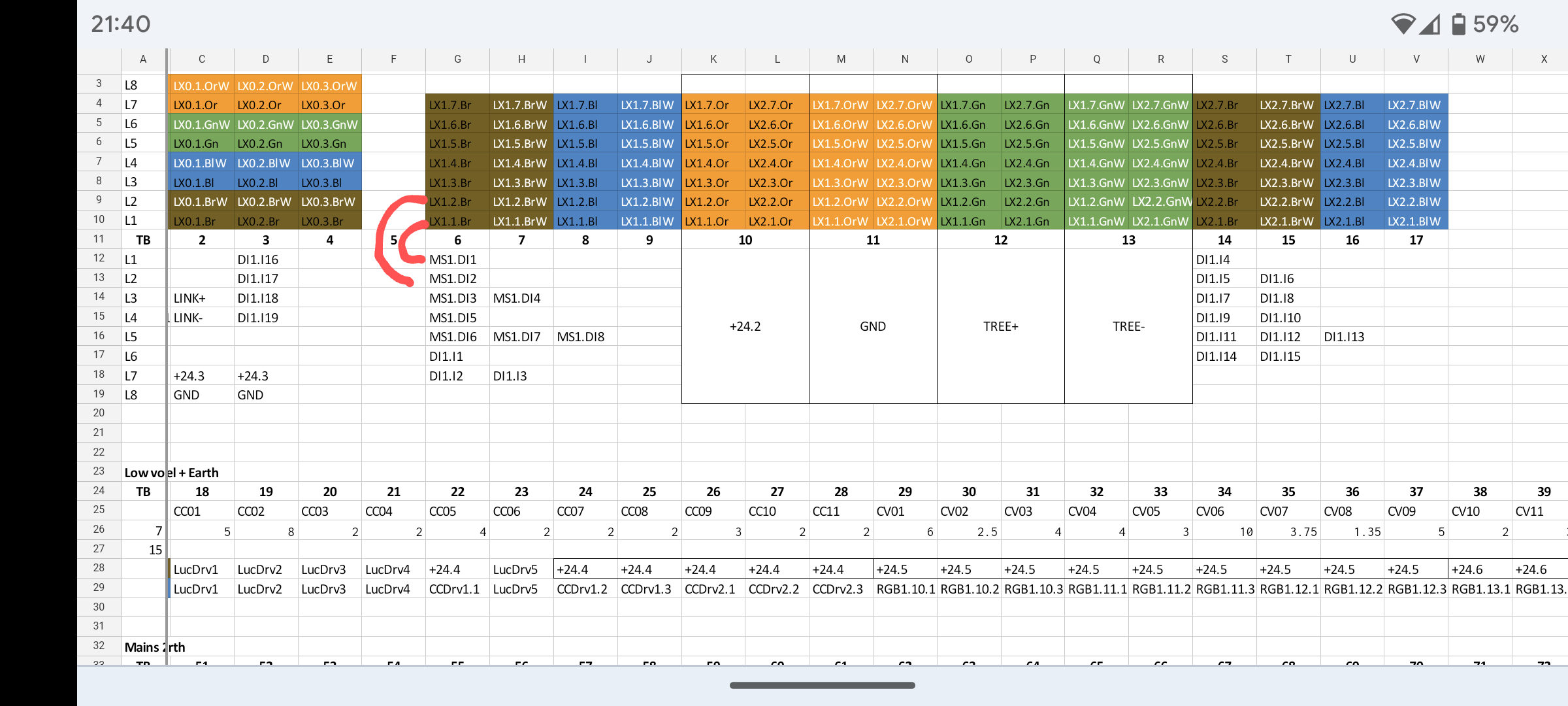
Here's an example of a spreadsheet I have mapping cat6 runs through the terminal blocks into cabinet devices. The highlited rows show that the brown core on cat6 cables LX1.1 and LX1.2 plug into Level 1 and 2 of block #6, and connects then to miniserver digital inputs 1 and 2 respectively.
-
You need to make a doc (spreadsheet) of all the things in the cabinet and what they all need to connect to. Methodically work through all incoming cables, and all devices, to make a mapping Any device that needs connected to many outgoing cores (power lines, Tree, etc) you can use interconnected blocks for, everything else is probably and individual blocks. I find it best to arrange the blocks according to the external wiring, to avoid lots of mess with CAT6 wires all over the place. The internal hookup wires can be routed flexibly according to external needs. In the extreme this means you can do everything with non-inconnected blocks: one per cat6 cable, and do interconnects manually by daisychaining jumps between the terminals as needed. Mine tend to be more of a hybrid, with orange and green pairs going to interconnected blocks, and the browns and blues going to individual terminals. HTH Maybe I can make a photo...
-
Personally I found the unifi design tool fairly useless, it seems to want one WAP per room, I wonder why 🤔 My standard approach is 2x on ground floor in opposite corners and 1x on the top floor high up centrally. This way viewing it as a 3D object you get less overlap (more total coverage) in the spherical balls of signal out of each WAP. Put the ground floor pair to maximise coverage (minimise distance) to places people will spend most time - so in dining /living room and snug, or kitchen and lounge. Secondarily position them to give best use of outdoor coverage, front door, driveway and back garden. Position then high up both to give better range on the floor they're on, and reduce distance to people lying in bed above. And the disc shaped unifi WAPs should alway be horizontal. So ceiling mount is great, maybe slightly hidden above high kitchen units or fitted furniture. If you find this is insufficient make sure you have plenty of wall ports and any of these can be swapped to a wall mount wap to fill in dead spots or reduce congestion. Putting one in an office for example. HTH
-
Electric+ASHP Underfloor Heating in passivhaus bathrooms - madness? =)
joth replied to puntloos's topic in Underfloor Heating
Yes. Also the ASHP maybe sized for DHW reheat time, with a eye to using it at a lower capacity for space heating. Also it may be designed to allow the daily heating load to be supplied in less than 24 hour block, e.g. allow for the DHW duty cycle, allow for boosting space heating during cheap rate energy, or simply not wanting the heat pump running 24/7 in an urban setting So many variables hard to categorically state one is too big. -
Questions relating to pipe centres
joth replied to Post and beam's topic in Air Source Heat Pumps (ASHP)
As an aside, I've been pointing to this document for an easy to read guide on self-balancing system in a low energy homes. It has a guideline of 30W/m2 max output which is in line with my expectation for a ~10W/m2 heating load home, as the UFH is often less than 100% of floor covering (often, only one floor out of 2 or even 3 has UFH) and you also want some headroom to allow for reheat the property from cold, DHW duty cycle, future changes in usage/heat loss, and potential TOU shifting of heating demand. It doesn't have much to say on pipe centres (pipe spacing) other than stating that a low temperature heat source like a heat pump will call for closer spacing to achieve the same W/m2 for a given deltaT -
Questions relating to pipe centres
joth replied to Post and beam's topic in Air Source Heat Pumps (ASHP)
@JohnMo posted the following graphic on the other thread, I'm responding here to keep it on the UFH rather than ecodan 8.5kW thread. (This topic is posted in the wrong forum section btw, should have been https://forum.buildhub.org.uk/forum/136-underfloor-heating/ but nvmd) Where are this figures taken from ? Not doubting them, would just like to read the full context they are made in, and be able to make my own citation to the OG author 🙂 (parts of them are reproduced on https://www.pandhengineering.co.uk/advice/low-carbon-ready-under-floor-heating-ufh but again without citation. But that's a generally silly article with statements like "My first choice for a low carbon ready underfloor heating system type is a low profile screed system with its high heat outputs and quick response times" -- wtf does high heat output and quick response have to do with low carbon heating?? Well OK unless designing UFH for an occasionally used wood frame shed or something). So yeah would be interested in the source for the above. -
Is there a no-frills R290 heat pump?
joth replied to sharpener's topic in Air Source Heat Pumps (ASHP)
Definitely. And manufacturer. Take my experience with Loxone. In my house (enerphit+ so near passivhaus) it's definitely useful having per room stats, as some rooms can heat up quicker than others and also have different ideal targets (living vs bedrooms - a family member specifically asked for the downstairs bedroom to be cooler, which is what made me finally install the actuators on the UFH manifold). However, the per-room controls in Loxone are all very much based around schedules - "Comfort" vs "Eco" times per room, and using presence to enable comfort. Also the control block outputs are very much "call for" heat, and when that's off it's not obvious if it's because of overheating avoidance or simply not in "comfort" mode. The system is very flexible so you can work around all of this, but it feels like constantly swimming upstream, against the flow of what is intended by its designers, so it's definitely not what any installer will do by default. (And this is before I mention on all the extra complications I made for myself like trying to 'boost' temps during cheap rate (or set back temps at prices surges), and enabling it for cooling as well as heating which inverts the direction all the logic, and have to deal with the fact my ASHP does not support weather compensation for cooling mode, plus our house is FAR more spotty in cooling requirements than in heating (heating via a whole house strategy basically works fine, but cooling there's really only two rooms that ever require any, and other areas get too cold if I leave the UFH cooling all the time to maintain system volume) AND I suspect my ASHP does not modulate down so well in cooling mode as in heating. So I've made peace with the idea that cooling via FCU likely will need a buffer by default, even if heating the same house via UFH does not. But I digress) -
Hmm if the ideal pullup resistor was simply a function of the wire resistance, this paper could have been much simpler https://www.analog.com/en/technical-articles/guidelines-for-reliable-long-line-1wire-networks.html I think the general process ppl use for passive pull up is is start with 4k7, see if you get errors, and if so try reducing the resistor. Or if needed, divide up the network (Interestingly the Loxone 1-wire extension has the pull up built in, so maybe it is active pullup circuit. Somehow I doubt it though)
-
Is there a no-frills R290 heat pump?
joth replied to sharpener's topic in Air Source Heat Pumps (ASHP)
LOL yes that section is clearly for cooling only. I'm sure there was a requirement for heating controls to have room by room schedule but I can't find it now... nearest I can find now is this table. Anyway yeah I agree the point has to be a set of room-wise controls designed and installed for the combi aren't going to be a automatically re-applicable for an ASHP without some redesign / reconfig, which is what the OP was asking for, but this will need adding to the BOM on any retrofit (in place of the buffer and other stuffs)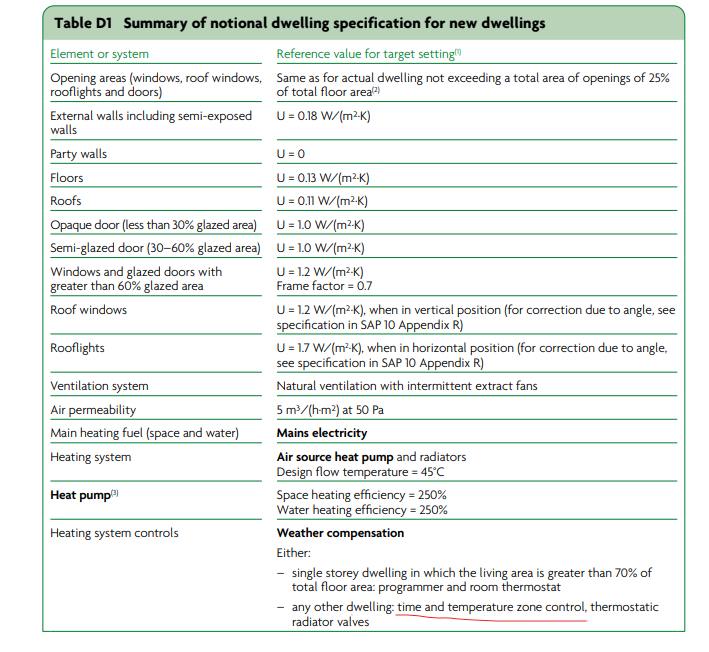
-
Right, so the same as an ESP32 just more expensive and more effort to maintain.
-
Is there a no-frills R290 heat pump?
joth replied to sharpener's topic in Air Source Heat Pumps (ASHP)
Right, and while you're on that roll, can you go ahead and re-write Approved Document L section 6.51? That's the part that requires each room to have it's own thermostat with per-room schedule, adjustable by the home owner, and that will ruin the system designer's attempt to run a carefully balanced whole-house heating strategy. For a self-builder this is moot (you can skip the controls and chance it, or install the controls and not use them - so just some wasted capital cost) but for the target of this conservation, it's installing an "energy saving feature" that the more the home owner uses it, the worse the system performs. -
Yeah I found the limit was below 10 too. But I'm using a star topology. What I do like about a star is if it is unreliable, you have lots options to fix it back at node zero (in my case, split the network to and have multiple master devices. A ESP32 costs pennies, and one can actually drive a few 1-wire networks, so I could even have one master per device if I really had to). While the daisy-chain is more reliable on paper, once you've locked that design in, it's much harder to change up. If well thought through it maybe fairly simple to cut one "ring" in half to make 2x radial lines, but anything else could be very invasive out of interest, are you using screened twisted pair? https://www.loxone.com/enen/kb/1-wire-extension/#1wconnect is the clearest guide I've seen: screened CAT6, GND and DQ on one pair, VDD (if connected) on a separate core, and the shield left floating. Remaining pairs must not be used for anything else. definitely not what I'm doing
-
Is there a no-frills R290 heat pump?
joth replied to sharpener's topic in Air Source Heat Pumps (ASHP)
Because people with per-room controls use them to shut off rooms when not in use, not for overheat protection, and owners have been conditioned to expect this. see point 4 on https://www.hivehome.com/discover-hive/smart-heating/five-ways-to-save-money-with-a-smart-thermostat for example. Also it's very possible a older, lesser insulated and non-cuboidal home would have a LOT of heat loss through in a single room, meaning that room will still require heat even when ~all other rooms are at temperature and are shut off to avoid overheating. Typically that leaky room would be the most used living area which the household also like to keep at the highest temperature for the longest periods. Obviously fixing the fabric would be the better answer, but that also doesn't meet the drop-in-replacement for combi boiler being wished for here. I wouldn't go as far as say the buffer is required by default, but it certainly can't be excluded without some careful thought. -
(reviving old post but this seems most focused on the topic) I came across this source that agrees: a daisy chain (linear bus) with short stubs (<3m) to each device is the best topology, and star network the least favourable. https://www.analog.com/en/technical-articles/guidelines-for-reliable-long-line-1wire-networks.html Also mentions the possibility of an active pullup rather than the passive 4k7 pull up resistor, which can increase the possible network size further.
-
Is there a no-frills R290 heat pump?
joth replied to sharpener's topic in Air Source Heat Pumps (ASHP)
Not included a buffer tank is tough call. So long as current building regs require per-room controls, if retrofitting ASHP to a house that already has per-room controls, you pretty much have to include a buffer unless you're confident the legacy room controls will reliably not call for heat one room at a time. If the owner has already shelled out $lots on Hive or Nest or whatever, they'll be reluctant to rip it out nor replace with new controls, and the ASHP supplier arguing for whole-house rather than room by room control is flying in the face of current regs and putting themselves into a risky position if it's a larger draughty house that genuinely does benefit from leaving some areas on a lesser used rooms less heated. -
change the mental model from "FF is colder than expected" to "FF is leaking heat energy faster than expected". Now, if it is leaking fast, how is it leaking? Probably via windows, conducting or convecting (drafts) or perhaps through the walls. Any of these mean the air will start to cool down *long* before the concrete floor starts to appreciable cool. After all, the high tog carpets are keeping that concrete nice and cosy warm as discussed as where. So somehow we need to get more energy into the air to replace the loss. This could come through MVHR (unlikely to shift enough energy to make a difference), natural convection (very possible if doors are left open), directly heating the air (FCU, humans or electrical appliances in the room) or if they're not enough it will come from material of the building, first walls and ceilings (unless they have high tog wallpaper on them) and last of all from the floor (as that's insulated with carpet). Anyway tldr you could have zero concrete on the FF or a million tonnes, but if the whole house heat loss is 5kW, all going out through the roof, the GF UFH needs to supply a steady 5kW regardless of the quantity of concrete in there. It'll just be a steeper energy gradient (i.e. colder upstairs than down).
-
This is only if you're heating the house up from freezing to target temperature. In a PH this rarely (virtually never) happens. Once at target temperature, the ASHP is not "Heating" the concrete of the FF, or any of the fabric that is already within the thermal envelope. That's already at temperature. The ONLY job of the heating system (ASHP+UFH) is to replace heat energy that is lost out through the thermal envelope. In this respect, the concrete first floor is as much your friend as your enemy, as it is a big fat thermal store (so-called thermal mass) that slows down the rate of loss as proportion of energy in building when e.g. doors or windows are opened briefly. [analogy: if your bucket has a hole yay big in it, leaking 1L/min, you need to top up the bucket at 1L/min to maintain its level. The volume of the bucket is entirely irrelevant, unless you're silly enough to let the bucket empty and then need to heat it from nothing] Yes, without the FF, the GF UFH will have to do all this work. Except it won't, as you already mentioned here and elsewhere you have several kW electrical appliances doing most the work (hint: relocate some of them upstairs /hint), and then there's those FCUs available to help too. Anyway point #1 is unassailable, and it's in essence the reason I'd always suggest putting UFH in the GF even if PHPP says it's not needed, so if that's the decider on its own, the rest of this conversation is entirely academic 🙂
-
But you know his promises are worth no more than the stain riddled keyboard they were typed on.
-
You maybe on the wrong bandwagon. I suggest you give me your current SE battery and swap to a more bespoke/flexible manufacturer for your niche requirements
-
3.68kW is the DC to AC rating. How do you know this is the AC to DC limit? Mine charges at 5kW (albeit on an 8kW inverter). This is entirely unrelated to dno or export, you need to ask SE. Probably best to raise a support ticket with them saying you need to charge two of their batteries from grid at 7kW so that both of them (20kWh total capacity) can be filled in a three hour window.
-
The SE battery has integrated charger so you literally just need a second battery hooked up to the inverter. Caveat: if you decide to charge batteries from the grid (e.g. overnight cheap) it has to come from the (master) inverter so there will be some whole system charge rate limit, probably 5kW. But that's still enough to completely fill 2x 10kWh batts in Octopus Go cheap window.
-
They're DC coupled so you can connect as many as you want to the SE inverter, no dno limit relevant, no notification required. Talk to a competent SE installer
-
To clarify, thes are not abstract 10kWh batteries, they are specifically your Tesla PW and solaredge energybank, yes? So one is ac coupled and the other DC coupled. If you have export limit on the SE inverter it should already do exactly what you want: charge the SE battery direct from the panels and and excess (over the 5kW limit it will charge at) will go to AC and charge the PW. Are you actually asking how to add more panels to this system?
-
What's your grid supply voltage typically like? If it's on the end bumping 250V you want the inverter as close to CU as possible, otherwise the long AC run can have a voltage rise along it and the inverter cut out on sunny days due to seeing grid overvoltage. A friend had this issue and electrician ended up putting the whole house on a voltage reducing transformer which seems a silly hack to get around this.