
joth
-
Posts
2918 -
Joined
-
Last visited
-
Days Won
5
Everything posted by joth
-
 If the controls are working then it should be possible, indeed preferable, to leave it "on" every hour of the year, and the system itself manage the buffer rather than the occupants having to understand it. The only control is the target temperature setpoint I'd fear a cut price ASHP install might be even more complicated to use and if the occupants treat it like a combi boiler it'll not give the desired savings.
 -
Any particular reason why? Running it for longer at a lower temperature, no more than 30°C, should work out as lower running costs
-
I doubt anyone can beat this https://www.theguardian.com/global/2023/sep/27/london-apartment-block-that-deviates-from-plans-must-be-torn-down-says-council London apartment block that deviates from plans must be torn down, says council ‘Blight on the landscape’ in Greenwich lacks promised gardens, children’s play areas and accessibility for wheelchair users
-
Looking for help installing my network
joth replied to Triassic's topic in Networks, AV, Security & Automation
Managed switch is useful if you want to setup VLANs and different SSIDs for different purposes (e.g. I have one with external internet access only, one with internal LAN access only, one with both) If you want to keep it simple, unmanaged switch is fine. As you have a reasonable sized 19" rack, I'd probably opt for the patch panel. You terminate the solid copper installation cable into that (with fairly simple punch down process) and then use flexible patch cables to hook each run into the Poe switch, or wherever else it needs to go -
Looking for help installing my network
joth replied to Triassic's topic in Networks, AV, Security & Automation
Be careful as there's some terminology ambiguity here. Most vendors still call it a mesh network even if you use wired ethernet for backhaul, which is what I think you're really recommending, as a mesh network has other advantages besides ability to seemlessly relay signal wirelessly. I've seen too many installs end up with a mishmash of APs connected via wired ethernet and inadvertently set them up as a few completely independent WiFi networks which perform very poorly. So the easiest thing is to specify a single consistent Mesh technology from a single vendor (such as Unifi) and then opt to connect the APs wherever possible very wired backhaul. -
Heat battery for just underfloor heating?
joth replied to Tilbert's topic in Energy Efficient & Sustainable Design Concepts
Are you thinking specifying the ASHP exactly to meet the needs of this one room of UFH, or oversize it for future connection to other rooms or providing DHW? If so, you may find it can't modulate down sufficiently to meet the needs of this one room, so you may need a buffer tank. Alternatively buy the smallest cheapest unit you can now with a eye to selling and replacing it if needs change. -
Looking for help installing my network
joth replied to Triassic's topic in Networks, AV, Security & Automation
So how many data points total, and how many of them need PoE? Will you only ever want to use these for ethernet, or do you think there's any chance you'd want to repurpose any of the wire for other things like HDbaseT? (I expect the answer is no, else you'd be not asking this sort of question). Easiest thing is to select a network switch of the correct size and with sufficient PoE outlets, terminate all the cat6 in rj45 plugs and plug straight into the switch. Installing a patch panel before the switch makes sense if you think you might want to swap around what each data point is used for over time. Either way, you then plug the router LAN port into the switch and off you go. What meshed WiFi do you have? Do they need PoE? -
Sure, so long as you're happy with it, you're the boss. For my part, I have no idea how installing 50mm of insulation when the BCO approved designed called for 100mm (and regs themselves are now more like 150mm minimum) can be said to be complying with regs, and I would not accept it if it happened on my build, but you don't have to convince me, I'm not the BR police.
-
Yup that's the one the FTC6 is pretty much designed around, think this is where I was pointed at it: @Jeremy Harris no longer posts on here unfortunately, but his advice and learning (especially around wishing he'd provisioned for FCU upstairs) is very much what guided my design
-
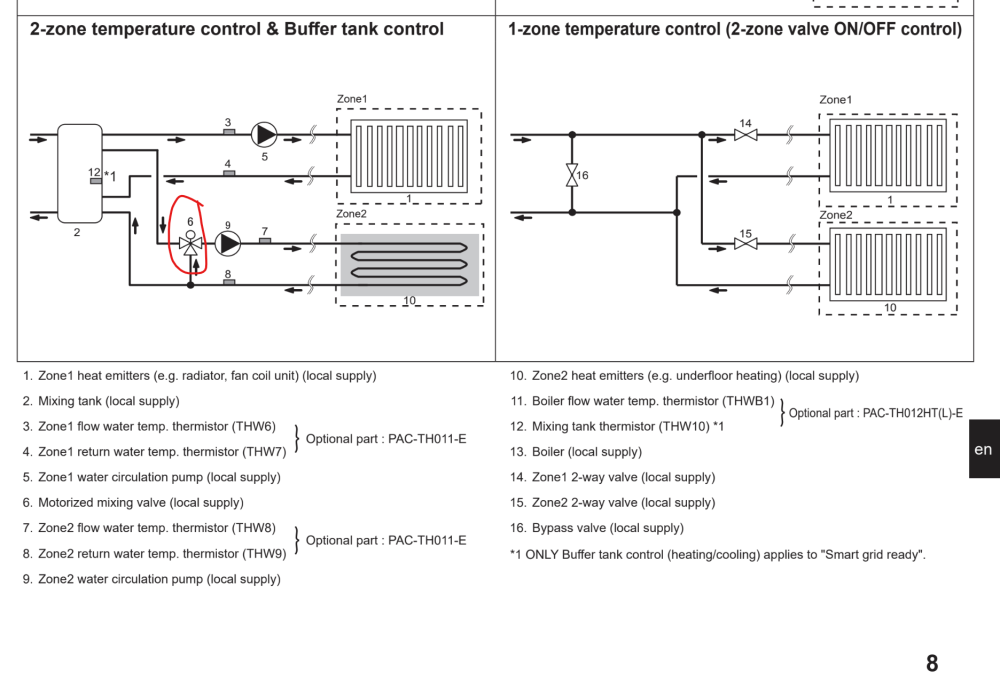
This would worry me: while the slab itself might not get down to 8°C, the pipework will be at that temp so any air that can get into the slab around the point the pipes enter could easily develop condensation. The pipes will also be 8°C before they enter the slab and the nature of gravity is any condensation on those pipes (hopefully none but hard to be sure every one is perfectly insulated and sealed) is going to run down into the slab. This is why using slab temp to shut off the pump is helpful to avoid heating over shoot, but not so useful for cooling. I agree focusing cooling mode on the FCUs and get them doing an excellent job will likely make the effort on UFH cooling moot. That's what I found. (And vice versa: I don't bother with FCU heating) For the electric mixing valve, what ASHP are you going with? I know the Mitusbishi FTC6 includes a 3-wire output to control a mixing valve, for example, and this is what I use. (I also have a Loxone server which also has mixing valve control block, but I haven't had to take that level of control over it so far)
-
Without reviewing the math, my setup is similar and my gut feeling is to agree with your logic. Main questions: What floor finish? Somethings like wood are rated only to about 30°C so you need more caution Will you put sensor probe in the screed? With logging you can use it to empirically verify your design, and/or hook it to thermostat to emergency switch off the pump in case of overheating. Will you be running ashp in cooling at all? And at what temp. This is the main reason you may want an electric mixing valve, to stop water below dew point creating condensation risk inside the slab. (Unlike heating, with cooling if you use a screed temp probe to shut it off if too cold you're probably already too late) Fwiw I do get an annoying slug of hot water in the FCU when switching out of DHW reheat, but my schematic is weird with the buffer in series after the FCU (acting as a volumizer) so doesn't temper the impact like yours will HTH
-
Limited height and ground floor Insulation Dilemma
joth replied to mickeych's topic in Underfloor Heating
I won't argue with 300mm of insulation if you can do it, to add some retrofit context we achieved a certified passivhaus retrofit with "merely" 160mm of insulation under the new slab for existing floors and 200mm under the new extension floor. Our SE / BCO were a bit OTT in the amount of depth of new concrete demanded under the insulation - if attempting it again I'd definitely try and rebalance that as others have shown is possible. -
Yes a new build may have some stricter building regs standards in places, but in the big scheme it is unlikely to cost noticeably more vs the extra labour in constantly working around what is already there. Hard stuff like digging new foundations you'll probably find are just as strict on your renovation as on the rebuild. For some reason a lot of the construction industry view regs as the enemy, like how many view a speed limit on a motorway, to be pushed as near as possible or even over step do long as you don't get caught. It's a false economy for you as client to take on that same mindset as it'll just give a worse quality build that costs more to live in. If you bought a "new" car with half bold tyres that barely scrapped the MOT and obsolete radio you'd feel totally ripped off, so I'm not sure why people have that opposite attitude to house building that's so so much bigger and more important investment Have a read of this thread for more examples of how cutting corners on regs can backfire.
-
Yeah my plumber went away thinking it was working perfectly too. It was only after a couple of days of occasionally having to run off a shedload of cold water when I opened a hot tap, that I worked out what was up. Fundamentally putting a TMV inside a secondary return circuit is bad design, as you're trying to mix in additional water with no where for it to go to. Regardless how far it is from the UVC, when sufficiently hot water hits the TMV it will shut off the hot supply and block the pump until the TMV cools again. Possibly resulting in the user having to draw a slug of cold through it to achieve that. So It will perform erratically for the user but very hard for them to recreate the issue for anyone to diagnose, so very possible that the designer/installer would ever know what they did wrong. (The MIs on my TMV also say it should be located as near the appliance as possible, but that's more that anti-legionnaire police wanting DHW distro at >60° than anything to do with correct function)
-
"British designed, British manufactured [and] optimised for British homes". Opps, that's not very inclusive wording if meant to include NI.
-
If the TMV is right on the cylinder then due to the heat wash it can sit idle at 80°C (if the immersion was on). So in that state it is just wanting to pass only the cold inlet through, meaning you spend a load of wasted water running a bucket of cold through it until it cools down enough to mix and let some of the hot water flow out. Add in the secondary return and things get worse, as the return pump is trying to suck water from a TMV that is set to only allow cold in and not let any hot out of the cylinder, so it's pushing against a dead end and gets no where and makes a racket. This is the main issue: the secondary circuit needs to be a closed circuit, not trying to conditionally mix in water from another source too. Then if you remove the check valve and of course (if the pump is turned off as it's making so much noise), the whole system just slowly draws tepid water the wrong way from the return port when a tap is opened. But that's just adding insult to injury.
-
You might want to go a bit larger, as you want it running less than 24/7 on heating on coldest day as it'll also need some time to do the DHW reheat. Also going larger means the DHW reheat is faster, meaning you can get away with a smaller tank. Spot on. You increase the stored energy by storing more volume, or higher temp, or both. Generally a larger volume at lower temp is more efficient (better COP to heat it, and lower standing losses due to lower delta T and the better surface area to volume ratio on the tank. I think 😅)
-
Word of warning from someone badly scolded by this: - putting a mixing valve on the UVC output is liable to cause issues if you have secondary return. - the mixing valve doesn't work at all if it's too close to the UVC outlet and gets heat washed by it (e.g. in the obvious place directly above the cylinder). - And it really doesn't work if you have both of the above - (and, it's even worse again if your installer forgets the check valve on the secondary return pump). In the end I decided easier to put a mixing valve on every tap / appliance that needs one than try and do this centrally. In practice this is just the bathtub for me, as everything else already had one.
-
You have expensive requirements therefore the solution is likely to be expensive. Are you wanting to have the whole-house fail over to battery in case of a grid outage? This adds complexity. (a lot of complexity in the diagram above is trying to provide this, albeit not necessarily in a UK regs compliant way) Are you resigned to the fact you can't get a net-metered 3ph supply so need to balance consumption and production per phase? Are you sure you need PV divert or would you be content to run ASHP (or even immersion heater on full) at the likely-cheap times and rely on the battery to smooth over any discontinuity in that assumption? Can you actually do it all on one-phase and just leave the 3 phase as a future upgrade possibility The more you can cut down your requirements, the more likely you can cut down some of the costs. Have you had a look at Solax 3phase hybrid inverter?
-
But "Normal" does not necessarily mean good (or even legal for that matter). What is the EPC of that other build, and how much are they actually spending on heating? The advice on this forum is generally predicated on the assumption that if you're building your own house, you want to do a (very) good job of it. Much better than BR minimum. It's what is called the "fabric first" approach. Unless the fabric of the building is good, all the other advice here built on it is not likely to work out so well. You either need to change tact to build a high quality building, concentrating on thermal bridge free insulation, airtightness and actively managed ventilation, or stick to normal build with the normal received wisdom on heating. If going the latter route it would mean keep the FF UFH, keeping the zoning, keep with the gas boiler. What U-value does your SAP report say this is? How about the floors and roof? Have you had anyone draw up a room by room heat loss calculation? Or you can do this yourself using the calculator on here
-
In essence the ASHP only runs when the whole house average temp gets low enough to need heating. Not when any single room is below temp. (It's slightly more complex as I boost the whole lot during the overnight cheaprate, but that's just a case of moving the setpoint for the whole house average). (I manage it with Loxone so have much finer grained control than conventional heating controls. Also the per-zone cost is lower, as the temperature sensors are already in the light switches anyway, and no need for any per-room key pads or wiring etc)
-
This sounds unlikely: 50mm PIR on its own cannot meet current (or any recent) building regs. The roof has 160mm (100mm between joists and 60mm continuous under it) which sounds more plausible for a BR grade of build. What do you have under the ground floor?
-
Just to call out one thing here in case it's not obvious: even if you run the UFH as a single zone, you'll still want to install it as multiple loops in order to ensure a good heat distribution. Those loops may as well be laid out according to the room layout, both because it's topologically simpler to run it that way, and also because it gives you a very simple path to add zone control in future if you ever find you need it. This is what I did: 100m2 GF of UFH (no heating upstairs). most of GF is one big open plan area, but the snug is well divided off and naturally maintains a different temperature. When I had a guest stay over in the snug they found it far too hot for sleeping, so it was very easy to manually close off the loops to that room to avoid it getting hotter. I've since added manifold actuators and use zoning to avoid individual rooms overshooting temperature, but no room can "call for heat" on its own therefore avoid the inefficiency of zoning that causes all the concern here. It just limits the max temp.
-
1. The buffer tank* currently runs at 17°C setpoint +/-2.2 hysteresis, so 14.8 - 19.2°C I would like to run it a tiny bit cooler than that, perhaps 12-17, but I need to finish some (a lot) more pipe insulation work before I can do that, and frankly this config got us through 8 people staying over on the hottest day of this year, so I think it's not bad I've never needed to use them for heating, but in theory if they did it'd run at 24 +/- 2.2. It should probably be a bit higher than that to be effective, especially given no condensation risk on heating. Loxone does have logic blocks to control flow temp based on load+weather compensation, but I'm not using them because wiring that into a mitsu FTC6 is non-trivial. (Either has to go through their gross Melcloud cloud API, or I need to rip out the melcloud wifi dongle and replace with modbus interface) 2. The smaller is a panasonic (Systemair) one, and the larger is something salvaged from the restaurant refit, details here and here. 3. Dampers are really basic on/off things from aliexpress https://www.aliexpress.com/item/4000627671878.html Loxone can modulate valves (and windows and shading) based on time of run but never attempted to apply it to these as the time of run seemed totally random. And for our use on/off seems fine Now I've proven the whole lot works well, if doing it again I'd do it properly with galvanized damper and belimo actuator Damper damper damper. I'm baffled why I keep calling them baffles. * - Note that while my system was designed without buffer tank and does not need it for UFH, I found adding FCUs very much necessitates addition of a buffer tank, as the nature of blown air is it's mostly useful just when the room(s) are occuplied, which can often mean very low kW demand on the heatpump which led to egregious short-cycling prior to adding the buffer. So I now have an unusual but IMHO very sensible design where UFH runs without a buffer in winter, but the FCUs run with a buffer in summer.
-
So small update - on Saturday (hottest day of the year!) I went to turn on the unit, and it didn't cool down at all. My partner said it wasn't very effective when used a week ago. I have a horrible feeling I had a leak and all the glorious R290 has escaped. What's the idiots guide to confirming this is the case? I did do the soapy water leak test at time of install, but it's not foolproof. Probably time I find my local f-gas engineer to come and take a look. (so I know it doesn't *need* the f-gas cert, but seems the easiest way to get someone that should have the knowhow)