joth
-
Posts
2918 -
Joined
-
Last visited
-
Days Won
5
Everything posted by joth
-

Acronyms, Abbreviations & Glossary Of Common Terms
joth replied to ProDave's topic in General Self Build & DIY Discussion
MCS = Microgeneration Certification Scheme -
(A forum glossary wouldn't be a bad call, can't recall we have one) DHW = Domestic hot water. The stuff you shower / wash hands with HP = Heat pump MCS = Microgeneration Certification scheme. Bureaucracy heavy installer standards body that are gate keepers to government grant money MVHR = Mechanical ventilation with heat recovery. Provides fresh breathable condensation free air to the whole house without throwing hard-won heat out the window. Standard in most of western Europe but still considered dark magic by most of the UK building industry
-
Was the quote for 5kW heat loss, or a 5kW heat pump? It's usual to oversize the HP a bit (1.5x or so) to avoid it running 24/7 in cold weather and to give duty cycle time for DHW reheat. And some head room incase incase... But yes as per JohnMo 2.5kW is very low heat loss. To sense check it, how many m2 floor area and what build quality? What is your EPC?
-
Problem is, there's USB-C and there's USB-C Most laptops, phones etc benefit from >5V for faster charging, but most cheap chargers, inc all those I'm aware of built into UK sockets, will only give 5V. (Note many advertise higher amperages, but this is largely irrelevant if they don't have PD compliance) Now beside the bed a trickle charge is often less problematic, but in the kitchen etc I much more often need to fast charge, maybe for a power guzzling laptop. And the kitchen is somewhere I value integrated USB sockets a lot more, as we have less places to hide a charger box -- under the bed or behind the nightstand is really easy in comparison. So for me I went with plain old 13A outlets pretty much everywhere, and will upgrade in 5-10yrs when I'm sure a standard has settled and better quality options exist. (On the flip side, I also have cheap bike lights with a "USB-C" charger socket that refuses to charge on a proper Power-Delivery compliant charger, it will only charge from a dumb 5V PSU... sigh. But they will have died and gone to landfill long before I put USB-C chargers integrated everywhere)
-
Yes, a lot of the shelly back boxes work like this. I have them in outbuildings (garage, shed, garden lights) and generally work great. My main gripe is the smart connection is wifi only (unless you go for the very expensive and more limited 'pro' stuff) and the wifi occasionally drops out (especially if installed in metal surface mount boxes, like I have in the garage, lol). At least when it does loose wifi, the hardwired backup works well. They're also a bit of a pain to manage at scale (manually commissioning, programming and keeping up to date 10s of switches would be a PITA) and its not so easy to get feedback through their API when the state is changed via the hard-wired switch But the concept for semi-distributed smarts is sound. It is what KNX is attempting to be, albeit rather long in the tooth now. yeah I did something similar by writing and pushing custom EspHome firmware into various Hue rip-off colour change bulbs. It works... but again, managing it at scale (and, wifi flakiness, and the more bespoke nature of the install) meant I backed off doing it for more than a couple toy applications.
-
Love the survey question format! (although note in Q4 you reframe your answers from describing the non-smart system you did install to a hypothetical smart system that you didn't install, which is a tad confusing to follow) Here's my view, all answers relative to the smart system I actually installed: Would or did I bother? - yes Is my life richer or poorer with or without smart switches? - richer, yes, marginally. mostly because smart switches enable other automations (time & motion based lighting, automatic lighting when out or cooking or playing a movie etc). But we've also appreciated being able to easily repurpose switches (inc double/long taps) to do non-lighting things on occasion. Future proof? - yes Could company remove functionality of the smart switch? - no, all locally controlled. Works even if the network router goes offline. Short life when installed? - possibly, but see examples elsewhere on how my design minimizes the risk Will I be able to get spares easily? - yes so far. Using a lot of commodity hardware (basic retractive switches and motion sensors) has improved my odds Will it [did it] cost more to install your lights? - yes. (DIY installing it minimized the biggest hit though, that being paying someone else to design+program it) Will you [did you] use all its functions after 5 days? - depends what is meant by "all", but yes we definitely use more functionality on a daily basis than is practical with dumb controls. (specifically, motion based lighting means we rarely use the switches) Would your other half or a new owner of the property or an electrician fix easily if you are not around? - most likely not, but a growing network of professional Loxone installers exits so I'm less worried about this than when I decided to go with it in 2018 Can you or the electrician get spares today? - yes (can order today, about 2 days to be delivered) Can you switch your lights on if there is a hardware or software issue? - possibly not, a weakness of Loxone is it does introduce more single points of failure. Have I got home assistant? - yes Do I have smart relays? - yes Are they the best thing ever? - no, great sometimes. Are smart things a good thing? - yes. Certainly not necessary or life changing, but they're good for me. Note I go to great lengths to avoid cloud-dependent and wireless connectivity except where unavoidable (cloud for weather forecasts and push notifications; wifi for retrofitting). I wager anyone doing all wifi and cloud dependent lighting controls will not have a good time.
-
It sounds like OP is converting a house currently on a combi boiler? If so unvented cylinder is simpler as you can reuse the pipework as is, and no need to install any header tanks. Personally I also find tanks of water in the loft a waste of space and a manky idea (after finding a dead pigeon in one)
-
The quoted sizes are m3 so room volume not area. Looks about right vs plans for 2.7m ish ceiling heights. @Gill are you able to make use of the E7 cheap rate at all now? Planning a battery, or moving to a different tariff might reduce running costs assuming you aren't running the a2a all night.
-
electric boilers are cheaper than heatpumps to run
joth replied to dpmiller's topic in Environmental Building Politics
But the OP is literally about running costs only, not capital outlay. So in the context of this thread quoting running cost only comparisons is completely reasonable and on point. -
Tiles too 'loud' - and excessive bathroom retile quote
joth replied to puntloos's topic in Bathrooms, Ensuites & Wetrooms
Context here is the house is still in the process of being built by a principal contractor. If they have their tiler start altering electrical or plumbing fittings that haven't yet all been commissioned or signed off, then any faults that subsequently develop would be a finger pointing nightmare. Thus the principle contractor will be obliged to have all the trades involved in the scope of work to wade in to do their bit for any changes In my experience as a client (or a different builder in the same area), these sorts of rework variations can overinflated both because the principal contractor does not want the risk to impact on the programme timeline, but also because of an emotional cost: the individual trades absolutely hate ripping up and redoing their handy work and will moan and drag heels over it, and whoever is directing the thing just doesn't want/need to be dealing with that extra headache, so sand bags it both to put off doing the variation and for their own overheads in making it happen -
Any reasonable alarm system will have tamper detection in the controls and sensors so if any are disconnected it will alarm. The central wiring panel is normally somewhere hard to access (ours is in the loft), but even if that is taken out with an EMP then the sounders should have their own battery backup and sound if disconnected from the panel.
-
For reference, how large is your battery and what's your typical daily usage? We have 10kWh storage and about 18kWh per day consumption, plus Octopus Go only has 4 hour cheap rate. So works out better overall value to blast the ASHP at high temp for all those four hours, which generally is more than enough to meet our daily demand (heating + DHW) and the battery covers all the non ASHP usage (including 2x ppl working from home and all cooking). With a larger battery:usage ratio I can see 24/7 ASHP with WC would be the next level of optimisation. But battery prices really don't justify it yet.
-
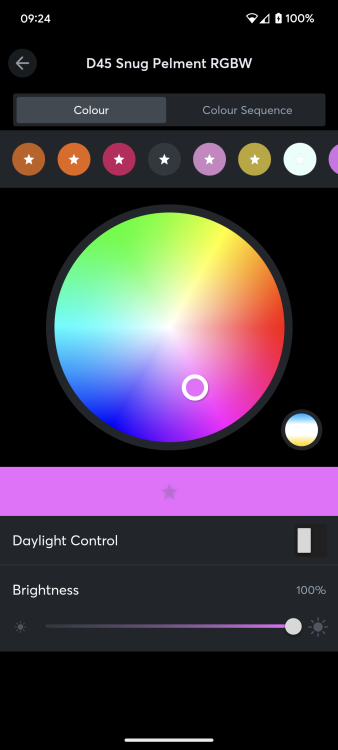
This is what the RGBW colour picker looks like Hadn't noticed DMX colour lights have the automatic daylight control option now, like Dali CCT lights.
-
Put +24v into the coil of a relay (or channel input on the SSR) and then into the relevant channel "output" of the whitewing decoder which will sink to ground when on. Then on the secondary side of the relay do whatever you have to do. Send 230v to the blind or light, and then from there back to the N of the appropriate rcbo. With a mechanical relay the secondary can do anything. If it's an SSR it has to be matched to the type of SSR. E.g. 230v AC or 12v DC etc. the SSRs I use only have one live input per module so all channels on it need to be on the same rcbo. Good luck and happy Christmas!
-
If you have spare 24v channels, have a bunch of 24V relays or SSRs you can have as interim these, 8 channel and cheap as chips https://www.aliexpress.com/item/1005004133687443.html
-
For long term maintenance there's a lot of benefit in having many of the same part. If you're already waist deep in Loxone relays I'd just keep with them, the simplicity will payback in the long run My suggestion was more if you hadn't bought anything yet (in 13 pages I'd lost track entirely where you're at 😂, thought still in design).
-
Using a whitewing 48ch decoder and half a dozen AliExpress 8 channel SSRs it's about £7 per relay channel (if you have the DMX channels spare already)
-
You want to check the installation manual on those assumptions. And especially on the device voltage. But yes assuming it is dual switched live control, you need two relay channels per blind. Be careful to never power both cores at the same time. Most are robust to it, but some dislike it immensely
-
The research evidence on security alarms
joth replied to Adsibob's topic in Networks, AV, Security & Automation
Forget trying to find an alarm that will pay for itself through insurance discount. The only reason to do it for insurance is if you have expensive items/collections (art, jewellery, antiques etc) that they simply won't insure at all without a graded alarm. Think £50,000+ value items. And even then the alarm and the insurance will cost a leg Like owning a super car. If you want monitored with police call out, the make of alarm is irrelevant the price is dominated by the mandatory maintenance and monitoring service. And this depends on the local installer competitiveness. For everything else it's just to make some noise for peace of mind. Last two times we were broken into we were nearby or in the house asleep, and the one false alarm since installing the alarm (different house entirely) the neighbours and the remote alert on my phone were enough to get eyes on the property very quickly and avoid a total ransacking. The biggest frustration for installing an alarm (DIY or pro) is if you have pets roaming everywhere -
Yes mvhr is basically useless for managing overheating. You can circulate air between rooms/thoroughfares like I do to manage it to some degree, but this is a much higher volume of air movement. At least 10x or more than an mvhr moves. Or just jump straight to a/c, but that does feel silly to use for cooling in winter when the rest of the house is requiring heating, hence my more complex hybrid approach
-
Can't see the spec but 1A maybe the inrush current. The definitely don't consume that much in steady state, that'd be appalling The mains 12V PSU is a fine way to go
-
Correct, I tend to use a cheap DC DC converter for any odd 12V (or 5v) item in the enclosure, especially if it has battery backup https://www.amazon.co.uk/Step-down-Converter-DC-DC-Efficiency-Supply/dp/B07L5K51YP/ref=asc_df_B07L5K51YP/
-
SSR is solid state relay. Quieter and faster switching than a mechanical relay. I use these. https://www.aliexpress.com/item/1005004133687443.html Perfect for switched live 230V devices. I have them for lights, pumps, UFH mats, towel rads. Just not use for anything that needs a "dry contact" input. The boards you linked from Amazon work fine, I have a couple, just a bit annoying to mount in a din rail enclosure
-
What are you using for 24V led strips? Do how many channels do you have spare on it? Use that to drive 24V coil mains relays, or even better SSRs (good for most loads, so long as not tiny wattage)
-
Oh dear! If you space outside the cabinet I'd get a cheap consumer unit enclosure to put the audio server etc in. That has no interconnection to the rest of the components. And try and squeeze the terminal blocks on just one row will make routing incoming cables much cleaner.