
joth
-
Posts
2918 -
Joined
-
Last visited
-
Days Won
5
Everything posted by joth
-

Internet switch - recommendations
joth replied to Moonshine's topic in Networks, AV, Security & Automation
This diagram shows "Optional ethernet backhaul" Consider it mandatory, not optional 🙂 I.e. each Deco E4R is plugged into a cat6 ethernet socket back via the switch (you just ordered) and to the M9.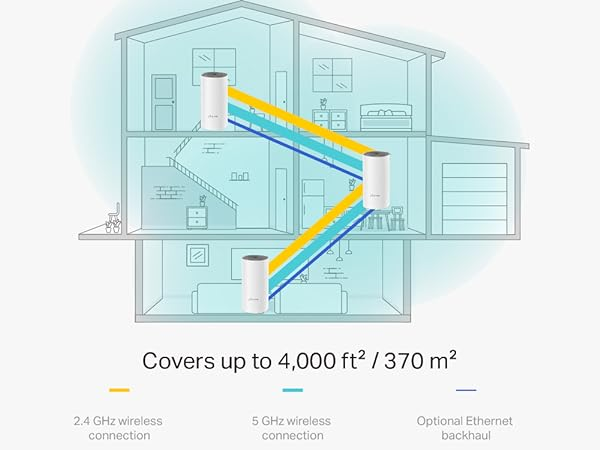
-
Internet switch - recommendations
joth replied to Moonshine's topic in Networks, AV, Security & Automation
Yep you're absolutely right. I've fallen into using the colloquial form of mesh to describe anything where all APs are configured to act as a single WiFi network, as any hardware supporting mesh will support this, even if you don't use the 802.11s multihop wireless routing aspects of mesh. As otherwise you might just end up with WiFi repeater/extenders with their inherent drawbacks Netgear follow this naming scheme too it seems https://www.netgear.com/hub/technology/wifi-extender-vs-mesh-wifi-which-is-better/#:~:text=Mesh WiFi systems offer better,they move around the home. -
Internet switch - recommendations
joth replied to Moonshine's topic in Networks, AV, Security & Automation
Note this only applies to WiFi APs that have (optional) router functionality built in, generally consumer products like Google WiFi and TP link. Alternatively you can keep the router functionality out the APs (either retain the virgin router or use a dedicated box like unifi udm) and then the APs are purely on the LAN side of the router. Personally I use Unifi in my house (cable to Virgin media superhub 3 in modem mode, to USG router, to PoE switch, to APs) and all those I manage now, except one Google WiFi install in a relative's house. @Pocster how do the ASUs work? Built in router or you using something else? -
Possible increase to BUS grant - anyone heard anything?
joth replied to sharpener's topic in Air Source Heat Pumps (ASHP)
Not heard of this, but hey this is how rumours work. Only thing I see is MCS Foundation calling for more subsidy for GSHP https://mcsfoundation.org.uk/campaigns/extend-the-boiler-upgrade-scheme/ My more cynical view is an installer mentioning this (maybe even rumour mongering this) has a very full order book, but wants to put people off going with another installer now and instead come back to them in N months when they may have more space. -
Internet switch - recommendations
joth replied to Moonshine's topic in Networks, AV, Security & Automation
Wifi design is another matter though.... What is your idea for Wifi for the rest of the house? Ideally you want all floors/areas to have APs from a single vendor, all managed and running as a single "mesh" network (not Wifi repeaters) You definitely don't *need* PoE switch to use PoE wifi APs. Unifi APs ones all come with a PoE injector, for example. But if having >2 APs, I personally would get a PoE switch. buying 2x switches, one PoE and one not, can work out cheaper. And give a bit of redundancy. So my "just buy a cheap non-PoE one for now" advice still stands. Tip: turning off the wifi built into the ISP router and supplying your own Wifi APs everywhere will give a better result, and avoid accidental ISP lock in. -
Internet switch - recommendations
joth replied to Moonshine's topic in Networks, AV, Security & Automation
Really, don't overthink this. An 8 port unmanaged switch is about 20gbp probably less if you shop about. TP-Link TL-SG108S or NETGEAR GS308. Looks like Amazon have some no-name brands for 12 quid. Slap that in, and add another or replace it if you ever need a managed switch or PoE or anything fancy. -
At that age, this is probably not inverter driven so will have little to no modulation range. If so, it either needs a large buffer to batch charge up, or replacing with something a little less antiquated.
-
I think there's a place for means tested grants for fabric upgrades. It's a positive way to make progress on net zero, build up the industry, tackle energy poverty and housing crisis, and ensure the hand outs actually go to improving the wellbeing of the children in the house and rather than wherever else it might end up if it was just handed out as cash
-
I do dislike "smart" electric rads. I had to deal with this recently: https://www.electriq.co.uk/p/vs8-1800-2.4dgw/electriq-vs818002.4dgw-heater-heater It has 2x 1.2kW elements in one radiator , with serious drawbacks - each element has its own Wifi connection to a Tuya cloud server run from china, so to set the target temperature of two separate room stats - makes an annoying beep when turned on, so my plan to automate it from central room stat (via Loxone Relays) is a non-starter as it would be beeping all day and night - they claim 2x1200W input makes it a 2.4kW "BTU" heat output. It isn't, as each element boils the water and shuts off, duty cycle is less than 50% on. Maybe 1kW effective sustained output. - even then, the area around the element is scoldingly hot to touch so needs protecting from small hands. - each stat picks up heat wash from the output from the other, so seemed to have to crank one up to 30C target to come on at all Not my cup of tea.
-
The extra shroud is to hide the condensation drip tray isn't it? It generally doesn't look very attractive, esp after residual water has pooled in and then evaporated off it. They really should publish dimensions including the cover though! Thanks for sharing keep us updated.
-
Got to bless YouTube, trying to watch this, it thrust an ad for this snakeoil at me https://evoheat.co/ Don't make perfect the enemy of good enough. The point is not to have perfect weather forecasting, as that doesn't exist. The point is to actually have it do it. Someone might go in tweak +1 your WC one day, forget to put it back the next, or totally fail to do it the week after. For me, I get annoyed switching my ASHP between cooling and heating, a twice per year job. Fiddling with it every day is never going to happen even if I'm there - and obviously not on days I'm not there.
-
These tweaks, especially future weather, really only work in highly insulated buildings. Typical UK homes lose heat so fast that trying to do anything in advance to get ahead of a cold snap the next day is pissing in the wind. So it's interesting Homely are focusing on marginal gains for already low energy users. In my mind chasing and nailing time of use shifting would be really powerful and only really possible automated. At the very least to avoid heating during short price surges. Only running heating during a short cheap rate window (E7 et al) is again marketing to the rare well built lower bill households.
-
Availability of combined A2A and A2W units in the UK
joth replied to FelixtheHousecat's topic in Air Source Heat Pumps (ASHP)
A2w with a FCU does give very effective and responsive cooling in demand. However it's not exactly "out of the box". Virtually no UK installer knows how to do cooling or FCU installation, let alone both. The parts are hard to source and you need to add additional controls for the FCU. -
Future Homes consultation 2023 - thoughts anyone?
joth replied to FelixtheHousecat's topic in Environmental Building Politics
It does have this positive word: """ We investigated including better walls, floors, roofs, triple glazing and improved thermal bridging. However, the only cost effective and practical improvement we found could be made to the standard was an improvement in airtightness. This improvement in airtightness is matched with the change to a decentralised mechanical extract ventilation system, in line with Approved Document F, Volume 1: Dwellings. """ Which is great. However it's hard to see any real airtightness improvement in the doc. They have option 1 to move it to 4, or option 2 that is 5. While this is a notional improvement vs the current L1A limit of 10, I understand most builds are already aiming for 5 per SAP anyway. And either way it's not a very ambitious goal. The reason is clear: "Option 1 is the most cost-effective option to maximise carbon savings, balanced against reducing energy bills for households. Although this option is cost-effective at reducing carbon overall, it comes with additional upfront costs for developers and may therefore affect overall housing supply." -
Availability of combined A2A and A2W units in the UK
joth replied to FelixtheHousecat's topic in Air Source Heat Pumps (ASHP)
Yup broadly agree. Brexit certainly hasn't helped, as people can't self import these sort of things anywhere near as easy. But BUS is the biggest one. I think there's loads of people that want ac, and there's an existing fgas industry here installing it. They are primarily commercial and have no interest in domestic HW, and the BUS limit means they never will. It's hilarious if you stop and think, how a2a is not eligible for BUS, but a2w2a (as I also did) is perfectly allowed. -
What happens when power comes back?
joth replied to puntloos's topic in Kitchen & Household Appliances
Impossible. The number of appliances varies over time (not to mention the number of occupants do) whereas the inverter is intended to last decades (and potentially across home sales) The options are to either only EPS backup a few key circuits (some lights, fridge/freezer, internet router, maybe one socket in the kitchen for basic off grid cooking), or else EPS backup everything but have someway to kick most/all discretionary high power users into their "off" state when there's grid failure. Introducing a 5sec delay when switching over from grid to EPS backup turns out to be a very effective way of powering off most high energy consuming devices. -
Mitsubishi vs Samsung Heat pump
joth replied to Slippin Jimmy's topic in Air Source Heat Pumps (ASHP)
I already answered about the Home assisstant -> ecodan integration but maybe wasn't clear as I just referred to MELcloud, which is the cloud portal for ecodan. As @JohnMo suggests you can also ignore the premade HA integration and just use a relay to trigger the call for heat input. This is the main control I use (albeit I use Loxone rather than Home Assistant to control the relay). I'd actually go down this route rather than the MELcloud integration for your needs. -
Acronyms, Abbreviations & Glossary Of Common Terms
joth replied to ProDave's topic in General Self Build & DIY Discussion
LWT = Leaving water temperature (of a boiler or ASHP. aka the "Flow temperature") -
What do you mean by 2 gang 2 way? Just that one faceplate controls two circuits? Or do you have some circuits (lights) being controlled by two different switches? If this is the case, it could be a wiring issue in 2 way controls. These are easy to get wrong. Otherwise it must just be poor quality dimmers Btw the pendant kit is irrelevant, it's the compatibility between dimmer and bulb that is key and unfortunately there's no easy way to know what will work other than try it. Or use the industry go to "use a Varilight dimmer" answer If you can take the same bulb as flickers on these dimmers and have them not flicker on another dimmer, you have your answer
-
Mitsubishi vs Samsung Heat pump
joth replied to Slippin Jimmy's topic in Air Source Heat Pumps (ASHP)
Fwiw the HA MELcloud integration isn't really up to what you are after. It can't turn off heating or DHW (nor switch to cooling mode). It can request DHW boost, and adjust the room target temperature, which maybe enough. Also, MELcloud itself is pretty flaky only update the device every 15mins, and I found hitting it with a lot of config changes confused it a lot. YMMV As an aside, the policy you mention sounds very limiting. Like, if the car ever goes on a trip away overnight or is in the garage being serviced anyone left at home in the house gets no heating or hot water. Obviously you can turn off automations then but it sounds a hassle. In my mind you want to boost usage during cheap rate but still leave things ticking over even when the car is not charging. The HA integration maybe just enough for that. -
I thought they modulate by adjusting the flow rate? So if output is too hot, they increase flow rate and vice versa.
-
When did you purchase the terminal blocks? You have at least 14day money back on them, likely more. I'd be looking at that option myself
-
Well of course they do. Its free money from government. Many of said companies are set up with that sole purpose, and will disappear the minute grants are switched off. Its not like there isnt any previous history with this sort of thing.................................................................. The only thing that continues to surprise me is how everyone on here continues to be surprised by this The primary goal of the govt subsidies, for ASHP like PV before it, is to stimulate an industry of installers, and to make it worth the effort of getting the training and setup businesses in this space. That is very clearly an invitation from governments for the installers to take a lion share of the subsidy. This is just not my interpretation, a friend is a senior civil servant in the dept of energy (or whatever it's called now) and stated it to me. Making it cheap to install is pointless if there's no one trained up to install, or maintain them long term. Yes the whole things leaves self builders/self installers hung out to dry, which stinks, but we're a super tiny fraction of the big picture and not the intended market for it. I don't like it any more than you do, but there's little point getting het up about it as however unhappy it makes you, it's not going to change. Obviously the long term risk of this is industry collapse when the subsides are removed. Hopefully they learnt from PV and can taper the subsidy over a longer period on a well published timeline. And hopefully pigs can fly
-
A: Zero. If you're not doing it yourself, it's not self build. A: Three. One to change the bulb, two to bitch about the architect that put it there.
-
You can. Four Allen bolts, remove the spacers, screw the rail back down directly to the chassis. Job done. Although, I'm unsure about those wago mains towers. They look too high even with the stands removed