joth
-
Posts
2918 -
Joined
-
Last visited
-
Days Won
5
Everything posted by joth
-
Actually, perhaps it goes support sub distribution boards, I found an option for it. I think the idea is you need exactly one Emporia per board. I don't have two Emporia so can't test it (and won't be buying another due to the battery/PV limitation)
-
Emporia supports 3 phase pretty well, setup detecting and confirming the phases (designed for US split phase installs but supports 3ph too it seems) However it's not good for anyone with PV generation or especially bad for bidirectional loads like battery storage. The main meter clamp detects power flow direction but it seems the individual circuit clamps don't, so it detects charging and discharging my battery as the same thing. Also it only supports a single distribution board really. It's a good product for quick and dirty monitoring setup but not something I'd want to use for fully designed long term monitoring. The lack of flexibility in setup and especially lack of local API is too big a limitation. Shame as it's excellent value and for what it does support a well implemented bit of kit.
-
 So I actually never use them at the TB end. Spring loaded terminals are (generally) designed for stranded as well as solid core wire and I generally find it easier and quicker to put them in non ferruled. You do have to press the release button right down when inserting them and of course this doesn't work on solid core only terminals without a release button like the Loxone link and knx wago blocks. One time on a hundred a single strand will sneak out into its neighbour's hole, but it's part of the fun debugging those case 😂
 -
Microcontroller based power switching revisited in 2024
joth replied to TerryE's topic in Boffin's Corner
Modbus even more so. Maybe DMX and Dali, a few others. MQTT is stuck between camps. Unlike KNX etc it's not a complete standard, just an application layer protocol. (A bit like modbusTCP or KNX/IP). It depends on a lot of other stuff to work, ethernet and IP layer, stable device naming or addressing, and good luck if you want TLS encryption. I certainly wouldn't want to build core house functions like lighting and heating around it. But nor is it consumer friendly either, it takes so much manual config. It shocks me to hear myself say this as MQTT support is one key feature I find shocking to be missing from Loxone, but maybe I just answered it 😂. Loxberry is moving to use it as the core messaging fabric. Maybe things will keep moving that way. -
if your schedule documentation is good, it can become quite quick to actually lace it up. The thing the slows me down is if I have to keep stopping to think. So long as I can leave the brain mostly disengaged it's quite a relaxing, almost therapeutic pass-time. Like knitting, I imagine. Indeed, that's what my wife likened it to. We spent several enjoyable evenings during lockdown stripping and crimping the wiring harness together.
-
Microcontroller based power switching revisited in 2024
joth replied to TerryE's topic in Boffin's Corner
I would add to these: or it's an established domain specific standard with multivendor support, but designed multiple decades ago, antiquated and a pain to use e.g. KNX. or it is Matter, which is of course trying to be the one-new-standard to solve them all, but I see several issues with it, mostly: wireless focused no standardized wired support; slow development; only has limited device types/profiles and not a great playground for vendors to innovate new device types. So all in all not a good choice for integrating into the fabric of a new build, not now, maybe not ever. If https://www.1home.io/server-for-knx really works and gets traction, it could form the bridge between the incumbent wired KNX and new kid consumer friendly Matter, and perhaps be the best path forward, but it's early days. -
Correct. Main thing I do is try and be consistent. You have to decide what makes most sense to yourself really, e.g. unswitched live feed always to the RHS of the enclosure (nearest the "Mains" side of the box), what to do with low voltage inputs, dry contact outputs, etc.
-
Microcontroller based power switching revisited in 2024
joth replied to TerryE's topic in Boffin's Corner
I guess that you'd turn off the ASHP only over the summer, though it might do "maintenance" cycling occasionally. Long off periods might affect the ASHP life so there is possibly a trade-off between the annualised standby cost savings v.v. ASHP life. For better or worse I'm not using glycol so I have to be very sure the thing is powered up whenever it is liable to freeze. (which is similar times of day and yar to when I want to use it for heating most, mind you) I also use if for DHW so need it powered up at least once a day for UVC reheat. And my control logic isn't yet clever enough to know I'll need to use it in ~1 hour, so I'd need another layer of prediction to power it up and let the crankcase heater do its work before calling for heat. I now have the ecodan modbus interface so have fairly fine-grained control over it. It does include a system power off/on function. I'm wondering if that saves on the crankcase heater when still keeping the freeze-stat function. I will experiment at some point, but it'll only be for course savings; it still needs that level of predictive control I just don't have built at this point. (Like, predicting someone is about to run a bath and two showers and empty the UVC at an unusual time of day - it's actually a tough problem). -
Microcontroller based power switching revisited in 2024
joth replied to TerryE's topic in Boffin's Corner
It depends a lot on scope. I've done a few installs now and they all come in at 2-3x what you quoted, even with a degree of mates rates built in, but that's controlling all the lighting, providing the light switches and motion sensors, and perhaps comprehensive shading/stack venting and whole house music, in 5+ bed houses. (In a very expensive area of the country, and I'm expensive too don't you know lol). But that's excluding light fittings, 230V mains work, cable pulling and certs, all done by site sparky. For say just HVAC controls it could be done under £2000 in materials. A retrofit would suggest putting some wireless sensors and controls around the place which is probably tying into their proprietary wireless Air protocol which I've totally avoided to date. I hear it works well, I just dislike wireless. I totally agree the single vendor lock-in is worrisome vs open source, but on the flip side I can leave a miniserver running for 12 months and it looks after itself, whereas with any OSS you need great hygiene on admin work: taking backups and applying security updates (to OS and apps) etc and dealing with the fallout when stuff then breaks. The whole strength is plethora of hardware supported, but it's also the Achilles heal for a (progressional) production system as the more add-ons and integrations you use, the higher the odds (and seemingly exponentially so) that something will break with each update. I love Home Assistant for tinkering, and providing user specific customisation, but once I have a prototype I try and remove it from the "real" implementation in the fabric of a building. Fwiw if you can wade through the rambling, there's a bit at the end of this podcast about my thinking on that dividing line https://www.houseplanninghelp.com/hph334-combining-smart-home-technology-with-energy-efficiency-with-jonathan-dixon/ -
Microcontroller based power switching revisited in 2024
joth replied to TerryE's topic in Boffin's Corner
For the immersion, I was lucky to pickup a Carlo Gavazzi RJ1P23I50E Semiconductor Contactor 50 A For about £28 on eBay. It has 0-10V input which is perfect for controlling from Loxone, no extra hardware needed. If I didn't have an analogue output spare I'd probably look at a DMX to 0-10V driver, very good prices available on AliExpress. For 24V switching I have a 48channel DMX led driver decoder which has spare channels. These are ideal for driving coupling relays or SSRs. Home assistant to DMX should be pretty simple and means downstream hardware is fairly cheap and standards based so easy to move to Loxone or kmx or any other system in future if desired. -
Microcontroller based power switching revisited in 2024
joth replied to TerryE's topic in Boffin's Corner
I think you have two distinct questions here, one about where to put control logic (Loxone, home assistant, ifttt, Google home, tuya cloud, etc etc) and the other about how to switch heavy loads in a safe and ideally low certification overhead way. The crux seems to be the latter What's the switching frequency? If more than once per 10sec I'd lean towards an SSR. Else a good quality relay or contactor https://www.wago.com/gb/relay-and-optocoupler-modules/relay-module/p/788-304 https://shellystore.co.uk/product/shelly-pro-1/ (Regarding Loxone I know at least 5 of us on here DIY installed it, but I think that's orthogonal to your main question) -
How to measure the remaining HW in an unvented cylinder
joth replied to Adsibob's topic in Boilers & Hot Water Tanks
A cylinder stat was popular energy saving measure in the 90s, surprised anyone can install a new build without one. Does your UVC have temperature probe pockets? -
Yeah not bad shout on plinth heaters especially if you could install them at floor level. If paying more for the fancy unit I'd want something that could cool too (ie wih condensate tray). And why on earth did they name it a UVC 🙄
-
Leave it on 24/7 while the house is occupied, but be sure weather compensation is in use. What emitters are you using? Depending on the property layout and draftyness it maybe beneficial to turn off "areas" that are unused for long periods. Especially if that allows one of the 2 ASHP to be turned off - effectively doubling your modulation ratio. But depends how quick the rooms are to heat back up when needed, and your patience to wait (or turn it on in advance) French houses, especially older ones and in the south, tend to have very thick uninsulated walls. High thermal mass. This will take yonks (multiple days).to heat up with the ASHP running at an efficient (low) temperature, likely why the installer is well versed in leaving the things on all the time.
-
Dumb question but to check this isn't asking about export allowance? "Size of Generation required" seems a weird way to describe supply or import but maybe that's just me.
-
Correct, as mentioned it was just installed for cooling. This winter the logic has cut in a couple times to try and heat the office. So far they don't actually seem to do much compared to heating. Not sure if it's because the outlet vent is up at ceiling height, or the flow rate is not high enough to transfer much energy. It's really not necessary so I've not investigated much. Bigger issue is the buffer tank (volumizer, in line on the zone return leg) does not seem so effective for cooling, the ASHP runs for a very short burst. Imagine this is because I plumbed it for cooling with the inlet on the bottom, draw off at the top. With hot water it raise straight to the top so the ASHP quickly sees a warm return temp.
-
Mitsubishi Ecodan immersion heater
joth replied to NightMail's topic in Air Source Heat Pumps (ASHP)
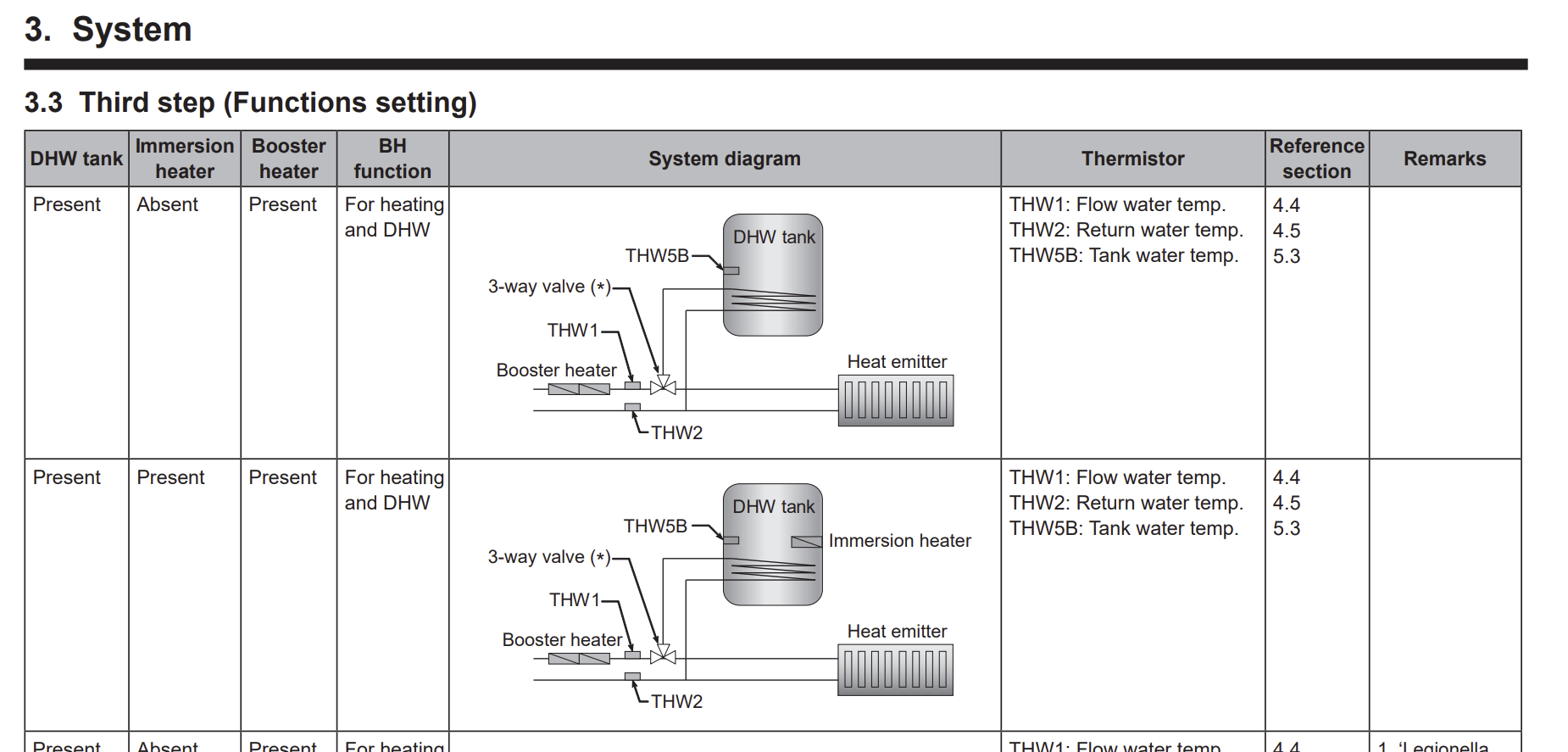
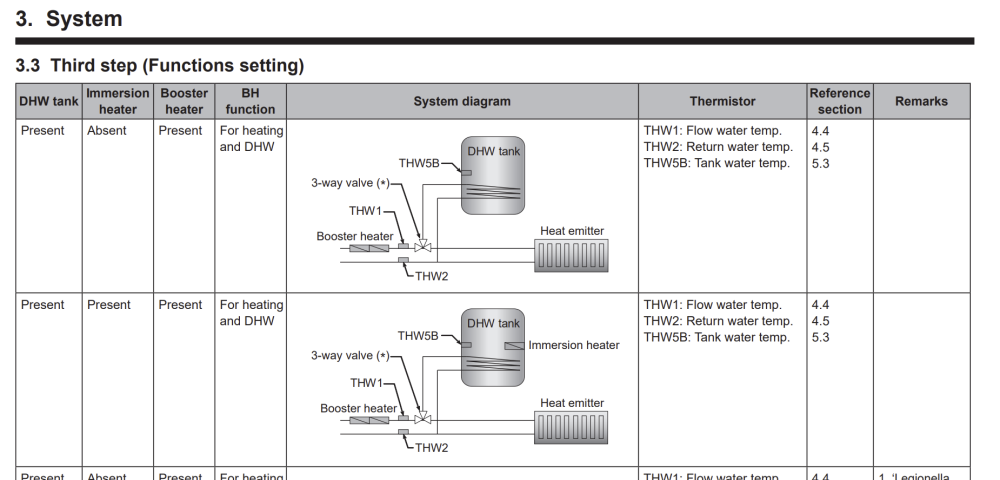
First thing is to confirm what your DHW Tank temperature target it set to. If this is >50 it maybe the ASHP struggles to achieve it so switches to immersion. It's helpful to confirm if you have an immersion heater (in the UVC), a booser heater (in line in the primary pipework), or both? See diagrams below. If it's a Booster heater, is maybe coming on because it's struggling to reach heating target temperature. Also check these Auxilliary settings - the DHW Delay can be used to delay the Booster/immersion coming on, to give the ASHP a longer run time to reach target. You need to ensure the DHW max runtime is high enough for it to run that long Also there's a setting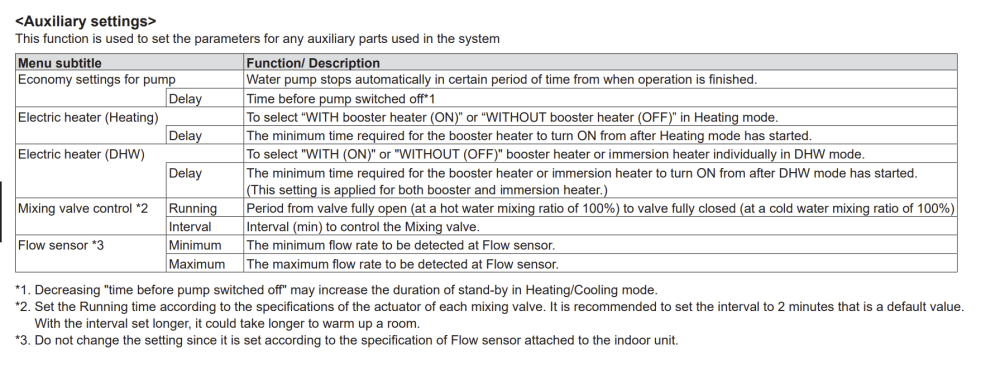
-
Solic 200 like Blackpool Lights - Help Needed
joth replied to canalsiderenovation's topic in Air Source Heat Pumps (ASHP)
So true. And it's not a new problem - 30 odd year ago my mate's Amiga 500 joystick port stopped working, the debounce capacitors had failed. I just removed them, and brought it back to life. (My first successful attempt at surface mount [de]soldering; fun times) -
No.F oil reflects infrared radiation. That's heat energy, not cold. I use my ASHP for cooling as well as heating, so yeah I should probably foil wrap the ones outdoors. 3. It's also good for creating an airtight layer if the insulation underneath doesn't, which is good for keeping moist air out which otherwise might condense on cold pipes within.
-
Anybody used ultra wide monitors
joth replied to Adsibob's topic in Networks, AV, Security & Automation
Think it depends on the application. My partner is an accountant and all those spreadsheets apparently benefit with the-wider-the-better monitors. Many SW engineers I worked with prefer vertical monitors (ideally 2 side by side, 24" or even 30", flipped up vertically) as code tends to scroll vertically more than horizontally. Especially my last employer had an 80 col line length in the coding standard for many years, hence very tall skinny code layout. -
Just stumbled across this - http://measuredheatloss.com/ tools for measuring as-built heat loss from a building, much like we do for air tightness.
-
Auto balancing actuators- is 2 way valve needed
joth replied to NewToAllOfThis's topic in Underfloor Heating
A photo of the valve in question (or it's part number) might help, but I think you mean 2 port aka zone valve? A 2 way valve (aka diverter or mid position valve) has 3 ports (pipes) but that wouldn't make sense here. By correct temperature, do you mean water flow temperature or room at target temperature? Manifold actuators normally manage the latter. Water flow temperature is normally set at the heating source and/or via thermostatic mixing valve on the manifold pump. Zone valves to separate upstairs and downstairs are likely unneeded but not likely to be a huge issue to have them. Just a bit more wiring -
The only way to be sure it won't stop working when the OEM turns off their server is to buy stuff that connects to a server you host yourself. So it's a a trade off between faff and longevity. The sweet spot would be IoT that easily lets you decide who's server to use (so you can change it over when the OG server fails) but the options for this are few and far between. The vast majority of chinesium WiFi devices use the Tuya platform and their servers. This is actually a fairly decent platform, and so far I've not seen stuff failing. But most the Tuya stuff I own I've flashed with custom firmware to connect to my own (Home Assistant) server. Perhaps the sweet spot is Shelly devices. These come with a cloud service they hose, but also a local API and good local integration with Home Assistant. So out of the box you have remote access and schedules/automations, but you can also do a lot more with them offline if requirements evolve.
-
The SSR has a very small load on the DC input side. I've never actually measured it but it can't be significant compared to the LED strips
-
Can the downstairs emitters fulfill the whole building heating demand? If so just cap off the pipes to upstairs and commission downstairs. Installing rads upstairs then becomes a retrofit upgrade job. Nothing in the BUS says you can't make future modifications to a system after it's installed? (Unlike the old RHI that came with 7 year strings attached)