
Radian
-
Posts
2586 -
Joined
-
Last visited
-
Days Won
15
Everything posted by Radian
-

Only just realised that this wall is uninsulated
Radian replied to Radian's topic in Heat Insulation
But lightweight concrete blocks are pretty useless at taking screws without plugs and setting up big sheets of PUR and drilling through, placing plugs and finding them again sounds like an almost impossible task. I've tried hammer-in 'screw' fixings but these also seem to blow out the blocks. Usually one is ok but comes loose when hammering in the next. -
Only just realised that this wall is uninsulated
Radian replied to Radian's topic in Heat Insulation
That's my house right there! I was just about to close the cavity by sawing strips of 50mm celotex that I've got off a skip and foaming them in when I though about what was on the other side of the blockwork. Now I'm thinking I should clad the entire wall in rigid insulation but 50mm won't really be enough. I make 220mm of thermalite and 50m rigid PUR out to have a U-value 0.24 W/(m²K) whereas 100mm PUR gets me down to a U-value 0.16 W/(m²K). So I need to buy some sheets of 100mm PUR but how best to attach it? -
Only just realised that this wall is uninsulated
Radian replied to Radian's topic in Heat Insulation
I'm obviously crap at thinking in 3D because I'd already understood that the cavity formed by this wall was internal to the house so cold attic air could descend into the walls all the way down to the ground floor: The wall plate runs around the top of the cavity and either side of this it's closed with insulation socks but they left this bit open..thumb.jpg.0837d7bf8a9327232d08cb6a618312d8.jpg)
-
Does everyone but me know what the frames are made from? I wouldn't go anywhere near solvents unless certain they'd be harmless. Vegetable oil, olive oil if you're posh, silicone spray or WD40 (a mixture of oil and silicone).
-
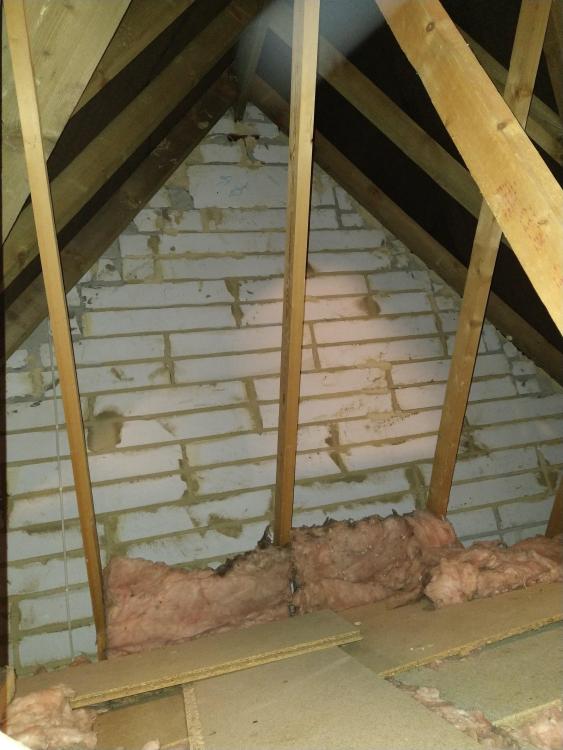
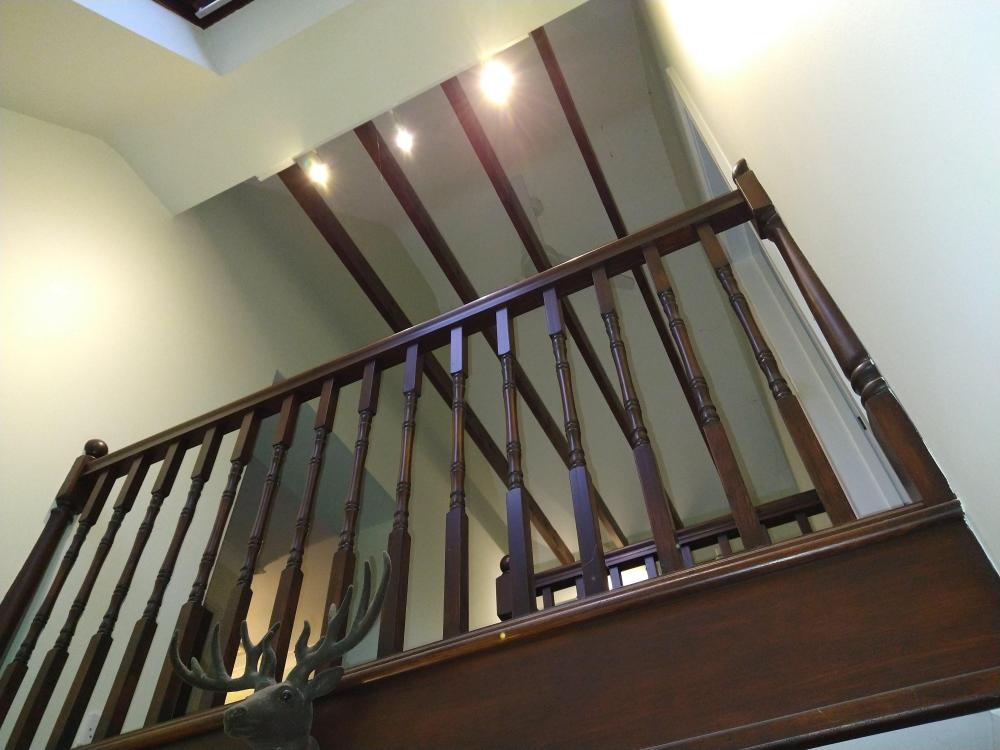
View of a bit of wall in our ventilated (cold) loft: View of inside hallway on the other side of that same blockwork: Been here over 20 years and not grokked that we have an uninsulated wall inside the house. Two actually because there's an identical setup on the other side. A separate loft space is to the right of this link bridge. In fact, that one's worse as it's just one width of dense concrete block whereas at least the main house to the left has lightweight blocks laid flat. No wonder the hallway gets cold in the winter!
-
Interesting website. Thanks for the link.
-
I made a wideband receiver using an old ferrite rod antenna and some cascaded transistor amplifier stages driving headphones to do the same thing. The harmonics from light dimmers gave the most detectable RF but the general mush from all the SMPS in the house also gave plenty to pick up. Of course this amplifier was not tuned and demodulation into audio was only by virtue of inherent non-linearities so I don't know how a fancy scanner might behave. Whatever, you could try scanning near a dimmer to identify the strongest harmonic then take that channel outside - starting at the incomer and see if, and how far from there, it persists.
-
RJ45 weak-current network: necessary?
Radian replied to Garald's topic in Networks, AV, Security & Automation
Leaky feeder -
Siemens HB676GBS6B/13 oven problems
Radian replied to Stones's topic in Kitchen & Household Appliances
What a neat hole! Never seen anything like that before. Presumably the PCB was vertical and the soot was rising with a flame? It's not for me to comment on that but how concerned are you about a repeat performance? -
...I meant to add that the tilt might tilt a bit further and lap over the edge slightly. Not sure how it would react to being wrangled into a circle though.
-
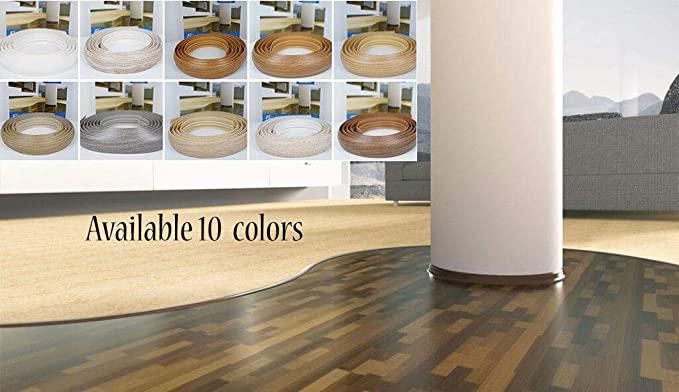
"Whiparound" is a good idea but they tend to use machines and would want the entire carpet to work on! How about Flexible Transition Threshold strip?
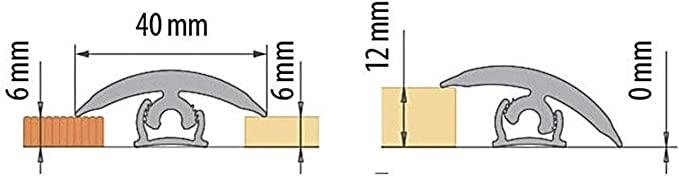
-
How is the inside of the aperture finished i.e. the vertical face?
-
Not necessarily. The less processing a product goes through the cheaper it is. Ring around some local stone quarries and get the price for "cropped walling stone" per ton delivered and tell them the dimensions of your wall. They guillotine off rocks to give you one dependable dimension. If you want to trade time for money, watch some youtubes on building stone walls. I'd definitely say it's much easier for a beginner to get a decent looking result than trying to lay bricks.
-
Siemens HB676GBS6B/13 oven problems
Radian replied to Stones's topic in Kitchen & Household Appliances
I can't help wondering at the ultimate cause of the failure. Mass produced items tend to fail at the same weak points, like the old ABB inverters that all end up showing EO31 when a dry joint on a relay finally gives. I couldn't see if there was a hole in the side of the relay or not. It might be worth patching up and keeping as a spare. If not, I'd at least strip it for spare relays if any can be salvaged. Electrolytic capacitors (if not surface mounted) might also be worth keeping as spares as it's really only these and electromechanical parts that ever really fail. -
Siemens HB676GBS6B/13 oven problems
Radian replied to Stones's topic in Kitchen & Household Appliances
I'm slightly confused. Did you replace the PCB but are now asking if the old one is worth repairing? The soot looks like the fibreglass PCB might have been burning, possibly by a dry solder joint on the relay pins. If the copper traces are badly affected it won't be easy to re-solder. If it were mine I'd de-solder the relay and check its operation (it might be OK) and then clean it all up and see if the high current path can be reinforced with some solid copper wire when reassembling the relay on the board. -
Only once used brick slips. Didn't find it very satisfying or easy. Built a few random stone walls using cropped stone and found it satisfyingly easy. Do you not have the space around this elevation for a real stone finish? Our walls are concrete blocks forming a standard cavity wall with a random stone 'cladding' tied to the inner blocks with SS mesh. Adds about 130mm to the wall thickness. Obvs. needs space on the foundation.
-
Sounds like a 'feature' wall. Are you cladding over concrete blocks as I saw in your porch topic?
-
Airtightness vs bugs
Radian replied to puntloos's topic in Energy Efficient & Sustainable Design Concepts
Have a search here and elsewhere for "cluster flies". They're looking for somewhere to over-winter and seem to understand that houses have warm spaces. Seriously. -
That's quite a premium over the price of genuine walling stone. Last time a built a wall using cropped sandstone (roughly 120mm deep by random width and heights) coverage was 4.5m2 per ton and each ton delivered was £150 so I'd expect your elevation to require £1.6K for the materials. You appear to be talking about £5 to £6.5K installation labour, and £7k for the slips!
-
This caught my eye. What controls your hot water temperature? Typical cylinders need a reasonable degree of headroom between the HW setpoint and boiler setpoint to transfer the heat from the boiler flow in the coil to the water. For example, if you set your cylinder stat to 55oC and your boiler flow to 55oC then the boiler would probably cycle on and off for the entire time HW was programmed to receive heat. If you set HW to 50oC it may still make the boiler cycle on and off for an excessive amount of time.
-
The batteries used with that inverter appear to have this spec: Specifications for HV2600 Battery module HV2600 Nominal capacity (kWh) 2.6 Maximum charge voltage (V) 58.4 Discharge cut voltage (V) 40 Max. charge/discharge current (A) 50A/50A Operating temperature (°C) -10 ~ 50 Storage temperature (°C) -20 ~50 Charge/Discharge efficiency (%) >98 Ingress protection IP21 Protective class I Cycle life >6000 @25°C @90% DOD Available SOC range 10%~100% Weight (kg) 29.7±1 kg Dimensions (L*W*H) (mm) 420*480*116 So similar to the Pylontech, although you should make sure of that.
-
Looking good! How do you rate the Dura-tec composite deck boards? They seem a fair bit cheaper than others I've looked at.
-
Forget using anything made from plastic. If it's in their way, they have all the time in the world to chew through it. And it doesn't take them all that long anyway.
-
What temperature should my hot water be set at?
Radian replied to Mike_scotland's topic in Boilers & Hot Water Tanks
I suspect it's why they put singe quote marks around 'flows' - after all water does actually flow through the radiator! Possibly it's the power dissipation resulting in a 20oC drop across the radiator that's the bit they instinctively know but fail to express succinctly. You're welcome to put it into better words 😃 I think the boiler might be doing this with it's modulation - the gas rate does drop as the return temperature increases - all the while the flow temperature remains close to set point. Only when the flow temperature exceeds the set point by a few degrees does it shut off completely for a bit. -
What temperature should my hot water be set at?
Radian replied to Mike_scotland's topic in Boilers & Hot Water Tanks
From The Heating Hub: How does a condensing boiler work? To understand how a condensing boiler works, and more importantly to explain why they are not as efficient as they should be in 99% of households, we first have to understand how a non-condensing boiler works. All central heating systems work by sending hot water out into the radiators in one direction (called the flow) and receiving back after it has travelled around the radiators (called the return). A non-condensing heating system is set up to deliver heat to the radiators at 80°C. As the water ‘flows’ through the radiators about 20°C of heat is given off to the room. Water ‘returns’ to the boiler at 60°C. Condensing boilers need to operate at lower temperatures to non-condensing boilers in order to recover the lost heat. The process is called condensing because the heat needs to turn back into water before it leaves the flue via the second heat exchanger. When the temperature of the water - as it returns to the boiler - is less than 54°C, the boiler will run in what is known as ‘condensing mode’. This is when the boiler starts to recovers its lost heat. Even this is a sliding scale however. At 54°C the boiler is 87% efficient (in perfect testing conditions). The boiler does not reach 90%+ efficiencies until the return temperatures are around 45°C. This means water must exit the boiler at a maximum of 65°C, impart 20°C of heat to the room via the radiators, and return at 45°C. This makes radiator balancing very important to ensure enough heat is given off to the room to lower the return temperature sufficiently. The problem is, most boilers are still set up to output at 80°C and return at 60°C. Some are reduced to 70°C because this is deemed efficient by many boiler manufacturers but as most systems are not balanced the return temperature can still be 60°C. The boiler still works but it does not condense and it certainly does not reach 90%+ efficiencies. ------- The above is very focussed on space heating rather than DHW but it makes it plain that operating a boiler in condensing mode isn't possible if heating DHW to 54 or above. I believe this limits their efficiency to 78% at a maximum (the maximum for a non-condensing boiler).
.jpg.21dd4887e25f210103c4225b8c6d2bfd.jpg)