
Radian
-
Posts
2586 -
Joined
-
Last visited
-
Days Won
15
Everything posted by Radian
-
I guess the reason it's called an 'air fryer' is to direct you away from composite food items like I've been asking about and towards anything that could be dropped into a fat fryer basket. Anything discreet like a chip or fish finger is perfect, as is a whole chicken. But anything that needs containment like lasagne isn't what it's meant for. Wrapping in foil might work for wrapped chicken breast and I've heard people using foil to prevent scorching of toppings so it might be a good work-around.
-

Drainage practical: down the trenches
Radian replied to saveasteading's topic in General Self Build & DIY Discussion
I thought everyone did this. Always smells funny though, especially 63mm downpipe. Probably toxic fumes so best to wear a face mask. -
Drainage practical: down the trenches
Radian replied to saveasteading's topic in General Self Build & DIY Discussion
I used a chop saw with a TCT blade. Nice clean, square cut. -
Daikin appear to have a 12 year warranty which is no doubt dependent on an approved installer performing regular maintenance - I haven't asked the installer about that yet as I was keen to get things moving before the colder weather sets in. Does anyone know what kind of surprises I might be in for?
-
Motion/PIR sensor with additional contacts?
Radian replied to Crowbar hero's topic in Networks, AV, Security & Automation
-
I was just wondering about what you do for things that are 'gloopy' like lasagne or even just hunters chicken where you slaver barbeque sauce over a ham wrapped chicken breast? In the conventional oven these would go in a Pyrex dish.
-
Yes I think that might be a significant factor in the planned system design. There's a long outside wall (thankfully a gated-off 12m dead end corridor behind of our garage) where the compressors will be but the indoor units will be well separated with one on the ground floor and the other at the far end of the upstairs room. This means two separate compressors can be located close to their respective indoor unit. Also, the upstairs is a room-in-roof office which gets very hot in the summer and shoulder months like now but the downstairs can be significantly cooler so I can envisage using a little bit of heating downstairs at the same time as cooling upstairs. Although the intention is to only use PV for cooling.
-
Got a couple of 3.5kW Daikin A2A air handlers being installed but the individual outdoor compressors are on a longish lead time. The installer recommended having a compressor for each unit rather than a single multisplit but I'm wondering what the issues are?
-
Motion/PIR sensor with additional contacts?
Radian replied to Crowbar hero's topic in Networks, AV, Security & Automation
I see you can pair those with lots of things but couldn't see a simple volt-free switch output for triggering an alarm. -
Motion/PIR sensor with additional contacts?
Radian replied to Crowbar hero's topic in Networks, AV, Security & Automation
Yes, an opto board like that would work instead of a relay and get around @joth's clicky noise problem, but it's all a bit exposed at the lethal end. With care though it could be a solution that might fit inside the PIR casing. -
Some day, some one will get a ruler out and measure the full height of the doors. If different, no amount of adjustment will make it all line up, so once again, I don't get it.
-
How's it ventilated at the eaves? Judging by the grime on the rockwool there is some airflow but without a proper risk analysis for condensation, the choice of insulation can't just be left to chance.
-
And if the gap was supposed to be hidden under the worktop then the top border should be 3mm thinner to keep the inset panel the same size. But you can see in the photo that the inset panels don't align either. I just don't get it.
-
Motion/PIR sensor with additional contacts?
Radian replied to Crowbar hero's topic in Networks, AV, Security & Automation
I suspect that you won't find one due to the required separation between 240VAC and the other volt-free contact. A different approach might be to find a 'smart' PIR that you could integrate with alarm and smart lights using IFTTT but I could only find indoor versions of that. From there it depends on how much tinkering you're prepared to do, as with all things electronic, you can do almost anything you can dream of with a little bit of know-how. Any SPST 240V outdoor PIR can power a relay with 240VAC coil to give you an additional volt-free contact. -
Took the plunge myself today, gone for a couple of Daikin Emura 3's. The UFH loop we put in to heat the ground floor room will just have to twiddle its thumbs for the time being. Maybe when the cost of air to water systems falls into line with A2A I might put yet another compressor unit on the back wall.
-
So the 'combination door' is 3mm shorter? Nobody seems to have asked about the bottom edges of the two doors? Is it that you 'get' there must be height difference (I don't) and just want some suggestions about hiding it?
-
No warning, I had already been hectoring the installation team about small things (like don't try filling the cavities that are already insulated!) so I did the "it's me again" intro and casually mentioned that the family had just vacated the house and he said it was quite normal for clouds of dust to appear - and apologised for not giving prior warning. I actually think they did a very tidy job though, the outside was left in good order. Just a great deal of hoovering and dusting to do indoors and lots of bedsheets to put though the wash. 😝
-
Well, the beads are in and I have now had a graphic demonstration of the amount of air leakage from the cavity into the interior of the house. We had to evacuate during the filling process as the high pressure air forced an extremely fine 'mist' of choking dust into all the rooms. There were no particular areas, just a general haze throughout every room. No doubt, the combined effects of air leaks though minute cracks around window frames, electrical outlets, skirtings etc. Of course this will be no surprise to anyone who's laboured over getting air-tightness into their new build but it's disappointing for me. I've spent most of this year draft proofing and going on search and destroy missions to fill gaps around pipework and junctions around the house. But the minute particle size as evidenced by the haze has taken me quite by surprise.
-
Founder chris cornelius says fracking won't work in the UK It's all government fluff like with hydrogen.
-
That 'grey' may well be steel. Ceramic (and some grout) is harder than steel so you're depositing a thin film of metal on the surface. It may well polish off with autosol or similar metal polish. I'd go at it again with a sharp blade like those used for scraping glass e.g https://www.screwfix.com/p/heavy-duty-scraper-4/16530 then see if you can polish it up.
-
The expansion coefficient for steel is around 9 x 10⁻⁶ per degree so 20 degree change in temperature for your 11m beam means it shrinks/grows by 2mm. I think you are getting stick/slip noise noise from it.
-
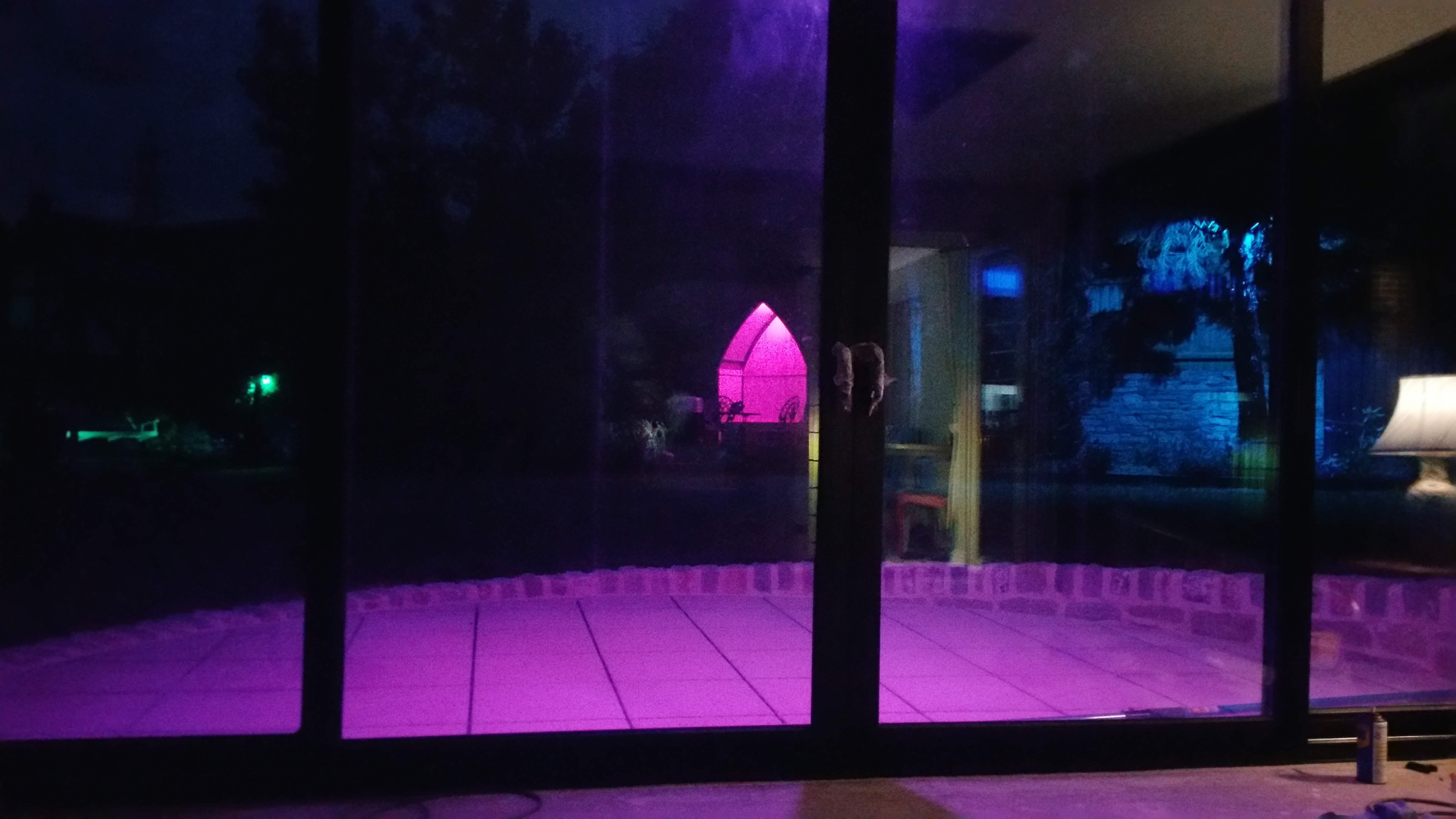
My kind of topic. 😍 The colour temperature of LED lamps is the most important parameter to me. The vast majority use blue or UV LED's to excite a phosphor to emit wideband light and are still very peaky at the blue end of the spectrum. They're fine for occasional task lighting, and I never use any that are over 3000K but I prefer using RGBW bulbs that are programmed to fade down to yellowish amber or deeper reds for the evening. This is the time of year people have lights on but curtains open at dusk and it amazes me how many people look like they're arc welding in their living rooms and bedrooms. Speaking of which, I literally get arc-eye in some illuminated spaces like supermarkets and public buildings. I do like pops of colour for contrast though. Especially outdoors, but then I've got pretty much unlimited numbers of prototype outdoor LEDs to call on. Couldn't agree more about illuminating what's outside the windows as it's pitch black around here otherwise.
-
You can get loud noises from materials having different thermal expansion coefficients when they're joined together and cooed or heated. An example of this we suffer from is a steel portal frame supporting the timber joists of a flat roof coupled with coach bolts. The kind of noise this makes is a single sudden bang. I wouldn't describe it as a crack, as it's much deeper in tone, but it is very brief. The mechanics involved is when friction is overcome and the energy stored in stretch or compression is suddenly released.
-
That's a bit unexpected, I wouldn't want to be sprayed all over with cheapo foam but you've saying at least I could still breathe? 😝
-
How was the insulation on the inside done?