
Radian
-
Posts
2586 -
Joined
-
Last visited
-
Days Won
15
Everything posted by Radian
-
 Unfortunately that would cause a different problem in our loft. Cluster flies crawl in between the tiles and find their way in between the overlapping sheets of felt to over-winter in our loft. The last thing I would want to do is make life easier form them!
 -
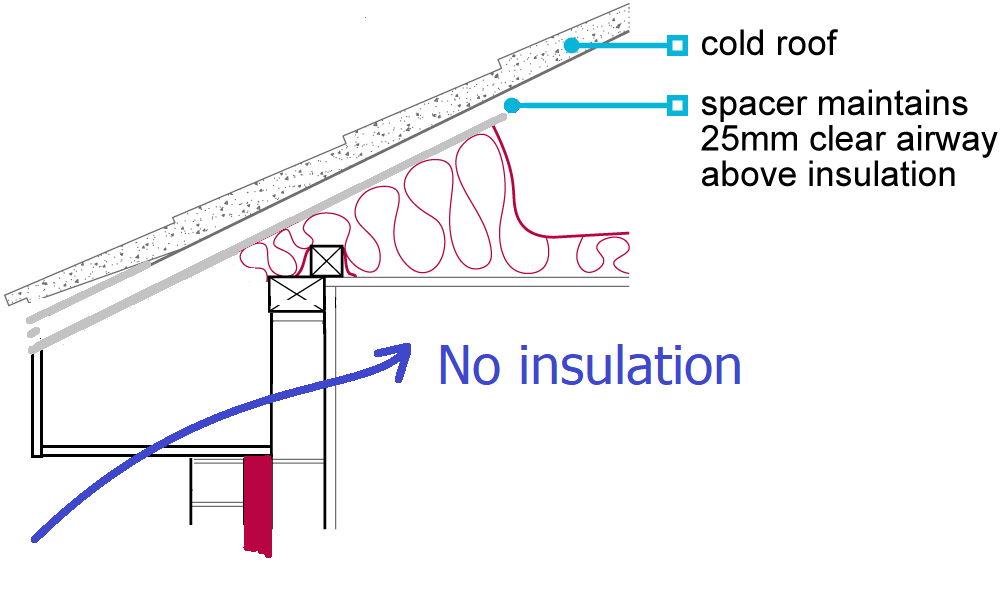
You've hit the nail on the head. It's unusually cold and calm. Normally the through draught would be carrying away the vapour but not lately. And the exceptionally cold roof is just the perfect thing to condense the vapour back into water. I think it's OK for this to happen occasionally (it's inevitable) and is inconsequential in the long run. It will cycle a few times (condensing, evaporating, condensing... ) but the weather will change and the next windy day will restore the former equilibrium. But be very careful when you're thinking about using rigid insulation. Unlike glass wool insulation, it isn't vapour permeable so it has to be guaranteed that moisture laden air from the house below can't accumulate anywhere that's not fully thermally insulated. Whatever you do here will lock-in the consequences and then, in the long run, may cause permanent damage. I recently realised that the eaves in my loft are poorly detailed for insulation. The inner leaf that carries the wall plate and trusses is around 300mm higher than the outer leaf (which supports the soffit board) and the loft roll stops at the wall plate. Here it meets the plastic eaves protector sheets that also form the eaves ventilation. Everything looks good from in the loft until you pull back the roll and realise there's a void forming the soffit:
-
Industrial use refers to the very high temperatures it will withstand. You might be paying a premium for something unnecessary I imagine. Have you looked at aerogel insulating plaster This would appear to have a thermal conductivity of 0.03W/(mK) so a 20mm thickness would have a U-value of around 1.5 W/(m²K) I still don't understand your wall makeup. The aerial photo looks like bricks but the plan makes it seem about 500mm deep. Is it two full bricks deep?
-
The protective layer could be as thin as you like though - 4mm plywood perhaps? And they come in small pieces that you tile to fit the space. Just a thought. When you said about using a small electric heater I would remind you that a purely resistive heater is very inefficient if that's all it's doing. As a bit of lateral thinking, is there anything you can put under the stairs that draws electrical power and does useful work for you at the same time? A fridge or freezer would be one example or the dehumidifier I suggested previously. All electrical power ends up as heat. You could even put a bunch of graphics cards to work mining cryptocurrencies and make some money from it.
-
Or you tile it with Vacupor® NT-B2-S https://www.morganthermalceramics.com/media/4113/vacupor-nt-b2-s-data-sheet-english-v2.pdf
-
It could of course be that they're still frozen solid. What's the opening at the top of your photo? The wet patches seem to be only in this area. Just wondering if it's potentially colder or warmer here. I'm sorry if replies sound a bit too matter-of-fact, I think there's a lot of sympathy here and it's not even certain that you do have a problem yet.
-
Aren't architects supposed to work this out for you?
-
How long is it since he moved here from the tropics?
-
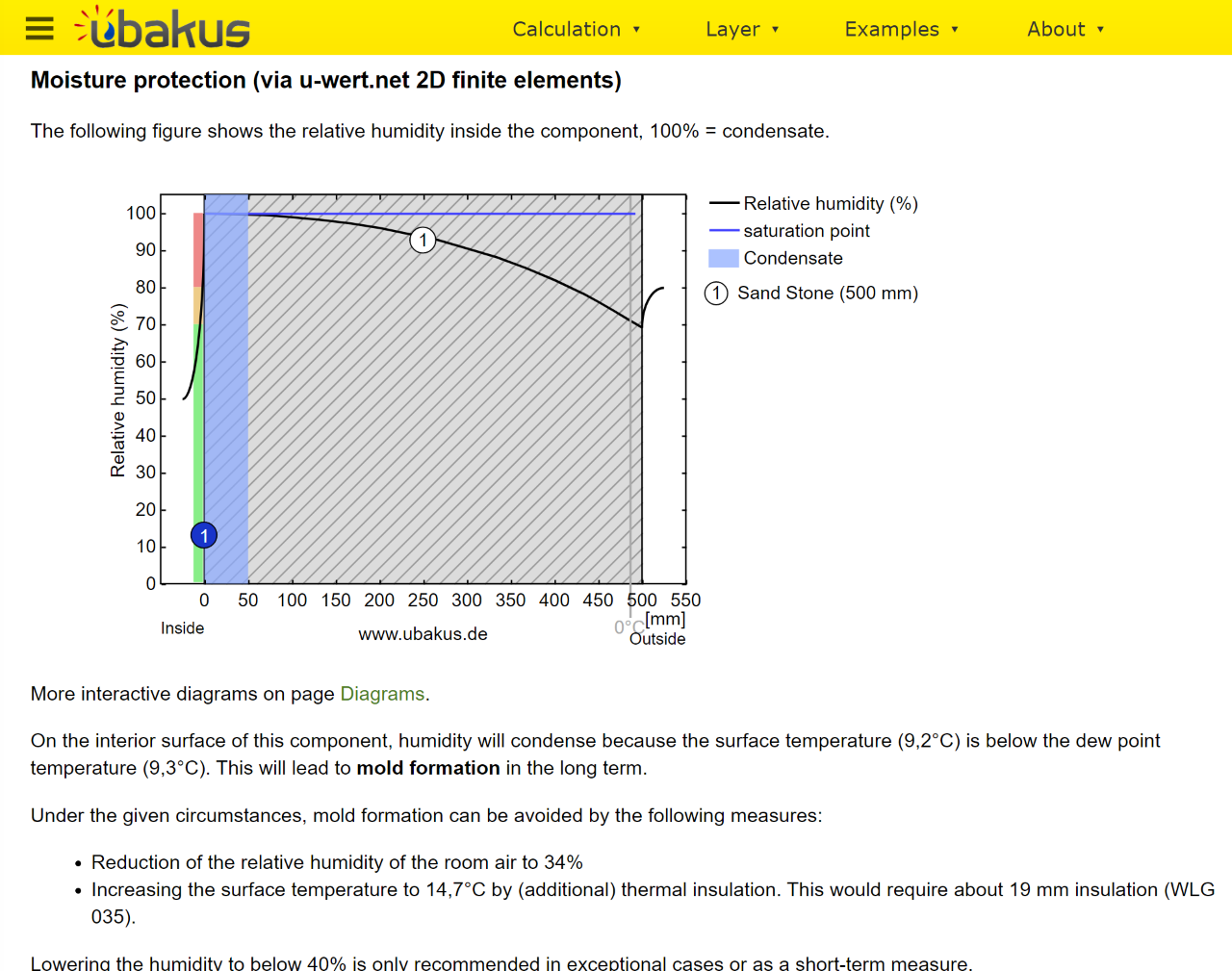
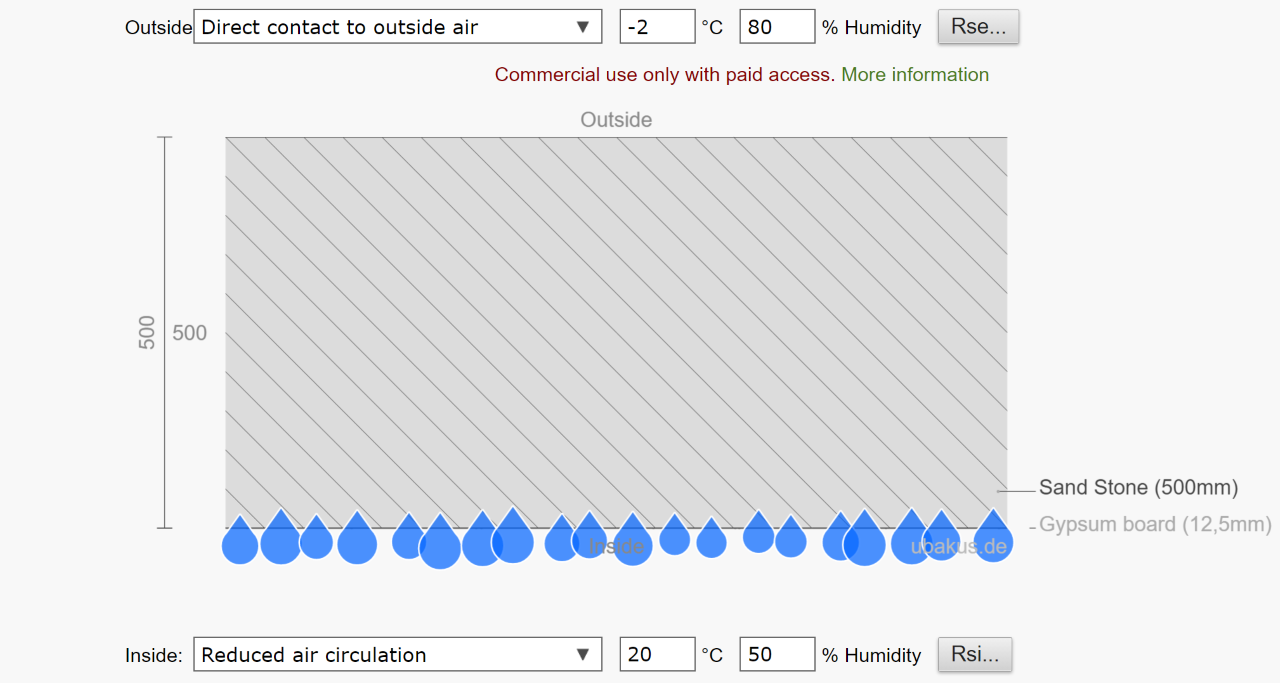
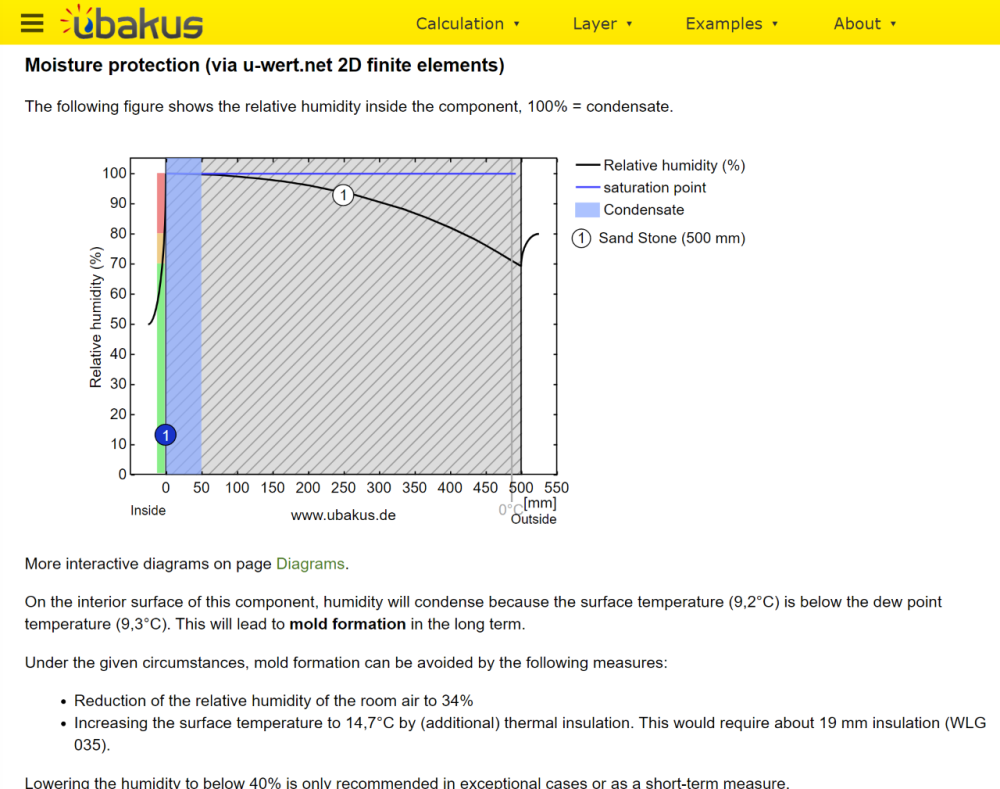
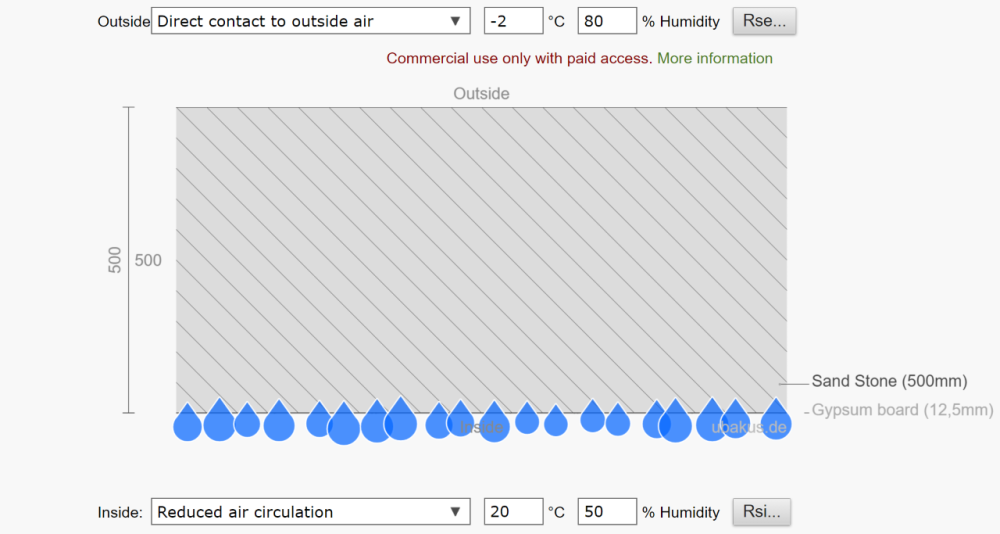
I didn't read anywhere what your wall makeup was. It looks like around 0.5m solid masonry, but what's on the other side? Fresh air or another building? If you can identify these parameters then you can use a simple online calculator like this one to get an idea of condensation risk e.g.
-
At least you know where to dig 😧
-
Good thinking to mark out the outline of the corpse wet patch on the floor. Are the drain valves still open?
-
Blow some heat on it to dry it out - then wait and see.
-
The air in the chimney void will probably be at outside temperature. Given the modest volume of the opening I would be looking to fill it with insulating material. Hence loose vermiculite poured in from a gap at the top of whatever panel you close the opening with.
-
You need to perform a condensation risk on that wall. As a poorly insulated surface amongst better insulated surfaces and other warmed spaces, it will be a surface that acts like an unintentional dehumidifier in you home.
-
ASHP / Underfloor heating issue
Radian replied to Benpointer's topic in Air Source Heat Pumps (ASHP)
Is it able to breathe properly? Evaporator coils full of ice? -
Do you mean 'is this a bad thing?' In this cold weather it would not be surprising if it took 6 hours to reach setpoint. What your boiler is actually doing during this time might be an issue though. If this is the only heating to come on overnight the boiler might short-cycle too much if it can't modulate down low enough to keep the return temperature rising too far. You need numbers for all the parameters involved: temperature either side of mixer, boiler flow and return. for the required flow rate divide the total loop length by 40 to get litres per minute.
-
The problem having one space colder than the rest of the house is that it will attract condensation as the air in the warmer spaces will host a greater amount of water vapour. This will degrade the fabric and anything you store in the space, therefore I would ensure that there was a mains outlet under the stairs and invest in a desiccant style de-humidifier with a drain hose for unattended operation (with a drain exit from the space). Desiccant because they are effective in unheated spaces (unlike refrigerated types of dehumidifier) and the small amount of electrical power used to recharge the desiccant provides a tiny bit of warmth.
-
May have bee a grass - or a chance drive-by. Interesting encounter all the same.
-
There's a spreadsheet that keeps popping up on the forums but I can never find it, correction: However it's really quite easy to do from scratch as I posted here: I tend to like doing these things from scratch anyway as I like to understand every step and get to customise the results in whatever way suits me.
-
Oh how I wish I could wind back the clock and do this on our garage roof conversion. Ruled it out at the time due to the increase of ridge height it would entail. But the reality of having to fit PIR between rafters and get a tight fit turned out to be near impossible. Compriband is crazy expensive so didn't use it. I also worry that the overall 50m PIR beneath the rafters brings the dew-point too close for comfort on their underside. How much simpler to deck over and lay a continuous PIR raft on top. Dammit.
-
Tell 'em to sling their hook: https://www.hse.gov.uk/construction/cdm/2015/summary.htm Summary of duties under Construction (Design and Management) Regulations 2015 (CDM 2015) ** CDM 2015 applies if the work is carried out by someone else on the domestic client's behalf. If the householder carries out the work themselves, it is classed as DIY and CDM 2015 does not apply.
-
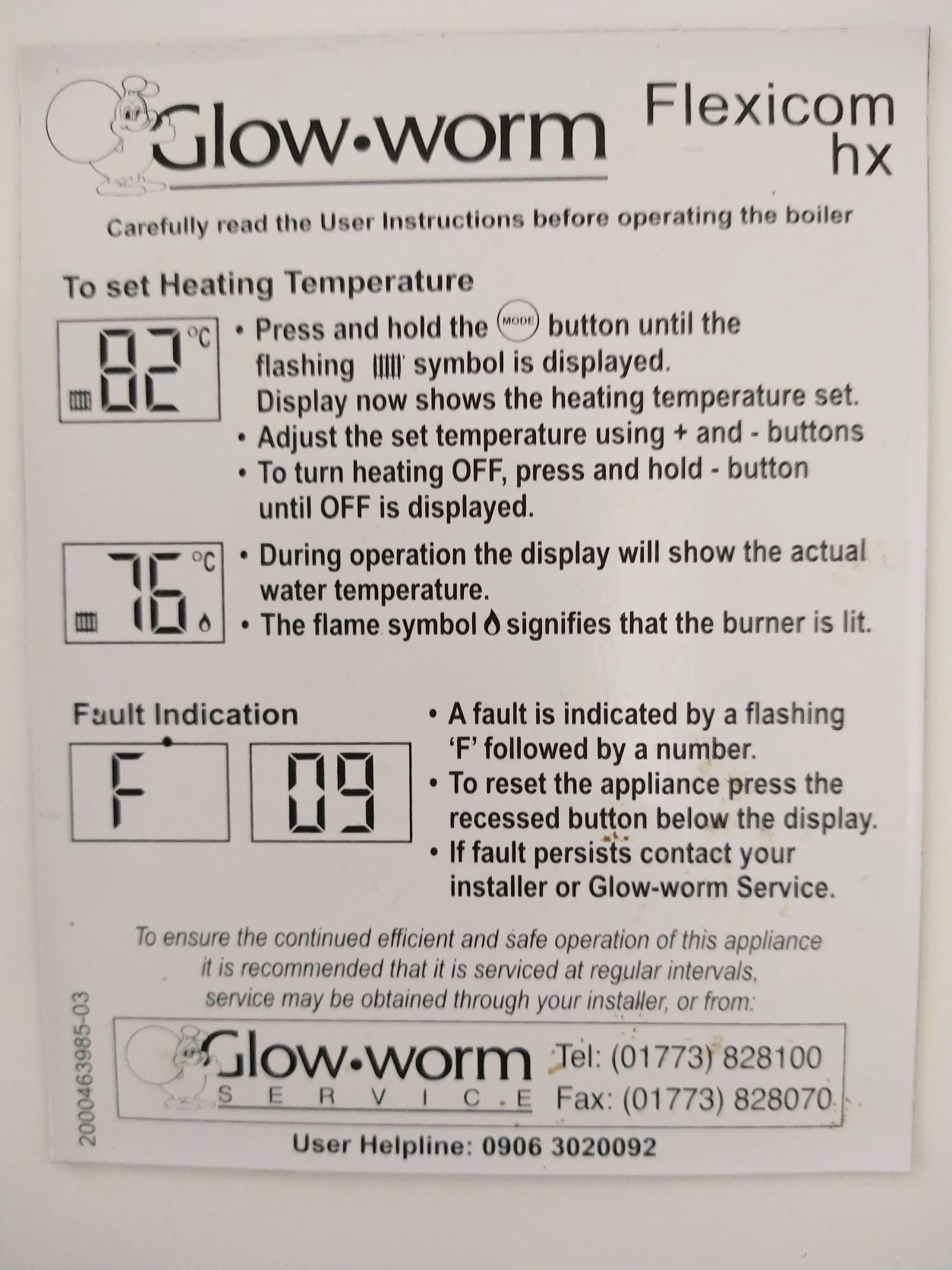
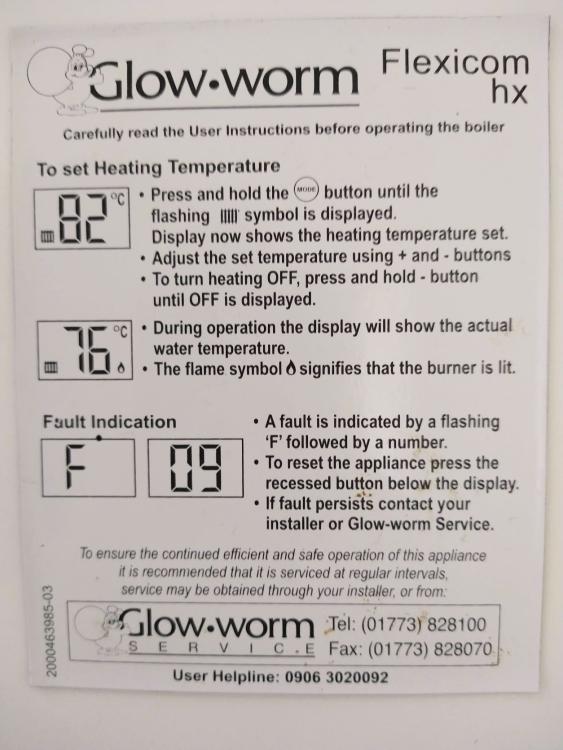
"Unfortunately we’re unable to suggest that you reduce your boiler flow temperature if you have a water tank. Our guidance doesn’t currently cover central heating systems that have a hot water tank. " Shame to put people off unnecessarily, many condensing heat-only boilers (if not most judging from my experience with a few different ones I've checked recently) are set to around 80oC The label on my own glow worm installed in 2008 perpetuates the old pre-condensing regime... ...by showing an example flow setting of 82oC. I'm pretty sure plenty of people would take this as advice when contemplating what the setting should be. Yet without any additional instruction, people with HW cylinders could be told to set the cylinder stat to 60oC and the boiler to 70oC and gain a bit of extra efficiency. The additional instruction would be that if they have a control system that provides independent HW and CH flow temperatures then take the extra step of reducing the CH in steps of 5oC until the system seems to take too long to heat the house. It does seem that they're trying to keep it dumbed down a bit too much to me. I mean, things are pretty serious at the moment. People need to apply themselves.
-
Can you tell me a bit more about this energy meter? I could do with something like that.
-
Start at the bottom and work up 🙃 Depends on whether we're looking at a cold roof or warm roof, vaulted ceilings can also be difficult to get right from the POV of insulation especially if there's a big steel ridge beam. We've seen this a few times here. Whatever work-around is found to remove the cold bridge could include ducting/vents.
-
I can't see a system that would hand an advantage to those who don't have a smart meter. Quite the opposite. Effectively raising all tariffs across the board then giving smart meters the advantage of automatic off-peak reductions would seem more logical - especially as the goal is more likely to get every home equipped with a smart meter that can be remotely managed for billing and disconnection.