
Radian
-
Posts
2586 -
Joined
-
Last visited
-
Days Won
15
Everything posted by Radian
-
 Thanks. But three occupants here as well. All with rather long hair 😎
 -
Good, that chimes with my instincts. Everyone goes on about how this same mechanism has been in Chamberlain Liftmasters since 1985, yet the double sprocket obviously hasn't been and at some point after the late 90's it was changed to the 'faster' single sprocket. Probably to keep up with the speed of competing brands (and with the bonus side effect of making the product fail sooner after warranty). I'm glad I've still got the option. In fact I didn't need to buy the whole assembly as the plastic cog can be bought on its own. I'll be getting one of those for the other door. At least the door we use most is working again now. Only in the extremely unlikely event that I live for as long as my Mother has (so far).
-
For balance, consider my marginally insulated, air-leaks-like-a-sieve 90's monstrosity = 70kWh/m2 pa. for space heating and 30kWh/m2 pa. DHW 🤦♂️
-
https://insulationgo.co.uk/53mm-british-gypsum-thermaline-pir-mr-insulated-plasterboard/ PUR backed gypsum composite?
-
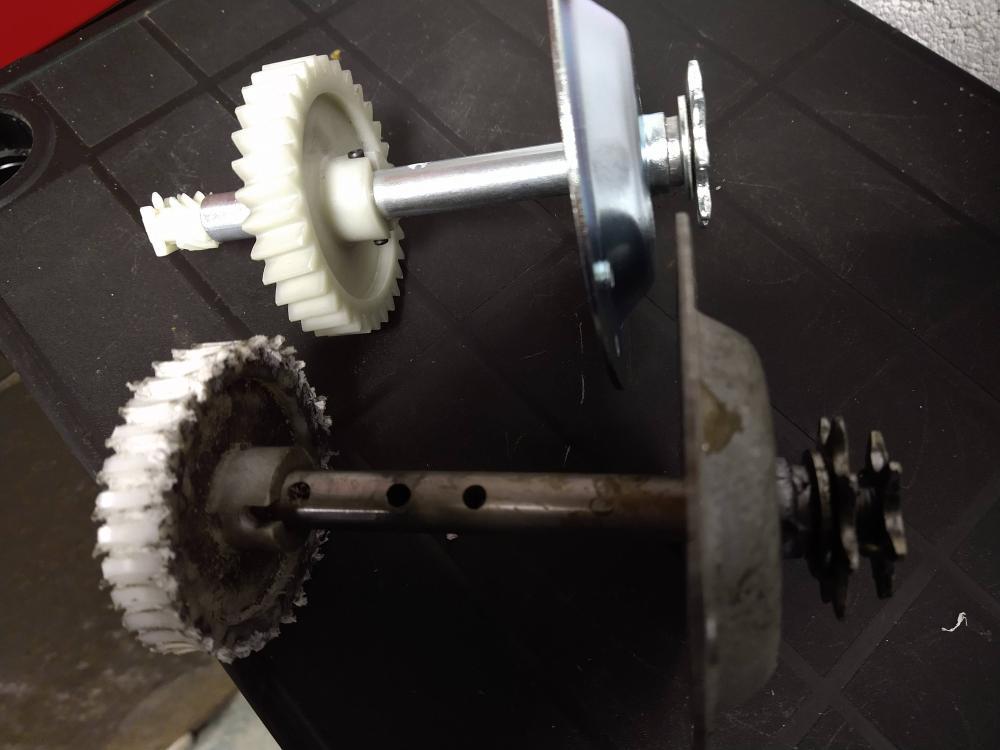
Both our automatic garage door openers recently packed up within a month of each other. Pretty remarkable seeing as how I installed them when we built the house 25 years ago! First the good news: just one plastic cog on the chain drive shaft was stripped and repair packs including a whole new shaft are available. Now the bad news: Amazon reviews are largely negative about the replacement plastic cogs saying they don't last very long. Regardless I bought one to try and the first thing I noticed was that my old drive shaft had two chain drive sprockets a the top, one big and one small, whereas the replacement kit has just the big one. I have been using the smaller chain drive sprocket all along so I started thinking about the difference between them. It's rather obvious that the larger sprocket will make the door move faster as one rev will pull round more chain than one rev of the smaller one. But what about the load on the plastic cogs? I can't recall any mechanical education I've ever had that covers this but it seems to me that a fixed amount of power must be transferred to lift the door for a complete cycle. The variable being how long it takes. So if it takes longer to transfer the power from the motor, the stress on the drivetrain at any instant would be lower. Is that right? If it is right then the reason these replacement cogs wear out so fast might be down to the missing small sprocket. For now, I've just removed the pins holding the cog and transferred it onto the original drive shaft so I can refit the chain on the smaller of the two sprockets just like it has been for the last 25 years.
-
If I said VHC only you would have understood (I'm being tongue in cheek) I'll give it a go from now on.
-
That's true to a certain extent and it may be more significant in a TF house but in a masonry building the more massive elements are what freewheel the heat. Air has a very low SHC so is easy to heat and quick to cool down. Keep it hot and blowing around for long enough and the heat in the air will transfer to the materials with a higher SHC. Infrequent use of A2A is not going to do that. It's why I spoke of there being a different feel to a room with A2A. The room may feel warm as you walk around but when you sit down on a chair or pick something up from a desk it feels a little cooler than you might expect. I've only been studying these effects since the beginning of December when the weather turned colder as my A2A units were only installed in November and I'm still learning about it.
-
Manufacturers Instructions I expect. Does the inverter say if it's transformerless?
-
I'm reluctant to leave things to cool too much as a room feels different if it's left to cold soak as you put it. Maybe I'll experiment by dropping the set back by a degree a week and monitor the power. Difficult doing long-term tests when the weather is as mental as it has been recently.
-
I see you're using Tasmota to monitor the power draw using MQTT I imagine. I have yet to insert some smart sockets to measure my A/C units. I bought a pack for this purpose but they've all been nabbed for the x-mass deccies. 🙄 But I think I might have made a mistake by scheduling the heating to be running all night set back to 16oC - I only have the crude energy report in the Daikin App to go on but it shows an average of 12kWh per day to maintain 16oC/20oC inside for two 3.5kW units heating 60m2 throughout last week when it barely got above freezing all day. On the other hand, by comparison, that's pretty good compared to the 160kWh/day average for my gas CH serving 190m2 😧
-
The beamforming antennas are part of radar in general but while Walabot is ultrawideband, operating from 3gHz to 10gHz, the Terahertz frequency range is generally considered to start at 0.3 THz which is 300gHz and up. We're not quite there yet with something handheld but it's no doubt coming.
-
RF moisture meters utilise the relatively high dielectric of water to most building materials. This results in radio signals being absorbed differentially so measuring the power loss gives an indication of moisture content. It won't be sufficiently sensitive to distinguish between different materials unless one has a higher moisture content than the other. Terrahertz waves, on the other hand, are beginning to be used for portable radar imaging. Give it a few years and they'll probably start appearing on the domestic market.
-
My architect suggest this for a family home, thought
Radian replied to Tennentslager's topic in New House & Self Build Design
I'll swear I once saw Poirot visiting a place like that. -
Insulating under block and beam floor with perlite
Radian replied to Patrick's topic in Heat Insulation
So here's where I come unstuck. The Kepler conjecture states that the maximum volume occupied by identical spherical units is 74% of the containing volume. This is an optimised arrangement of spheres while a random arrangement results in a typical packing density of 65%. Non-identical sized spheres would tend to increase this percentage but I instinctively feel 75% could be the limit. But in any mass flow situation, the pressure increases when the flow is restricted tending towards conservation of volumetric flow. This is why achieving airtightness is so damn difficult - as holes are plugged, a bigger draught comes through the ones you've missed. So does this mean that a space filled with beads would actually be safer than a totally empty void? The volume of potentially harmful gasses might be reduced by 65% to 75% while the airflow purging them would remain largely the same? Seems too good to be true. -
Insulating under block and beam floor with perlite
Radian replied to Patrick's topic in Heat Insulation
Is it though? Progressive Foam don't seem to agree: What is EPS? Expanded Polystyrene Insulation, more commonly referred to as EPS, is a closed cell insulation that has been around since the 1950’s. EPS is made of 98% trapped air and only 2% plastic, making it an efficient insulator with a small amount of raw material. -
That could work - but wall and batten would probably be in thermal equilibrium when you first approach it. The trick might be to put a fan heater blowing on the surface for a while, then look at the IR as it cools back down to the original temperature. The area with the battens would tend to remain a little warmer for a while longer. Any rapid change in temperature in either direction should work - it's the difference in rate of change that's most likely to show. This is sometimes useful when looking for air leaks/thermal bridges because of the tendency of materials to reach equilibrium.
-
Good observation. I will do absolutely everything in my power to avoid being taken for a mug like that.
-
That's interesting, I know the water from condensation is good for cleaning windows but not heard about watering plants. I suppose plants have been getting along fine for the last 500 million years without us feeding them chlorinated water so makes perfect sense!
-
Insulating under block and beam floor with perlite
Radian replied to Patrick's topic in Heat Insulation
So yes, gas build-up. And it's not just radon that's a concern! Part of the requirement for voids to be ventilated is to prevent lethal explosions from gas leaks coming from defective pipework and harder to spot sources of methane coming from rotting material in the ground. But to what extent would loose EPS granules restrict the airflow and how would their presence affect the explosive potential of the gas air mix? These are questions for which I've seen no research. My instincts tell me the volume of potential explosive gasses would be reduced in proportion to the reduction in ventilation making the effect of loose fill neutral in this regard. But I have no feel for what EPS does for airflow. It's a windy day - I could go up in the loft and find out. -
Blimey - an umlaut and all! Is toolden' pack of 12 for £119.99 the best price for these?
-
Insulating under block and beam floor with perlite
Radian replied to Patrick's topic in Heat Insulation
The obvious answer of lifting all the carpets, pulling up the chipboard and replacing the EPS with 50mm PUR brings us down to 0.372 W/(m²K) Simply not worth the trouble and the 0.144 W/(m²K) saving will never, ever, cover the cost of the materials let alone the whole job. There's also no prospect of raising the floor level at all. Now, pumping in 300mm of EPS beads (the average depth of the void below floors here) would achieve something like 0.09 W/(m²K) which is well into passive house territory. Apart from the addition of virtually unlimited amounts of insulation in the loft, there's no other single improvement that I can think of that would make such a big difference. I also suspect that there is no XPS in the floor makeup for the kitchen/utility rooms as these were screeded for tiling, and there's not enough depth - maybe 25mm XPS and 43mm screed but I very much doubt it. Insulating under these rooms alone could make a huge difference (the kitchen and utility room have always baffled me as to why they're so cold). -
Insulating under block and beam floor with perlite
Radian replied to Patrick's topic in Heat Insulation
This thread went quiet a long time ago but the issue has cropped up again recently. There must be an awful lot of houses with suspended concrete B & B floors that have just experienced -10oC rushing around beneath. To meet building regs in the late 90's our house had just 50mm of XPS sheet topped with chipboard flooring: A U-value of 0.5W/(m²K) (0.6 without the carpet 🙄) is not very clever at all. But it exceeded the minimum requirement of 1.2 at the time: Those numbers look criminal now. So what to do?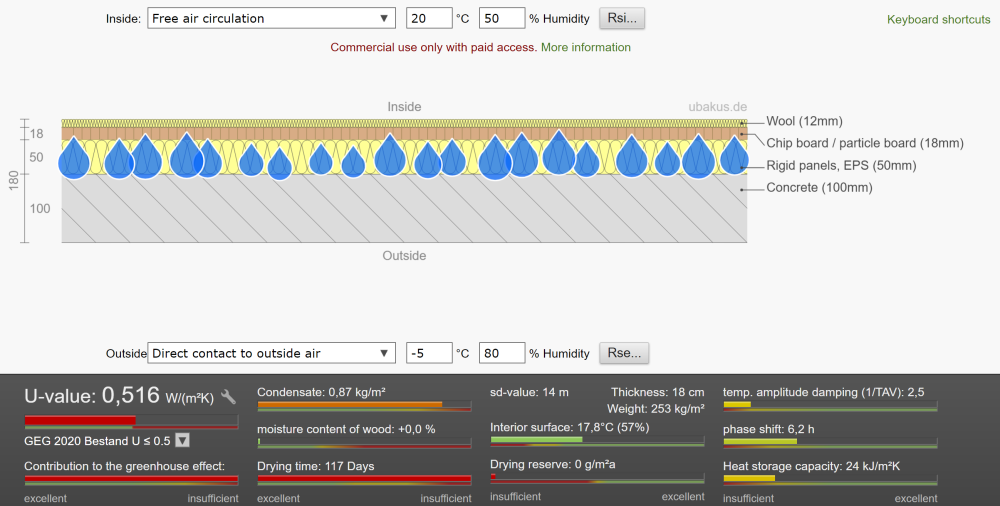

-
So has been sort or discussed before. Going to resurrect that thread.
-
What about under concrete block & beam? That could be a game changer for me.
-
That's probably what I'd go for If it wasn't something I have to choose for someone else to buy me - on a budget.