


Mr Punter
-
Posts
8582 -
Joined
-
Last visited
-
Days Won
27
Everything posted by Mr Punter
-
Large screw type piled decking foundations
Mr Punter replied to Post and beam's topic in Landscaping, Decking & Patios
OK he did say But I think you are right. -
Sounds like your warranty company are being dickheads. Is this Protek?
-
Large screw type piled decking foundations
Mr Punter replied to Post and beam's topic in Landscaping, Decking & Patios
Yes the sun and wind will dry it and that will prolong the life considerably. The concrete pillars will help a lot too. 20 years is very good. -
Large screw type piled decking foundations
Mr Punter replied to Post and beam's topic in Landscaping, Decking & Patios
Decking looks OK when it is first installed but with softwood it does not last long. I doubt the timber screw piles will be very durable. -
Have you used washing up liquid? Maybe the air treatment has made it bubble up.
-
The US and Canada like imperial. Timber frame with studs at 2 ft centres, timber sheet material being 8' x 4'. It can make it easy to set out. I doubt many use imperial weights, other than for people eg 5 foot 8 and 18 stone = fat bastard etc.
-
+1 Mot, crushed concrete, terram. Dig out the topsoil over footprint +2m and get rid. Make a nice clean road in.
-
My understanding of the Compriband system is that you have a vapour impermeable membrane - such as adhesive tape /EPDM - stuck between the frame and the structure before the plasterboard, insulation in the gap - like closed cell expanding foam, them Compriband on the outside. This means no internal vapour should get between frame and structure, frame is not a cold bridge, window is sealed from outside weather and any moisture the gets in can escape externally.
-
You can tell by giving it a prod with your finger. If it is fairly stiff it is compressed. Soft and squishy and they should have used a wider one. Also, make sure it is proper Compriband, not a cheaper lookalike.
-
Air monitoring thingamajig
Mr Punter replied to Russell griffiths's topic in General Self Build & DIY Discussion
I have got stuff from AliExpress and it has been crap. Not working, doesn't connect, chews through batteries. Cheap shit from China. -
Insulating 45 degree internal ceiling returns in loft space
Mr Punter replied to jc212's topic in Heat Insulation
To do this properly, strip the plasterboard, insulation between the rafters to leave a 50mm gap beneath the felt, 75mm insulation under the rafters, plasterboard. A bit of a pain but it means you maintain good loft ventilation and prevent associated mould / damp risk. -
There is a good reason that stair nosings are rounded. Those look lethal.
-
Protek and Mechanical Ventilation certificate
Mr Punter replied to SarahG's topic in New House & Structural Warranties
As long as the fans have been installed correctly, without excessive ducting, you will be fine. It takes less than a minute per extract. I suspect the cooker hood rates are made up. -
Soil stack to male stub - double femal connector OK?
Mr Punter replied to Dunc's topic in Waste & Sewerage
I guess you could use solvent weld for the first fitting? https://www.screwfix.com/p/floplast-push-fit-solvent-weld-single-socket-pipe-coupler-grey-110mm/13738 -
Protek and Mechanical Ventilation certificate
Mr Punter replied to SarahG's topic in New House & Structural Warranties
I have had this done in the past and had it done in conjunction with airtightness tests. The tester did not spend long on this. Here is an example: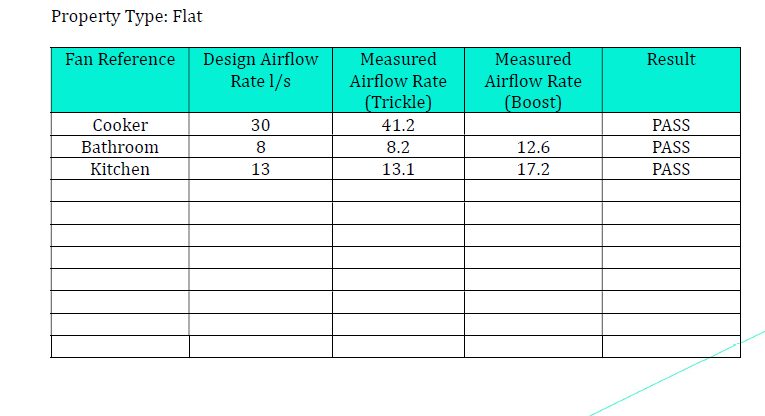
-
Yes, the intersection is the most likely place. Can you get any drawings from the Building Regs submission? These may give you a clue where things have been left and just boarded over. There is often no proper spec on the drawings for how these things should be detailed so they can often end up causing issues.
-
Very often they will not cover the cost of remedying any defects. These policies tend to cover legal costs against PI cover or to defend against the LA or others taking legal action. They would have so many exclusions and such a high excess they are not much use.
-
Bear in mind that in another 7 years the warranty will be moot.
-
Well that will save you having to measure! It is now a case of identifying where it it leaking and I can see you are doing some decent investigation. If you can Identify and seal the leaks with, say mineral wool, you will not need to add more insulated plasterboard. Maybe a 100mm hole saw to remove some plasterboard around the perimeter will give you some clues.
-
Get in touch with the managing agent and kick up a fuss. Get chatgpt to come up with some wording and a plan.
-
Looks like the party is over....
Mr Punter replied to Beelbeebub's topic in Air Source Heat Pumps (ASHP)
Are you using a heat pump? -
I don't think this is down to the door installer. Perhaps look at removing the top course of bricks and replacing with high compressive strength EPS. What is the floor finish?
-
If I were you I would get a tape measure and some paper and measure in the downlight hole from the OSB to the bottom of the plasterboard. Then measure from the plasterboard to your finished floor and add the measurements. Then go outside and measure from the top of the flat roof to the internal finished floor. If you subtract the external measurement from the internal measurement you should have a rough measurement of the insulation thickness. This will probably be between 100mm and 200mm. If it is less than this the roof may not have been insulated correctly. If there is a parapet around the roof you will need to take account for this in your measurements.
-
With the polystyrene beads they get mixed with a small amount of adhesive as they are installed, so if you later make a hole in the wall they don't just continue to escape. You would not be able to do this easily.
-
What did your build cost come out at 2024/25!
Mr Punter replied to PSC88's topic in Costing & Estimating
I think you should shop around for more quotes or just sell the land on. Surely you can buy a top end finished project for less than this?


