

.jpg.c21f3ac78c9b7efd90cbdcb312744dc5.jpg)
jack
-
Posts
7460 -
Joined
-
Last visited
-
Days Won
41
Everything posted by jack
-
.jpg.c21f3ac78c9b7efd90cbdcb312744dc5.thumb.jpg.7adcad4c0e384f5ecd7d56b0618df6e5.jpg)
What's the case for not getting an ASHP?
jack replied to kentar's topic in Air Source Heat Pumps (ASHP)
If I get a few mins later, I might try to split out all the later content into a new thread. -
Sorting out expansion vessel and overtemperature valve
jack replied to jack's topic in Boilers & Hot Water Tanks
Thanks Nick. I was talking about using an accumulator (i.e, a vessel sold as an accumulator) as an additional expansion vessel rather than as an accumulator per se. Neither here nor there now, as I'm going to go for an actual expansion vessel. Does the best location change if we're talking about an expansion vessel? I figured it should be connected on the DHW tank side, without any other components (e.g., water softener, second PRV) between it and the DHW tank. As for the location of the 22 L tank, that's where it's currently installed. I figured the simplest thing would be to add more capacity on the cold side, as you suggest. I suppose there's nothing stopping me moving the 22 L tank to the cold side as well. Thanks John. I modified your spreadsheet the other day to get the numbers I referred to above. My version lets you put in start and end temps (updated 29 Aug to include graph and comparison table): System pressure calculator - updated for BH.xlsx -
Sorting out expansion vessel and overtemperature valve
jack replied to jack's topic in Boilers & Hot Water Tanks
Thanks John. I think the numbers for using an accumulator as an accumulator (rather than as a glorified expansion vessel) don't work that well in my case. Our mains is only about 3.4 bar, so realistically we'd need to consider a pumped system to get useable volume out of it. A 200 L accumulator + pump + additional pipework/valves would add a lot of cost and complexity, plus we don't really have space for a 200 L accumulator. Having done a bit of research, I don't think there's any benefit in using an accumulator instead of an expansion vessel in this application. They don't seem to be much cheaper. -
Sorting out expansion vessel and overtemperature valve
jack replied to jack's topic in Boilers & Hot Water Tanks
Just coming back to this after spending some time reading and thinking over the weekend. First, I've installed the new 3.5 bar pressure relief valve, turned off the immersion diverter, and reduced the inlet PRV pressure to 2.2 bar while I sort all of this out. Second, @John Carroll, your spreadsheet was hugely helpful, so thanks again for sharing it. While I understood the general principle behind expansion vessels, seeing the actual numbers was eye-opening to say the least. A few percent expansion doesn't sound like a lot, but when you combine it with a limited maximum DHW tank pressure and an immersion diverter, the peak operating pressure very quickly gets problematic. As an example, with a starting temp of 10 °C and a finishing temp of 70 °C (not crazy numbers with the immersion diverter working on a sunny day with colder mains in the autumn), the inlet PRV set at 2.5 bar, and my current 22 L expansion vessel, the final guage pressure of the system would exceed 3.5 bar. Adding a 50 L expansion vessel would drop the final pressure to 2.8 bar. 2.2 bar is proving to be unpleasantly low in practice, so I really want to bump that number up with a larger expansion vessel or accumulator. Using the nominal operating parameters in the cylinder manual (2.1 bar inlet PRV, operating temp 65 °C), and assuming an inlet temp of 7 °C (doubt it ever gets much lower in my circumstances), gives a peak pressure of about 3.1 bar. This should be a reasonable guide to a maximum operating pressure. By fitting an additional 80 L expansion vessel, I can run at close to 3 bar on the inlet PRV while keeping a similar peak pressure. Even allowing for a final temperature of 80 °C, I'd still be 0.2 bar below the 3.5 bar set by the pressure relief valve. These are pretty extreme numbers, so I should rarely reach them. @Nickfromwales, I know the difference in principle between an expansion vessel and an accumulator, but in practice, is there any benefit to choosing one over the other? Are they structurally different? I see diaphragm versus bladder - are diaphragms intended to stretch, so that the pressure buffering is partly provided by the elasticity of the membrane? In general, would you expect either type to last longer than the other? The 22 L expansion vessel would stay in place near the outlet at the top of the tank. I assume the new vessel/accumulator would go after the water softener in this diagram?: I also plan to install a new PRV between the softener and the new pressure vessel/accumulator, so that the 3 bar supply is set after the water softener.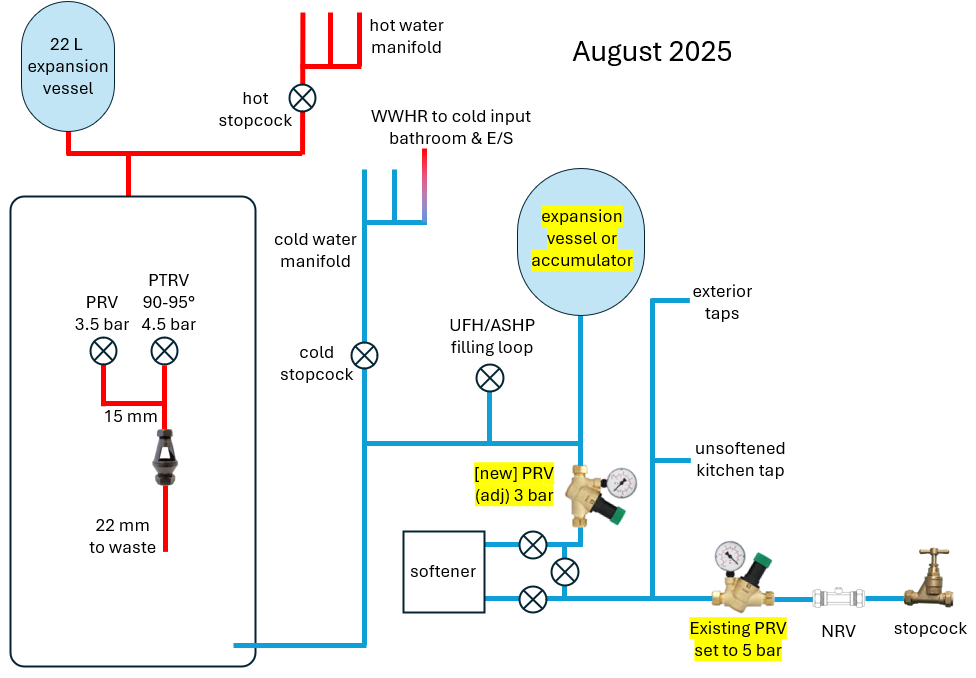
-
Sorting out expansion vessel and overtemperature valve
jack replied to jack's topic in Boilers & Hot Water Tanks
Thanks John. I found that document a couple of days ago. It was one of the triggers for my comment about rethinking the setup as a whole. It's frustrating the original plumber apparently didn't read the manual before installing a 3 bar PVR on the incoming mains 10 years ago! While it's been fine operating at 3 bar for 10 years, I'm going to lower the incoming PRV to the recommended pressure. I'll also install another expansion vessel to help keep the pressure low. While static pressure is fine, it does drop noticeably if a couple of showers or taps are in use. I suspect the most likely culprit is the water softener, but I'll be doing some pressure tests on the weekend to see what I can learn. Either way, I'd like to do what I can (within reason) to avoid making the crappy dynamic pressure any worse when I change to the lower pressure PRV on the incoming main. -
Sorting out expansion vessel and overtemperature valve
jack replied to jack's topic in Boilers & Hot Water Tanks
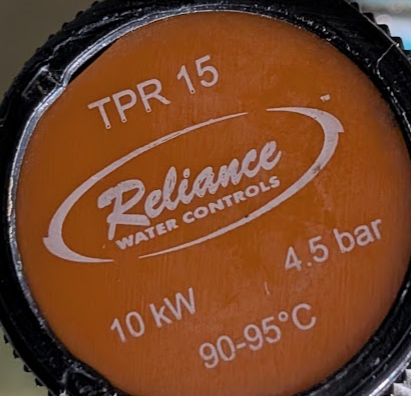
Originally 3 bar and it's located above the cylinder. I'll make sure I do what you say when I recharge it (didn't manage to do it over the weekend). I've turned off my immersion diverter for the moment, so the temperature in the tank won't exceed ~50° C until I've got all of this sorted out. There's a 3 bar pressure reducing valve on the incoming mains. I already have a pressure gauge on its way so I can test it. Okay, thanks. I'm going to have a think about the setup as a whole. Currently considering adding an additional expension vessel to the cold feed near the tank, as there's more space there than where the current one is near the ceiling. There are two valves: 3.5 bar pressure relief, and 90-95°/4.5 bar temperature/pressure relief. Thanks again, I appreciate the feedback. -
Sorting out expansion vessel and overtemperature valve
jack replied to jack's topic in Boilers & Hot Water Tanks
Thanks John, it sounds like a larger (or additional) expansion vessel is definitely needed, as per @Nickfromwales's suggestion. -
Sorting out expansion vessel and overtemperature valve
jack replied to jack's topic in Boilers & Hot Water Tanks
Ha, no need to apologise, I'd rather have the honest feedback. I assume the reason for the low relief valve pressure is that this is a copper cylinder, which I expect has a lower max pressure than stainless steel? -
Sorting out expansion vessel and overtemperature valve
jack replied to jack's topic in Boilers & Hot Water Tanks
Nope. Cylinder manufacturer's instructions say this is supplied with a 3.5 bar PRV: (The guy was a complete monkey though. Installed the water softener isolation valves the wrong way around, so you wouldn't have been able to isolate the unit. I sorted it was wrong the second a looked at it. He failed to screw the waste trap onto its fitting when he was done, which I only learned about several months later when I found mould growing behind the tank. And the pipework he assembled for the water softener was crooked and put a lot of sidewards force onto some of the fittings. And my wife wonders why I don't just get trades in to do things that need doing around the house!)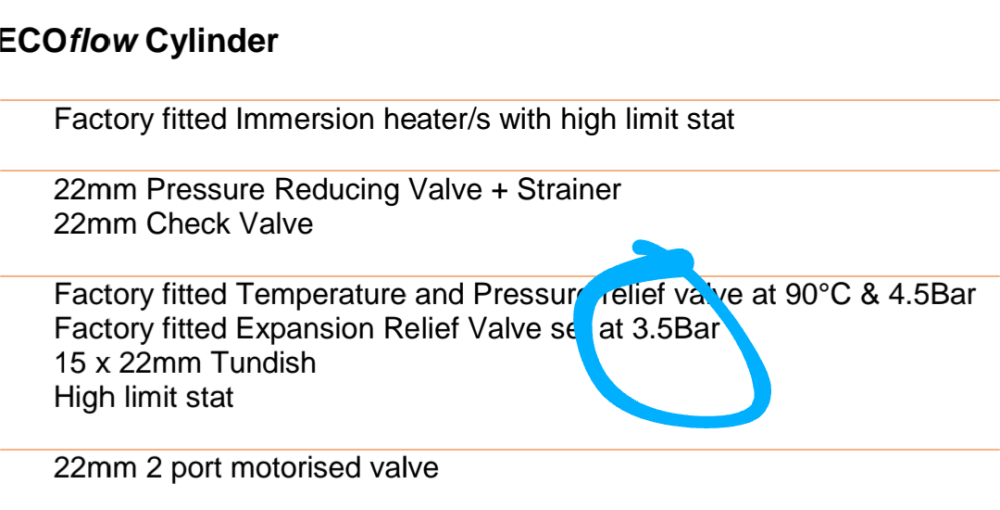
-
Sorting out expansion vessel and overtemperature valve
jack replied to jack's topic in Boilers & Hot Water Tanks
Incidentally, this is the same setup as Altecnic (possibly rebadged? I know McDonald and another manufacturer sell exactly the same cylinder we bought from them):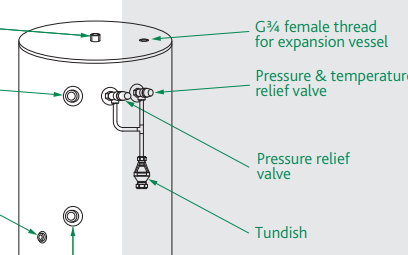
-
Sorting out expansion vessel and overtemperature valve
jack replied to jack's topic in Boilers & Hot Water Tanks
There's no control group as such. There's a pressure reducing valve on the incoming main. It's a bit hard to get to and I can't remember the pressure it's set at, but possibly 3 bar? Our static water pressure is typically around 2.8-3 bar I think. There's no pressure relief valve at that point. I'd be happy to use this opportunity to rejig the whole setup tbh. The dynamic water pressure's always been a bit shite, probably at least partly due to the pressure drop across the water softener. There's been the odd weep from a couple of the connections that I want to sort out too. -
Sorting out expansion vessel and overtemperature valve
jack replied to jack's topic in Boilers & Hot Water Tanks
It's on the cylinder. To save me going and taking a photo, this is how it came from the manufacturer (McDonald Cylinders): The one on the left is the PRV, which is what's failed. Interestingly, this diagram shows a light blue handle on the valve, which accords with the 107-series ("cold only", but rated to 110° C) Reliance valve I mentioned above.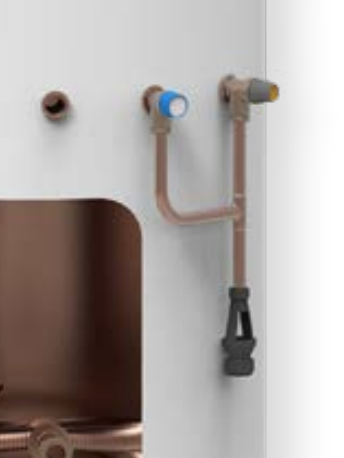
-
Sorting out expansion vessel and overtemperature valve
jack replied to jack's topic in Boilers & Hot Water Tanks
Right, I've had a bit of time this morning to look more closely at this. It's actually the pressure relief valve that's failed. The 15 mm pipework from outlets of the PRV and the PTRV joins before the tundish (I assume that's acceptable?), so it isn't possible to tell which one's failed without disconnecting the pipework from the valve outlets. The failed valve is a Reliance 102-series 3.5 bar PRV. Apparently that's a "cold water only" valve. I think this was the valve originally supplied with the cylinder, but it's also possible I asked that it be replaced at the same time I had the TPRV replaced a few years back. Either way, it doesn't appear to be the correct valve for this application. Annoyingly, none of the Reliance valves designed for hot water systems come in a 3.5 bar variant. There's 107 series that is allegedly for "cold water use only", but it has a 110° max working temp. Shame I didn't realise what was going on yesterday or I could have given their technical department a call to see what the deal is there. On the assumption that I shouldn't increase to a 4 bar version, and a 3 bar version is too low given I'm already having issues with the 3.5 bar version, I may need to look elsewhere. Annoyingly, I can't see any obvious options with the same form factor, inlet fitting, and outlet fitting. If the Reliance 107 model mentioned above isn't suitable, it might be time to replace both valves with a different brand and adapt the outlet pipework to suit. Anyone have any thoughts? -
Sorting out expansion vessel and overtemperature valve
jack replied to jack's topic in Boilers & Hot Water Tanks
I'd need to check, but definitely nothing like 90 deg. The issue is that the immersion is quite low on the tank (the upper immersion died and I've never gotten around to replacing it). By the time that lower region of the tank gets hot enough to turn off the immersion, there's been a lot of time for the water at the top of the tank to get very hot due to convection. That was my thinking when I mentioned a destratification pump. -
Sorting out expansion vessel and overtemperature valve
jack replied to jack's topic in Boilers & Hot Water Tanks
Did it ~15 times aggressively but no luck. Any recommendations for an alternative brand? What's "big" in this context? It's a 22 L tank for a 250 L unvented cylinder. Minimum appears to be something like 4-5%, but rule of thumb is 10%, so it's above the minimum but a little short of the rule of thumb. The bladder on the original one died a few years ago, so I replaced it with a new one with a replaceable bladder. I'd ideally rather hang onto that than replace it again, although if it's important, I'm pretty sure I have the space for a larger one. Any brand you'd recommend? -
Sorting out expansion vessel and overtemperature valve
jack replied to jack's topic in Boilers & Hot Water Tanks
Thanks Nick. I tried that a few times earlier, but could try it a few more times and see what happens. No HRC circuit. I just checked and the expansion vessel had no pressure. Bah! So likely that, possibly made worse by the immersion diverter. I need to put a reminder in to check the pressure in the expansion vessel more regularly. -
The overtemperature/pressure valve on my pressurised DHW tank has started leaking (again). This is the model: My understanding it that it's a combined temp/pressure release valve (there's a separate 3.5 bar overpressure valve connected to the same tundish). I also remember reading that these types of valves have a tendency to leak after they've been triggered, or even after testing. This is the second time this one has failed. Last time, the bladder on the expansion vessel had failed without me realising, leading to higher than usual system pressure. However, I don't now whether that was the cause of the valve failure. Our static pressure is less than 3 bar, so I doubt the system has ever seen anything like 4.5 bar, even with the immersion diverter working. I wonder whether the immersion diverter is occasionally causing the temperature near the top of the tank to exceed the trigger temp for this valve? I recently installed the relay module on our Eddi immersion diverter, which will let me control the maximum temperature better. I also have a couple of spare pockets that I could use for something like a solar mixing pump, but I'd rather avoid any more complexity. So my questions: If you had to speculate, what do you think is the most likely source of failure? If it's likely to be temperature, are there brands of valve that are better at coping with being triggered and returning to closed without leaking? What is the most appropriate pressure for my expansion vessel? Anything else I should be thinking about? Thanks as always.
-
Welcome, you're in the right place.
-
The mods removed it because it was a breach of copyright.
-
Self build house - is MVHR worth cost?
jack replied to Wadrian's topic in Mechanical Ventilation with Heat Recovery (MVHR)
I can't help you with recent costs, but we've lived in a house with MVHR for (unbelievably!) 10 years this Christmas. There's no way I'd ever consider building a house without it. There's something magical about having fresh, warm air throughout the house in winter. I don't really think about it any more until I encounter stuffy air in other peoples' houses in miserable winter weather. If you're even vaguely handy, it's one of the most straightforward things you can self-install, and you'll save a lot of money compared with having professionals do it. We installed everything ourselves except the drain and the power supply wiring. I did most of it myself over perhaps three easy days, with my wife helping me pull ducts through the easi-joists. There are arguments about the costs/benefits of running an MVHR system. You have a permament load of something like 10-40 W, depending on how big the unit is and what flow rate you run, which is a a few tens of quid a year in electricity. You need to regularly clean and occasionally replace filters, which could be another few tens of quid a year depending on brand, how often you replace them, whether you're willing to make your own from cheap filter media, etc. I'd be surprised if the reduced cost of heating due to the heat recovery offered by MVHR didn't save us more than the cost of its power consumption and filter maintenance. That said, it's a big upfront cost. If it last 10 years, it's something like £300-400 a year if you install it yourself. I doubt MVHR saves us anything like that amount on our heating bills. That said, I'm coming up to 10 years with the same unit. It's becoming apparent that the motors need new bearings, but otherwise the unit shows no sign of degradation. Hope that helps. -
Have you listened to any of the Peter MacCormack podcast? Too many right-wingers and Reform nutters overall for or my liking, but otherwise some very interesting guests you're unlikely to encounter on many other shows.
-
I don't disagree with any of that, but it's a matter of personal preference which option is riskier or less pleasant to look at. My personal opinion is that I wouldn't mount one in the rooftop position being proposed. I'd be concerned about the noise impact in the bedrooms. I think it looks horrible on the roof (the drawing view from the garden places it against the wall - it needs to be moved a long way out to give a more accurate impression). And I think the risk of noise to the upstairs neighbour shouldn't be ignored. Yes it's 7m and a decent unit won't make a lot of noise, but there's brick wall behind the unit, a brick wall to the side, and the same on the neighbour's side of the fence, without a fence or any other ground-level obstacles to absorb and disperse sound. I could live with it being in the garden if that were the only alternative. Face the outlet down the garden. Screen the garden side parallel to the fence. That will leave the unit in a corridor without any obstructions to the front or rear, so there's no risk of recycling cold air.
-
100% this. It's trivial to hide an ASHP at ground level in a garden. The right shrub or an open screen a short distance from the unit will completely hide it.
-
If the plot you're looking at has full planning permission for that house, you might consider re-applying for permission for something that will be cheaper to build. Even with the cost of another architect, you could potentially end up saving money overall with a cheaper design. How long does the current planning permission have to go until it expires? If it's still got a fair bit of time to run, you could easily get permission to get something else built without risking the existing permission expiring. Just over a year from demolition to moving in.
.jpg.c21f3ac78c9b7efd90cbdcb312744dc5.thumb.jpg.7adcad4c0e384f5ecd7d56b0618df6e5.jpg)



