.jpg.c21f3ac78c9b7efd90cbdcb312744dc5.jpg)
jack
-
Posts
7460 -
Joined
-
Last visited
-
Days Won
41
Everything posted by jack
-
@Oceanjules, FYI I hid your duplicate post over in 'General Joinery'. It's generally better to keep discussions to one thread, and I think this is the better sub-forum for this topic.
-
.jpg.c21f3ac78c9b7efd90cbdcb312744dc5.thumb.jpg.7adcad4c0e384f5ecd7d56b0618df6e5.jpg) Any or all of what I said might be wrong, but that's exactly the point I was discussing:
Any or all of what I said might be wrong, but that's exactly the point I was discussing: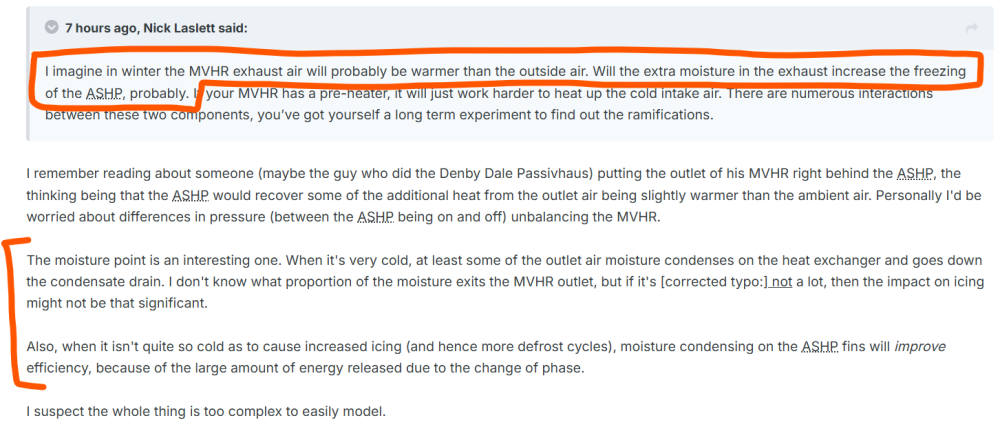
-
I remember reading about someone (maybe the guy who did the Denby Dale Passivhaus) putting the outlet of his MVHR right behind the ASHP, the thinking being that the ASHP would recover some of the additional heat from the outlet air being slightly warmer than the ambient air. Personally I'd be worried about differences in pressure (between the ASHP being on and off) unbalancing the MVHR. The moisture point is an interesting one. When it's very cold, at least some of the outlet air moisture condenses on the heat exchanger and goes down the condensate drain. I don't know what proportion of the moisture exits the MVHR outlet, but if it's [corrected typo:] not a lot, then the impact on icing might not be that significant. Also, when it isn't quite so cold as to cause increased icing (and hence more defrost cycles), moisture condensing on the ASHP fins will improve efficiency, because of the large amount of energy released due to the change of phase. I suspect the whole thing is too complex to easily model. The one thing I would try to do is to direct the MVHR outlet air towards the far side of the ASHP. With a bit of luck, the outward airflow from the ASHP might entrain some of the air from the MVHR outlet and push it away from the house. Some sort of baffling or screening could also help encourage the "right" sort of air movement overall.
-
200 mm seems small. Have you checked your ASHP installation manual? I have a very low capacity ASHP (5 kW) and I believe the minimum spacing from the wall for that was 300 or 400 mm.
-
Not 400 m2, but I have a four bedroom, 289 m2 house where I've been successfully operating my UFH as a single zone for nearly 10 years. It's a very well-insulated house so there's no heating in the bedrooms. We do have panel heaters in the bathrooms that get used in winter, but that's it for heating upstairs. I suppose if I had wet UFH in the bathrooms, I'd want to run those on a separate zone(s), but that's about it. As for different rooms requiring different heating outputs, that's just a set-once adjustment using the manual manifold flow controls. I haven't bothered - they're all just wide open. Also, if you know in advance that you want more or less heat in a particular room, you could adjust the pipe-spacing accordingly.
-
Welcome to BuildHub David. I've removed the company name from your posts. I'm definitely not saying you fall into this category, but new members sometimes express a positive opinion about some supplier or other in their first post, and with a bit of digging we find out they're an employee or director of the supplier. The link isn't always that obvious though. Since we're a strictly non-commerical forum, we don't allow people to post supplier opinions without some sort of posting history. Thanks for your understanding.
-
@Mubbashshir, I've merged the two threads you started on this topic.
-
FYI, this was a spammer (posted a spam link later in this thread), so his post has been hidden.
-
Norrsken - Let them airtight tape or do it myself?
jack replied to boxrick's topic in Windows & Glazing
Awesome, you were playing the role of "Airtightness Champion": https://carbonlite.net/wp-content/uploads/2017/04/Aldas-12-Steps-to-Airtightness-revised-June-2019.pdf -
Power floated slab. Now rethinking micro-cement
jack replied to flanagaj's topic in General Flooring
That could well be what happened. I know, I did my garage floor with it. That isn't what I meant by "expensive". My main point on epoxy is that I don't like how it looks. As such, all I would achieve by putting it down is covering some stains. Even the modest amount it would cost to lay epoxy just wouldn't be good value (to me) in the circumstances. The door opening height wouldn't be affected. The problem would be that the unit is in one piece (including threshold) and difficult to move. -
Power floated slab. Now rethinking micro-cement
jack replied to flanagaj's topic in General Flooring
The doors that would need raising include: a 5.5 m long, ~900kg (according to the installer), flush threshold, triple-glazed slider, which is built in behind a wooden facade. two large, flush threshold, triple-glazed window doors. a 2+ m high, one-piece front door assembly with door and side window. two large, triple glazed windows with lower frames flush with the floor. The screed is on a slip membrane, so easy enough to separate from the underlying slab. While cutting it out would be messy and unpleasant, it seems to me it would be a much more straightforward and lower risk job. Epoxy coating would be a lot of expense to avoid looking at a few stains. I also don't much like solid colours on floors, as I think they show every bit of dirt and wear. That's why we went for concrete in the first place! Personally, I doubt I'd ever be able to justify the cost of replacing or covering the entire downstairs floor. I might, however, get just the kitchen done at some stage, since that's where 95% of the problems are. Can't see it happening for at least 5 years based on current household finances! -
Power floated slab. Now rethinking micro-cement
jack replied to flanagaj's topic in General Flooring
100% should be done before walls if you want an even result. Also, my recollection is that (at least with actual concrete) the grinding needs to be done within a certain period of pouring - from memory it was within a few days of pouring. After that, it hardens so much that it takes a lot more work and diamond stones to grind and polish. One other thing I forgot to mention: we were advised to keep it covered for as long as possible. We bought a load of correx sheets, laid them down, and taped all seams. Weirdly, ten years later you can still see lines showing where the joins were. I have no idea whether the joins allowed the underlying concrete to cure and/or dry out faster, but it's something to think about. To be fair, I'm the only one who notices them. -
Power floated slab. Now rethinking micro-cement
jack replied to flanagaj's topic in General Flooring
It's all relevant to the topic, so no issues from my perspective. Partly aesthetics, partly function (easy to clean, good for UFH). It was not a particularly cheap option. I think it was comparable to getting decent wood flooring installed, but it's been over 10 years so I don't remember. No, it's ordinary poured concrete. It had a tint added, so it's slightly darker than regular concrete. No fibres (wouldn't they show on the surface?). It had the aggregate mixed in. I don't remember them doing a dry shake, but it was a long time ago. Certainly no stones were visible after power floating. It took quite a bit of coarse grinding to start exposing the aggregate, and even after that, there are areas with little to no visible aggregate. To be fair, that outcome was partly driven by my wife, who didn't want a lot of it visible. One of the things that might have contributed to the couple of cracks we have is that our nominally 65 mm thickness is 10 mm less than the recommended minimum. They did warn us in writing of an increased risk of cracking, so I can't really fault the supplier. No-one's suggested torching, but the big stain is almost certainly too deep to be torched or polished out. I've considered repeatedly applying and mopping up a solvent to see whether that would help, but it's so far down the (long!) list of life priorities that I'll probably never get to it. *Thumbs up* -
Norrsken - Let them airtight tape or do it myself?
jack replied to boxrick's topic in Windows & Glazing
We still have visible bits of airtightness tape at the junction between plasterboard and frame in some of our reveals. Ours is a combination of bad window installation, sub-optimal taping, and careless plasterers who did everything the easy way. Personally, I'd absolutely do it myself if I were doing it again. I doubt it's difficult, but doing it properly takes good preparation, time, and attention to detail. There are good vids on YouTube showing what's required. -
Mains voltage is RMS. Multimeters nominally display RMS, but I think cheaper ones do something like measuring the average peak and estimating RMS by dividing by the relevant factor (sqrt 2, roughly 1.4). This assumes a perfect sine wave. The further from a perfect sine wave the input signal is, the more incorrect the value will be. Better ones will display "true" RMS, which involves performing the actual RMS calculations based on sampled voltage values. There's a lot more to calculate, so you need more memory and processing power, hence true RMS meters are more expensive.
-
Power floated slab. Now rethinking micro-cement
jack replied to flanagaj's topic in General Flooring
We have an MBC slab topped by a ~65 mm polished concrete screed that was installed by a specialist polished concrete company. A few thoughts in no particular order: 1. You can't predict the outcome of a pour The quality of surface finish of a structural slab can't reliably be predicted in advance, and it isn't necessarily to do with the installer. In our case, the slab was poured in January. I believe (without any real evidence) that the concrete we were supplied with wasn't ideal in terms of slump. I think, in particular, that it had too much water in it. In any event, we started pouring first thing in the morning, but even by 11 o'clock that night it hadn't gone off enough to power float. It got very cold that night and we ended up with really bad spalling on large areas of the slab. To their credit, MBC offered to fix at their cost by raising the frame and covering the slab with a self-levelling screed. We went with polished concrete instead so that wasn't necessary. The main point I'm making here is that if something goes wrong with the pour or finishing and you haven't allowed for the additional buildup of a screed to fix, you'll need to think about microscreed or other thin finish to rectify. 2. Polished concrete is usually not just "concrete" As others have said, ideally you should add the right additives to the mix and use a surface hardener (I think our guys sprayed something on right before the power floated, or maybe before they started polishing). I don't know how this all works when you're talking about doing everything based on the structural slab, but if you're getting a specialist in to do the polishing, you should probably be getting their advice in advance, and possibly even onsite input during and immediately after the pour. 3. Polishing is best done before the frame goes up We made the mistake of leaving the decision on flooring until the frame was already up. Large polishing machines can't get right up to edges, and corners are a real challenge. These areas are polished with smaller hand machines which definitely don't do as good or consistent a job as the large machines. We have lots of waviness and visible artefacts along edges and in corners. We've convinced ourselves they add character. We also have a couple of large cracks. We did have crack-relief cuts made in the appropriate places, but because the frame was in the way, the cuts couldn't be made all the way to the edge. This wouldn't have happened if it had all be done before the frame went up. 4. Polishing isn't perfect Along with the edge and corner inconsistencies, we have several spots in our floor where you can see blade marks from power float being stopped. They look like big '+' signs. The underlying aggregate is inconsistently exposed. This is something you might be able to improve by being present during the polishing (and particularly the early part where the coarser grinding is done). Yes, and yes! Our floors are completely covered in fine surface microcracks. You can't see them in most places unless you look closely, but they're more obvious where there's wear or staining. 5. Concrete doesn't (in my personal experience) age well This is just my experience, but we've found the concrete to be an absolute bear to keep clean, especially in the kitchen. Every spill, particularly containing oil, risks a permanent stain on the surface unless it's wiped up immediately. Some months after moving in, my wife took the rubbish bag out of the bin in the kitchen and put it on the floor. She forgot to take it out and it leaked overnight. The resultant large and obvious stain is still there over 9 years later. There are smaller stains underneath the bin, in front of the fridge, along the bottom edge of the dishwasher, and at various random points throughout the kitchen/dining area. It's just my personal impression, but it also just feels like it's become a bit grubby over time. It's partly due to the stains mentioned above, but also the polished surface has dulled in areas of high traffic. To me, there's a difference between a rustic, "honest" finish that shows the construction method (e.g., edge/corner inconsistency and float marks) and the history of the house (general wear, such as more matte areas where the polished surface has worn down over time), and stains that just make the place look dirty. We're not super tidy people but we are quite clean, so the staining really annoys me. I don't personally see how you can avoid staining. Perhaps regularly applying a sealant would reduce the problem (we've only done that once or twice after the original sealant was applied), but the big stain mentioned above happened only a few months after the first industrial sealant was applied. 6. You might be stuck with it If you really hated a tiled or wooden floor after a while, it would be costly to replace, but it wouldn't necessarily be that difficult to break up a tiled floor or remove a wooden floor. It's potentially a real challenge to do the same with concrete. In my case, I don't know what the process for taking up the whole screed would be. I suppose we could cut down through it along walls and around kitchen units, then chop it into sections for removal. A breaker probably wouldn't be ideal, as there's anti-crack mesh, and I wouldn't want to damage the underlying structural slab and its UFH pipework. Where the structural slab is polished, it might be even worse. You're unlikely to have much space to add a different floor on top of the existing slab. In our case, there's only a few millimetres' clearance underneath a couple of the external doors, so even adding a topping layer such as a microcement screed would be challenging (quite aside from the fact we couldn't afford it anyway!). Probably the best option would be to apply some sort of industrial epoxy topper, but that really limits the end look. Other thoughts It's not all bad. In general, it looks pretty good other than in the kitchen where all the stains are. It's very easy to run a broom, vacuum cleaner, or mop over - far less resistance than even a wooden surface. This is great if (like us) you have a dog that sheds hair and drops dirt/dust around the place. It's brilliant for underfloor heating and cooling - it feels nice and cool in summer and warm in winter. Some people think the surface will feel unpleasantly hard, but I don't find that bothers me at all. We have rugs in some places to soften it out, but even without them I don't have any issues. On balance, my wife and I agree that we definitely wouldn't go for concrete again. She'd prefer wooden floors throughout. I'd prefer tiles (either large format, or possibly those wood-effect tiles you can get, although I'd want a closer look at them before committing). -
From memory, the DNO can change the local voltage by switching which tap they connect to on the local transformer. I'm sure there was a member a few years ago who was trying to get the DNO to do this but I don't recall the outcome.
-
I replaced all of my fire/smoke alarms last week, as they're coming up to 10 years old (two starting beeping within a week of each other). Each came with an elasticated cover and instructions not to remove the cover until at least 24 hours after completion of any work involving decorating, including sanding and painting. I've put the covers aside for when we eventually repaint.
-
Sorting out expansion vessel and overtemperature valve
jack replied to jack's topic in Boilers & Hot Water Tanks
Good point. I haven't mentioned it in this thread, but I'm absolutely getting a plumber involved. This thread is more about making sure I know exactly what I want done, as in my experience, trades tend to advise what's convenient for them rather than best for you (e.g., the last time I had a G3 inspection, the plumber installed - directly onto the tank- an overpressure valve designed for strictly cold water use, presumably because that's all the local plumber's merchant had in stock and he didn't want to come back again). -
Sorting out expansion vessel and overtemperature valve
jack replied to jack's topic in Boilers & Hot Water Tanks
Our NRV is right at the mains inlet. There's no separate NRV after the branch to the cylinder from the cold feed. It's funny you mention that. Until I did the diagram above, I assumed we had one. Indeed, I thought it was a requirement (or at least a recommendation), but from a brief review I couldn't find any such requirement. No such valve is shown in the manufacturer's installation diagram, as shown in John's post above. I was going to ask whether it's at least best practice, as this would be a good opportunity to add one. The cold feed to the cylinder is quite long and there's plenty of room to fit an NRV in the cold feed to the cylinder upstream of the expansion vessels. -
Sorting out expansion vessel and overtemperature valve
jack replied to jack's topic in Boilers & Hot Water Tanks
Thanks John. Yes, the existing EV is right above the cylinder. I'll take this opportunity to move it to the cold inlet. Given that the water softener has isolation valves, would it be best practice to connect the EVs after the softener, so they can never be disconnected from the cylinder? Thanks. -
Sorting out expansion vessel and overtemperature valve
jack replied to jack's topic in Boilers & Hot Water Tanks
I don't know why you found the offset being there so offensive! 😆 I could have moved the table so the offset wasn't required, but it was easier to add the offset than to undo the cell merges, move the table, and re-merge the cells. Not even close. I've figured out which one to get but I need to figure out where to locate it in the plant room. This needs a bit of thinking due to the location of the water softener. -
Look up Andrew Jones, "The VATman". A few on here have used him, with good feedback from memory. In at least a couple of cases, the BH member successfully claimed back additional items worth more than the cost of the VAT reclaim service, due to additional items Andrew's team identified that the BH member hadn't considered.
-
Depends on the type of rain. It's just about impossible to predict localised patchy rain. You can only really rely on the forecasts that say 90% chance of rain for at least a couple of hours. For short term predictions (minutes to an hour or two), looking at the weather radar can help.
-
Sorting out expansion vessel and overtemperature valve
jack replied to jack's topic in Boilers & Hot Water Tanks
I've put the answer to your "indirect" question in bold below, but in case anyone's interested in the way the whole thing works (which might give an insight into how my brain "works"): As you know, the coefficient of expansion for water changes with temperature, and the actual equation for calculating expansion between two temps is quite complicated. I made a table of temps from 4 - 95 °C, at 1 °C per cell. I inserted the known cofficients for 4 °C, 10 °C, 20 °C, ..., 90 °C at the appropriate positions in the table. I then did a linear interpolation for the values between the known values. For the values between, say, 10 and 20 °C, I took the average of the coefficients for 10 and 20 °C, then divided by 10 (call that value "x"). The value for 11 °C is the (known) value for 10 °C + x. The value for 12 °C is the value for 11 °C + x. It's not perfectly accurate, because the relationship isn't actually linear, but it's certainly close enough for this task. Since the coefficient represents the expansion at that temperature for a 1 °C temperature change, all you need to do to find the total expansion is to add all of the values between the two temperatures. The indirect function in Excel (which I only learned about when doing this spreadsheet) lets you construct a cell reference based on any other input. In this case, the row in which each temperature value sits in the table is one higher than value of the temperature itself. For example, the coefficient for 7 °C is in row 8. I therefore needed to add 1 to the values of the start and end temps to use them as references to the correct rows in column G. I can't remember where I got the values for the expansion coefficients this is all based on, but the results are very close to the table you included in your original spreadsheet. I assume the difference is due to the interpolation mentioned above, but either way, it's close enough for this purpose. Edited to add: Updated version of my earlier spreadsheet includes a graph and the comparison table above: System pressure calculator - updated for BH.xlsx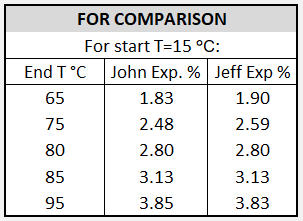
.jpg.c21f3ac78c9b7efd90cbdcb312744dc5.thumb.jpg.7adcad4c0e384f5ecd7d56b0618df6e5.jpg)