

.jpg.c21f3ac78c9b7efd90cbdcb312744dc5.jpg)
jack
-
Posts
7460 -
Joined
-
Last visited
-
Days Won
41
Everything posted by jack
-
You're right, I haven't!
-
It was quite a bit less than that when I did it, I think - less than £200 from memory. Also, do check whether the discounts that you're reading about are actually offered to non-trade punters. I was led onto the course largely based on this discount, but was then calmly told when I went to claim it a couple of weeks later that the discount was only for trade. I provided what I thought was pretty clear feedback about how misleading this was, and then HerbJ had a similar experience only a few months later. I don't think they do it on purpose - I think they genuinely expect that most of the people on the course will be trade (as were 90% of the guys on the course I did). I also had serious problems with the significantly higher pricing they had in the UK at the time I bought. They argued that they wanted to be able to fix prices for a year or two at a time and didn't want to keep reprinting materials with new prices. That might have been ok if if you could have ordered from the German site, but you couldn't, which as far as I'm concerned is contrary to EU regs. I was basically fobbed off when I raised it with them. I started looking into doing something more formal about it, but didn't have the time or energy as I was buried in the build at the time. All that said, they're a really good company and they're putting together some really great tech. They're always more than helpful when you have technical questions. The only other question mark I have over them is their interface. It's better than what I've seen of, eg, Control4, and to be honest, I hardly use it because most of what it controls is either automatic (heating/DHW/blinds) or has a hard switch (lights, blinds).
-
.jpg.c21f3ac78c9b7efd90cbdcb312744dc5.thumb.jpg.7adcad4c0e384f5ecd7d56b0618df6e5.jpg)
Crane insurance, windows insurance for window lift???
jack replied to oranjeboom's topic in Self Build Insurance
We all know that by "Redbull" he means "ale". Let's face it, he always means "ale". -
You are my father in law and I claim my £5. I hate negotiating more than just about anything else in the world.
-
Crane insurance, windows insurance for window lift???
jack replied to oranjeboom's topic in Self Build Insurance
I wish I could be sure you were joking! -
Crane insurance, windows insurance for window lift???
jack replied to oranjeboom's topic in Self Build Insurance
I personally don't think it's an option that can ever be safe unless it's in conjunction with some sort of heavy-duty fail safe support system - either a solid frame with outriggers to prevent tipping, or some sort of strap system attached to hard points like rafters or floor joists. Having seen how hard it was just rolling it on scaffold poles, there's no way I'd accept the responsibility for nearly a ton's worth of top-heavy glass being carried by people without such safety systems. If it tips and lands on someone, they're dead. -
I don't know whether the suppliers are loading up the sub-contractor's costs so they get a cut too. I think I calculated that we were paying somewhere north of £300 per person per day, and one of the three was essentially a labourer.
-
Crane insurance, windows insurance for window lift???
jack replied to oranjeboom's topic in Self Build Insurance
Ha, tempting! But seeing how stressful it was for even experienced installers to do this, I think I'll pass thanks -
We have something like 25 windows and doors, some very large (including a 5m long lift and slide triple glazed job that weighs nearly a tonne!) We were initially charged around £6k to install them, which included travel from Ireland. Seemed a bit high for the number of days involved, but we were spending a lot on expensive German windows, so we were willing spend more to get the right job done (the installers were the Irish representative for the company that supplied the windows). While the guys clearly knew what they were doing, it's also clear that they underestimated the size of the job. They also hadn't installed the particular external blind system we went for and didn't realise that when they failed to lift all the windows by 15mm as shown in every drawing, none of the cills would fit, which meant none of the blinds could be installed. A couple of the the MBC apertures were slightly shorter than they should have been, but to their credit they had someone onsite within a couple of hours to adjust a couple of the apertures that were particularly tight. The real failure was that the installers failed to understand the impact of not packing up the windows as shown in the detailed drawings they'd had since they quoted. In the end, they left site early then returned the following week once the cills were "adjusted" (ie, butchered by me with an oscillating tool). Unfortunately, at 4pm the day before they left to return to the site, they sent us a new invoice for something like an additional £1500, without any comment, for their extra travel time, accommodation and time on site. They simply couldn't see why this would be a problem. As far as they were concerned, the apertures were the wrong size, so it was our fault and they shouldn't be out of pocket because of it. My position was that they held themselves out as the rep for this company, and I should therefore expect them to know the product, understand how to read details supplied by the window company, and understand the ramifications of not complying with them. After some negotiation, they eventually ended up onsite, only to discover that although the cills were now fine, they'd failed to understand how the external rails for the blinds needed to be fitted. Cue me going around in front of them with a hammer, crowbar and oscillating tool removing all the lovely battening that MBC had so lovingly installed (and which we had been assured by the fitters wouldn't be in the way) from both sides of every window that had external blinds. The perfect end to it all was a few weeks later when I went to remove the cills so I could put some EPDM over the now-exposed OSB in the window closure. Imagine my surprise when I found that what I had thought was a blob of sealant around each screw holding the cills onto the window frames was in fact just evidence of the construction glue they used to permanently glue every cill into place! Turns out that the screws they'd brought weren't long enough to go through the insulation and into the wooden frame, so they used glue and just used the screws to hold the cills in place while it went off. As some point, I'm going to have to get new cills made, then cut off the old ones, repair the EPDM, and screw the new ones over them. It's a real shame that it went this way, as the guys doing the installation were decent blokes who clearly knew what they were doing generally. In my opinion, if they'd spent a little bit more of the travel time they'd billed us for looking at the detailed drawings, things would have been lot smoother. I consider the window installation to be the thing I'm second-least happy with about the entire build (the brick slips were the worst, but that's another story!)
-
We were only very slightly below the passivhaus 0.6ACH standard on our first test. Then one of the MBC lads realised he hadn't actually pushed the front door closed! Second test went much better, but I was surprised we got such a good result with a slightly cracked door. The Denby Dale Passivhaus was built with masonry and a parge layer. Worth a read of the blog to anyone contemplating it.
-
Crane insurance, windows insurance for window lift???
jack replied to oranjeboom's topic in Self Build Insurance
Having helped install a 5m long, roughly 900kg triple glazed lift and slide, forget about people lifting it. The sheer sense of mass of the thing was incredible. It's so top-heavy that the slightest tilt would end in disaster. We'd originally planned for a crane to install from outside using exactly the tilt-and-drop method described above, but there were issues with the scaffolding (despite repeated assurances from the installers before they got onsite that it wouldn't be a problem). In the end, we got it in through our (thankfully unusually tall) front door, rolled it on scaffold poles to where it need to be, then somehow manhandled and wedged it into place from inside. Still not sure how we managed it with four of us, if I'm honest! -
It you haven't already done it, I'd highly recommend doing at least the first three days of the Loxone training courses. I looked at some online training stuff before starting but I found having someone take me through it by the hand really invaluable. Once I'd done that, I was able to do all the programming myself. It's a very powerful system. I'd also recommend joining (or at least reading) a couple of the forums that were set up when the official one was pulled last year.
-
Our groundworks team did all the drainage and left pipework sticking up in the right places (well, most of them!). MBC just laid and levelled the blinding layer, installed the EPS and laid the concrete around them. Edited to add: I don't, however, know whether the reference above is to mains drainage. Sounds more like drainage for under the slab, presumably to be connected to a soakaway. What kid of ground are you on? Clay?
-
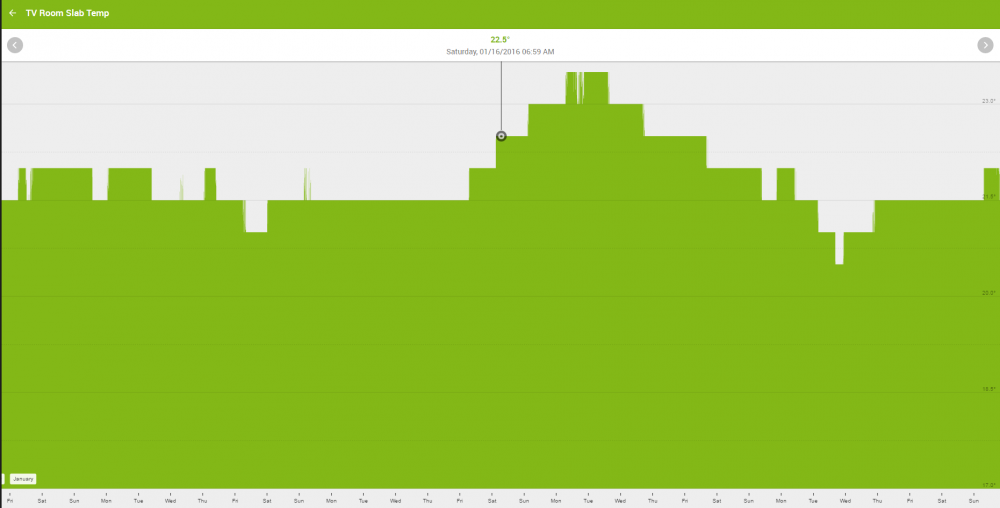
I didn't really check it. Sometimes it was on (generally with the fan barely moving) when I went near it, other times it was off. I'm not presently set up to record how much energy it uses or when it's on/off - that's a plan for when everything else is finished! Certainly there was no discernible change in slab temperature. This image shows the slab temp for one of the sensors across January (each step is 0.5 degrees - I'll eventually swap out this one-wire sensor for one with a higher resolution): The biggest temperature difference across an entire day was about 1 degree (bearing in mind the resolution limitations) and usually it's a lot less than that. Of course, the ASHP was only in DHW mode for two hours every morning, so not a lot of time for the temperature to fall.
-
Moved in - couldn't have done it with out you all...!
jack replied to Bitpipe's topic in General Self Build & DIY Discussion
Indeed. Moving out of our tiny, horrible, freezing, mouldy, falling-apart rental property around the corner was a superb feeling! -
Moved in - couldn't have done it with out you all...!
jack replied to Bitpipe's topic in General Self Build & DIY Discussion
Great stuff - fantastic feeling isn't it? -
We have a 5kW Panasonic Aquarea for our close-to-Passive-House-standard 289m2 house. As I've mentioned elsewhere, we have quite a bit of shading and nothing like Jeremy's warm microclimate, so the ASHP spent a lot of winter ticking over gently keeping the insulated slab at around 21-22 degrees. As for DHW, over winter we have the ASHP heat the tank to 55 degrees between 4 and 6 o'clock each morning. Looking at the temperature plots, that seemed to be about the maximum time it took to get the whole 250L tank up to temperature (and it did get to pretty-well bang on 55 degrees, despite the ASHP being located 9 or 10m away from the tank). The top 30% of the tank is then heated to 85 degrees by the upper immersion heater that switches on at 6am. I don't believe we've ever run out of water with our family of four. Also, we have 8.5kW of PV. It occurred to me the other day that the ASHP probably hasn't had cause to turn on for several months due to the amount of energy being pumped into the tank every day. I wonder whether not being used in this way could negatively impact longevity?
-
In our case, MBC didn't go much beyond the position of the actual house with the blinding layer. Certainly they didn't cover anything like the full surrounding metre of recycled railway ballast that we used as the base layer. But agreed, external markers are desirable for sure. We also had a height marker for FFL put in, which they appreciated.
-
Terry, I think he means groundworks in the sense of the stuff that happens before MBC arrives. Is there an MBC start date?
-
Do you ever feel like giving up
jack replied to Vijay's topic in General Self Build & DIY Discussion
Wow that came around quickly! Great feeling, isn't it? We were just discussing in the car on the way home that we need to set a date for completing everything and getting it signed off. As the conversation went on, we realised that we're now in September, and moved in just before Christmas last, meaning even if we really get our skates on we're going to be pushing it to finish before this Christmas. Still, it's a good deadline and will hopefully give us the push we need. Vijay, it gets so much easier once things actually start happening. You'll still have stress and tiredness and all the rest of it, but when you can see the ongoing fruits of your labour (compromises and all), it's so much easier to keep plodding on. It does end! -
Large Downstairs WC or Separate Plant Room??
jack replied to Barney12's topic in New House & Self Build Design
Yes to both of those. Also, consider sizing the room to match a standard shower tray (with extra for boarding, tiles etc). I was told that the outward opening regulation is at least partly to ensure the door can be opened easily if someone falls off a wheelchair while the door is closed. -
Never a truer word said. We got a tape measure and double-checked everything because we were convinced they'd made it 20% too small!
-
Do look into it further. Not all services are off limits for zero rating. For example, plumbing is a service and is clearly zero-rated for a new build. I don't know the answer in this case, but suspect it may depend on how closely associated with the building of the house it is. Muckaway following digging of foundations would be closer to that than reshaping a nearby bank for landscaping purposes, for example. Hopefully @Temp will be along to give some more guidance in the near future!
-
Large Downstairs WC or Separate Plant Room??
jack replied to Barney12's topic in New House & Self Build Design
Realistically the MVHR should go on the outside wall, meaning you'll have to squeeze past the TS/UVC to get to it. I suppose you won't need to get past it very often, but what happens in the worst case scenario of the MVHR failing and you having to get it out past the TS/UVC? I don't know what the realistic minimum footprint is for installing a TS/UVC. Perhaps start with that and see how much room there really is? If it does work, and TS/UVC + MVHR is all that's in there, then you can always use the space just inside the door for storage and clothes drying (assuming there's ventilation in the plant room). -
I don't think our ASHP has turned on for several months. We get a full 250L of 80 deg C water every day from our 8.5kW solar + immersun. Shame they've stopped trading as their kit is really quite good. Sometimes by mid morning the whole tank is done and it just sits there sending several kW back into the grid! I've seriously been eyeing up a small plug-in car to replace our current runabout. I imagine there'd be almost no recharging costs for a good 4+ months of the year.
.jpg.c21f3ac78c9b7efd90cbdcb312744dc5.thumb.jpg.7adcad4c0e384f5ecd7d56b0618df6e5.jpg)

