

.jpg.c21f3ac78c9b7efd90cbdcb312744dc5.jpg)
jack
-
Posts
7352 -
Joined
-
Last visited
-
Days Won
38
Everything posted by jack
-
.jpg.c21f3ac78c9b7efd90cbdcb312744dc5.thumb.jpg.7adcad4c0e384f5ecd7d56b0618df6e5.jpg)
Discount Offers of the Week
jack replied to Ferdinand's topic in General Self Build & DIY Discussion
Yes, definitely needs some looking at the numbers, and only makes sense if you can attend in person. Some looked they were going cheaply even considering the fees, but I didn't look to closely since it's nowhere near me. And hey, surely you're the king of saving a few percent here and there! -
Discount Offers of the Week
jack replied to Ferdinand's topic in General Self Build & DIY Discussion
Looks like the contents of Alltools (tools shop) in Sheffield are up for auction here: https://www.bidspotter.co.uk/en-gb/auction-catalogues/timed/charterfields/catalogue-id-charte10023 There are loads of Bosch, Makita and other branded tools for sale (240V, 110V and cordless), along with lots of sundries (bits, discs, general tools and hardware). The auction is under way now, with items finishing over the next few hours, so you'll need to get your skates on if interested. -
This has been a pretty consistent approach from you. Is it a point of principle, or are there financial implications as well?
-
The other theory is that induction hobs don't produce all the hot gases that burning gas does. There's therefore apparently less of a hot, upwardly moving column to push cooking steam/smells etc upwards, so you have a better chance of catching it at hob level than you would if cooking with gas. Whether that's true in practice I can't say.
-
Sorry, I missed the word "condition" in your original post! Unless they said that subsequent approval was needed for design/materials of the gate, I can't see how they can come back asking about it now. @Temp and/or @Sensus might be better sources of info than me though! I do find it bizarre that anyone in a planning department has any inclination to be getting involved in this years after the fact.
-
Weird. Is any of this related to conditions associated with the planning approval?
-
Cheap, Thermally Efficient Non-Structural Wall Detail
jack replied to Nick's topic in General Construction Issues
If you're okay with sexism, they do "one-man" boards: see page 4 -
Cheap, Thermally Efficient Non-Structural Wall Detail
jack replied to Nick's topic in General Construction Issues
I could be wrong, but I don't think the wet-spray approach is used in the UK. Dry cellulose is generally pumped into a hole at the top of each cavity under pressure. No issue with corrosion that way I'd have thought. It does hold water, no doubt (we had a roof leak into ours, so I'm more than familiar with its characteristics when sodden!) I don't know that it's any worse than other porous products in this regard though. Have a look at Fermacell. More expensive than OSB + plasterboard, and harder to install due to its weight, but its very dense and strong. Excellent for weight bearing (from memory, over 30kg point load per screw, and that's not into a stud) and due to its density has better acoustic properties than plasterboard. We have a mix of that and double-layer plasterboard. -
I didn't love the way the house looked from the outside, but the interior of that arch was awe-inspiring. I did briefly look into whether we could do something interesting inside our house like this but it was just too impractical (for which read expensive). I went to a talk by the architect/owner of that house two or three years ago. What I found really interesting is that he only decided to go for Passivhaus certification very late - certainly after construction was well under way, if not after it was finished. Fascinating guy.
-
Fixed that for you!
-
It's pretty common to run a ring around each room at socket level. See this page, which has some helpful drawings about zones (note: do check that it's correct and up to date before relying on it!)
-
Cheap, Thermally Efficient Non-Structural Wall Detail
jack replied to Nick's topic in General Construction Issues
I've heard of this sort of thing in critical applications like sound rooms. I believe the main aim is to avoid having multiple sources of resonance at a particular frequency, rather than reducing overall sound transmission levels. I doubt it would make much difference if you're just trying to reduce external noise. 300mm of a dense insulation like cellulose (which is what we have) or wood fibre will cut noise like you wouldn't believe. -
They were designed as right hand cars from the start, it's just that Japan standardised to indicator on the right. Someone once told me that in the UK the indicator stalk used to be on the right, but changed over time due to the number of Euro imports. Not sure whether that's true. I lived in Australia for several years and most non-European cars have the indicator stalk on the right. It actually makes a lot of sense, because you can operate the indicator while you're changing gears during lane changes or coming up to an intersection. It's a pain changing over though, for sure. I find it easier to change between left hand and right hand drive than to switch indicator sides!
-
Hello to Everyone, Look Forward to Talking to You All
jack replied to Nick's topic in Introduce Yourself
+1, that's what we did. No way I'd have been able to afford a "building plot", but we just managed it with the bungalow (buying in 2012 didn't hurt either). Services already on site, no argument about the allowability of development in principle. If you're surrounded by larger houses, as we were, and the plot is a decent size, planning should be reasonably straightforward. I believe - but do check - that there's no strict maximum percentage size increase unless you're in the countryside or a conservation area. We replaced an 87m2 bungalow with a 289m2 very modern house with barely a whimper from anyone. You'll fit in fine around here. Are all Nicks like this? -
Hello to Everyone, Look Forward to Talking to You All
jack replied to Nick's topic in Introduce Yourself
Oh god, not another one! Just kidding (if you've read around, you know the @Nickfromwales I'm talking about). Welcome to the forum and thanks for your kind offer to contribute. Always lots of questions about glass! -
I don't want to know how much time I spent/wasted thinking about this blimmin' house! I'm a thinker rather than a doer by nature. I'm certain that there were days when I just wandered around the house for several hours absorbing what was going on and pondering. Even though we moved in over a year ago, there's still time being spent/wasted on figuring out how to approach what's left. Worse, because the easier stuff gets done first, it's the "hmm, how best to do that" stuff that ends up filling your remaining to-do list. I'm at the point of just asking a builder in and paying them to do the rest, because I simply can't face any more decisions! The problem is finding the right builder
-
Wasn't 2015 pretty dim too? I seem to recall people talking about day after day towards the end of the year with zero production!
-
I'd report it now. This scam relies on ignorant people contacting him by email before paying via Amazon. Since you already paid via Amazon, I suspect you're no longer a target and won't hear from him again.
-
Not sure about that. Take the end case of there only being one small hole left. It'll take a lot of fast pressure changes between inside and outside for much air to be driven through it. I'd guess that the more of the larger holes you block off, the harder it will be to detect air movement through the remaining smaller ones.
-
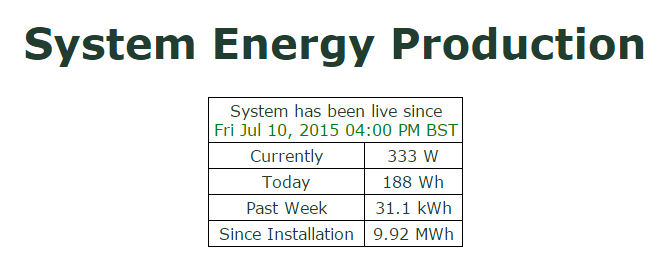
We have an 8.5kW array on two sections of flat roof on the Hampshire/Surrey border. About 40% of them are facing directly south at a fairly shallow angle. The remaining 60% are in a flat east-west concertina shape with a very slight tilt towards the north. There's some morning shading throughout the year. We went for Enphase microinverters following modelling that showed how much more power would be generated. This is the summary from about half an hour ago: It's dull and rainy here this morning, so I'm surprised we even have that much being generated.
-
Official testing is an average of positive and negative tests, for exactly the reason you mention. They also make a note of wind conditions on the day, and won't (or shouldn't) test if it's above a certain wind speed, I believe. I think they did three cycles ([positive + negative] x 3) of the test when they did ours. With the house depressurised, even small leaks were very obvious. We got just under Passivhaus airtightness on our first run (despite the front door not actually being closed properly!) They depressurised it after the last run and let us go around for a few minutes looking for any leaks. The biggest was clearly around our large slider, as expected. There were also a couple of pin-pricks in the airtightness tape due to misplaced staples near windows. Unfortunately, for a decent sized house you'll spend a lot of time going around all the interfaces for relatively small gains, and it's unlikely a tester is going to hang around for that unless you're paying.
-
Stage 1 Is Very Nearly Complete :)
jack replied to Construction Channel's topic in General Self Build & DIY Discussion
Well I hope she wears proper footwear. The boots that woman is wearing are completely inappropriate for site work. -
@Construction Channel Ed, your address is in some of the screenshots above.
-
Good point. Even less reason to buy this one
-
Interesting unit. A couple of concerns would be: - corrugated pipes = higher likelihood of blockage/grunge build-up - stainless steel = good for longevity but heat transfer not as good as copper - looks like it would be difficult if not impossible to clean - looks like only a single wall construction. If so, doesn't building regs (but don't quote me on that - I'm no expert!) - the whole unit is only 60mm in diameter, and the waste water connections are 1.25" BSP fittings. This seems very small for a shower outlet. It also suggests that the gaps between the internal pipes in only a few mm. I can only imagine how little hair it would take to cause a blockage in one of these units.
