

.jpg.c21f3ac78c9b7efd90cbdcb312744dc5.jpg)
jack
-
Posts
7462 -
Joined
-
Last visited
-
Days Won
41
Everything posted by jack
-
.jpg.c21f3ac78c9b7efd90cbdcb312744dc5.thumb.jpg.7adcad4c0e384f5ecd7d56b0618df6e5.jpg)
The Optimum domestic hot water and heating system
jack replied to Triassic's topic in Other Heating Systems
Vented either means gravity (=low pressure) or thermal store (=less available hot water for a given storage volume). -
The Optimum domestic hot water and heating system
jack replied to Triassic's topic in Other Heating Systems
I meant to mention, while looking through my ASHP's installation manual yesterday, I noticed that the default DHW run-time is 30 mins, just like you mentioned yours was (mine's a Panasonic Aquarea). Custom control of mine should be fine, as I believe there are dry contacts allowing calls for heating, cooling and DHW. It's just a matter of making sure that the dry contacts can't accidentally be used to trigger an undesirable series of states (no idea what those might be, but things like minimum run times come to mind). -
The Optimum domestic hot water and heating system
jack replied to Triassic's topic in Other Heating Systems
The main reason I've not bothered in the past is that downstairs (which is where the UFH circuits are) rarely gets so warm as to be uncomfortable. It's taken two weeks of unusually hot weather to get to this point, and that was the trigger to go and look up the code. My main concern is cooling upstairs, as that's definitely where it gets hot. Night purging works well, but in past years we've had real issue with mosquitoes getting in. It isn't so bad this year, possibly because it's been so dry(?) Insect screens would fix that, but to get the full effect of night purging, you also need to open blinds and curtains at least a bit, which means you get woken up by the sun really early in the morning. We've also had a few nights recently where it's been very still, and where the temperature has only fallen into the teens for a few hours overnight. Purging hasn't worked very well in that scenario. We have two windows that give us significant solar gain. One of those is a massive slider, and we have plans for a shade sail to significantly reduce sun during the hottest months of the year. The other is an east-facing window in our double height area. We plan to fit external blinds (already wired for and have a suitable recess) to that as we have on other east-, south- and west-facing windows. I expect that will improve things. I also have a roof light that would be excellent for stack ventilation if only it would open. Another thing on the list of things that need fixing! In absolute terms, yes, probably. I'm not sure whether it's possible to design out overheating in all scenarios, but yes, it should absolutely be minimised as much as possible. And yes to air conditioning, although you need somewhere discreet for the inside unit(s). The natural place in our house would have been in the middle of the upstairs landing, where it would have stuck out like the dog's proverbials. Of more use, I think, is an inline duct cooler in the MVHR ducting driven by the ASHP to cool incoming air. Coupled with the cooling UFH, I'd hope that over the course of a summer's day you'd at least keep the worst of the heat under control, ready for night purging. -
The Optimum domestic hot water and heating system
jack replied to Triassic's topic in Other Heating Systems
This is what mines looks like: There are one or two more valves than what's shown, and the two filling loops (one inside, the other outside) aren't shown. We went for an ASHP because we don't have gas, and wanted the ability to cool as well. (Incidentally, I enabled the cooling mode the day before yesterday for the first time, and was amazed at how quickly it had an impact. Now just need a way to cool the bedrooms.) I went with an unvented cylinder because a thermal store would need to have been a lot bigger for the same effective capacity (ie, how much hot water you can get out), and we're a little tight on space in our plant room. If I were doing it again today, I might consider a thermal store (no need for G3 inspections) or perhaps a Sunamp if they do a unit(s) that's compatible with the rest of our system. It's pretty simple. The main annoyance is that the standard controller for the ASHP is dire. It's slow and counterintuitive to program. You can't program any logic into it (eg, once we leave the cooling season, I'll need to reprogram it for heating - not difficult, but 5 annoying mins trying to remember how the programming works). You can't even copy a day's settings to another day. Longer term I'd like to replace this with a more intuitive interface via our home automation system.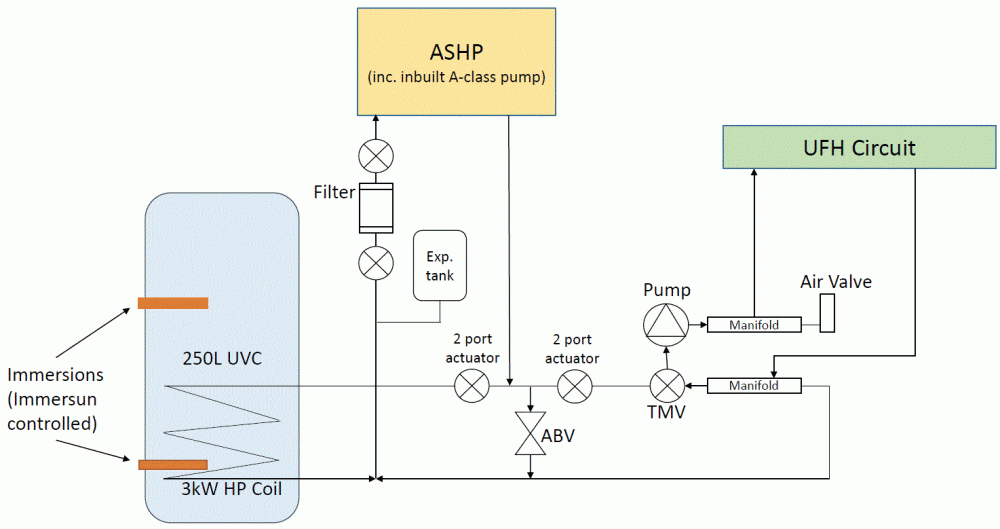
-
Wow, you're not kidding about dust! I can't see ours from the ground and have been meaning to go up on the (flat) roof for a couple of months now to check them. Your photo's given me the impetus to do it today! Re: cleaning, I think some sort of detergent would be useful. Car washing detergent might be the ticket, as it's designed to be safe with paintwork etc. Softened water might make it a little easier to get a streak-free finish, but if you did it in the rain (assuming it ever rains again!) I suppose that's as good.
-
That's my theory as well. Not sure how accurate it is for me in practice...
-
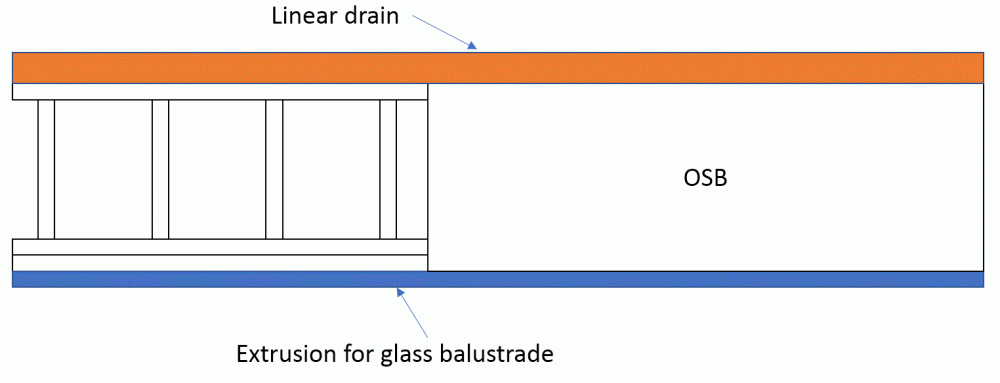
Hi all My wife and I have 9 days without the kids coming up first week of the school holidays, and we plan to make as big a dent in the outstanding jobs on the house as possible. One of those is finishing off balconies. We have three of these: two are about 900mm deep (way less than what "A Pattern Language" says is the minimum for usability!) and run the width of the room they're accessed from (roughly 7m and 4m long). At the moment, they're open joists. These were built up to to a certain height, but with one thing and another this ended up being too high, so we removed the top layer of the frame and now plan to reinstate slightly lower and with a fall. To do this, I need to build a frame from 6x2s, with a slight fall towards a drain along the long length of the balcony. It looks something like this (not to scale!): The original frame that's being replaced was engineered and designed to take the loads from the glass balustrade, and was solely held to together and to the frame below using ring shank nails. Naturally I want to be sure I don't end up with something weaker than the original design and structure. I could hire/borrow/buy a gas nailer and just replicate what was on offer. Is this the best way to go? The alternative is to use lag bolts and/or lots of smaller (but still substantial) stainless or galvanised screws, along with stainless angle brackets and plates, to hold the main frame together. This will take a lot longer, but I've never used a gas nailer before so am a little nervous about cocking up (plus some of the tales of nailer injuries some of the people we had on site exchanged isn't exactly encouraging!) The OSB on the top will add more strength than was originally engineered (at one point the idea was to have decking that just let water through), so that helps, as will the GRP going on top of the OSB. Any advice/tips/warnings? Thanks as always.
-
Comically enormous bath questions
jack replied to divorcingjack's topic in Bathrooms, Ensuites & Wetrooms
I believe building regs specify allowable water usage per person per day, and make assumptions about how often baths are used. Large baths can be a problem I believe, but don't quote me! -
We're equally confused, because I thought the same thing. My ASHP kept throwing an error message until I rang the tech help line and they talked me through changing the pump speed. I assume they expect ASHPs will be installed by trained installers, but even our instruction manual doesn't mention much about flow rates from memory.
-
Yes, sorry, forgot to mention that one!
-
Someone will correct me if I'm wrong, but if there's no tree preservation order on that tree, then the mandated protection scheme only counts until a completion certificate is issued for the house. Once you've got that, you can just remove the tree at will.
-
Actually, we do have a circulating pump on our UFH manifold (I assume this is the one you're talking about?) This setup works fine to keep the house comfortable over winter, but I'm not convinced that the current setup is optimal. I have no idea, for example, how often or for how long the ASHP comes on for. I plan to look at it before winter later this year.
-
I've heard of applying to the council for a demolition licence, but not this. I think the photos + invoice should be enough. If they really want to push it, cancel the direct debit and dare them to take you to court over it!
-
When we had the ceiling in our bedroom re-done following the leak, it was repainted in a different paint than what we originally chose. It's still allegedly matt, but it's clearly got more of a sheen to it than the original stuff that's in the rest of the house. At this time of year, the bright morning sun makes this slight sheen really obvious, and I can see the (very) minor imperfections in the plaster. Put your foot down - the ceiling will be matt, or you'll slash her inflatable jacuzzi
-
No help to you at all, but I personally can't stand non-matt finishes on ceilings. They drive me to distraction, as well as highlighting every little flaw (not that there'll be any on this ceiling, of course ).
-
Welcome to Buildhub!
-
Estate Car to carry house doors inside, flat
jack replied to Ferdinand's topic in General Self Build & DIY Discussion
Problem might be that it's a small market, and 3 for sale effectively floods said market. Amazing cars though - ahead of their time in many ways. -
You definitely feel the drop in temperature when you walk into ours on a hot day. The only thing we've done for cooling is to keep the external blinds closed and to throw all the windows and doors open first thing every morning to get rid of as much heat as possible before the outside temperature gets too high. Once that's done, the windows and doors are closed to keep the heat out. I'd love to do an overnight purge, but insects are a bit of an issue. Long term, we'll definitely be doing something with insect screens on bedroom windows and possibly a security screen door on a downstairs rear door so it can be left open for stack ventilation overnight.
-
Under no circumstances should you wait until the bathroom is finished before starting this!
-
Welcome back, great to see you at Build hub. It looks like we have a new took-the-longest-to-find-us-after-ebuild nominee! Exactly the right attitude imo.
-
Welcome! We're probably not far from you (Surrey/Hampshire border). Lovely part of the world!
-
Don't be so modest. Soz, just deleted the image before reading your comment. It was there because I was going to suggest you get a tool belt before you said you had a nail bag. Deleted it in-text, but forgot to delete it as an attachment.
-
Can you tie a cherry stalk into a knot with your tongue?
-
After 9 years, I hope you have an industrial vacuum cleaner! Ours can be vacuumed, and we got about 18 months of out the filters (vacuuming every 3 months or so) before they started going fluffy and didn't seem to clean up that well. I bought a couple of replacements and will buy some filter media to cut and attach to the original frame when I remove the old filter media. I now have three pairs, so each time I can put in a new/reconditioned one, and still have a spare to tide me over until a recondition the one I've just taken out.
-
Does anybody have underfloor heating with carpets?
jack replied to ThePoplars's topic in Underfloor Heating
We have low temperature underfloor heating (typically the floor is around 21-22 deg C). The only carpeted room downstairs can feel a little cooler than the rest of the house, presumably due to the fact that the concrete elsewhere is a much better heat conductor. If your wet UFH is reasonably high temperature, the carpet will be less of an issue.
.jpg.c21f3ac78c9b7efd90cbdcb312744dc5.thumb.jpg.7adcad4c0e384f5ecd7d56b0618df6e5.jpg)



