


Mike
-
Posts
1565 -
Joined
-
Last visited
-
Days Won
9
Everything posted by Mike
-
As per @Russell griffiths, if you're thinking of using aerated concrete blocks, they're better avoided. They are are notorious for cracking even when, in my experience, correctly using the recommended movement joints and bed reinforcement. Better to choose a medium density block instead. The only other block I know of that can take thin joint are Porotherm, but they have a different set of issues.
-
Yes, rates per 1,000 bricks or m² are normal. Why? You can just measure how many m² of each there is.
-
Yes, the tube. There is no doubt something less harmful, but not one I've used.
-
That's good, but it's possible that the textured ceiling does contain a little. Worth getting a test done.
-
Contact adhesive should do it - I've previously used Evostik.
-
Insulating a former Concrete Water Balancing Tank
Mike replied to Dave and Helen's topic in General Construction Issues
Don't create an internal structure - I'm with @Russell griffiths - insulate externally - those arches should definitely be on show! Plenty of opportunity for an interesting lighting scheme too. Hmm - never tired, but not sure how easy it would be to get a structural warranty on a 1930s structure (as opposed to on the new portion of the build). If it's been storing water I'd guess that the concrete may already be reasonably water-resistant? If so, then controlling any humidity is controlled through MVHR + breathable construction may be adequate. -
Insulating a former Concrete Water Balancing Tank
Mike replied to Dave and Helen's topic in General Construction Issues
In interesting structure that may well outlast the house! Clad it as a roof, not a wall - for example by building a half-barrel vault / parabaloid over the face of it. Could be clad in black sheet metal or zinc (to match your cladding?) or planted as a green 'bank'. Otherwise, for brickwork, a company like Ancon could no doubt come up with a custom supporting structure.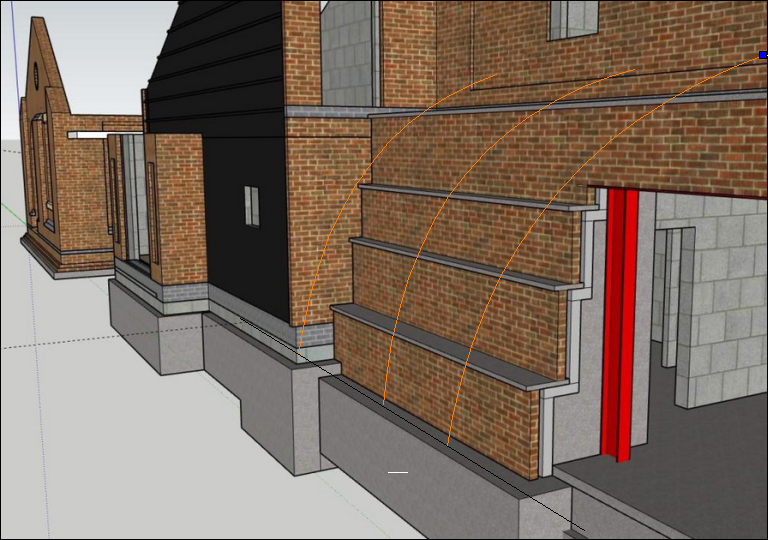
-
My understanding is that the Fire Safety Act 2021 clarified that the building owner is responsible for the fire-safety of the structure (which would, no doubt, include the floor & ceiling with the flat above yours), and the leaseholder is responsible for the fire door into the flat. I'm sure that it's more complex than that, but it may be worth checking it out. I doubt that it says anything about noise though.
-
I agree that insulating externally would be ideal. At the least you should be able add warm roof external insulation above the flat roof. If insulating internally / between the timbers, add additional timbers to the existing external insulation to make space for thicker insulation. I don't have time to reply on air barrier & vapour control - plenty of threads on here discuss them anyway - but you do need an air barrier, don't need a vapour barrier, and may want a vapour control membrane. I wouldn't use wool insulation; if you want a natural product there's wood fibre insulation board, or preferably hemp (which has better vapour control properties) - for example https://hemspan.com/product/bio-wall-natural-fibre-hemp-insulation/.
-
It's for my French renovation, so the supplier won't help much! However this looks very similar: https://www.corkstore24.co.uk/shop/11-thermal-and-sound-insulation-expanded-cork-boards/
-
I'll soon be ordering 30 or 40mm cork board for my current refurb - it's waterproof, breathable and rigid enough to glue plasterboard to.
-
DIY MVHR Design Sanity Checking
Mike replied to BadgerBadger's topic in Mechanical Ventilation with Heat Recovery (MVHR)
...which is exactly what the Zehnder can do in Eco mode, as mentioned rather more briefly above. -
I still prefer hemp & jointing compound.
-
DIY MVHR Design Sanity Checking
Mike replied to BadgerBadger's topic in Mechanical Ventilation with Heat Recovery (MVHR)
I have a pre-heater on my Zehnder unit in France. Without it, in 'standard' mode the unit would shut down if the incoming air drops below around 5°C (there are 3 other modes, including an 'eco' mode that plays with the ventilation rate to switch it on as late as possible. I'd guess that all Zehnders would do the same. I'd rather pay a little extra on the electricity and have the unit working all the time, but you can probably track down some weather data for your area if you want to evaluate roughly how much it would be. -
Yes, 100mm depth works fine. It just takes the floor longer to respond to any changes in settings (compared to thinner screeds) as you have a larger mass to heat up / cool down.
-
DIY MVHR Design Sanity Checking
Mike replied to BadgerBadger's topic in Mechanical Ventilation with Heat Recovery (MVHR)
The Passivhaus component database indicates that the Q450 is suitable for a capacity of 345m³/hr (according to their independent testing). As a guide, you'd want to run it at a maximum of 2/3 to 3/4 of full capacity in normal use to provide some headroom, so in the 230 to 260m³/hr range. As you're likely to be able to run it at less than Building Regs suggests, that's likely to be adequate. As for noise, you probably wouldn't notice a 2dB difference; if it's in a plant room anyway then ignore it. On the other hand, if the cost difference isn't much I might go with the upgrade. -
In a modern French installation, 16A for power and 10A for lighting - you should be able to verify that on your consumer unit. A 500W heater uses 2.2A, so no problem.
-
This. Never sign a contract until you've read it and understand it.
-
I'd go for something like this (and only €17) : https://www.cdiscount.com/bricolage/chauffage/chauffage-soufflant-500w-radiateur-soufflant/f-1661205-byo1692176283180.html
-
Then I'd use a structural wall (blocks or in-situ concrete) faced with brickwork or stone. The most robust timber fence that I can recall that wasn't fixed to a concrete wall, was one that used sections of old railway track as posts. They were cast into deep into the ground before the retaining wall was built around them, and didn't look like they or the fence would be going anywhere.
-
AFAIK there's nothing official. Personally I'd allow 100 to 150mm either side or - for a similar distance & potentially better filtering - choose a wider hood than the hob. For example 600mm hob + 900mm hood.
-
Not an electrician, but my recollection is that you can only have one spur from any 'one point' on a ring main, unless the spur is fused - though maybe 2 connections still count if they're not connected in series (if you can jam in all the wires). But otherwise option 3 would need to be modified to have 1st a FCU, then the 2 new sockets - it would at least be another way of doing it. But I agree that option 1 is best, and option 2 to be avoided.
-
Exterior / Interior Farmhouse Stonewalls - insulation
Mike replied to DavidKilburn's topic in Barn Conversions
If it's cement-based, I'd remove at least the lower 1m to promote moisture evaporation. I'd also remove any gypsum finish anywhere. And anything loose, crazed or hollow sounding. -
Sounds like the support is pretty good. The next significant risk would be from wind getting into the roof. Unless you have calm weather forecast you may need to install a temporary stud gable wall first - you can potentially do the framework from the inside - which may also be helpful for security. However, if there is wall tie failure, are you certain that's confined to the gable?

