Mike
-
Posts
1565 -
Joined
-
Last visited
-
Days Won
9
Everything posted by Mike
-
I'm currently doing similar, but using metal studwork and either 100mm or 145mm (depending on elevation & exposure) of hemp insulation batts, though in France, not the UK, and with render not pointed stone. A good rule of thumb, and wise to stick to it in the absence of a WUFI evaluation. From playing with the trial version of WUFI, in some circumstances more insulation actually reduces the risk (at least when using hemp insulation, which has superior vapour-handling properties to non-natural insulation materials). Plasterboard and skim is indeed vapour-permiable. Make sure that the paint that you use is too though, or you'll negate that. Chances are it's not needed, especially with MVHR, but but 'intelligent' VCLs are commonly specified. Good pointing is crucial. Especially on an exposed wall, moisture ingress from outside may be a much bigger factor that vapour ingress from the inside. Airtightness from the outside is also important. Junctions of materials (wall to window etc.) are the weak points. Plenty of other threads on that here. Agreed. And contrary to official UK Government advice too - https://www.gov.uk/government/publications/retrofit-internal-wall-insulation-best-practice It would be crazy not to!
-
Important points. Unfortunately that's no longer the case; they overtook us in 1998. In terms of cumulative emissions since 1750, and by 2022 the UK had contributed 4.45%, Germany 5.3%, Russia 6.73% China 14.7% and the USA 24.08% More info and animation at https://ourworldindata.org/grapher/share-of-cumulative-co2?tab=map

-
I think this is your answer: For example: https://www.satellitevu.com/
-
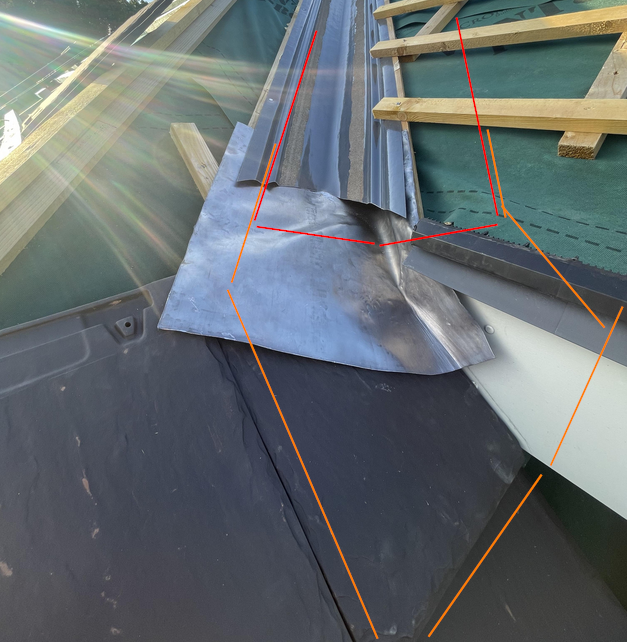
You also need a bigger piece of lead, so that the fascia board is protected where it meets the tiles. You may be able to place the lead under the tile as a soaker, if the pre-formed valley projects further.
-
I don't recall what I last used, but Mapei Silancolor and Emperor would be on my shortlist. By the way, if you do end up painting direct to the wall, remove the point by steam, not paint stripper - you don't want any residue to strip off the new paint. I guess there's a small chance that a new grant/subsidy scheme may turn up now there's a new Government. Possibly worth handing on a few months just in case?
-
May be worth looking at in the UK, but since Brexit it's not going to work in the EU - except for anyone rich enough to buy a local passport, or (if the rules allow it) as a holiday home.
-
I'd use either or a lime render, preferably over external insulation (but stopping short of the DPC, if there is one), or a vapour-permiable masonry paint, or both. I'd strip the existing masonry paint first, though that may not be easy. Try a paint stripper, or get in a specialist to steam it off. Internally, nothing - just let it dry out for as long as you can. Then vapour-permiable insulation (if you can't insulate externally) + lime plaster + vapour permeable paint.
-
Large van or dropside truck?
Mike replied to flanagaj's topic in General Self Build & DIY Discussion
I don't own one, but have hired one (or the Toyota Proace version) several times when needed. The bulkhead flap is handy for longer items such as 3m long metal studs. With deliveries, I've not needed anything bigger, though depends what you're building, I guess. -
You don't hear about them much these days, but back in the 80s there was an uptick in community self-build schemes (also known as self-build co-operatives and various other names). They do still happen, and if you can find others interested, you could potentially set one up. It's the sort of things that councils once supported / help organise. Normally they employed a pro site manager and had a mix of people - some with building trades knowledge, others none. The idea was often to build everyone a house of similar size, so typically each contributed the same number of hours and those without skills learnt as they went. Though there are other models. More reading at https://mycommunity.org.uk/what-is-a-community-self-build-housing-project
-
2.500 Acre Solar Farm.
Mike replied to twice round the block's topic in Environmental Building Politics
Some examples: https://www.batimentphotovoltaique.fr/details-ombriere+solaire+de+parking+a+toulouse+marseille+bordeaux-114.html https://www.francebleu.fr/infos/climat-environnement/un-parking-ecolo-l-aeroport-de-montpellier-1447431640 https://actu.fr/pays-de-la-loire/saint-aignan-grandlieu_44150/pres-laeroport-nantes-citoyens-investissent-dans-photovoltaique_24928418.html The last one is particularly interesting as it's partly crowd funded. Projects that meet the required standards (suitable scope, transparent investment information, positive environmental impact, etc.) can obtain official recognition, via a number of approved crowd-funding platforms, under the national 'crowd funding for green growth' scheme. In this case anyone in the département (county), or the neighbouring ones, could buy a stake for €100 and earn a 5% annual return - https://fr.enerfip.eu/placer-son-argent/investissement-solaire/centrale-au-sol-de-saint-aignan/ -
2.500 Acre Solar Farm.
Mike replied to twice round the block's topic in Environmental Building Politics
Or maybe free recharging... -
2.500 Acre Solar Farm.
Mike replied to twice round the block's topic in Environmental Building Politics
Not sure about the economics in the UK, but it happens elsewhere - https://en.wikipedia.org/wiki/Agrivoltaics France has recently published updated legislation on the topic - https://apasec.net/articles/18/04/2024/Agrivoltaisme-le-decret-est-enfin-publie-au-Journal-officiel-91204/ (summary in French). The key rules, to be reviewed after a year, are it must be possible to return the land to its previous state, no more than 40% of the land surface can be covered by panels, and the land must loose no more than 10% of it's production capacity each year (compared to a suitable reference plot). France has made progress on that too. The 2019 ELAN law now (in 2024) requires all new or re-roofed commercial buildings >500m², to have at least 30% of the roof (50% from 2027) covered with solar PV, or a green roof, or something else of similar environmental value. It will be extended to cover most non-domestic buildings from 2028. There are exemptions where it's not technically / financially realistic to do so. Similar rules apply to new and existing car parks >500m², whether covered or open air, which must have at least 50% PV coverage. Existing car parks must be retrofitted by either 2026 or 2028 depending on size. -
Large MVHR recommendations.
Mike replied to ChrisDL's topic in Mechanical Ventilation with Heat Recovery (MVHR)
You may well be better off with 2, but here's the PassivHaus database for large units: https://database.passivehouse.com/en/components/list/ventilation_big?page_count=50 -
Habito, Fermacell, OSB & Plasterboard, Ply & Plasterboard, or…..
Mike replied to G and J's topic in Building Materials
I'm using Gypsotech GopsoLignum, often in 2 layers. It's somewhere above Habito in properties, on the way towards Fermacell. They do have a UK office, but not sure how easy it is to find (I'm using it in France) It depends on the brand. Some are, others are not. -
2003:
-
MVHR and log burner
Mike replied to Tetrarch's topic in Mechanical Ventilation with Heat Recovery (MVHR)
A fully room-sealed stove is undoubtedly the way to go, but also worth knowing that some MVHR units - those from Zehnder, at least - include an optional 'chimney' mode that can reduce the risk of air being pulled back from a chimney. Presumably it maintains a positive pressure in the house. -
It looks like efflorescence to me - crystalline salt deposits. Crush some and it should turn to powder. It's caused by the presence of moisture though, so eliminating that would be the long-term solution (as it would be for mould too).
-
If I recall corrrectly, UFCH pipe generally needs to be protected from UV light, so I wouldn't expect it to last long in a garden. Unless, perhaps, you plan to bury it.
-
Yes, a perfect vapour barrier would result in no migration and would solve the problem, and save me having to pay a consultant too, which would be good! Unfortunately perfect vapour barriers are not easy to achieve in new-build, and harder in retrofit (UK Government advice is not to use them in retrofit). I am sure that there will be some leakage through the partitions into the ceiling insulation, so have added an allowance for that in the WUFI model. In the best case the moisture escaping through the top of the structure to outside is enough to keep relative humidity below 80%, but in the worse it's above 80% for around 9 months of the year. To find the actual leakage level would need a blower door test, but that value may well worsen over time as the building ages. Adding an smart vapour check, such as Intello (which lets vapour through in both directions at a variable rate depending on the temperature differential between the two sides) is likely to be a better option. Under 'worst-case' air leakage, the forecast maximum moisture content in the insulation during a year is reduced by about 13%, compared to having no vapour check. And, instead of the top of the insulation having the highest moisture content (75% peak relative humidity), it's the bottom of the insulation, next to the Intello that has the higher value (80% peak relative humidity). I suspect that I'll end up installing Intello to provide some extra safety, but it's not a panacea. Either way, the more realistic the curve for relative humidity the better, so any ideas on that are still welcome.
-
Sounds good - I'll add it to my list, thanks!
-
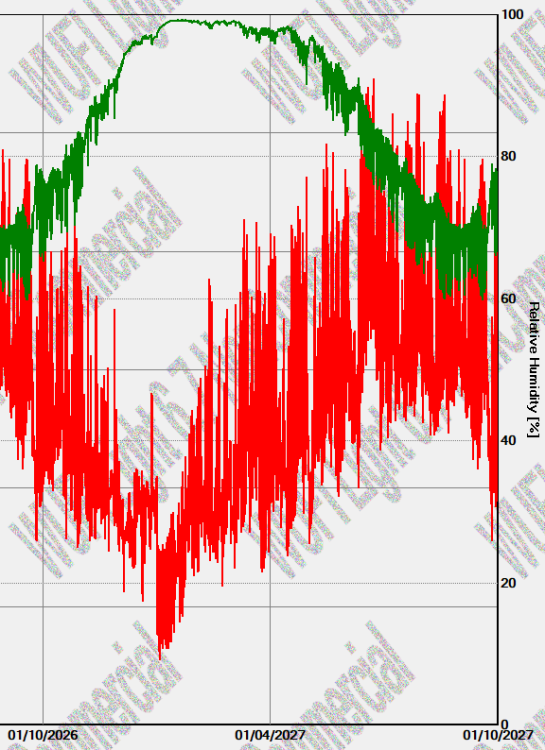
It makes a difference in the context of WUFI modelling and, in real life in the structure being modelled. Simplistically, moisture builds up in the structure when internal RH goes up or external temperature drops, and is released when the opposite happens. For example, at the top of the insulation in my unventilated ceiling, using the improbably 'ASHRAE 160' internal relative humidity proposed by my consultant, the insulation would stay at almost 100% relative humidity for more than half the year (the green line). Which would be seriously bad. This is modelled without adding an Intello membrane, but that's wouldn't save it. Using an updated version of the sine curve I posted above for temperature & RH, it looks as below, with RH peaking below 80%, also without Intello. It's OK if it peaks above 80%, as long as it doesn't stay there for too long, but since I expect to be near that danger line and the internal environment is one of the biggest drivers of what happens, It's essential that the consultant uses sensible, realistic internal RH values. Yes, that would certainly be useful to cap the upper limit!

-
Good idea. I've put together a minor Excel calculator, posted here in case anyone else finds it useful. Still need to have a think about adding some allowance for internally generated humidity. While it will be removed via the MVHR system, there will be some additional moisture load. MikeRelativeHumidityConverter_v1.0.xlsx
- 44 replies
-
- 1
-

-
- mvhr
- relative humidity
- (and 3 more)
-
I'm also adding an inline pre-filter to mine - a Paul / Zehnder Iso-box DN 160 - that can take a carbon filter, in case it's needed.
-
I'm getting a pro involved too, partly for the same reason - I have an tricky unventilated ceiling to insulate with limited options (a renovation) - and partly because the the free version is too restrictive anyway. However the consultant has proposed using ASHRAE 160 for the internal environment which, from playing with the free version, seems entirely unrealistic - as do all the other options. Hence this thread. The free version is useful for exploring some of the materials choices too - such as the impact of using Intello (more pronounced than I'd expected); choosing between hemp -v- Rockwool insulation batts (hemp results in lower peak moisture loads, which I'd expected) and the insulation thickness (adding more insulation also reduces peak moisture). I've been thinking about that too - which ones do you select, and what are you monitoring them with? That's why I'm after something better. The more realist the input the more realistic the output, even if still only a guide. An interesting couple of graphs there, thanks!
-
Yes, it soon gets complicated like that, and I'm going to have to be very unscientific this time. However the methods included with WUFI look detached from reality for MVHR: The ISO 13788 option has 'humidity classes' to choose (i.e. guess), and one mean internal temperature to pick (constant for the entire year). To get relative humidity into the kind of range that I'd expect for a year (35% to 50% or so) requires that temperature to be around 30°C, which clearly isn't realistic. ASHRAE 160 takes the external climate file and generates the internal climate from that. It can take into account air changes, but assumes pulling in air at external temperature & RH, modified only by heating or aircon - no heat exchange option. That makes it very driven by building volume, and for a small volume like mine the internal climate generated is sub-tropical - in my case forecasting year-round RH at about 70%. Or from 35% in winter to 70% in summer if I plug in a moisture generation rate of 0.00003 kg/s (which has no link to anything). EN 15026, if I choose a 'low moisture load', comes closest to my expectations, but relative humidity is capped at 55% from mid-June until the end of September. It may peak at that, but to stay that way for a third of the year? Seems unlikely, but maybe. The external climate file (based on real data) can also be used as-is, but that's not helpful unless designing a building without walls or a roof (not even a tent). It looks like the paid version may have the option to input your own data, which is fine If you've been monitoring an existing building for a while, or you have some other software in which to model the internal environment (edit: looks like WUFI Plus can do that), but no good to me. The only other option is to 'best guess' one sine curve for temperature and another for RH, ignoring the fine detail. As the results from WUFI are only used a long time scales - months or years - such generalisation should work, I imagine. So data to (literally) help shape these would be useful - or just comments & opinions. At the cold end that looks about in line with my attempt, which is encouraging. I've picked low RH of 32% in mid-March, and a high of 48% in mid September (the peak and high have to be 6 months apart; I've put the high one month after peak August temperatures) - does that seem plausible?