Bitpipe
-
Posts
4118 -
Joined
-
Last visited
-
Days Won
53
Everything posted by Bitpipe
-
I've learned a lot from our limestone patio. While it looks good, the flat grey grey 600x800 flags should have been sealed immediately after laying (my fault) as they're like sponges. I also used BAL wide joint grout but was not happy with the end result, so ground out the joins that I had done and redone with a few buckets of sweep in Easy Joint which is much easier to use. Biggest issue is that we laid them on sand and cement mortar over a well compacted MOT 1 base. However as they're porous, the downpour followed by hard frost over winter caused a few to pop and start moving. I lifted and re-laid the worst ones with tile adhesive and all is good. Ideally I should have poured a concrete base and bonded them all with tile adhesive but this would have significantly increased the cost. I bonded a few others with waterproof PVA and while they're holding fast, there are shadows where the PVA has leeched up into the limestone so they will need to be replaced or may try and clean with a sealant remover first. Will give them all a good clean with a limestone cleaning product and then seal. Upside is I got the slabs at a very keen rate of £39.99/m2 which is approaching half price - no idea how the merchant got that price and as they have now gone bust, maybe neither did they ... Like all things, you obsess over the detail, kick yourself over the mistakes and then move onto something else and forget about it
-

Using a garage as a caravan awning.
Bitpipe replied to epsilonGreedy's topic in General Self Build & DIY Discussion
We used a dehumidifier to keep our caravan dry and warm in winter - found that the gas fire created too much water vapour which settled on the floor at night and made it damp and cold in the mornings. However keeping warm was never a challenge, it got super hot in the summer and cooling it was much more difficult. -
Or anticipating a post football hangover. Will the national co2 / beer shortage drive an increase of productivity?
-
We bought our own cable (TLC 10 pair, 50m for £60) and pulled it through our own laid duct - had a grey BT hockey stick next to the pole and they made the connection there and in the plant room where the cable came in. BT never saw the duct in the ground but most of it was the right stuff. This was cheaper than getting OR to do it (would have charged £5/m for cable and pull though plus ££ for the road crossing). Because we were opting out of a overhead drop wire, we needed to pay for the works or DIY them. No charge for the connections though as we ordered a new line.
-
Thought exercise: On my system, there is an IC directly where the internal run meets the external run for each stack (I have four - utility, kitchen, front stack, rear stack). Then ICs where runs meet or to break up long linear runs. If I get a blockage in the external run (and I've had a few, obviously some debris found its way in during construction) it's easy to rod / powerwash the drains from IC to IC and clean everything out from the house to the main sewer. In your blue run, how would you do this? If you have the first IC on the terrace , you'd be able to flush from there to sewer but how would you clean the section behind it (without pushing blockage further back up the pipe). Not sure if its a good idea or not, but you could extend the blue runs further back to a rodding eye (one next to bin store, one next to parking) and solve for this issue. We have these for rain water runs - no idea if they are acceptable for foul runs. Its tempting to save money on ICs, pipe, excavation etc at this stage but think carefully on any unintended consequences - you will not be able to remedy later.
-
Having just completed hard landscaping, I've had to deal with a few poorly located chambers - two were partially covered by my path to the driveway and another was too close to the house. ICs can more or less go anywhere so do some thinking on where hard and soft surfaces will be, boundaries (fences, walls etc) and make sure your chambers are well clear of any interface. Can't really move them once they're in! Agree with Mike that IC covers in lawn are tricky - you can try and keep them low so a mower will go over them (paint green ) - turf tends not to do well on top of them.
-
No expert, but the established practice tends to be minimising long foul runs under your slab to enable maintenance, rodding etc. Both your architect and builder seem to be following this convention. I have a similar arrangement, basically a square footprint with fouls front and back, main sewer to front. The rear fouls exit the house and follow the house footprint with an IC at each turn. Felt like a bit of overkill but there was enough fall to make it work and wasn't that expensive in the grand scheme (also worked for us as we had a caravan at the rear of the site during the build that used that foul run also). I've had a few blockages since and have been glad that rodding the whole run is straight forward. N.B. best practice is also to have ICs every 8-9m as the rodding kits are typically 10m long. If you use Clarke style covers then they blend in very well with paving or other hard surfacing. You seem to have plenty of fall (1:40-1:80 is the recommended range) so no need to minimise the length of the run - what's your motivation?
-
Ours (also Siemens) is so quiet I often open it by mistake when it's on and get a free wash. Yes, I know there is a light that shines on the floor but I never notice that.
-
We had to twist our architect's arm to include a basement and it's the best idea we had - just think carefully on how it works with the house above - ideally you want it to follow the footprint as much as possible - at the very least spine walls etc. The cost per m2 is quite reasonable but only if you go large - small basements are quite expensive.
-
In planning we had to respond to the Lifetime for Homes standard - while not binding (like part M) there was good food for thought on how the house could be adapted to enable ground floor sleeping and washing facilities, chairlifts to upper floors, support of hoists etc incase disability or illness changed the needs of the occupants.
-
Lots of feedback here that is valid. A basement is good value and adds valuable space that planners tend not to look at too closely, but they're only really economical if they follow the footprint of the house and act as the foundations. Great for cinema room, gym etc and as teenager space when the kids get older. You will need a means of escape that is independent to the internal stairwell or a sprinkler system to meet regs though. If you put these rooms in loft then consider the noise transmission to bedrooms below (It's very expensive and difficult to minimise impact noise from floor to floor). Think also as to which bedrooms are above which reception rooms and how they will be used in the evening - when you have teens and want an early night, will their watching TV disturb you? Orientation to sun is also key - we put the kids rooms on east so bright in morning and darker at night. I think theres a lot to be said for designing the house from inside out vs the other way round... Other than that I agree on the comments on flow. Our previous house was new build but lots of individual rooms which never really worked (after we sold it, the new owners made it open plan). Current self built house is effectively a cube with an open plan U downstairs from kitchen to dining to living and a separate study. Rooms are defined by furniture and there is more flexibility in use and layout - works well. Before you redesign, read the Mark Brinkley Home Builders bible - lots of important principals there on designing out cost - a cube always has the maximum practical usable area to wall ratio, rectangles less so and corners cost money. Gable ends vs hipped roof reduce complexity and offer more room in roof space. Obviously you don't want a plain facade but too much detail will just end up costing you money (I have pretty bedroom balconies that I will rarely use and they gobbled up lots of budget) balustrade glass is quite expensive and needs careful structural thought on what it sits on or attaches to. Also, assuming you build to a relatively decent standard of airtightness and insulation, overheating will be your main concern, especially with large expanses of glass. Have you given thought to your heating / ventilation strategy? location of DHW generation / MVHR wrt use (i.e. as central as possible) Where will your DHW storage be? Why do you have a chimney? If its for a log burner etc, consider whether it is needed for heat generation (big risk of overheating that small lounge) and the environmental issues of wood burning and possible restrictions on that. Regarding storage, you always need more than you think but my experience is that long shallow cupboards are more useful than narrow deep ones. We gave each bedroom a run of ikea wardrobes that were framed in once assembled and that's more than enough for each room. A large cupboard downstairs for coats, shoes, and cleaning/ironing equipment and one on the first floor for laundry, towels bedding etc.
-
To grey water or not to grey water.
Bitpipe replied to MikeSharp01's topic in Environmental Products
Yup - and you have the satisfaction of a jumbo up-cycling project. -
Thinking about ditching our 'Architect'
Bitpipe replied to CADjockey's topic in Surveyors & Architects
Our architect came up with a design that was contemporary but also fitted into the street scene, met our aesthetic and delivered on the usability front also. We had a lot of input into the process but got a lot out of them also. We got it through planning on the second attempt and their knowledge of local planning politics and ability to tactically draw on expertise (traffic engineering, planning consultants etc) was very useful and central to getting planning permission. Would never have managed to get this far solo. Thereafter however we parted company (on friendly terms) as they wanted a sizeable fee for the next stage building regs / planning conditions / tendering etc. As it was, we had a pause in proceedings while we decided on our build strategy and I stumbled into this forum's predecessor - learning about low energy builds etc and then going down the route of timber frame package builds. This gave us the confidence to take on the second stage activities ourselves and proceed to project manage the build. Like Jack, while not perfect, we're pretty happy with the outcome. I have friends in Ireland who were about to start work on approved designs, got cold feet and started again from scratch - never regretted it for a moment, despite the sunk cost. Look at it this way, you've not entirely wasted the money you've spent so far as you've qualified a lot of issues but you may need to spend some more to get what you need. Believe me, by the end of the build, architect fees will seem like a distant memory -
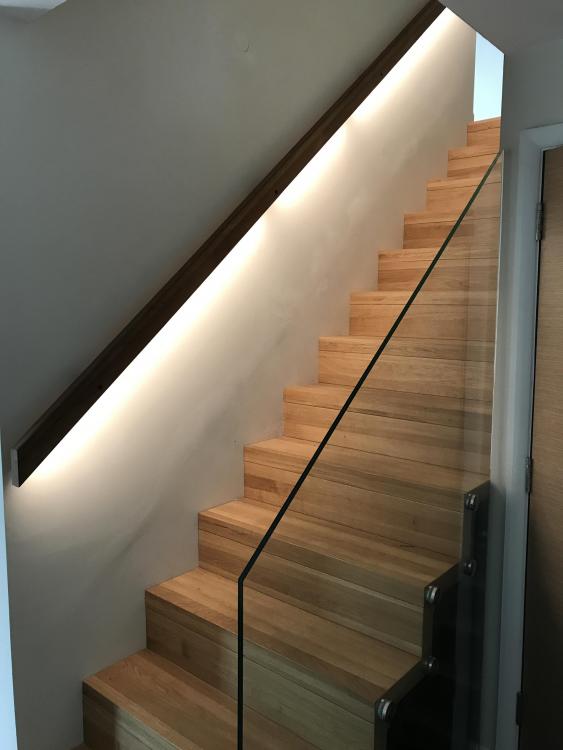
Was cheap to do - had handrail company route a groove and sparky installed an alu channel, LED strip and diffuser. Main challenge was remembering where the cable was hidden behind wall - wasn’t able to fish it out neatly so needed to cut a small disc out of wall, fish cable and make good.
-
We put a LED strip in a routed recess (done by manufacturer) in the underside of the handrail, which is fixed to the wall. Sparky made provision for this at 1st fix with a low voltage cable placed behind the wall and the connection to the transformer made in ceiling behind a downlight. Only challenge has been how to control it - currently on a lux but that is not sensitive enough and is on all night. Going to switch to a PIR at some stage.
-
The Build - Scaffolding ahead of TF arriving
Bitpipe commented on Redoctober's blog entry in Our Journey North of the Border
So the week that I was under pressure to order the scaff, my other half was doing jury duty. She obv. wasn't allowed to say anything at the time but the trial was guys from a local scaff firm who were up for burglary and receiving. Luckily I was talking to a different firm.... -
I'm applying a 200mm band of Ubiflex, the lead flashing replacement on the strip of exposed EPS - its a mesh bitumen sandwich finished with stone chips so looks quite smart. I'm sure a strip of EPS 300 or equivalent would have the same load bearing properties - we used EPS 200 in our basement slab and it was rock hard - did not need to cut any thank goodness. However challenge would be getting the foam cut to size (I could only get it in 1200 x 2400 blocks. For our thresholds we cast the walls as flat and then when applying the external 200mm thick EPS 70, first resin bonded 200mm cuts of rebar 100mm into the wall at regular intervals and then tied a bar across that. The EPS had a 100mm x 100mm x window / door length channel cut in the top and that created the former for the concrete that formed the corbel. So each one still has 100m insulation vs 200mm elsewhere. Corbels still needed about 75mm timber buildup to enable the doors to be flush with internal floors - could have tried to do that in concrete but wanted to wait until frame was up and sub floor in.
-
The Build - Scaffolding ahead of TF arriving
Bitpipe commented on Redoctober's blog entry in Our Journey North of the Border
I paid more or less the same for 12 week hire, was playing two guys against each other until we got down to best prices. That said I wasn't savvy enough to negotiate on the 12 week hire (5% overage per week) and didn't agree any adaptions as none were anticipated. Ours was two main lifts with a third table at the gable ends - about 8.5m high. It was over the exposed basement which was about 3m deep so quite a drop - wasn't brave enough to go beyond the second stage until the frame was up. MBC did knock it about a bit when installing as it was too tight, much to displeasure of the scaff guys who wanted ££s to 'make safe' before takign it down. Render crew put it back right again, no trades had issues with the safety, was more like the scaff guys trying to make a few quid. Of all the trades, they were the only vaguely unpleasant ones on site. -
Come on baby, light my fire!
Bitpipe replied to vivienz's topic in General Self Build & DIY Discussion
When the lads cleared our garden last July, they started by building a modest fire, a few m high, with the hedge cuttings that had been lying around for a year, the old chicken coop, greenhouse frame and I added some tree cuttings that were a few years old plus any old timber still lying on site. They planned to burn it later in the week when rain was forecast but it was blazing hot all week. Finally on the Thursday they lit it with no accelerant whatsoever. Flames went about 15m up and a spruce about 20 m away started to smoulder. After 10 mins intensive blaze, fire collapsed into a heap and was done - virtually no smoke. A few weeks later, the hedge 12m either side of the fire and the spruce started to go brown, showing how big the heat ball was... They tried to hose it but was too hot to get anywhere close. So be careful -
Come on baby, light my fire!
Bitpipe replied to vivienz's topic in General Self Build & DIY Discussion
Our landscapers dispatched lots of beech hedge and a few trees in January - roots and all. I was sceptical that it wouldn't burn but they started with a few smashed up pallets and used a leaf blower to keep it going - the roots will smoulder overnight to ash once the main fire has died down. A good hot fire will not generate that much smoke. Declan, you remind me why I can never have any of the old NI gang round to visit - always desperate to get a wee fire going. One mate had to be restrained from burning the garden Jenga .. -
Despite wanting to ditch our landline (as we never use it, BB is now on the separate business line I use) we found the PostOffice has the cheapest voice only deal if you want basic connectivity - I think about £12 a month. When we did the initial re-connection with BT, they waived the fee as we took a 18 Mo BB package. Use Quidco to get a decent sign up cash back (I can see deals today from £65 to £210) Order your BT products (or PlusNet / Sky etc...) When the OR crew come to site you can then chat through any specifics - this is when I discussed using my ducting vs drop wire from pole. The engineer then organised a survey and the conclusion from that was that I'd do my own road work. I let the order lapse, did the work and then did a new order with BT. OR came and were happy to use the wire I'd coiled at the bottom of the pole. You can't get through to OR directly, they'll only come out once an order is on the system from a service provider.
-
Sobering - there must be countless occurrences of asbestos exposure though less diligent practices than yours. My uncle died from a lung condition in his mid 70s a few years back - not asbestos related but suspected to be something similar that he was exposed to while working in a chemical plant in the 60s. Our 1950's build had surprisingly little asbestos when we did the pre-demo destructive survey (not even in soffits) and the suspicion was that they had been removed in the 80s when the house had a refurb - probably just skipped & dumped back then. Anyway, onward and upward - hopefully that's the last of the nasty surprises.
-
Plastering ICF Basement Walls
Bitpipe replied to Triassic's topic in Insulated Concrete Formwork (ICF)
I remember from our own ICF research that render can be applied direct to the outside face but the internal finish needs to be PB. http://becowallform.co.uk/wp-content/uploads/BuildIt.0616.ICF_.pdf Inside, the plasterboard is dot and dabbed to the internal facings and plaster skimmed ready for final finishing. -
Not sure why you think that extending your private home network around the house would incur any subscription cost? You obv. pay for the home internet connection (of whatever flavour) but after that its up to you. I currently use old BT SmartHubs acting as repeaters to squirt the wifi around the house and it works fine - not sure if I'm loosing any bandwidth in doing this. I set each up with a different SSID (basically the same SSID with a number at the end) and provided all three are provisioned on the device then it will usually jump on the strongest one - should work fine if they have the same SSID but then I have no way to 'shove' a device onto a stronger signal if it's clinging to an old one. Like the look of the Ubiquiti kit - I only have a standard 48 port switch at present in loft where all the cat 6 terminates but almost every wall plate is next to power so not a huge issue. How does it compare to the BT branded mesh wifi as resold on Amazon etc?
-
MVHR - flies!
Bitpipe replied to readiescards's topic in Mechanical Ventilation with Heat Recovery (MVHR)
I have one - have not had this issue but agree that the seal between incoming filter and chamber is not 100% - I gave our heat exchanger a good clean last year once we'd finished our landscaping - was quite grubby but scrubbed up well.