


Beelbeebub
-
Posts
1522 -
Joined
-
Last visited
-
Days Won
11
Everything posted by Beelbeebub
-
Mimicking solar panels from an AC supply
Beelbeebub replied to Beelbeebub's topic in Photovoltaics (PV)
I don't think supplying each flat with a submeter PV would work. The connection from the PV would have to be after their meter, otherwise I could supply elec and their energy supplier would get paid! 😁 But that would mean each flat would be interconnected after the meter. If flat A drew power it would flow through the meters of Flat A, B, C etc. There would be no way to untangle who used what. I could wire each flat to it's own string but then have to run DC to each flat, there there are issues of a particular panel fails that flat loses it's PV, whilst if I share across one big array I can just disconnect the affected string and the system runs at a reduced capacity Which is why I thought about distributing the PV power as DC through the solar input. It should isolate each system and prevent "cross feeding" and allow flexibility for each flat to use more than it's share if nobody else is using it. -
Mimicking solar panels from an AC supply
Beelbeebub replied to Beelbeebub's topic in Photovoltaics (PV)
I'm trying to work out a way for a number of flats to share a single panel array. My thinking is a single large array and 3ph inverter provide a 240v supply and then each flat can have a standard hybrid inverter and battery pack fed by what it thinks is it's own PV array, but is actually this hypothetical device taking power from the actual array supply (that is totally separated from the mains). -
Bit of an odd question : Is anybody aware of a device that takes an AC 240v input and outputs a DC supply in a manner so it can be plugged into a hybrid inverter and the inverter think it's connected to a PV string? Ideally the device would be able to be controlled so the power delivered to the inverter could be varied in real time.
-
Most newer inverters have an export limiter so you can run an 8kw inverter with a 4kw export limit. I believe you still need to fill in a form but there isn't an approval issue. The worst case is they limit you to the 3.7Kw "default".
-
Saw this over on bluesky "Right now, mainland Britain has got almost enough wind and solar power to meet our electricity demand. Add in the power from nuclear and a small dash of gas (used solely to maintain enough mechanical inertia to stabilise the grid) and we are having to export 4.4GW to neighbouring countries. The need for that safety inertia will fall away with new renewable sites like Dogger Bank, whose inverters are capable of ‘grid forming’ as opposed to merely grid following… ... What this means is that their power electronics are designed to mimic the frequency and voltage stabilisation the the old spinning tire w turbines produce mechanically. Massive batteries being built around the country will do the same. That means that soon, on a day like this, we will see the grid run exclusively on renewables and nuclear." I did wonder about the various takes that we need fossil fuel generators for grid stability. Yes the spinning inertia helps stabilise the frequency but only so far as a spinning energy store will drop frequency as it delivers power. Once it slows down from 50hz to 48.8hz (or whatever the cutout is) it has to disconnect. So only a small portion of the power is available. Whereas inverter systems can theoretically provide 50hz for their entire power delivery.
-
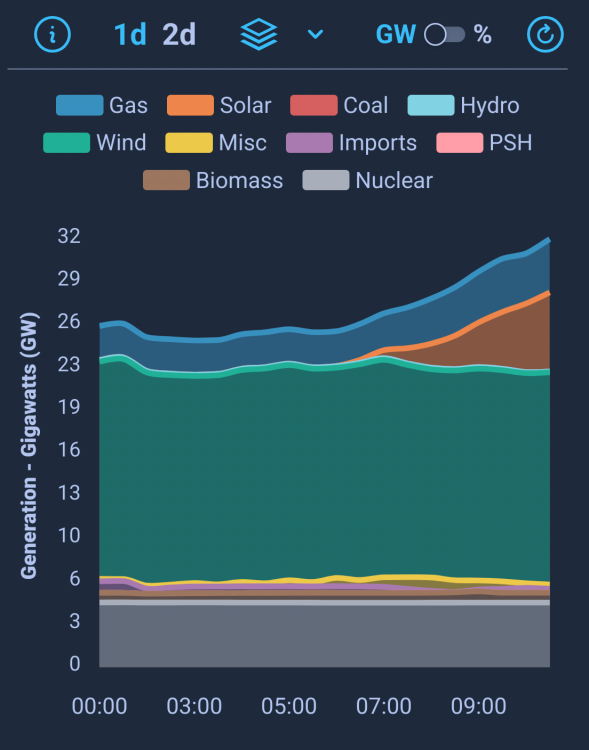
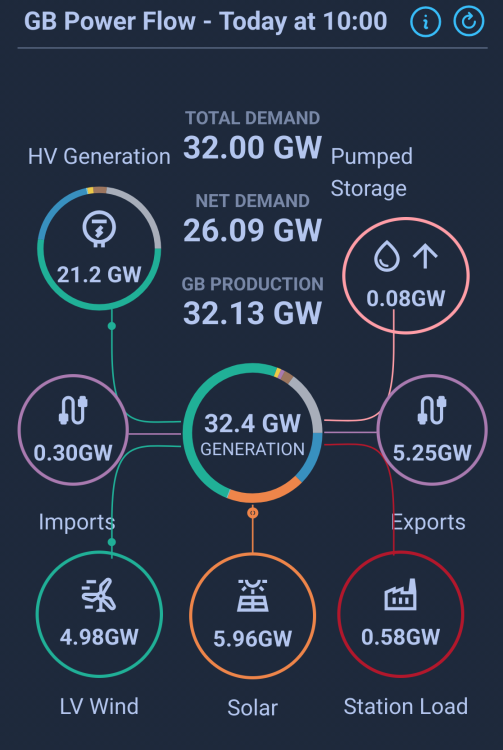
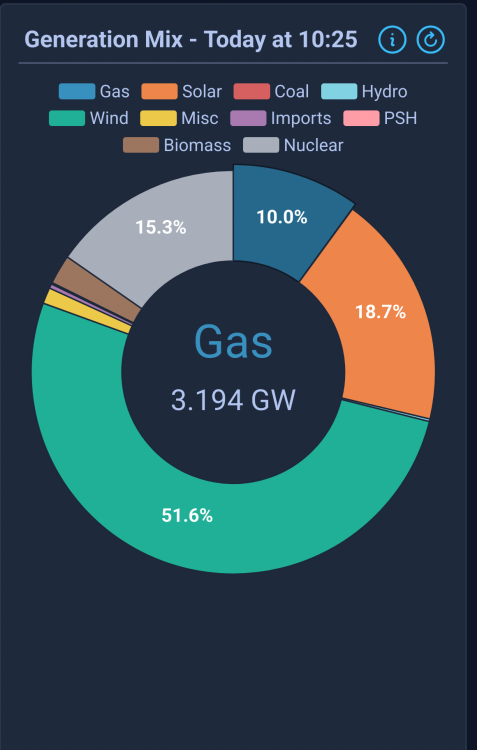
So this morning (Sunday 25 May) the wind is blowing, the sun is shining and nearly 70% of our electrifty is coming from renewables. But the wholesale price will be set by the 3GW of gas that is being produced. Fine, that's just how it is. But we are also currently exporting 5GW of electricity. So if we just exported 2GW we could burn no gas and get cheaper electricity? If you look at the generation mix graphs you can see that we seem to be constantly burning gas even though we have enough generation for demand (and even export). The gas portion holds at a steady 3GW-ish. I get we need to keep gas plants up and spinning even in periods of plentiful renewables just in case we get a fault or the wind unexpectedly dies or whatever and they have to step in rapidly. But in that case is the Dutch auction system really a good way to price electricity? Surely it wouod be better for gas plants to be in their own separate silo as a "backup" generator with costs spread equally across the year as with other infrastructure like substations and cables.
-
Spain/Portugal blackout
Beelbeebub replied to Beelbeebub's topic in General Alternative Energy Issues
I think the rise in gas later on is due to their model not "seeing" any more renewable generation being added in the future due to assumptions. From the notes on the graph you mention. "Natural gas generation responds to this increasing low carbon generation by falling rapidly until the late 2020s. It then stabilises as less new low carbon generation capacity comes online based only on EEP-ready policies. By 2040 it will be around 48 TWh, 61% lower than 2022 levels...." (my emphasis) The EPP-ready bit is that they only consider policies that have been approved or funded at the current time. So they aren't including any new capacity that is at too early stage of development. We don't know what the policies will be in 2040 or even the technologies available then. Maybe we'll all be whizzing about in our cold fusion powered jetpack by then. It is likely (in the absence of the aforementioned cold fusion jet packs or similar) that we will need some sort of thermal power backup and that may well be gas. But hopefully in smaller amounts than predicted there. -
Spain/Portugal blackout
Beelbeebub replied to Beelbeebub's topic in General Alternative Energy Issues
All good points about the possibility of local substation store The counter would be the tech for the home batt system is already here from multiple vendors There aren't any planning or space issues. The per house would be part funded by householders, probably the richer ones. The subsidy being maybe lower vat or some sort of rebate. That rebate could be scaled for companies or technologies we deem worthy eg UK manufactured systems or new chemistries like sodium thus giving an industrial benefit. The per house would give very good resilience against a Spain style blackout - plus alot will split "critical" circuits that are backed up (eg lights, freezers, comms) from non critical stuff like drivers or ev chargers to improve the runtime per stored kwh. This isn't easy for a substation system which woukd have to support people charging EVs, taking showers etc during a blackout. The per house would also make peak shifting /shaving more of an individual choice rather than enforced from above. -
Spain/Portugal blackout
Beelbeebub replied to Beelbeebub's topic in General Alternative Energy Issues
If lots of properties had 5 or 10kWh batteries with maybe a 3-5kW inverter then alot of the peaks could probably be ironed out. It would give a pretty good load shedding option for when something catastrophic happened to the grid eg a major inter connector going down. A 10kWh /55kW unit is pretty discreet these days and around about 5-7k installed. -
Spain/Portugal blackout
Beelbeebub replied to Beelbeebub's topic in General Alternative Energy Issues
The report projects gas falling by around 60% from current ie 10% total annual. As you say we will always need something for when wind and solar are a no go. In the absence of lots more nuclear it will likely be gas. But that's fine. What we do need to do is stop gas being the price setter outside of the times when it is doing the majority. Maybe if the price is set on gas (or whichever fuel) only if it exceeds a certain percentage. Essentially setting the price on the 90% (or whatever) generator not the 100% So the expensive gas etc get paid, but everyone else gets a lower (but still higher than cost) price. -
Spain/Portugal blackout
Beelbeebub replied to Beelbeebub's topic in General Alternative Energy Issues
I think the stats are that gas is the price setter 98% of the time in the UK. We seem to run it quite a lot of the time providing 1 or 2 Gw, so I assume as a balancing source. -
Spain/Portugal blackout
Beelbeebub replied to Beelbeebub's topic in General Alternative Energy Issues
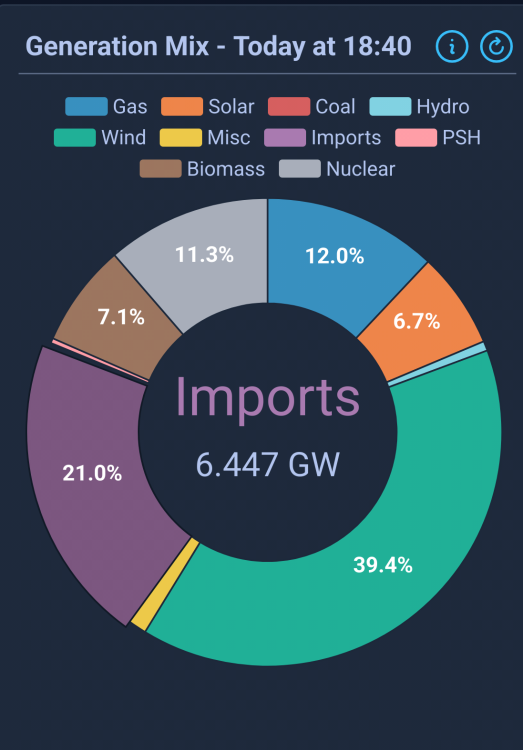
I think it comes under imports. If you look here https://www.energydashboard.co.uk/live Which comes from the same ultimate source it splits out imports by country and CO2 For example today... The French imports are the 7.9% And wind is nearly 40% of total and gas is that tiddly 12% (but sets the prices for the rest)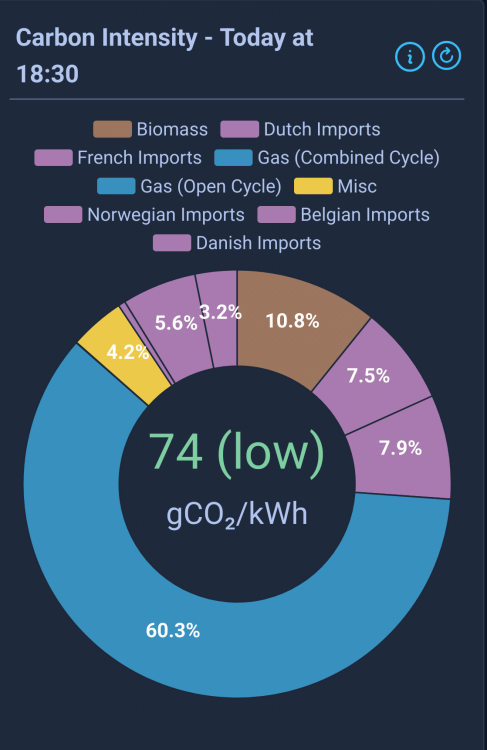
-
Spain/Portugal blackout
Beelbeebub replied to Beelbeebub's topic in General Alternative Energy Issues
Although, to be fair, our home grown AGR reactors were crap. -
Spain/Portugal blackout
Beelbeebub replied to Beelbeebub's topic in General Alternative Energy Issues
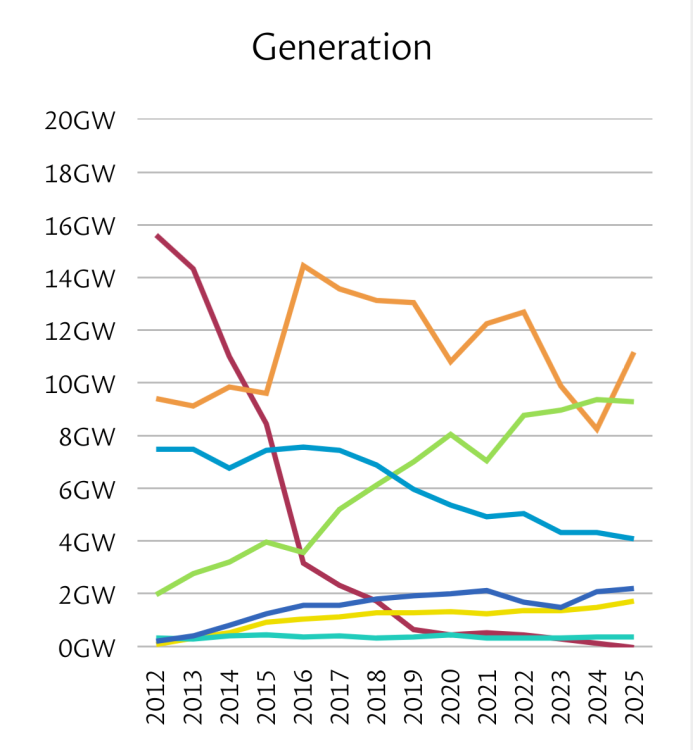
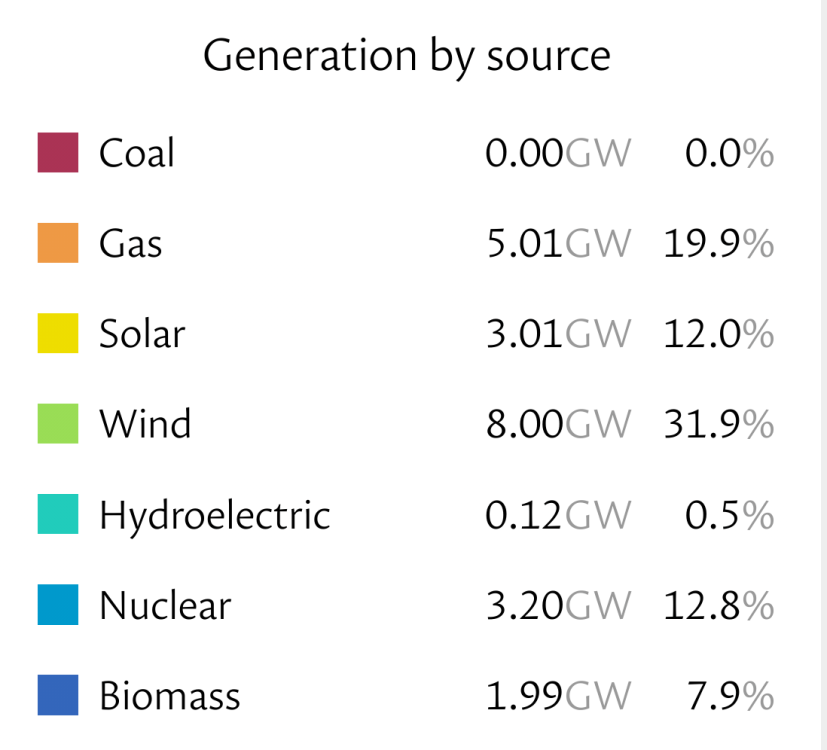
When you say "our" do you mean your local area or the UK? Just because it is windy in one place doesn't mean it's windy everywhere. Over the past day wind has generated nearly 1/3 of our electricity and renewables over half. Over the last 12 months just shy of 36% of our electricity has come from renewables. Greater than the just over 30% from fossil fuels (gas mainly) This is absolutely amazing. In under 15 years renewables have replaced all of our coal use and about 50% of our nuclear use.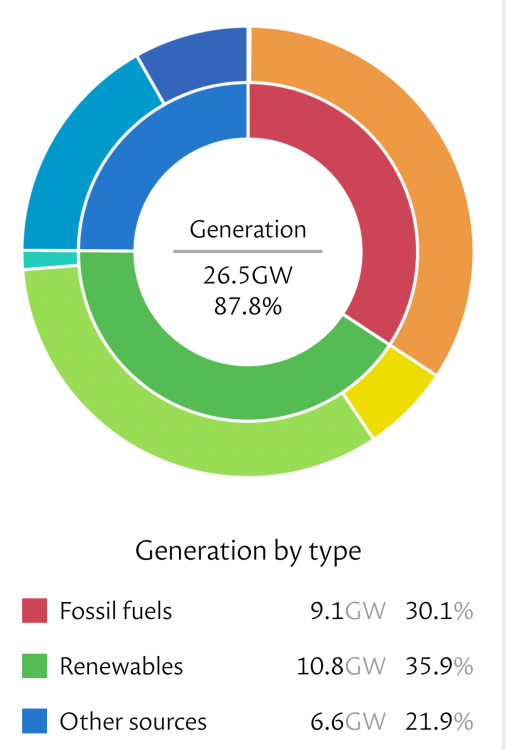
-
Spain/Portugal blackout
Beelbeebub replied to Beelbeebub's topic in General Alternative Energy Issues
I do wonder if individual domestic (and light industry) batteries might be a big benefit for these types of events. In the first instance they would be able to buffer the grid from demand spikes (the classic everyone plugging in the kettle at half time) but also make blackouts like this much less of a major issue. When it comes to restarting the grid the re connection (and thus reloading) can be tricky. Yeas ago our office had an issue that tripped the main breakers and every time they tried to flip them back on everyone's massive CRT monitors (i said it was a while ago) went "ping" drew huge currents through the coils and tripped the breaker again. We had to unplug our monitors so they could get the breaker flipped and then plug them in again to avoid surges. I thin ka similar thing happens at a grid level. If a massive power cut hits and most people's homes and businesses just keep rolling then when the power comes back if the batteries all wait a random amount of time (say up to 60 seconds) before handing over to the grid again it would make the start much softer. -
Spain/Portugal blackout
Beelbeebub replied to Beelbeebub's topic in General Alternative Energy Issues
Unless the flywheels are connected by an inverter setup their energy storage is limited due to frequency drop If they are connected by inverters then they are simply storage devices in which case it's a simple cost/kwh over life analysis - About 20 years ago when i did a study on high capacity, high power energy storage flywheels were quite attractive given the cost of batteries and capacitors back then. I think they are about even at the moment at £200-300/kwh but with batteries dropping so fast that may not hold for long. -
Spain/Portugal blackout
Beelbeebub replied to Beelbeebub's topic in General Alternative Energy Issues
Apparently the Portuguese utility company quoted as having blamed "extreme temperature gradients" etc are saying they never said that ie. it was a hoax social media post. So we are back to https://www.bbc.co.uk/news/live/c9wpq8xrvd9t?post=asset%3A29c975d4-7442-42f4-98a7-3646f41861b2#post "Some more comments from Spanish power company Red Eléctrica's (REE) news conference earlier. As reported earlier, Eduardo Prieto, head of operation services, has explained that on Monday there were two consecutive "disconnection events". Systems managed to recover from the first event, but Prieto said they couldn't recover from the second, which led to the power outage in Spain and Portugal. When asked, Prieto admitted it is "very possible" that the affected generation was solar, though he said authorities don't yet have enough information to be sure. Finally, he said REE restored power to the grid by using hydro and combined-cycle gas, which operate through a combined gas and steam turbine method." It sounds like something happened to trip out some generating sources and that caused a cascade. There is no indication if it was 2 separate incidents that happened to coincide or if there was an original event that then caused the second event. We will have to wait until there is a thorough investigation to find out. To cause such a large drop in output would require more than just a simple cloud going over a panel or wind turbine breaking. This level and speed of drop is more likely to be either an actual infrastructure failure like a cable breaking or transformer catching fire etc (I imagine we would have heard about the latter) or a series of cascading automatic trips. Unless it is shown that the cascade only happened because of a unique characteristic of renewables this isn't really a "net zero" issue. After all a fuse can blow regardless of whether the power source is coal fired plant or a solar panel. I did read that the large battery farm in MW Australia (100MW IIRC) made a huge difference to stabilizing the grid and stopping blackouts. If anything, a large battery farm can react even quicker to grid outages than flywheels. -
Spain/Portugal blackout
Beelbeebub replied to Beelbeebub's topic in General Alternative Energy Issues
I used to be active on a politics forum where the vast majority of users (and mods) were right wing pro-Brexit ukip/reform types. I wasn't going to change their minds and they weren't ever able to mount a cogent argument that would change mine. The sole reason I stayed on the forum was to get a different viewpoint and try to avoid falling into an echo chamber. -
Spain/Portugal blackout
Beelbeebub replied to Beelbeebub's topic in General Alternative Energy Issues
Isn't a cold start always problematic regardless of your generation sources? If anything I would have thought synthetic frequency sources would be easier to cold start as they can synchronise themselves very quickly with the existing grid frequency and phase rather than having to mechanically synchronise. Given inter-connects with the wider euro grid I assume that would be your "master" frequency source. -
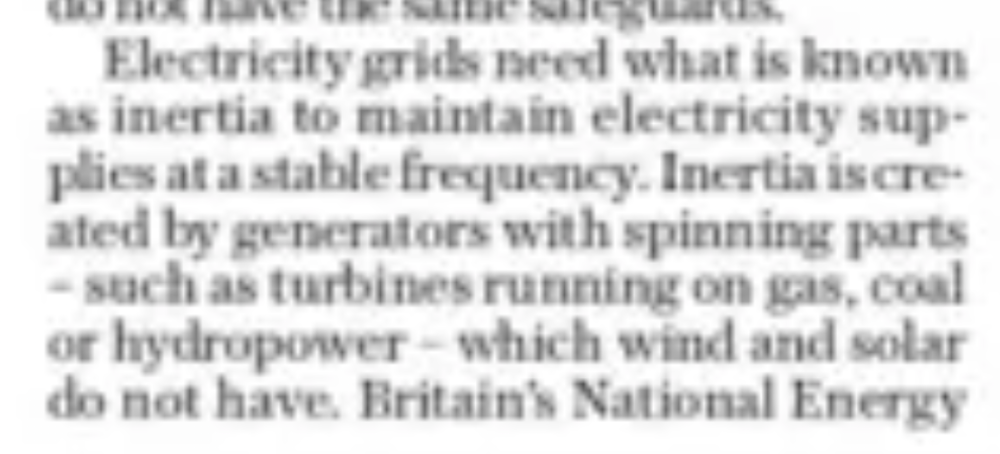
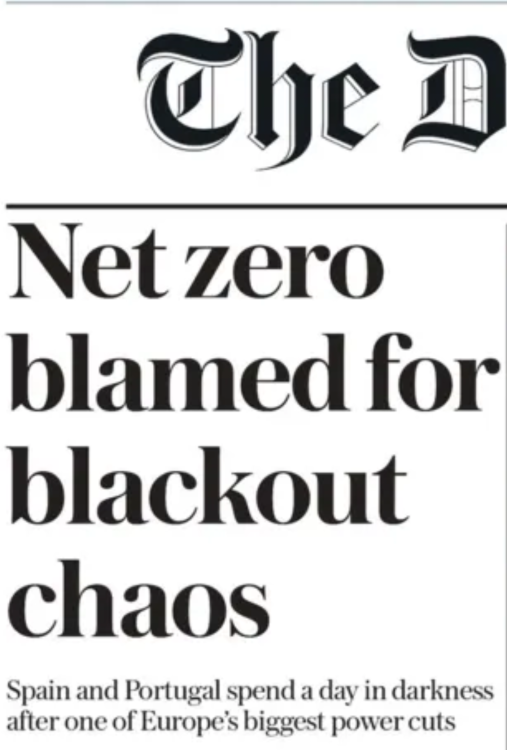
Predictably the Telegraph blames "net zero"... They talk about "experts say" but never really say who the experts are. And then there's this... Wind turbines famously lack any spinning parts.....
-
TBH in that sort of property warm clothing, electric blankets and possibly a 4 poster bed with heavy curtains are your best bet. Basically a victorian approach (apart from the electric blanket)
-
Can you expand on this? I know they have some massive commercial systems that have 2 compressors but I was unaware of any small domestic units. A HP with a wide modulation range and a fairly big top end say a 16kw unit that could modulate down below 2kw (at 15C external) would be a real game changer, especially if they could get the price reasonable. It would allow a "one size fits all" solution. Installed wouldn't need to think as much - just wack the unit in and make sure the flow temp is low enough. No more worrying if the client will be cold or the unit will cycle too much. Hopefully the increased volume of sales (only having to make one model) would allow for better economies of scale. The other option would be to make 1 unit, say max 7kw. But make it really easy to just stick 2 units side by side (or stacked one on top) for the bigger properties or ones where the 7kw proved too small.
-
The irony is that very efficient houses, where the heating requirement is especially low, will often be cheaper to heat by gas as their energy requirement is dominated by DHW where Heatpumps struggle to reach cost parity. This is entirely a function of our electricity market pricing strategy. However, given our greening grid, in all cases a HP now outperforms a gas boiler when it comes to CO2 - which wasn't the case as little as 16 years ago. Whichever way you look at it discussing Heatpumps, even subsidies, isn't politically controversial. It's no different from a consumer program discussing and informing viewers about how to find out which benefits they can apply for. Is "moneybox" going to be canceled because they advise on disability allowance or unemployment benefit claims - about as politically charged subject as you can get at the moment?
-
I suspect the axe being ground is trying to pull evermore things into the culture war. Net Zero and climate change is a natural thing for certain factions to latch onto now Brexit has occured. Consider. It is a fairly technical subject that most people don't have the time or inclination to understand. It requires trusting what experts tell us. It is highly complex. Experts (by definition) cannot offer certainty. Whereas commentators can offer certainty and simplicity. It requires changes to our behaviour - we primarily use metric measures (Brexit), we shouldn't drive such big cars (climate change) All of these features make climate change ripen to be the next Brexit which is why it's no surprise Reform/Farage are pitching their tent firmly in the "no to net zero" camp.
-
Exactly, if a podcast on Heatpumps is to controversial politcally, then a motoring podcast would be equally controversial.


