


Beelbeebub
-
Posts
1522 -
Joined
-
Last visited
-
Days Won
11
Everything posted by Beelbeebub
-
What's the case for not getting an ASHP?
Beelbeebub replied to kentar's topic in Air Source Heat Pumps (ASHP)
Can I ask, how long for? Like 7kw of air all day or 7kw for an hour or so? I wonder if an 8kw 3ph inverter/battery would do you? Solax do one (x3 ies) With 20kwh of battery storage you could run for over 2h at full pelt without drawing anything from the grid. IIRC they feature a 2x overload for upto 10 seconds ie 16kw which should sort out startup currents -
What's the case for not getting an ASHP?
Beelbeebub replied to kentar's topic in Air Source Heat Pumps (ASHP)
I was referring to the curtailment. The issue with gas setting the price most of the time may well be as you say. I've noticed that there is always 2gw or so of gas in our generation mix even when it seems it isn't needed. It just sits there in the mix even as interconnect, renewables, demand etc rise and fall. If that falls away we may well start to get cheaper elec, but that will have a knock on effect on renewables build out Still the point is, renewables are growing fast and promise cheaper electricity when we turn off the majority of gas. I do still believe we will need a fairly big gas capacity (maybe even more than now) to cover us for some of the winter etc, but running the UK 90% of the time on lure renewables and burning a bit of gas every now and then is a perfectly acceptable target for the medium term. -
What's the case for not getting an ASHP?
Beelbeebub replied to kentar's topic in Air Source Heat Pumps (ASHP)
There are various plans, but they often run into local opposition I saw one local pressure group against some pylon lines using the "it will take valuable farmland and damage our food security" argument - which is clearly bollocks given the relatively miniscule footprint of pylons. There are arguments against putting pylons in certain places but they almost always boil down to aesthetics, ie people don't want to see them. That's fair enough, but at least put that argument forward (why should my view be altered for the national good) rather than BS ones. -
I assume your flexi panels, charge controller and some small leisure batteries are on the van? You arrive at "home", park up. Go through your disconnect routine to unplug/isolate your flexi panels from your charge controller. You now have a van with no solar panels (as far as it's aware) running as though it is night time. i.e. off batteries. Unlock your little waterproof box, unspool the cables from your fixed panels - however many your controller will handle and spsce/money allows and go through your reconnection routine. Now your charge controller is hooked up to some panels, it doesn't care they are different from the van mounted ones, it just goes about it's business. Basically all the work you were going to do, except you just need to disconnect your flexi panels rather than have them in parallel.
-
What's the case for not getting an ASHP?
Beelbeebub replied to kentar's topic in Air Source Heat Pumps (ASHP)
This is true, but is a consequence of our grid not habug the right interconnections - it was.set up to supply power from a few concentrations of coal plants in the Midlands and North. Shifting power from thr coast is harder. Sometimes there isn't enough capacity to shift the power Solutions would be to beef up the grid, including some new lines. Grid scale battery storage to store the energy locally and then supply it when the generation is low Local storage (down to house level) will help sooth out peaks on demand but won't help shift the power out of high generation areas. -
What's the case for not getting an ASHP?
Beelbeebub replied to kentar's topic in Air Source Heat Pumps (ASHP)
A battery system would allow higher instantaneous demand for periods of time without overloading the grid. 60a (14kw) could be upped to 90a (+30a, 8kw) with an 8kw battery system. -
Ah I get it. Might in suggest, rather than trying to parallel them up, with the attendant issues, you arrange it such that when you are at "home" you totally disconnect from you van mounted panels and just use as many standard panels as you want, then switch over to the flexible for mobile use. You can make up for the loss of the flexible panels by adding a single extra standard panel to your ground array. Much less chance of issues. As mentioned the disconnection and reconnection needs to be handled with some care.
-
What's the max output of your controller? It looks like you have 3x 100w panels. That's less than the output of a single modern standard panel. panel, just buy one extra and bingiveaway/reuse the old ones. https://www.cityplumbing.co.uk/p/dmegc-450w-all-black-solar-panel-2mm/p/120106 £61 each for 450w. Under £200 to quadruple your capacity
-
What's the case for not getting an ASHP?
Beelbeebub replied to kentar's topic in Air Source Heat Pumps (ASHP)
On the pessimist view of climate change actions. https://www.theguardian.com/environment/commentisfree/2025/aug/20/voices-arguing-climate-crisis-action-is-a-waste-of-time-are-wrong TLDR: yes there's a ton of stuff to do and we need to move faster, but real progress has been made. -
What's the case for not getting an ASHP?
Beelbeebub replied to kentar's topic in Air Source Heat Pumps (ASHP)
Which i addressed. If we had zero renewables and were fracking all day every day (which is the position of some in the political discourse) our electricity would be no cheaper and possibly more expensive. On the other hand, installing renewables offers the UK yhr chance of much greater energy independence. Sure we'll always need oil and gas for feedstocks and for situations we can't electrify (aviation comes to mind) but if we decouple our heating and transport (two big energy users) from gas and oil we'll be better off. And the most practical route to removing gas from our heating demand is Heatpumps. -
What's the case for not getting an ASHP?
Beelbeebub replied to kentar's topic in Air Source Heat Pumps (ASHP)
The "we're an insignificant bit of world co2 emissions so there is no point in doing anything..." argument annoys me so much. 1)it's usually made by people who, a few breaths ago, were proclaiming how important and world leading the UK is. It seems we the nation all others shoikd look to for all sorts of things, except climate change. 2)the UK per capita emissions are around aboit mid pack. The real danger is if the vast numbers of people in developing nations who are currently emmiting less carbon per capita look at our lifestyle (cars, consumption, hearing, cooling etc) and think "I'll have some of that". If the UK and other developed nations are moving down it makes it much more compelling to say "hey guys, why not skip the high emissions part of the cycle and meet us at the low emissions phase" 3) renewable power is the cheapest power and the cost of power is a big driver of economic success. -
What's the case for not getting an ASHP?
Beelbeebub replied to kentar's topic in Air Source Heat Pumps (ASHP)
Elec prices are tricky. On the one hand renewable electricity is pretty much thr cheapest there is. Solar is cheoeast, with onshore wind and then offshore roughly on a par with CCGT depending on gasmlroces at any given time. On the other, the high price of elec (effectively tied to gas) means there are big profits in putting in renewable capacity, and hence a big surge in that capacity. So our high prices are helping drive renewable. But also hampering the shift to HPs. On thing we could do is shift some of the so called "green taxes" from elec to gas use. My napkin calcs imply this would slightly raise gas and slightly lower elec, enough to bring the price ration from 4:1 down to 3:1 or even a bit better. At that point HPs start being cheaper than gas in almost all homes. Of course there would be pushback from people who already struggle.to afford gas heating. We would need to ensure there were mechanisms in place to prevent hardship -
What's the case for not getting an ASHP?
Beelbeebub replied to kentar's topic in Air Source Heat Pumps (ASHP)
The issue with that approach is the generation capacity to replace gas on a. 1:1 basis would be vastly larger than to replace each kwh of gas heating with 0.3kwh of electricity generation. -
Integrated/ flush solar panels on a metal standing seam roof
Beelbeebub replied to WisteriaMews's topic in Photovoltaics (PV)
There was a fair bit of discussion about the border, but nobody could come up with exactly why it should be there. The closest explanation was wind uplift, but if it's not on a roof ie just panels on a frame there is zero margin. We did fix the edges of the roof and the panels extra securely, plus we are in a fairly sheltered area - might not do this if we were on top of a cliff on the West Coast of Scotland! Regarding access, the central gap was left for exactly that, and access to the outer panels is safer from the sides anyway. My case is fairly specific but does show what is possible. I did look at using the gse system but cost wise this was cheaper and also easier to install. The pitch is only 12deg which loses a bit of output, but was done for aesthetic reasons plus it means the roof was safely walkable for installing the panels -
Integrated/ flush solar panels on a metal standing seam roof
Beelbeebub replied to WisteriaMews's topic in Photovoltaics (PV)
This may not be what you're after, but I fitted my panels onto trapizodal "32/1000" pvc coated roof sheets - think industrial roofing. It's about as cheap as roofing gets and the panels fit really easily to the tops of the profile with small "mini rails". The trick was to have the panels go edge to edge and eaves to ridge of the roof, which I could do as it was a mono pitch (though it would work with a duo pitch). And, though it's not suited to every aesthetic or roof layout, it does work especially well on outbuildings (mine was a carport)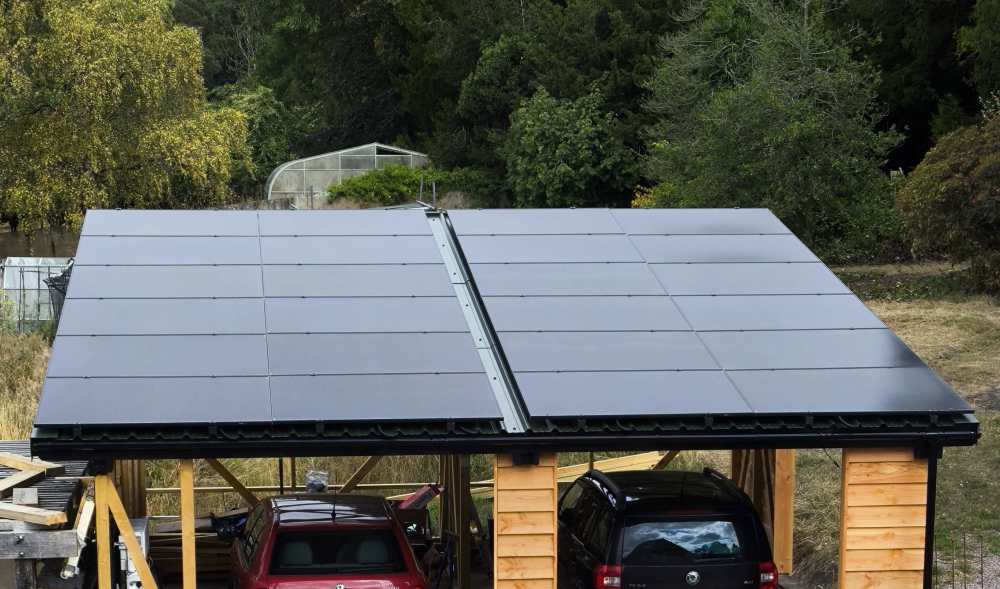
-
That's what an optimiser does, but I don't think the more basic bypass diodes are as effective (despite what the manufacturers claim). There's a video with someone testing the Neostar 3's which the manufacturer tours as being much more shade resistant - but shows if the shade is the wrong way, it doesn't work as well. I found this with a cheap 60w panel that keeps a tractor battery topped up. If you shaded it with a thin stick vertically you lost a bit under a 1/3 the output, but the same stick horizontally knocked it down to very little (like under 10w or something). As for minimum start up, half the array is 12 panels with is pretty much the maximum that a single string can handle on my inverter. IIRC the start up is 40v, which isn't even 25% of the full output Again, because I've wired it as 4 blocks it's really easy to switch between 2x12 (if I find start up voltage is a problem) or various 12 + 2x6 configurations which deal with different aspects of my shading issue (the tree tends to cause an issue with one corner, my house will shade the entire bottom edge, creeping up as winter advances) I don't propose to switch regularly, just a few times to get a feel for which one (if any) will give me the best (as in most suited to my needs) overall production.
-
My understanding is the built in bypass mechanism effectively divides the panel into 2 or 3 sub panels so is useful if a bit of a panel is shaded, as long as the shading happens to align with the sub panels but can't help if the entire (or most of) the panel is shaded. But dividing the array into 3 to use the existing strings is effectively for free (just a little extra cable) and the arrangement of 4 sets of 6 panels means I could always rewire the array to be 2 strings of 12 if I wanted.
-
Good question. We looked at that. The original layout was 2 strings of 12 and only the 3 corner panels of one string had a shading issue. The options were to add 3 optimisers - £150-300 Or to use the unused 3rd string to get around the shading issue. The panes have been wired up a 4 groups of 6 and the connectors brought down to an internal location where 2 of the groups will be connected in serial and the other 2 will get a string each. This will allow for easy rejigging if we want to and the location of the panels makes it very easy to add the optimisers later. The array is well oversized so i'm not looking for the nth degree of optimisation, but losing 1/2 the array until lunchtime because the bottom left corner panel is shaded would be a bit annoying.
-
I'm just about to finish getting a similar system up. Large house - about 5,500 kwh a year demand on a single phase. 24x neostar 2 (465w IIRC) on a single array with slight shading issues (big tree and house shade some of the array at various times of day/year). The large number of panels was my way of conterwcting the less then ideal site. I'm making up for lost generation from shading, pointing SW and having a low pitch by just having more panels and stopping up the inverter size from 6kw to 8kw . The step up in cost was a few hundred £, which was far cheaper than trying to get the panels in a more optimum position. The panels seem OK, honestly won't know until about 10 years from now. Dealing with the shading by splitting the array into 3 strings of 12,6 and 6 panels (inverter has 3 inputs) so the shading only knocks out the smaller blocks. 8kw solax IES inverter with 3x 5kwh battery modules. I did look at the Sig system - it looks very nice (frankly a step up from the Solax) but was about 1.5k more like for like and finding a local installer was hard. The Solax unit seems pretty solid, if a little more utilitarian - think Skoda vs Audi. Went in very easily took about 30 minutes. Just a case of stacking boxes. The main advantages the Sig seems to have are A) looks B) can have higher total battery (solax is 20kwh per inverter, though inverters can be paired up) C) Sig has multiple battery sizes, solax does 5kwh D) potential V2H/car charger with Sig (though I believe solax are working on one too) The solax advantage seems to be cost and potentially availability. They have also been established quite a while and offer various units from small all the way to industrial ie they appear to be a likely to not go bust (I hope) The solax also handles power cuts more or less out of the box. You don't need a separate gateway box like other brands (I think Sig need one) but it does require an extra 2 conductors to the unit (5 cores rather than 3) which might be a consideration if you are locating the unit well away from your consumer unit and meter. As a side note when will these modular systems put the inverter at the bottom of the stack! At the moment you would need to lift of the inverter modules (the BMS is separate module) add the battery, then restack the inverter and adjust the cables. If the inverter was the bottom unit adding modules would be very simple, just stack a new one on.
-
Is it a split system? The "primary" pipes will be small bore copper taking the refrigerant inside to a box which then transfers the heat to the water. The outside unit is no different from a standard aircon unit. They seem to be falling out of favour in the UK but apparently are the more common implementation on the continent.
-
Mimicking solar panels from an AC supply
Beelbeebub replied to Beelbeebub's topic in Photovoltaics (PV)
Roughly the area to fit panels is 2 chimneys 12m high x 4m wide. So if we assume I can get 10 x 2 panels per chimney we are talking 40 panels. Assume 450w panels so nominal 18kwp but with them being vertical and other practical limits maybe 14kw peak. So a fair split of about 1kw per flat maybe. Maybe each flat has a 3kw inverter and maybe 5kwh or 10kwh storage. -
Mimicking solar panels from an AC supply
Beelbeebub replied to Beelbeebub's topic in Photovoltaics (PV)
. Thanks for the solshare link. I've looked into it, and it is definitely a possibility. My two concerns are 1. It only does 15 flats per unit and I have 17! So two units or possibly 2 flats having their own standalone setup. 2. It seems quite "smart" and cloud enabled etc. I'm wary of stuff that requires a subscription - what happens if the company goes bust or is bought out and the new owner (or even the orginal owners) decide to jack up the prices or "enhance" your package by making it worse (hello Netflix)? Hence my wondering if there was a relatively simple sub £500 device that could allow for distribution of a single array between multiple flats via the already existing DC panel input. I was thinking of something along the lines of a current limiting 240v (or maybe 110v) power supply. The MPPT function would simply ramp up the current until it hit the limit which would be the maximum power point. If I wanted to reduce the power delivered to a given flat the current limit would reduce. The goal would be a system not reliant on external Internet connections etc. -
Mimicking solar panels from an AC supply
Beelbeebub replied to Beelbeebub's topic in Photovoltaics (PV)
So 17 flats in a 5 story building so the roof space is limited. The roof is also very old, very complex and not at all suitible for fitting PV to. The main option for panels is a pair of vertical arrays on the south side, where there are two large external chimney stacks - all the other vertical faces have windows, pipework etc on. There is also the matter of planning (aonb and conservation area) so it may be no panels are possible at all. Thereis alsoo two east facing balconies that could potentially have "balconysolar" style mounting on the balustrade . The problem is the flats near where the panels are don't need the EPC boost as much. It seems unfair to fit panels next to someone's flat and them not benefit from them, so I'd like to spread the benefits about a bit. Separate systems as mentioned by NickFromWales is a possibility but my worry is we could end up with a flat not using much of it's generating capacity, whilst the flat next door could use more capacity. Sort of like individual car ownership vs car pooling. A chunk of this depends on the upcoming EPC regs (due soon IIRC) currently (mains powered demand shifting) batteries are more or less ignored despite the potential impact on bills.It maybe fitting batteries gives me a big jump. Or not, who knows. At the mo I am just kicking about ideas. -
Mimicking solar panels from an AC supply
Beelbeebub replied to Beelbeebub's topic in Photovoltaics (PV)
Did that already but there is ultimately a limit to how long that can go on for as the running costs don't stop. The driving force is to get the EPC rating up. Reducing tenantt's utility bills is a nice side effect. -
Mimicking solar panels from an AC supply
Beelbeebub replied to Beelbeebub's topic in Photovoltaics (PV)
They all pay individually with whatever supplier they pick. I'm looking to provide some PV as a benefit, as you would new carpets or the like. It also helps with the EPC ratings. It might be that providing solar is the cheapest and easiest way to get a C (it used to be switching to gas) So the generated elec would be provided free and unmetered to reduce their bills. Obviously some days would be better than others and some usage patterns would be more cost effective than others but that's on the tenants.

