


Beelbeebub
-
Posts
1522 -
Joined
-
Last visited
-
Days Won
11
Everything posted by Beelbeebub
-
Looks like the party is over....
Beelbeebub replied to Beelbeebub's topic in Air Source Heat Pumps (ASHP)
A bit off topic but I don't think people have range anxiety. They have refueling anxiety. My work vehicle struggles to hit 150miles on a tank (large, old, automatic and petrol) That's less than many electric cars. Am I worried? No. Because I know that even if I have 30 miles left I could find a filling station, I am very unlikely to have to wait more than 5 minutes for a filling slot and it won't take me more than 5 minutes to fill up. I also know that the difference between the cheapest and most expensive fuel is no more than about 10%. I can predict pretty accurately what my cost will be. I have a relatively short range but no anxiety about refueling. Electric cars don't need super long ranges. 200miles is probably enough. They do need a fairly dense network of high speed chargers with a simple and consistent prices. Ironically the shorter ranges (200mikes or less) imply smaller batteries (50kwh or so). In turn this means faster recharge times (as well as lower build costs, lighter weight etc) -
Looks like the party is over....
Beelbeebub replied to Beelbeebub's topic in Air Source Heat Pumps (ASHP)
There is a key point, the efficiency of converting gas to electricity is 40% (over 50% with the most modern plants running optimally). So if we all converted to electric radiators from gas boilers the net gas demand would shoot up. For every cubic meter saved from being burnt in a boiler 2.5 would be burnt at the power plant. Which is why Heatpumps are fundamental to the switch. As long as the heatpump is more than 250% efficient you end up using less gas by burning it in a power plant, transmitting it to a house and using a heat pump than by using a gas boiler. And (as a bonus) the heat pump doesn't care how you generate the elecreicty. It could come from wind, solar, imports, nuclear, wave, hydro - whatever you want. Burning gas for heat and power isn't a long term option. I will caveat that with - I'm not dogmatic about never burning gas. I can see a future where we have more gas plant capacity than now but it is only used infrequently as a state level backup. The national equivalent of a generator and some petrol cans in your garage -
Looks like the party is over....
Beelbeebub replied to Beelbeebub's topic in Air Source Heat Pumps (ASHP)
It's capital vs running costs. The house builder sees the capital costs and the running costs.are irrelevant to them except in so much as they might reduce the attractiveness of a property and hence the price. But the property market being what it is the price is set by location rather than running costs. -
Looks like the party is over....
Beelbeebub replied to Beelbeebub's topic in Air Source Heat Pumps (ASHP)
I mean you could just mandate an efficency of greater than 250% But that does mean a heatpump of some description. I do agree we are being too dogmatic in going down the air to water route. Air to air would be a much better (and cheaper) route. -
Looks like the party is over....
Beelbeebub replied to Beelbeebub's topic in Air Source Heat Pumps (ASHP)
Except there is some discussion of removing the green levies on elec hence the proposal to reduce the eligibility for the 7.5k grant (as they aren't proposing to stick the green levies on gas) So the elec/gas ratio (which is the important metric) might fall from the current 4.2 times. Green levies make about 15% of the current elec price, so we"d drop from 26p to around 22p. Assuming gas stays the same that's 3.5x ratio. That's an achievable SCOP and That"s before things like time of use tariffs which can drop the price even lower. -
Looks like the party is over....
Beelbeebub replied to Beelbeebub's topic in Air Source Heat Pumps (ASHP)
It's fair enough that many installers and HP advocates glossed over the fsct that even though HPs are more efficient than boilers the cost differential on regular electric vs gas of around 4:1 means it can be hard to be cheaper than a gas boiler. That said, variable tariffs exist and it is entirely possible to achive break even or better with a well-designed system, ironically one which is often simpler and cheaper than the "giant buffer" installs that seem to be standard. Ultimately we, as a country need to move off gas for heating. Not only is it enviromentally sound, but it will reduce our delendance on gas from unstable parts of the world run by dictators who might not be friendly towards us. This is both a strategic weak point and also puts our economy at the mercy of international gas prices. There are some things we can do to reduce the ratio between gas and electric and we should. -
Looks like the party is over....
Beelbeebub replied to Beelbeebub's topic in Air Source Heat Pumps (ASHP)
100% agree with the new build. Shouldn't even be a question. And very easy to implement Just change the building regs - set a.date in the not too distant future (a month or two after announcement) where any application after that date must have electric heating with a scop of at least 3.5 (or a similar metric like cop of at least 2.5 space heating at -10C) That should ensure 200k+ installs a year. Which should be sufficient motivation to train a lot of installers and prime the supply chain. Which then makes the aftermarket easier. And with the aftermarket there needs to be a way for Heatpumps to always be cheaper than gas. Obviously dropping the elec price relative to gas would help that. -
https://www.theguardian.com/politics/2025/nov/13/hundreds-of-thousands-to-lose-heat-pump-subsidies-in-reevess-budget-plan There are some valid criticisms of the current setup, but cutting it back seems a backwards step. Again I'll wave the flag for spending the same amount but on subsidies to guarentee the cost of heating by electricity and heatpump will never be more expensive than gas. I think it would cost less and speed up rollout.
-
Sunny Boy SB3.0-1AV-40 continually rebooting
Beelbeebub replied to Ultima357's topic in Photovoltaics (PV)
How old are the panels? -
-
Just to tie this up..... My DNO came out, they poked about, took some measurements and concluded they could change the tap on my transformer. This involved some backfeeding via links to other transformers and de-energizing my transformer, but there was no supply interruption and the change was seamless. Took a week or so to happen. They called to say they had done it. He mentioned they actually found a fault when they did the work which might have been making the spikes worse. Now my normal voltage is high 230's to low 240's and I don't think i've seen over 250. The only question now is: will this allow me to export more!
-
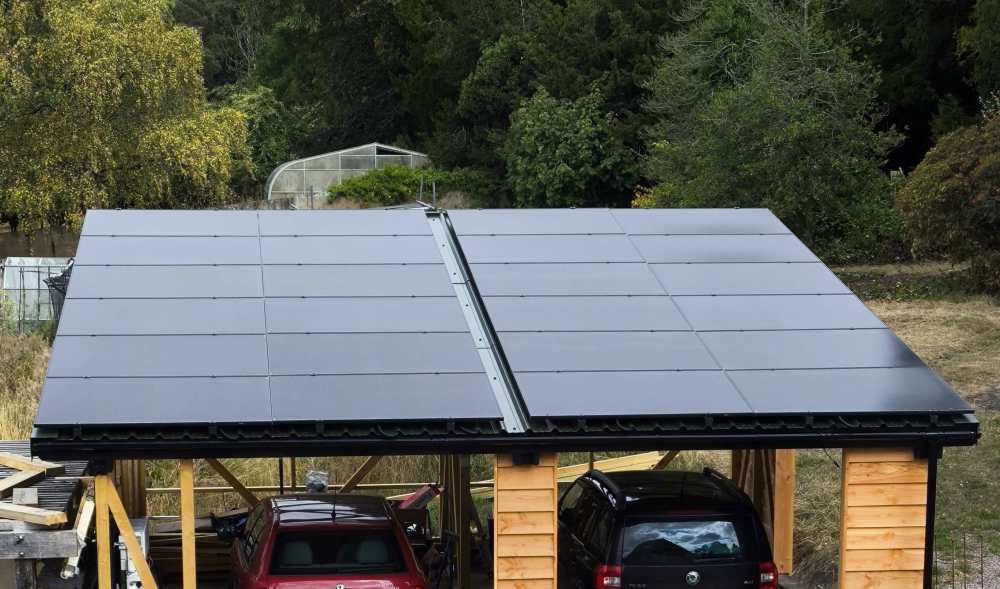
From your OP i assume you haven't actually built (or modified) anything yet. Just FYI: I have a carport with a 12degre pitch covered in solar (24 panels) Initially I thought of using the panels as the rood covering but couldn't find any way to seal between the panels even for a carport standard of weatherproofing. It was either silicone seals or rubber inserts. There were a few Chinese systems that used extruded aluminum sections as the rafters and "gutters" to catch the water, but that would not be suitable for a house roof. I then looked at the "in roof" tray systems (GSE trays). The wooden roof structure needs lots of additional battens to support the trays and IIRC there is a minimum pitch requirement and I don't think 12 degrees was enough though 20degrees might be). The cost of each tray (or pairs as they have split system now) was not insignificant either. I ended up using a trapezoidal metal roof (think out of town retail park roof/cladding) and then rails attached directly to the roof. It worked really well for construction, 12 degrees is perfectly easy and safe to walk on and the metal roof is nice and robust. The result looks good and wasn't expensive. I didn't worry about the sub optimal roof pitches, the few % loss of output is compensated for by just having more panels I used a s SolaX IES (single phase) 8kw which could handle up to 16kw of panels. They do make a 15kw 3 phase unit that will take 30kw of panels They also make various models that aren't integrated but do have a bit more flexibility on batteries With 30kwp of panels you will easily be able to provide "baseload" power for your house even on dark days. My 11kwp panels provide for the 400w base load of my house even on pretty gloomy drizzly days which is about 3.5% of peak. If you had 30kw you'd be making over 1kw on all but the worst days. Given you have gas heating I can't think why your house would need more than that (unless you bitcoin mine or run an aluminum smelter as a hobby!) As for batteries, if you can export alot there is an argument that you don't need huge batteries - the grid acts as your battery. Even if your import/export prices aren't perfectly aligned (and I don't know how long the Octopus 15p rate will hang about) and you only get (say) half the price for export as you pay for import, it doesn't really matter if you are exporting so much that your export earnings handily pass you import costs.
-
Nobody wants to touch my roof for solar and alternative location
Beelbeebub replied to SimonD's topic in Photovoltaics (PV)
That is a good looking roof! It really would be a shame to spoil it with solar panels. I think looking at alternative locations, even redesigning any outbuildings yet to be built or building a bespoke structure will yield very satisfactory solar performance and much easier instillation and maintenance, For reference my 24 panel setup structure was 3-4k in materials excluding any ground works (there was an already existing foundation - but the set up could have used a much simpler foundation eg a simple slab or even large concrete pads) and took me about 100 hours to build on my own (would have been less than 40 hours if there were two of us as I spent a lot of time having to temp fix because there was only one of me and god knows how much time going up and down to fetch items that could have been passed up!) The panels and battery were under 12k fully fitted and wired up. Good luck! -
Nobody wants to touch my roof for solar and alternative location
Beelbeebub replied to SimonD's topic in Photovoltaics (PV)
given how nice your roof looks, the various hurdles fitting to it and the fact you have to option of garage/ground mount. I would suggest spending the money you would save on calculations, specialists and scaffolding on the garage/ground option. Panels are so cheap now that it's much less important to get the maximum efficiency out of their orientation, just stick more panels on to compensate. -
I'd also say with a high power inverter (eg 8kw) you can wire your whole house from the inverter and be immune to power cuts. Depending on manufacturer the cost of the high output inverters is not much on top of the low output ones. Eg a solax 3.7kw plus a battery is £2,975 whilst the 8kw version is £3,050. At that price difference it's an absolute no brainer to go for the 8kw unit and export limit it.
-
Doh! Pretty much beaten too it by @JohnMo !
-
How many panels are you wanting? AFAIK most inverters can't handle more than 2x (often 1.5x) panels being connected to them. So if you fitted an g98 device with a hard max output of 3.7kw you couldn't fit more than 7.2kw peak of panels (16ish). You would also have the situation where any load greater than 3.7kw (eg kettle and toaster) would require grid import. Even on a sunny summer day when your panels could output 7kw. Unless you want a limited system I'd suggest you pretty much need to have a higher power inverter with software export limits. That means you need an export limited device. This has the added advantage that, should your infrastructure be upgraded, you can increace your export very easily without having to replace your system. The worst case is you fit a sigenstor or SolaX or whatever, make an application and they come back and say "2kw max", and you set your inverter to 2kw max export. Can I also ask why you want low voltage batteries? The trend is to move to high voltage systems which are more efficient especially at the higher inverter powers. At 8kw your batteries, connectors and inverter will need to handle 160A plus.
-
I'm trying to work out why you don't just get a hybrid inverter with the ability to export limit? Eg FoxESS, SolaX, Sigenstor etc. As I understand it the DNO has to allow you 3.7kw export and, if the infrastructure isn't up to it, upgrade it at their cost. (my DNO has been monkeying about with the local transformers to resolve a high voltage issue I've had) I believe some of the brands can use other battery brands if you are concerned about battery "lock in" -there's a guy out there running scrapped Tesla batteries from his setup (a fox inverter I think) and someone else has been using leaf batteries for the same.
-
The flow temps quoted are usually the design flow temp, ie at minimum Pat. So in your case the flow temp would e described as "35C" even though it only hits that for a few days a year. Trying to heat you house at - 2.5 outside with (say) 30C flow would be tricky as the DT would likely only be a few degrees (mean rad temp is half way between flow ad return so for 30C flow, it would be 27C ave temp for a DT of only 7C at which point rads output about 15% the rated output) My point is that UFH flown temps are usually limited to avoid damaging floor finishes. This maximum varies but can be in the low 30's which is about where the sensible minimum flow temps are. My house runs low 30's and my k22 rads are barely warm to touch but it manages to stay warm(ish). But if I had a leakier house I doubt it would work.
-
Rads and UFH manifolds in series?
Beelbeebub replied to SuperPav's topic in Air Source Heat Pumps (ASHP)
They were convinced to use a now discontinued (because it failed so often the company went under) system. Basically it use small bore pipes made of a very flexible synthetic rubber, which they were assured had a 50year guarentee and was super durable - "used by NASA and the medical industry" Unfortunately the material was degraded when in prolonged contact with warm water with dissolved copper (or possibly iron) ions. Situations that don't occur in space or medical devices, but basically describe heating systems! The pipes started to fail after a few years. You're not likely to come across it, and certainly not if you're putting a new system in. I favour the speedfit systems that just uses their standard (and very durable) 15mm pipe - either PEX or PB. It's fairly cheap and very robust. Some of the other systems use smaller bore and single layer pipe that i trust less. Plus speedfit are a big player and likely to be around a long time. -
Rads and UFH manifolds in series?
Beelbeebub replied to SuperPav's topic in Air Source Heat Pumps (ASHP)
I have ufh and rads. Basically the house was originally all ufh, but the pipework failed (long story) so I had to disable the entire system. Now can run part of the downstairs on ufh and the upper rooms have rads (those that have heating at all). Anyway, everything runs at the same flow temp. The upstairs rads are farily chunky) and I have one fan coil as an experiment). Bit of balancing of the flows and everything ticks along OK. The main issue would be if the upstairs rads weren't big enough to heat the rooms at the lower ufh temps, but that doesn't seem to be your problem. -
Be aware that the flow temps in UFH are lower than even a fairly low temp rad system - so 35C is a typical maximum flow temp for UFH - but 35C is about the lowest maximum flow temp for a rad system before the radiator sizes start getting silly. Basically it is possible to run much lower flow temps (and hence higher efficiencies) with UFH. That said, you can still get very good efficiencies with rads, it's just that UFH has the potential to be even more efficient. One thing to watch out for if you have an old building is that the maximum power output of UFH before you start hitting impractical floor temps might not be enough if you house is particularly drafty or poorly insulated. Effectively you need to cook your feet in order to stay warm. On the other side, if you have a tile/concrete floor, which is best for UFH and you ar every well insulated the temp of your floor might have to be so low that the floor feels cold to bare feet, even though it's warm enough to keep the room at 22C. My old house need a temp difference of about 2C down to near freezing, so our 20C rooms meant the floors were 22C, which felt cold to bare feet. It only became comfortable to walk on in bare feet well below zero!
-
Oil boilers are currently cheaper to run than gas but the price tends to be more volatile when world events happen around oil producing nations....
-
G99 refusal. G100...where do I go from here?
Beelbeebub replied to jimseng's topic in Photovoltaics (PV)
Honestly, the easiest route is to use a certified hybrid system. Then you can use a large inverter that will handle all the likely loads (eg 8kw) and it will throttle down to the 3.6kw the grid will allow you. If the local grid is upgraded and you are granted a bigger export limit it can be changed with a few keystrokes. Get enough batteries up front (they should last a decade or so) by the time they are knackered you'll prob want to upgrade anyway to a new system 2x as good for 1/2 the price. how many people with 10-15yo solar systems (a dozen low efficency panels, a 5kwh battery the size of a fridge and maybe a 3kw inverter) are thinking "if only I could find some compatible batteries"? Thry"ll be thinking "this has paid for itself, let's get a 5kw inverter with 10kwh of battery with emergency power and all the bells and whistles " -
This unit uses the newer (and more powerful) rp2350 chip, it's got an sd card if I wanted to log locally. I'm not bothered about local logging as the solax cloud does that and I can download that easily enough. This is more for a super simple, real time, low latency view of what's going on. I can watch the sun go in and the power drop, whilst the cloud (ha!) can take 20.or 30 seconds to reflect that. It a mainly for my wife so she can just look at it and then decide to put an extra load of washing on rather than ask me, who then checks my phone. She's not bothered about the minutie of data, just a "go/no go" display (it does put up a "surplus!" message if we hit our export limit - which often means we have significantly more power availible.


