


Beelbeebub
-
Posts
1522 -
Joined
-
Last visited
-
Days Won
11
Everything posted by Beelbeebub
-
Looks like the party is over....
Beelbeebub replied to Beelbeebub's topic in Air Source Heat Pumps (ASHP)
I thi k we have to be a little careful about interpreting that graph. It says that a higher % of over 65 (just) pay income tax - *not* that the tax take from that segment is higher The basic state pension is a hair over 9k for those who became pensioners before 2016. That means any pensioner who earns more than about 3.5k from other sources will pay income tax. For those that retired after 2016 the basic is just under 12k, so they onky be to earn £500 or so to start paying taxes. This (and the triple lock) is probably why there was a distinct upward kink from 2018/19ish. So pretty much every pensioner who earns more than a few k from an old work place pension or maybe letting a room, or doing a day a week at the supermarket pays income tax. Whereas the under 65's are less likely to pay income tax because their income floor is zero. So more pensioners pay tax, thanks to the increaces in state pension over the last 15years or so. The really interesting figure would be total taxes collected from over 65's vs pensions (and if you want to be thorough - medical and social care costs for over 65's) I am not certain that is a positive nunber -
Looks like the party is over....
Beelbeebub replied to Beelbeebub's topic in Air Source Heat Pumps (ASHP)
Just for completeness here is a graph of oil & gas production (hence the hugher BoE numbers) production from an oil and gas consultancy that errs on the high side of things. As you can see it still shows a big drop even with discoveries and prospects included.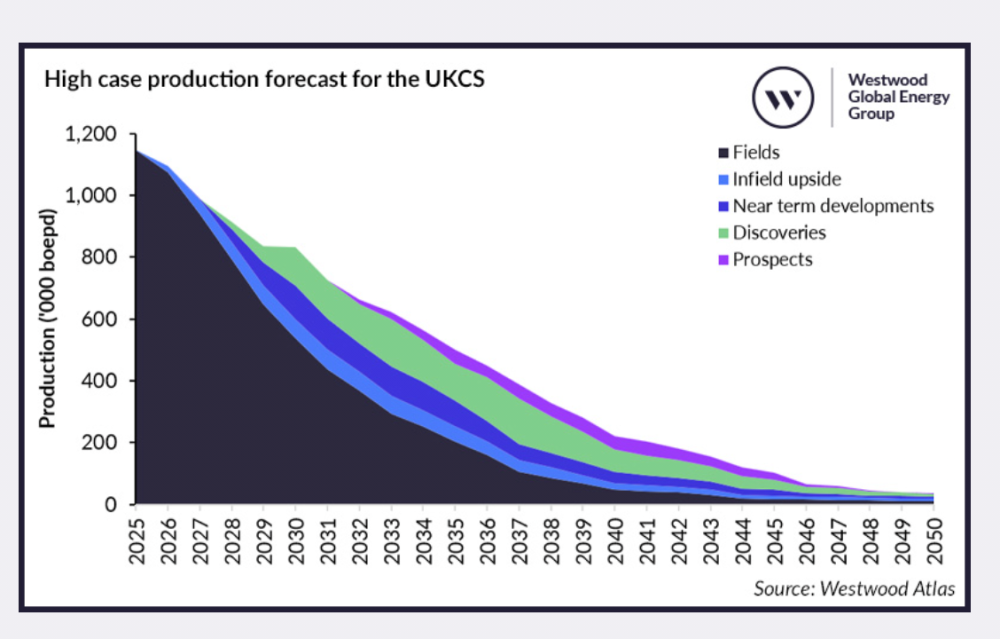
-
Looks like the party is over....
Beelbeebub replied to Beelbeebub's topic in Air Source Heat Pumps (ASHP)
Sadly you are probably right that this argument will keep popping up. Still, feel free to quote that post back at them. -
Is the party over (pt2) - End of high fixed price export tariffs?
Beelbeebub replied to -rick-'s topic in Photovoltaics (PV)
Yeah but they give you 15p all the time even when they could be buying it at 1p wholesale. It also aids predictability. I know that I will get paid 15p for every kwh I export and it will cost me 13.4p for every E7 kwh I import . Given losses the two prices are essentially the same and I can effectively use the grid as an extension of my battery. It makes planning easy. I don't have to worry about onky partially filling my battery to maximise self use. Or what the weather will be. If if fill up 10kwh (£1.50) and the excess solar was 4wkh (60p) it cost the same (90p) as if I fill up 6kwh (90p) and exported nothing. -
I have those sensors, they are pretty good for the price. The app can be a bit janky at times but they outperform way more expensive ones and don't come with a ton of bloat and cloud services.
-
Looks like the party is over....
Beelbeebub replied to Beelbeebub's topic in Air Source Heat Pumps (ASHP)
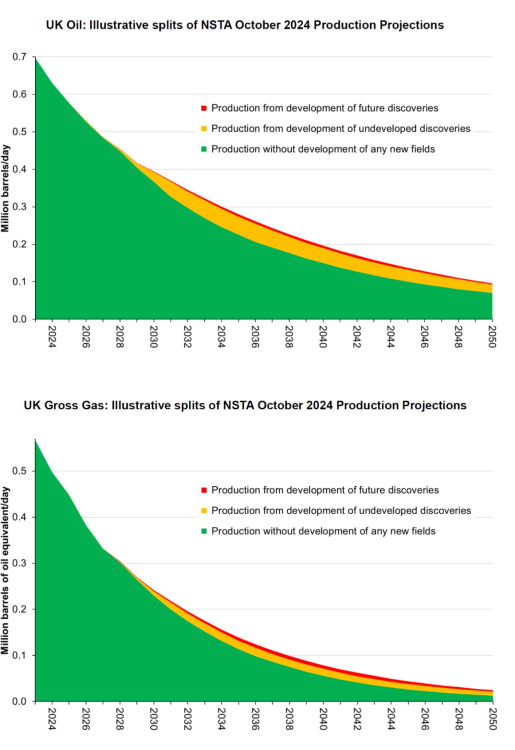
Right, let's put this to bed once and for all. First, the UK produces less than 1% of world oil/gas. That isn't enough to affect the world price. Even if we were to double our production, adding 1% to the world supply isn't going to change the prices. Secondly, and this is the most important bit - our oil & gas fields are nearly exhausted. A quite from the latest consultation on the UK pop and gas industry "The UK’s offshore oil and gas industry launched sixty years ago, when the first licence to explore for oil and gas in the North Sea was issued to British Petroleum (BP). This long history of oil and gas production in the UK means our offshore basin is mature – much more so than other areas of the world. The most accessible oil and gas has already been extracted. Production is naturally declining and has done so for the last 25 years. Our North Sea no longer has the reserves available to meet domestic energy demand." (emphasis mine) Here is graph of the Uk's projected production if we carry on as now (green). Note that it is falling quickly and will have dropped to less than a quarter of today's production (which is only 50%of our consumption as it is) in less than 2 decades. Now look at the yellow and red bits. That represents our production if we drill everything we know about (orange) and everything we are likely to find (red). So even if we go drill crazy we will only change our oil production from 150,000 barrels a day to 200,000 barrels a day down from 700,000 barrels a day now. Like it or not, we are import dependent and it's only going to get worse over time.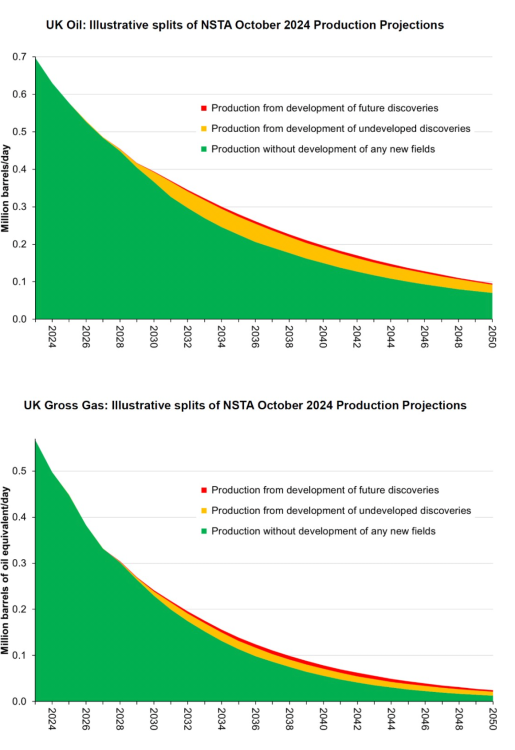
-
Looks like the party is over....
Beelbeebub replied to Beelbeebub's topic in Air Source Heat Pumps (ASHP)
I wonder, now we have rent tribunals, if the rent tribunals were to fix a fair rent ignoring the energy performance, then subtract the difference between the EPC running cost and the potential epc running cost if the property made C. -
Looks like the party is over....
Beelbeebub replied to Beelbeebub's topic in Air Source Heat Pumps (ASHP)
100% it's the scammers and subsidy harvesters. The core idea of encouraging insulation etc by making it cheaper is sound. It is hard to think how to do this without attracting the cowboys - see the recently unearthed external insulation debacle. My problem, as a LL, is how to upgrade old properties (mostly victorian) whilst navigating planning, conservation areas and finance. For example switching to double glazed windows makes a big difference to tenants. But it's expensive about £1k a window (they are big) and one building alone has 125 windows. Now this isn't an issue, we could just start plugging away at it, but if we swap out all the windows in a property for £5-10k (we've down a few) we get 2-3 points on the EPC, barely moves the needle. We've insulated all the roofs to at leat 200mm, most are 300+. But the majority of EPC inspectors won't actually look through the loft hatch - they just put it down as "as built" ie totally unisulated. Obviously wall insulation. That leaves walls and floors. Which are all solid so expensive and with downsides. My latest plan is to try and fit solar as that seems to have alot of points attached to it. I can get 10+ points for £10k of slap and batteries vs 3 points for £10k of windows. -
Looks like the party is over....
Beelbeebub replied to Beelbeebub's topic in Air Source Heat Pumps (ASHP)
Landlords already have to upgrade at their own expense unless the tenant (not LL) is eligible for certain subsidies. And those subsidies are crap - I think mainly there for subsidy harvesters. We organised one for a tenant. They came back with a package of measures including insulating the loft as it had no insulation. It def had at least 200mm of insulation, 300mm in places as it was up insulated when the roof was redone a few years ago. They also would onky do internal insulation but not pay for any redecoration, just leave the plasterboard finish. They also would only do the whole lot, not just the loft insulation. We had the same thing with windows. I the end we just paid for it ourselves. It would be great to increace the EPC ratings but the %of "poor" rental properties (less than c) is nearly identical to that of the owner occupied sector. Basically it reflects our poor overall housing stock. -
Is the party over (pt2) - End of high fixed price export tariffs?
Beelbeebub replied to -rick-'s topic in Photovoltaics (PV)
There was one YTer who sat in on the latest Octopus "webinar" and apparently the question was put to the octopus CEO. The answer was it [getting rid of the 15p export] wasn't something they were looking at or had plans to look at. Of course he could be lying or they might start looking at it tomorrow. But there isn't much we can do about it. The 15p rate seems to be too good to be true and it will probably have to go - or at least go if you have an extra cheap rate well below the 15p eg EV tariff. To be fair, banning the ev tariff lot isn't a terrible thing. There were people exploiting it a bit (one YT guy has a couple of tesla batteries to exploit the rate difference). The best thing is not to build your financial case on high export rates but on self consumption. Treat the high export as a nice bonus. -
Looks like the party is over....
Beelbeebub replied to Beelbeebub's topic in Air Source Heat Pumps (ASHP)
Oh, I've moved house since then! 😁 The system I put in 14 years ago is trucking along just fine We swapped houses with my parents as they were struggling in their house and ours was designed for "elderly living". Their house was built on the late 90's when UFH was over new (to the UK). It's not the (now common) PEX/PB pipe akin to speedfit. It was a small bore rubber (actually thermoplastic elasomer - think edge of an aerobie or soft touch handles) pipe system. With a clever counter flow design to minimise the temperature variation over the length of the run, which allowed it to be laid "up and down" rather than in spirals. Turns out that isn't an issue anyway. Unfortunately the rubber started failing after about 5 years due to a catastrophic screw up over material compatibility (turns out it degraded when in contact with warm water with dissolved copper ions in it). At that point the company went bust so the "50 year guarentee" was useless. So my parents fiddled the system on at low pressure and temperature for the next 25 years. Interestingly it kept the house warm at a flow temp of below 40C. If it was still operational it would be great for a HP,! Unfortunately my dad's dementia meant he tried to fill the Ch system and forgot how to turn the filler off so it over pressured and burst loads of thr (now brittle) pipes. So it now leaks like a sieve and is mostly decommissioned. Ironically the only but that is still operational is the zones embedded in the slab as the concrete provided the structure to resist the pressure. -
Looks like the party is over....
Beelbeebub replied to Beelbeebub's topic in Air Source Heat Pumps (ASHP)
When I installed mine, I filked each loop via a hose and checked the water flowed out nicely as a way of checking for restrictions. The I pressure tested the system. I was also careful laying down the loops not to kink the pipe. One loop did get kinked and was lifted out and repaid with a fresh coil (the kinked coil was reused for a shorter loop where the knik was cut away) - took about 30 minutes extra. Given most of the loops require the flow valves winding in to restrict them anyway, even if there was a mild restriction as long as you can get the flow required by upping the pump settings and winding the restrictions down on the other loops it isn't a major practical issues (though a bad one from an installation quality perspective) -
Solar cable runs from roof space to plant room on ground floor.
Beelbeebub replied to jimseng's topic in Photovoltaics (PV)
Isn't there a DC specific SWA cable now (the regular SWA not being compliant for DC)? -
Looks like the party is over....
Beelbeebub replied to Beelbeebub's topic in Air Source Heat Pumps (ASHP)
Pretty much every single UFH install checklist has a flow test (in that you fill the pipes with water so obviously you pick up any glow issues then) and a pressure/leak test - usually 24h. If any leaks or damage are detected the whole loop is replaced - it's never advised to joint the pipes. As Rick said, a bad install wil have problems, but that is true of any aspect of any building. I remember seeing a YT vid where an extension had some settlement and when the builder dug down the foundations had been filled with rubble including empty paint tins and bottles with just a skim of concrete over the top. -
Looks like the party is over....
Beelbeebub replied to Beelbeebub's topic in Air Source Heat Pumps (ASHP)
As someone who is slowly retrofitting radiators and fan coils to replace a failed UFH install (not for any of the reasons Gus cites though) - whilst adding a radiator is the simplest and cheapest option, it is not always simple or cheap and I have the advantage of preexisting distribution pipes to individual room manifolds. I'd also say that the floor finishes argument is not an issue in new builds because the low heat loss makes the target flow temps low to start with and you don't need to jack them up much to compensate for any furniture reducing output. We had our "bare" floor areas cut at least in half by rubber playmates, foam sofas and beanbag on the floor, rugs etc. And still the flow temp was 30C or less and the surface temp was onky a degree or so above target air temp. In fact the issue we had was as it was a concrete finish the slab temp to hold 22C was often no more than 23C, which feels a bit cool on bare feet (hence the rugs). It was only on the coldest of days (like -10c) that tge floor temp ever got to about 25C and didn't feel cold on bare feet. Of course, retro fitting may require much higher floor temps to cope with higher losses -
We've been getting sun pretty much all week, but my problem not is my damn house is getting in the way! The sun is so low it doesn't rise above the ridge of the house. I get a brief 2h of direct sun, but fortunately generate 4kw over that time so can top up my battery nicely. At some point I'll lose the direct sun but that was a trade off I was willing to make.
-
I have solar and a battery and gas heating so I currently use old fashioned economy 7. I charge my battery overnight at 13.5p and then any elec the panels generate that isn't used in the house is exported at 15p. When the sun goes down we run off the battery until the next charge period. If it's been a bad day solar wise and we've used a lot of elec (washing etc) then we migbt use a bit of peak rate elec (30p) for a few hours in the night. My average cost per unit is about 15p and if I include my PV it"s about 2p at the moment.
-
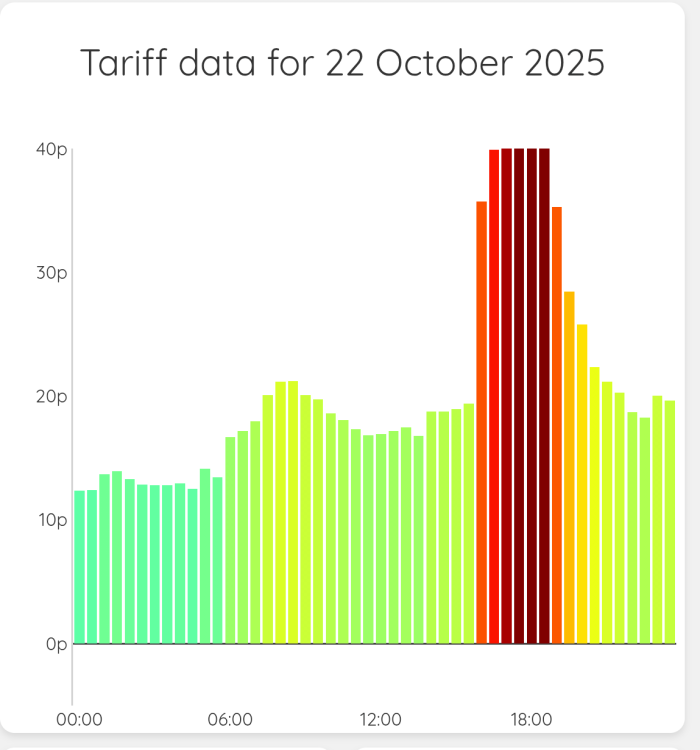
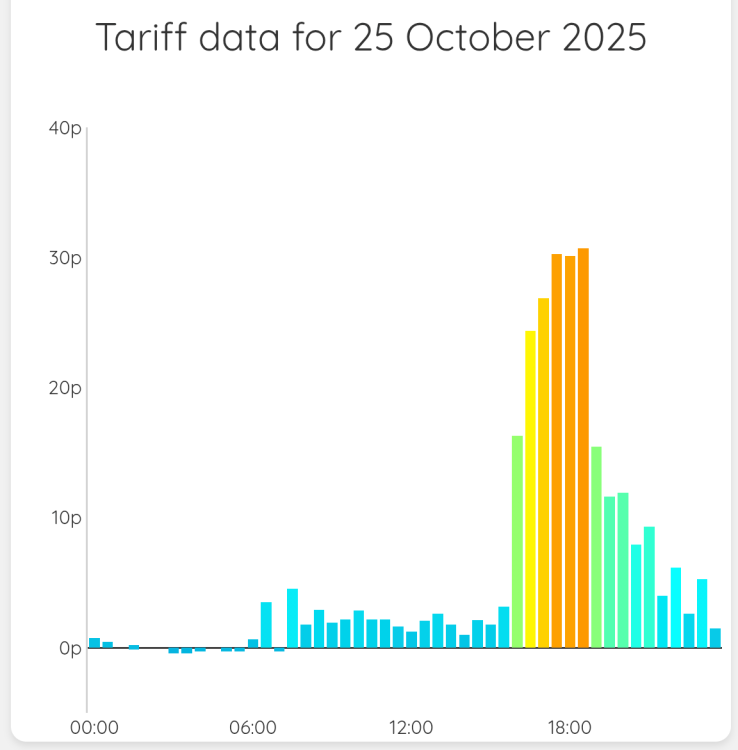
If I'm honest, there doesn't seem to be much wrong with your setup. The 17th was pretty cold where I was and I assume where you were, so £5.46 all in isn't too bad. Remember this is for one of the coldest days you are likely to see. In August your per day costs were much lower but it stands to reason your heating costs will be higher in the winter! One thing that does stand out is you're using the agile tariff whilst also using lots of 4-7pm elec. Because the unit cost changes hour to hour and day to day the cost on any given day can vary wildly. For example here is the cost for the 25th Oct As you can see it was near zero in the early morning and only a few p/kwh for most of thr day with a peak of 30p 4-7 Now compare that with a few days before. At no point was the unit price below 10p but the peak was huge (off the gaph, at 60p). You could could charge an electric car up (say 75kwh) on the morning of the 25th for less than running your dishwasher after tea on the 22nd. Over a year you migbt save vs a Cosy tariff but the day to day costs will occasionally be a real shocker. For your sanity, look at the monthly or weekly costs rather than daily and try to minimise any use in thr peak eg dishwasher, washing machine. You should def make sure your heat pump is not heating hot water in that time slot unless it absolutely has to. There will be settings you can change for that. If your house doesn't lose heat too quickly you could try setting the target temp back a bit in that slot to use a bit less. Otherwise your usage seems about waht would be expected - unfortunately energy is expensive these days. Good. Luck!
-
If you used 31kwh yesterday (20th) that's pretty good. The 20th was pretty cold (dunno where you are but it was sub zero across the Midlands). If we assume your house uses something like 6kwh a day for non heating stuff like fridges and lights, then you used 24kwh in a day, basically 1kw continuous heating load. If we assume a cop of about 2.5, that's a heat demand of around 2.5kwh. Not unreasonable for a house kept at 22-24C during a subs zero cold snap. If I read your graphs correctly on the 20th you used 31kwh and paid £6.52. That's 21p per kwh. Coukd you post some pairs of graphs for the kwh in a given day, then the £for the same day. I suspect you are losing out by using some energy during the agile peak period. You could save a fair bit by making sure your hot water heating doesn't occur then and also maybe turning your heating off for those hours. Agile is best used with some sort of automatic system that adapts your use to the variable daily price curves. You migbt get a better price using Cosy.
-
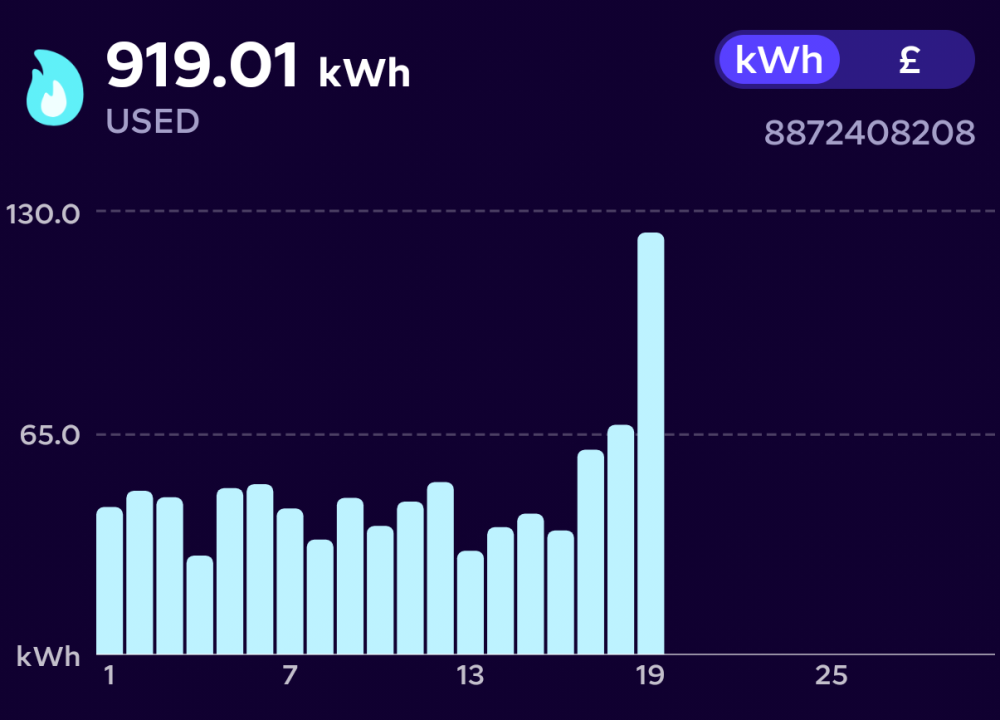
Just for perspective our gas heating has shot up during this cold snap (shock!) We were sub 50kwh a day then the cold snap hit and we are more like 100kwh plus - and that's with a log burner going to take the edge off things.
-
Could the Op post the kwh usage graph from. Octopus. Thry say they are on agile which has a massive spike between 4-7pm (eg today 21st Nov it's neatly 50p/kwh) Agile is for people with a battery (mostly) For a HP you need a Cosy tariff.
-
Looks like the party is over....
Beelbeebub replied to Beelbeebub's topic in Air Source Heat Pumps (ASHP)
Yes inverters have efficiencies, depending on the operating range it can range from 90-97%. Even if you take the absolute worst cases (90% in, 90%out and 95% battery) you're still over 75% round trip. But at more general levels my system can beat 90% round trip efficencies. I think the drop in price of hybrid systems has made them a "no-brainer" for the majority of installations - not least because even without PV you can save by time shifting your demand. Obviously there will be edge cases where it doesn't make sense - but the majority of those will be the result of tarrifs that may not hang around. If the ratio of import/export prices widens or the price of imported electricity rises batteries will make even more sense. -
Looks like the party is over....
Beelbeebub replied to Beelbeebub's topic in Air Source Heat Pumps (ASHP)
i am assuming he is talking about round trip efficiency ie how many kwh it takes to charge a battery so that you can discharge 1kwh. For lead acid batteries it can be 60% round trip ie you only get 6kwh out after putting 10kwh in. LFP batteries are very good in these circumstances with efficiencies in the 95% plus range. This is independent* of the nominal and usable batter capacities * nearly - i believe you get worse round trip efficiencies if you use all of the usable capacity vs a smaller subsection (eg 20-80%) but it's not a huge effect and i believe most data sheets assume a higher depth of discharge 10-100% -
Looks like the party is over....
Beelbeebub replied to Beelbeebub's topic in Air Source Heat Pumps (ASHP)
The grid is already sized and set up for all the houses on it. If you have enough PV and battery that you never export or import you essentially dissappear from the grid in the same way as if you disconnected. Yes your neighbours can't use your solar but there is now more headroom in the infrastructure for increaced demands from them. Your contribution to the local grid will not be as stable, when thry are charging an EV and your panels are cutting in and out because of clouds the grid is having to take up the slack. They may not even be charging at that time and your lower might be effectively powering a factory across town - which requires the grid to carry the current. If I installed a 2Mw solar farm, more than enough to run all the houses in thr area, the grid would still prob be overloaded because it couldn't carry the current from me out. Imagine a block of flats with water pipes, a big water main splitting into smaller pipes for each floor and then smaller ones for each flat before even smaller ones for individual taps. If I had a magic water fountain, that produced free water from nothing, I still couldn't provide water for the entire block just by plugging the fountain into my kitchen tap. On the other hand, if I (and some other tenants) used our magic water fountains to satisfy all our individual water needs, the remaining tenants without magic water fountains would have better flow and pressure. -
Looks like the party is over....
Beelbeebub replied to Beelbeebub's topic in Air Source Heat Pumps (ASHP)
You're right, 30p saving by using a battery. Given the sun doesn't sine 24h a day at some point we cannot use the panels directly. Our options are use the grid or use a battery. The viability of using the grid as your battery (ie exporting when you have excess and then importing when you have shortfall ) is critically dependant on the price ratio between import and export. Without a battery the best you are likely to get is 15p all day, and the best import you can get is 25p because you can't time shift without a battery. This is equivalent to a storage efficiency of 60% and is unlikely to stay as good. The SEG rate is a better long term metric which is around 5p IIRC (could be more but it's nowhere near 15p). This drops the efficency really low. For a battery, your estimate of 6 to 7kwh in to get 5kwh out implies a round trip efficency of 70-80% which I think is too low it's more likely 80-90% or better. To be fair panels are so cheap now that *if you could get a really high export limit*, like 10kw or something you could have a huge array, big enough to export so much elecreicty in the day and summer months that you could build up enough credit to import "off sun" and still end up ahead. But you would need the space for the panel and the high export limit.






