Beelbeebub
-
Posts
1522 -
Joined
-
Last visited
-
Days Won
11
Everything posted by Beelbeebub
-
Is that via the Web Api? I'm using thr local one and (as far as I can see) there is no rate limit, beyond simple network traffic, currently every 3 seconds with no problems I did see the Web Api has a rate and daily limit.
-
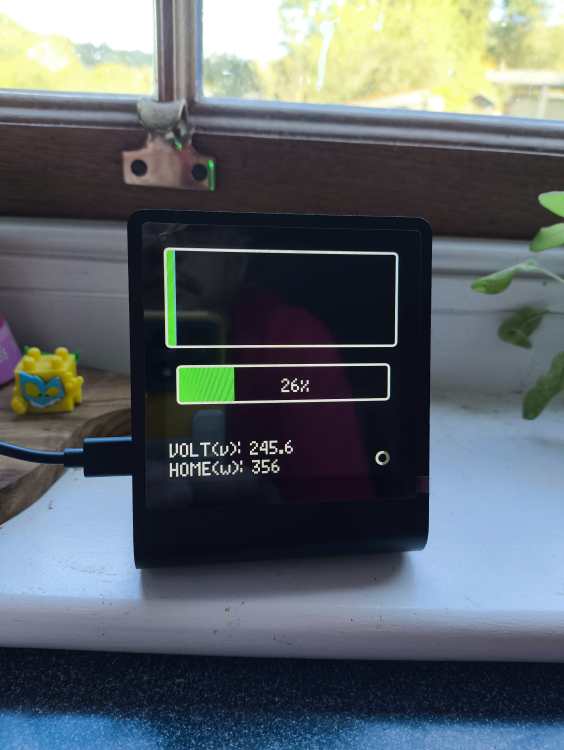
I've hacked together a basic monitor for my SolaX (IES) inverter. The goal was a standalone display so we can see the battery status and also charge/discharge/imoort/export status of our system - primarily to make it easy to decide if there is surplus power to stick an extra wash on etc. Yes, you can get all this and more from your phone app, but you ha e to get your phone out plus this is entirely local and cloud independent, though it does use your home WiFi. Anyway, it's pretty basic for now. The hardware is a £60 "Presto" from pimoroni - essentially a hobby electronics board with a display. It's a microcontroller, so no issues with operating system updates, viruses etc. There's no reason this couldn't be modified to work with other solax inverters or potentially other inverters. It's just a case of knowing what local call to make to the inverter to get it to spit out it's data and then how to parse that data. I'll tidy up the source code and put it on giyhub if there's interest.
-
excluding cooking and heating the average home is pretty low powered these days. 10kwh would do you a day without any issues. 2 or 3 if you were little frugal If you cook or heat with the elec, you'll chew through the energy pretty fast. if you're really concerned about off grid run time, get bigger batteries don't forget your panels will provide some energy in all but the crappest of weather
-
G99 refusal. G100...where do I go from here?
Beelbeebub replied to jimseng's topic in Photovoltaics (PV)
As Pro Dave I thought you can always get a 16A, 3.7kw export - and they will upgrade if required (which it seems might be the case) As PD says, a compliant inverter may be the better route I have 11kw of panels and use a Solax IES 8kw, with a 3.6kw export limit. It has 3 MPPT inputs so you can have 3 separate arrays. The export limit is adjustable in software so if your limit is upped in the future you can up your export. It seems a good bit of kit, the only downside is that it uses it's proprietary modular batteries which aren't as cheap per kwh as the fogstars and each 8kw inverter is limited to 20kwh storage - so you would need 2 inverters to get the equiv storage. They do connect together to cooperate. IRRC the inverter is about £1200 and each battery module (5kwh) is similar -
I'm not sure if my neighbours are on the same "branch" as me. Ours is a newer build (as in built after 1900) and I seem to remember a power cable was dug in for it back down to the road because the existing one was too crap. I will get the voltage at the meter read and compare it with the voltage at the inverter just to check there isn't an issue in the connection between the inverter and grid or the internal voltage sensor isn't out of whack.
-
Cheers, I contacted the installer to have a chat as we had a few more spikes over 255v and periods where the 10min average exceeded 253v (which cause shutdowns) today. They said they'd pop round to check everything and also take a calibrated voltage measurement, which will be good because I can then confirm it isn't my inverter being a bit out of tolerance with the voltage reading (I don't think it is). They also said contact the DNO and they should be pretty quick about doing something, especially if it's a setting at the local transformer (changing which output taps they use I assume). So that's on my list for Monday. Anyway, right now I don't actually get paid for any export at the mo, but I've just sent off my Octopus Outgoing application so hopefully I'll start getting paid just in time for the sun to bugger off for the winter!
-
Just following on, I think my local grid must be pretty rubbish. My voltage got as low as 234v this afternoon before shooting up to 255v repeatedly and tripping my inverter offline. I don't actually mind my export being curtailed, but kicking my I verter offline so I end up importing elec is annoying.
-
Dunno, there's the corroding and falling apart lead sheathed, paper insulatied main feed to a block of 4 flats I look after that clearly runs hot, the pitch potting in the head is leaking out that we repeatedly point out to the dno (basically every time an electrician comes in and goes "holy shit". And every time somelne comes out, agrees it's crap and needs replacing and then bugger all happens. I've still got several tenants on the old radio switch meters. Repeated visits by meter swap teams have failed to actually swap the meters.... 😞
-
Yeah, they basically stuck me the bare minimum, and I suspect (given the voltage rise) they would have set it to zero if they were allowed. I"ll monitor the voltage and see if they can/will make the required adjustments. I do wonder, I'm in a long thin village and not too far from the transformer. But some other people, presumably on the same line will be a lot further. If the cables are a bit skinny it's possible they have to set the transformer voltage at the high end so the people furthest away aren't too low. If that's the case there may not be much room for adjustment. Oh well. It's not the end of the world, it would be nice to be able to get more export money but ultimately the better option would be to find another use for the spare capacity <starts scrolling through autotrader>
-
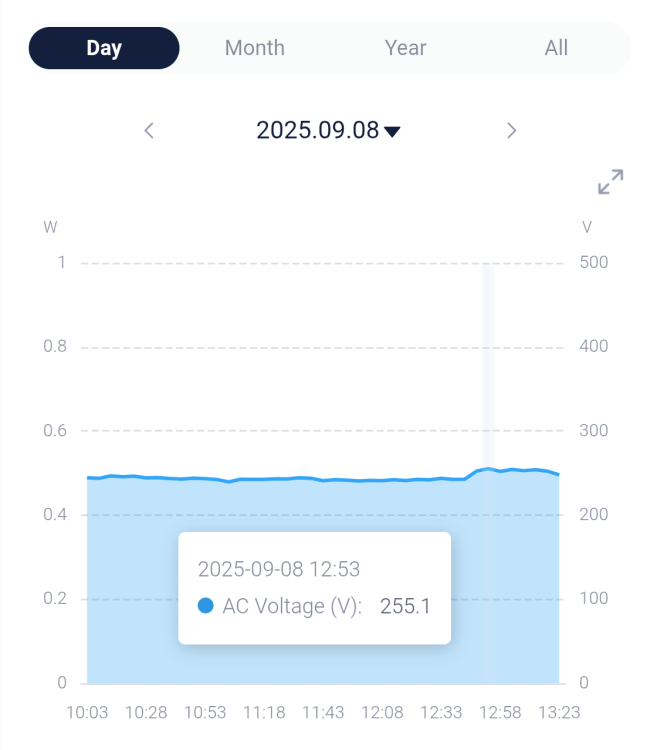
So this morning my panels were charging my batteries at about 7kw, with around 500w going to my house. The grid voltage was low 240's, maybe 242, 245 etc. Then around 12.40, my battery hit 100% and the system switched to export mode. The DNO limited me to 3.7kw (I can see why) but even so.my voltage jumped well over 250, peaking at 255! It seems to be stabilising around 250ish now, but my connection seems to be a bit crap. I alps noticed they limited me to a 75a supply but I'm pretty sure we have a 100a fuse!
-
I've managed to get good data directly from mine by using a cUrl query and the parsing the reply. (SolaX). It's possible other brands can do the same, just a matter of finding the right query.
-
Thanks all. I'm just a little worried as my inverter shuts down if the voltage goes too high (253.6 for more than a certain time) - nothing dramatic, it just dumps me back to grid power - which is annoying as I then start consuming grid power even though my panels and battery are able to support me. Currently my export is set to 2kw limit pending the paperwork coming through for higher (waiting on installer). But the other day it threw some warnings and shut down briefly. It's nit the end of the world if I can't export much, though I do have a bunch to spare, but having the inverter shut down from time to time because the operators are running to close to the upper limit would be annoying.
-
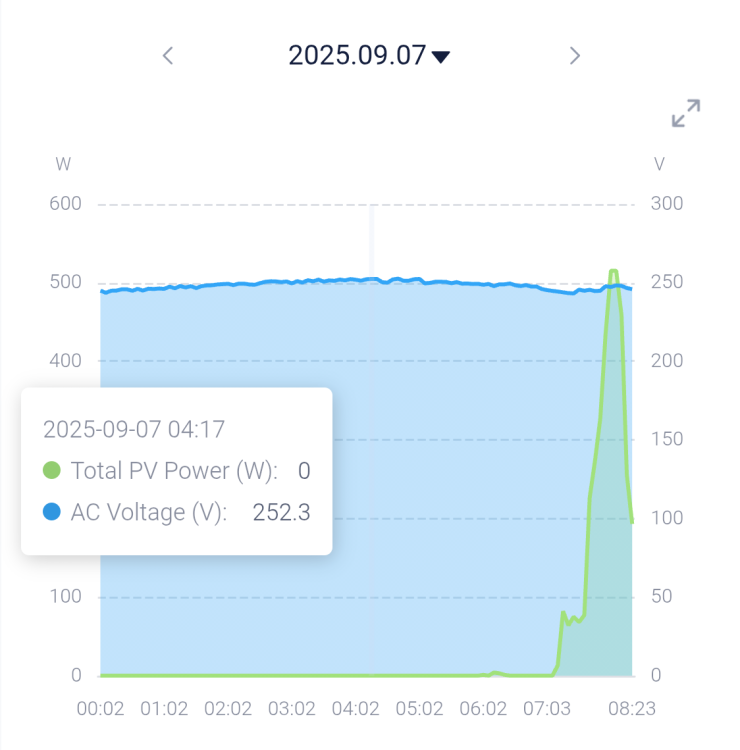
So at midnight the grid voltage was 245v, but just after 4am (ie no PV generation in thr UK!) it peaked at 252.3
-
Pretty much this. My sorry is it limiting my export. Do they lower the voltage locally to allow export?
-
Quick question for those of you with grid PV systems and the ability to monitor their grid voltage..... What is the typical voltage you are currently getting? Mine is the high 240's over the last 3 days. This is even overnight so I don't think it's just that there's alot of solar in my area. I was wondering if running so high (even without my export) was normal?
-
Fill your roof with in-roof PV panels instead of pantiles?
Beelbeebub replied to Alan Ambrose's topic in Photovoltaics (PV)
This is the shutdown procedure for my system (SolaX) a. Press the Button on the inverter to shut down the system; b. Turn off the AC and EPS breakers between the inverter and the power grid; c. Turn off the DC switch on the inverter. d. Turn off the BAT switch and button on the battery So the first action is to click the "off" button on the inverter. This powers it down so it is no longer absorbing power from the panels. At this point the current is zero. The B step is just isolating the unit from the grid The C step then isolates the panels physically. At this point, again the current is zero, but there is the added safety of a physical break. Then you can unplug the panels from the inverter safely as there is no current - obviously the system may still be live if there is light on the panels - but no chance of an arc. There are some little rubber covers you can pop over the connectors for extra safety afterwards. I don't see how adding another physical break makes it significantly safer - obviously it may make it a bit safer in that all the live bits are fully enclosed, but at some point you will still have live parts during the day and it does introduce another point of failure over a continuous wire eg arcing or loose contacts. -
Just a though about modulation and over sizing etc. Rather than a single 15.5kw unit, how about a 9kw and a 6.5kw (it would cost a bit more) If the controls could manage it correctly you would be able to mldulate down to the lowest of the 6.5 up to the max of both together.
-
I believe the r290 grant units use their newer interface and control box. Quite how good it is, i don't know, but it looks OK and is a step up from the functional but not very user friendly old ones.
-
Fill your roof with in-roof PV panels instead of pantiles?
Beelbeebub replied to Alan Ambrose's topic in Photovoltaics (PV)
Yes We took each point in turn Wind lift (my main concern) - the location is very sheltered and the fixing method provides a very direct load path from the panels, via the shee metal to the main structural timbers, which are in turn specifically fixed down to resist wind uplift (in this case from the sheet metal) Ridge tiles - sheet metal mono pitch roof so not a concern. Even in a duo or hipped roof, the ridge flashing are screwed down rather than mortared on as a tiled roof, so no danger of them coming loose from turbulence. Rain and snow - care was taken at the eaves to make sure the run off the panels didn't 'over shoot' the gutter. Basically the lowest edge was stepped in about 2 inches. As there are gaps between the panels the runoff from the upper panels tends to fall through onto the metal roof anyway. Snow wise, other than making sure the dead load of the snow is fine we didn't worry. Snow is fairly rare here and the low pitch of the roof means there is little chance of big slabs sliding off to damage anyone/thing Wind noise - we get plenty of wind noise from the trees, there is little chance of wind noise being a regular problem. Any structure can generate noise in specific conditions. It's just a case of making sure those conditions are not the common ones. The 400mm rule of thumb is not a bad thing for retrofit to tiled roofs. But it shouldn't be allowed to become a golden rule for all circumstances - especially roofs specifically designed with solar in mind. -
Fill your roof with in-roof PV panels instead of pantiles?
Beelbeebub replied to Alan Ambrose's topic in Photovoltaics (PV)
Thank you. I used a mini rail system. I can't remember the exact make, but I'm very similar to this https://midsummerwholesale.co.uk/buy/k2-pitched/k2-mutlirail-10-with-screws Fastensol and Renusol do similar. Basically short bits of rail with an epdm pad underneath. These get screwed to the top flat bit of the roof profile allowing the standard mounts to clip in. Effectively you are using the sheet metal profile as the rail itself. It was very easy to put up, especially as the sheet metal roofing was easy to walk on. I made (3d printed) some end caps to give the exposed rail ends a nice finish. I could stick some skirting round to neaten stuff up but I don't think I will have any bird/pest issues and it does allow for better ventilation. Visually being able to line up with the edges makes a difference. There was a fair bit of discussion about this as the guidelines talk of 400mm margins and the like but nobody could really find out exactly why. The best explanation was wind lift, so we took extra care to make sure everything was well fastened down and there was a good load path to the heavy foundations. -
Fill your roof with in-roof PV panels instead of pantiles?
Beelbeebub replied to Alan Ambrose's topic in Photovoltaics (PV)
I wanted to do the same (make a roof out of the panels for cost. I went round the houses so to speak) with things like GSE trays and even rubber stripes between the panels. In the end I used trapizodal metal roofing (think industrial unit) as the waterproof layer. It seemed the easiest way to ensure watertightness. It's light (less than 25kg including panels and mounting rails), robust, easy to work on (no cracking or knocking tiles) and pretty long lasting. Industrial metal roofs easily last 25 years, often 30 or 40 (lots of units built in the 80's are still knocking about). The primary aging mechanism seems to be UV damage to the Pvc coating (don't get the painted finish) and that will be helped by the UV shading the roof. I didn't put a roof membrane under (because it's a carport) but you could easily. Then there are a number of systems that use self drilling and tapping screws (the same as used to mount the metal panels to the purlins) to mount little sections of aluminum rail or you could use full length sections (just costs a bit more). The panels then just mount as normal. The total standoff from the top of the trapizodal roof profile is about 50mm to the top of the panels. Of course it depends a bit on your roof design (complex hips and valleys or curves etc are harder) and overall aesthetic (work well on a modern building, not so much on a stone cottage in thr cotswolds)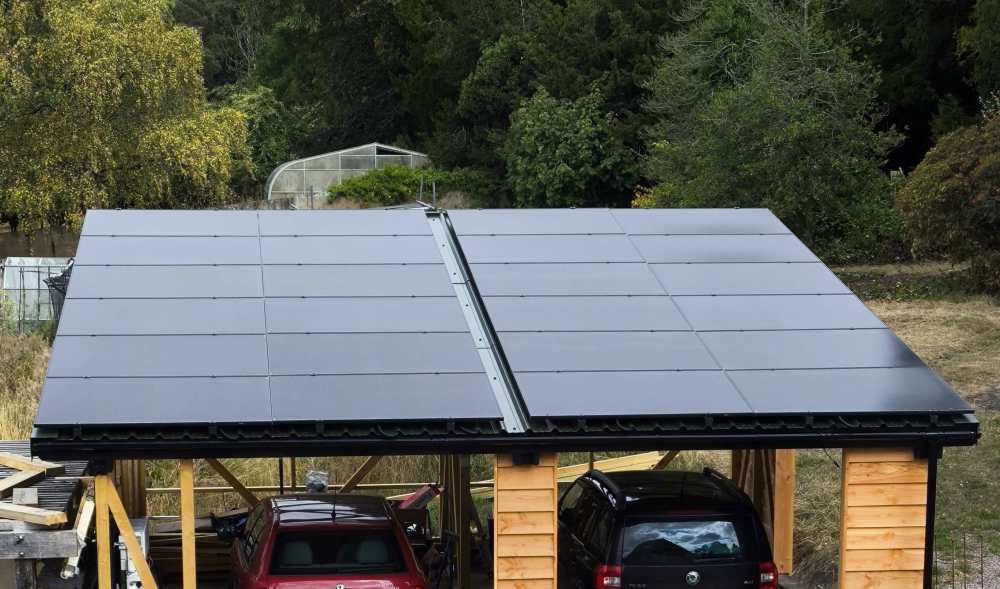
-
Fill your roof with in-roof PV panels instead of pantiles?
Beelbeebub replied to Alan Ambrose's topic in Photovoltaics (PV)
My inverter has a big rotary dc isolator set built in - you turn that and the panels are disconnected therefore no load, then the mc4 connectors into the inverter can be removed with no issue (arcing) even though they are still at high voltage. I can't see how an external isolator helps there except that there will be zero voltage. Ultimately at some point with solar, unless you work at night or cover the panels completely you will have to work with live HV. The MC4's are crimped onto live wires at some point (yes, doing as much work on the disconnected system as possible is best practice, but you can't avoid some work on live bits) -
You could wait for (hopefully) the position on grants for air to air systems to change for the better and then just install one of those. Our UK obsession with A2W systems is based on retro fitting to existing heating systems. As far as I can see the only 2 advantages A2W systems have is 1) *once installed* the emitter side of the system can be worked on by a regular plumber 2) it will retro fit into an existing wwt system *as long as the pipes and emitter are suitible* There is a possible 3rd which is some people prefer the heat given off by a wet system to a blow air system. This is particularly true of UFH. But if you are using fan coils that 3rd point is moot and even the 2nd point is fairly weak. Which leaves you with point 1. If you are comfortable with calling in a specialist to do work then that's sort of irrelevant. Right now not you need to find a specialist plumber to work on A2W anyway, so not much difference to call an air con guy instead.
-
What's the case for not getting an ASHP?
Beelbeebub replied to kentar's topic in Air Source Heat Pumps (ASHP)
I'm intrigued! Painting, I assume, is just normal airbrush painting like for cars etc. What is aqua blasting? -
What's the case for not getting an ASHP?
Beelbeebub replied to kentar's topic in Air Source Heat Pumps (ASHP)
Also, I'm curious what you using the air for? I'm trying to think of a hobby that uses 7kw of compressed air! Is it for a pumpkin cannon?! 😁