


Beelbeebub
-
Posts
1522 -
Joined
-
Last visited
-
Days Won
11
Everything posted by Beelbeebub
-
Heatpump output vs efficiency dilemma
Beelbeebub replied to Archer's topic in Air Source Heat Pumps (ASHP)
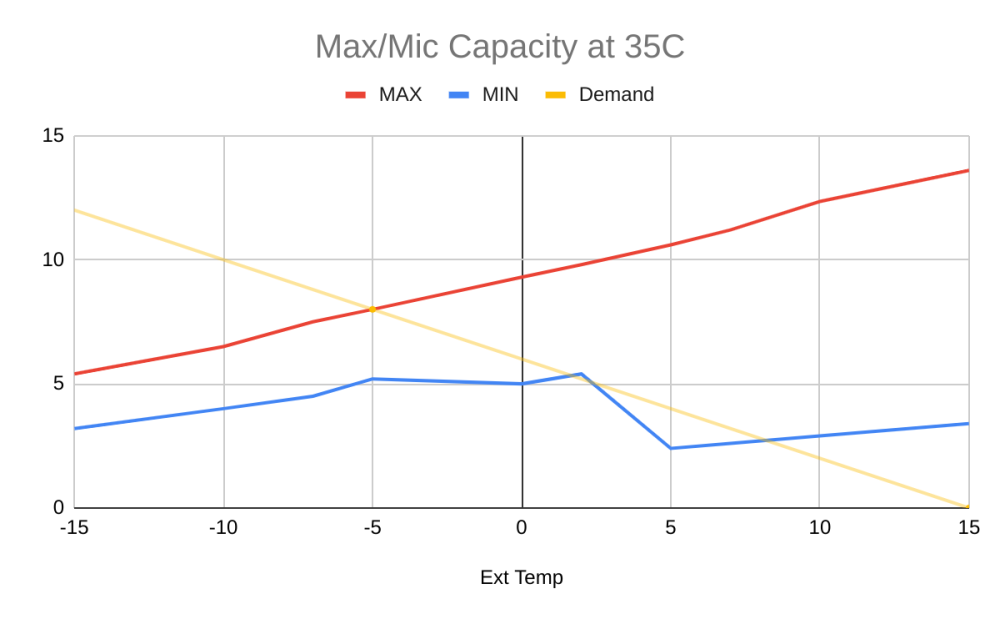
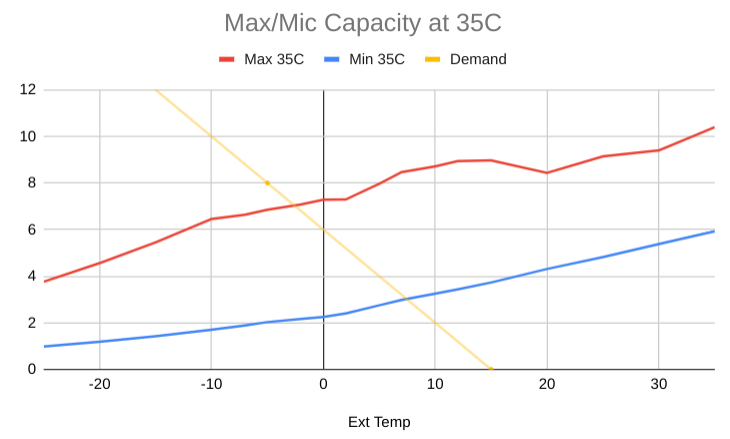
I picked -5C as the coldest you are likely to see in the UK therefore also the highest load you are likely to see. 15C was picked (again slightly arbitrarily) as the temp at which most houses don't need much extra heating to stay warm, some will be lower, some higher. But this is the point at which you want you HP to be running at it's lowest. So from the table you posted the 7C range (red) would be 2.6-11.2kw or 1:4.3 But in reality you are more interested in the max power at -5C (or maybe -2C or whatever you pick as the coldest day) which is 8kw (green) And your minimum requirement will be at around 15C which is 3.4kw So your practical modulation is more like 1:2.3 I did a rough graph.... The kink in min from 2 to 5C is interesting, my guess is the % modulation isn't true compressor speed, but % of available range, ie the compressor speed at 10% modulation isn't the same at every temperature. For reference this is the graph I got for an A2W (nominal 9kw) HP, which is worse than the other graph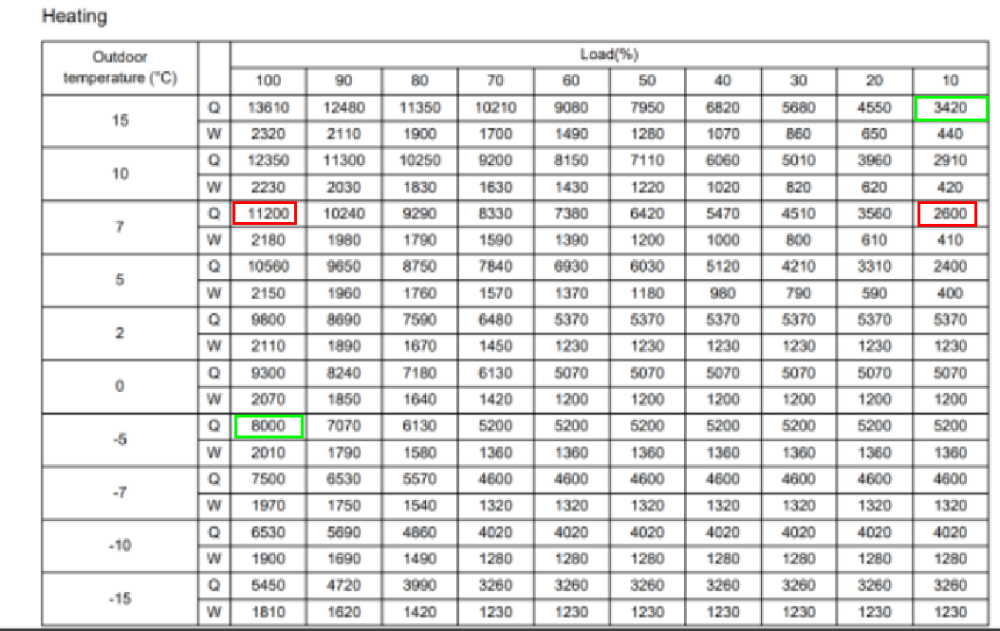
-
Heatpump output vs efficiency dilemma
Beelbeebub replied to Archer's topic in Air Source Heat Pumps (ASHP)
I don't have the figures on my phone, but I'll look up what the "Advertising Executive" min/max figures are for the heatpump i have data for and then compare it with the max @-5 and min @12C figures which I would argue are the more representative figures. -
Heatpump output vs efficiency dilemma
Beelbeebub replied to Archer's topic in Air Source Heat Pumps (ASHP)
The only way would be to get the data table showing output at min/nom/max for each outside/inside temp. The min/max output must be related to temperatures even if they don't mention it in the brochure. For example is that 7kw at 15C or - 15C? Given manufacturers always like to put a good spin on specs I'd bet it was the maximum in close to ideal conditions. Similarly of I wanted to show the lowest output I could (to make the modulations seem better) I would absolutely quite the output in fairly cold conditions. -
Heatpump output vs efficiency dilemma
Beelbeebub replied to Archer's topic in Air Source Heat Pumps (ASHP)
The one thing I would caution about modulation range, which I noticed from A2W units and may (or may not) apply to A2A.... The modulation range is generally quoted as the max and min outputs at a given temp. So it may be a max of 12kw at - 5C and 3kw min at - 5C So 4:1 Except you don't use the minimum modulation at - 5C. Thatvs when you need max power! You need min modulation when it's warmer, say 10C or 15C. Thr minimum a HP (at least the ones I looked at) can modulate down to at the higher temps is higher than at the lower temps - which is obvious really. But that means the minimum you HP might be able to turn down to, when you actually need it to turn down, is higher than you might think. Say 5kw When I looked at the "max at minimum vs minimum at maximum" values I was seeing a modulation ratio closer to 3:1 Does that make sense? -
No I mean the heat store water is the CH water. Runs at 1.5bar. Yeah, that seems about right from my measurements, though the store isn't held at that all the time. It drifts down to about 48C before boiler kicks in. Actually, as I monitor the dhw coil temp I might be able to experiment with what temp you need the TS to be at to give a certain output temp of water. Hummm. Anyway, if I swap to a HP, ripping that big tank out would be a right sod so I may be stuck with it and live or get around the inefficiency. On the plus side it does allow me to get a lot of free DHW from the solar in the summer - last year we had weeks with zero gas burn, less so this year! And it also. Allows the integration of the log burner in winter - one IKEA bag of wood is DHW and heating for 24hrs, though ironically we can only run the burner when it's bear or below zero otherwise we get too warm!
-
Beginning of the end for MCS?
Beelbeebub replied to sharpener's topic in Air Source Heat Pumps (ASHP)
i have no idea about the Smiths quality. There are a couple of other similar products, mainly italian. Quiet fan convector rads at a reasonable price would be a key component of the HP roll out. It would be nice to have a choice and units tailored to the UK market (sizes, style etc) The use of a variable speed fan (easy these days) also means the output for a given flow temp and rate can be varied. This means you could run WC at full flow and the radiators would reduce their output if they detected the room was overheating but simply reducing the fan speed. Likewise, at night they could ensure quiet operation by dropping the fan speed but increasing the flow temp to compensate (albeit at the cost of efficiency) They could even have a direct electric heater element built in so they could act as the backup/extreme cold heater. -
Beginning of the end for MCS?
Beelbeebub replied to sharpener's topic in Air Source Heat Pumps (ASHP)
true enough, sometimes it would be a bit obtrusive, though it is very much context dependent. What people find acceptable varies. People used to rip out those "old fashioned" cast iron rads for modern slimline steel panel rads. Now they're sticking the same rads back in as "period" (though period would be a coal fire, jumper and TB!) Fan convectors and fan assisted are an option. Smiths do a fan assisted unit that gives roughly the same 1.4kw at 40C that the same sized (1200x400) k22 rad gives at 75C. Looks pretty similar too.... -
thanks, i currently have a 750l TS which is used as the summing point for the solar, log burner and gas boiler with the UFH taking a blended down temp of about 30C I was wondering if I had to ditch it when i eventually go for a HP. I'd def run the UFH direct, but I was wondering if i could totally fill the TS with 55C water (it's a direct from boiler store, no coil) and get enough 45C water out. Currently it stores about half full at 67C top temp, with the middle around 45C and the bottom around 20C, lower if i've just used lots of hot water. Be a massive saving if I could keep the TS
-
Heatpump output vs efficiency dilemma
Beelbeebub replied to Archer's topic in Air Source Heat Pumps (ASHP)
I think Vaillant and others have similar though I think they are optional upgrades to the hydrobox or unitower indoor units. -
Beginning of the end for MCS?
Beelbeebub replied to sharpener's topic in Air Source Heat Pumps (ASHP)
Isn't the issue not the heat demand of the house, but the size of the emmiters? You could have a house with 20kw of heat demand, but if the emmiters are sized so that could be supplied at 35C flow temp, your costs would be lower than gas. Obviously, the lower the heat demand, the smaller and cheaper the emitters can be and the lower the running costs. Fabric first and all that. But there exists, in the eyes of the public, the idea that heatpump can only work in tiny super insulated homes. A friend is doing major renovations. It's a big victorian solid wall semi. They've been told their house is too big for a HP and they'd need 2. So they are going with a gas boiler - not actually a bad decision. *but* the idea that they can never have a HP and will be using a gas (and later hydrogen) boiler means they are paying out the new parts of the heating system with small high temp rads. Some of that is aesthetics - they have the old fashioned cast rads for looks and they have put underfloor in the new floor area. But some of it is driven by not considering that low flow temp heating will ever work for them. So when they do need to switch to a HP at some point, the emmiters (and some pipework) will need redoing. And I'm pretty sure their house could be heated with a mid teens (say 15kw) unit which are readily available. -
Heatpump output vs efficiency dilemma
Beelbeebub replied to Archer's topic in Air Source Heat Pumps (ASHP)
BRE have looked at this topic. They have an online calculator/simulator you can play with. TLDR, the simulator implies slight undersizing is beneficial mainly due to lower cycling most of the time outweighing the use of booster heating occasionally.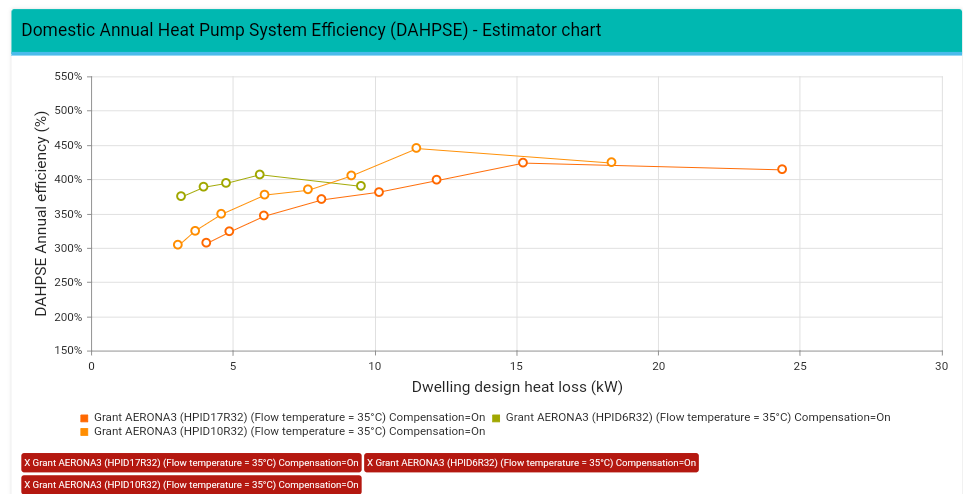
-
Joules ASHP, set 2 different output temps, rads & UFH?
Beelbeebub replied to Andeh's topic in Air Source Heat Pumps (ASHP)
I think you are right, just an interesting thought experiment Yes -
Joules ASHP, set 2 different output temps, rads & UFH?
Beelbeebub replied to Andeh's topic in Air Source Heat Pumps (ASHP)
Yeah, I'm pondering the maths too. The only thing that your analysis might be missing is the flow rate issue. Energy delivered is proportional to dT across emiiters and flow rate. If we double the flow (q) through the system we double the energy, assuming same dT. For rads, we are limited by the emitter area. As we up the flow rate the dT tends to drop. So the flow temp of the rads will need to be a bit higher to compensate for the intermittent heating. But for UFH, at least the heavy slab type, the slab tends to absorb much more energy than you can throw at it. My slab returns the flow at pretty much the slab temp until I reach a high enough flow that the water can't transfer enough heat before it leaves. (as an aside I am tinkering with this as a way of measuring the slab temp -then controlling the actual slab temp to a weather compensation curve by "blipping" the flow from my Thermal store) So if we assume the heat transfer to the slab is well below the "saturation" rate, we could inject double the energy into the slab by doubling the flow rate at the same flow temp during the "on" time slice. We can do that because out HP is directing all it's output to the UFH and not dividing it between UFH and rads. Does that make sense? As I say, it's just a gut feeling rather than hard maths at the mo Could be wrong. -
Joules ASHP, set 2 different output temps, rads & UFH?
Beelbeebub replied to Andeh's topic in Air Source Heat Pumps (ASHP)
Yes, I was thinking time slicing. You have the efficency of running at higher rad temp all the time and blending down the UFH Vs The higher efficency of running half the time at lower UFH temps and half the time running at Rad temps. Because you are time slicing, you may need to run the UFH a little higher temp than if it was full time, but that would still be lower than the rad temp. Likewise the rad temp would be a tad higher than if it was full time rad temp. So you would lose a little efficency there. One advantage would be: If you run the "traditional" HP outputs huger rad temps and UFH blends down approach, you can it have weather compensation for the UFH flow temp. It is stuck at whatever the blending valve is set to (unless you use an electronically adjustable blending valve). If you use the time slice approach there is nothing stopping you using a WC curve for UFH and one for the radiators. That may yield a bit more efficiency. -
Beginning of the end for MCS?
Beelbeebub replied to sharpener's topic in Air Source Heat Pumps (ASHP)
Agreed. Borehole GSHPs might be a useful tech if the cost of borehole drilling can be lowered. They do have smaller units, and potentially higher efficency. The communal borehole network idea is interesting as it can get around the high individual cost by slitting over many users, and reduce the risks of a dud hole, especially if you join an existing proven network in your street. -
Beginning of the end for MCS?
Beelbeebub replied to sharpener's topic in Air Source Heat Pumps (ASHP)
They do seem to work well. I'm not questioning that. I was just questioning the assumptions in your napkin calculation. You h are right, you do need to start somewhere, but I would suggest setting the lower limit of the source at 0C (or maybe a bit above) rather than - 15C as that is unrealistic. A quick Google shows freezing of GSHP boreholes is generally to be avoided. Several installer FAQ's address this directly by saying (in effect) "a week designed system won't freeze". They don't say "freezing isn't a biggie" I found this from a study in Sweden. "... This paper concerns a rare freezing problem that occurs in 1 of 10,000 systems. In such cases freezing that occurs in the boreholes as a result of heat extraction creates an over pressure that flattens the pipe system, thereby stopping the circulating of the heat carrier fluid. Even if this is a rare problem it means big problems for the unlucky individuals and also for the industry since one such problem reduces the market in that region." I think that implies that wholesale freezing of the borehole is considered a bad thing that is rarely encountered because designers work to avoid it. -
Beginning of the end for MCS?
Beelbeebub replied to sharpener's topic in Air Source Heat Pumps (ASHP)
Is that good assumption? I may be wrong, but I thiught freezing the ground was a bad thing. Certainly close to the surface you'll get all manner of frost heave issues. Any vegetation eg lawns will suffer too. More importantly if the ground is pushed down to near or sub zero temps that means the return water from the borehole (to the HP)will be very low temp, which messes with the COP. GSHPs get good Scops because they never really see very cold source temps. It may be - 5C air temp, but all your HP sees is a balmy 12C from the ground. If it starts seeing - 5C it will perfrom poorly. -
Joules ASHP, set 2 different output temps, rads & UFH?
Beelbeebub replied to Andeh's topic in Air Source Heat Pumps (ASHP)
I guess it's better to run the UFH at as low a flow temp as poss, and then the rads at a higher temp than to run every thing at the higher temp and blend down. It isn't ideal, the ideal would be to get the rads large enough to run at the same low flow as the UFH, but that is fairly unrealistic. As to whether the heatpump can do it, I think it depends on the make. I think some brands allow 2 different zones, and temps. Ideally you would want weather comp on both with a different curve. -
Beginning of the end for MCS?
Beelbeebub replied to sharpener's topic in Air Source Heat Pumps (ASHP)
It is quite a neat idea, there is a lot of high density housing with a public road outside. The road itself acts as a heat collector in the summer. The bore hole drilling would be about the same level of disruption as installing any other road services ie moderately but not catastrophically annoying. If the houses also cooled in the summer, they would pump heat in to replenish. In fact excess power from the grid, PV or even local industrial process could be used to recharge the ground in the summer. -
Beginning of the end for MCS?
Beelbeebub replied to sharpener's topic in Air Source Heat Pumps (ASHP)
https://www.homebuilding.co.uk/news/community-heating-with-boreholes-under-road The only issue I can see is if someone over extracts from the community borehole array and causes the temp to drop for everyone. You could guard against that by having limits on what power HP you can fit, to some extent having limited pipe sizes into the property would do that. Of course the hypothetical heat pirate would also have to be using a lot of heat, so unless they are willing to just burn the heat to piss their neighbours off or are a cannibis farm, I don't think it would be an issue. A further guard would be to meter the heat and have it either as "unlimited subject to fair use" or outright charge per kwh.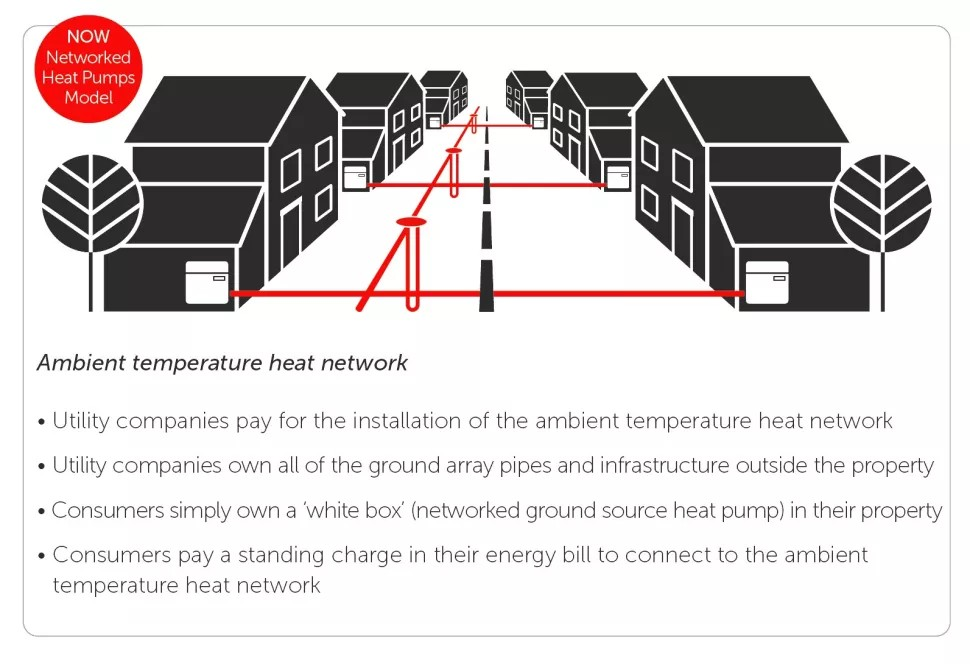
-
Beginning of the end for MCS?
Beelbeebub replied to sharpener's topic in Air Source Heat Pumps (ASHP)
Though the equation is different if you look at carbon. Even if the electricity is 100% renewable the generation capacity is considerably higher, which had a capital cost, albeit one not a visible to the consumer. -
Beginning of the end for MCS?
Beelbeebub replied to sharpener's topic in Air Source Heat Pumps (ASHP)
kensa are doing a project in the south west where they have put community bore holes under the road with brine pipe leading back to the homes. They have worked out that the brine system can be communal even when each property has it's own HP. It may be useful but the problem is i don't think there is enough ground heat for dense areas. Most of the heat in the ground comes from above, except in geothermally active areas. -
Beginning of the end for MCS?
Beelbeebub replied to sharpener's topic in Air Source Heat Pumps (ASHP)
I have looked into that, the block of flats is well served with chimneys - which are just a royal pain in the arse, but might be useful of we could have a unit that sat in the fire place and spat out heat.... WRT the losses from the house, would they be losses? Because they would cycle right back into the heatpump? -
Beginning of the end for MCS?
Beelbeebub replied to sharpener's topic in Air Source Heat Pumps (ASHP)
The other idea I had was if you had a HP that could fit through a loft hatch and had a ducted exhaust.... The ducted exhaust would exit upwards through the roof like a chimney. The intake would be drawn from the loft area, with extra soffit venting to allow airflow into the loft space. Additionally any house air or heat that leaks into the loft would be taken into the supply air and on sunny winter days any warming of the roof (dark tiles) would add supplemental heat. The big issue would be retrofit (getting the bugger in the loft, putting the exhaust through the roof etc) and possibly structural vibration into the dwelling, but external noise would be much lower. -
Beginning of the end for MCS?
Beelbeebub replied to sharpener's topic in Air Source Heat Pumps (ASHP)
Of all the noise sources of a HP, the hardest to silence is the airflow. Compressors, expansion valves, pups etc can all be put in a soundproof box, on isolation mounts etc. But the air rushing through the heat exchanger and the fan powering that must be out in the open air. We use fans to reduce the size of the heat exchange area, but what if we just increased the area instead? A 1200x1200 triple panel radiator would extract 6kw if the delta T were 50C if we make a more conservative dT of 20C you get about 2kw. So if we had 3 of those 1200x1200 triple radiators we could extract about 6kw of heat using a dT of 20C (i.e. the refrigerant was at -25C when external air was -5C) Ecoforest have a system where they pump the "brine" for the GSHP system through some aero heat exchangers (i think danfoss used to have a similar system) So if we stuck 5 or so of those rads on the outside of the house (let's say on the upstairs between the windows so the effect was not unlike upstairs cladding) and pumped brine through them to a plate HX heat pump.....


