


ADLIan
-
Posts
771 -
Joined
-
Last visited
-
Days Won
1
Everything posted by ADLIan
-
Photographic evidence of build quality (insulation levels, dealing at junctions, preventing thermal bridging etc) is now part of the Building Regs. Requirement of the 'new' 2021 Approved Doc L, effective mid 2022, for all new dwellings.
-
Insulating under block and beam floor with perlite
ADLIan replied to Patrick's topic in Heat Insulation
Only for new build. Not sure how you’d retrofit a dpm under an existing b&b floor?? Under existing Appr Docs and British Standards adding the insulation layer under b&b floor makes it a ‘solid’ floor which requires a dpm. -
'SFUF' has a core thermal resistance of 0.8 m2K/W. This is equivalent to approx 18mm of polyurethane foam board - I'm sure we'll all agree totally inadequate for a heated floor.
-
No real rocket science there! Report needs a different title too - sends the totally wrong message.
-
Fire is a totally different issue and not part of the ‘normal’ use of insulation, or most other construction products. Most houses are full of materials that are perfectly safe to use on a day to day basis but set fire to them and is very different scenario. Combustible insulation products are still acceptable in many instances under the Building Regs provided they are encapsulated within the construction - within masonry cavity walls, concrete floors etc. the risk is deemed to be low and they will not contribute to the development stage of a fire. Smoke inhalation from burning furniture and fittings in a house will kill a person a long time before the insulation in a cavity wall is involved. Grenfell was very different with certain manufacturers conspiring to promote the use of combustible insulation in an application where the risks were already well understood, documented and covered by the Approved Document B. Rock and glass wool products, both ‘mineral’ wool, are safe to use; modern glass wool formulations being much more pleasant to handle and install.
-
I don’t think any insulation manufacturer would market a product that was inherently dangerous to health either in its install or use. Mineral wool products are well understood and newer formulations are much more pleasant to handle. In France look at ‘pure one’ from Ursa, better thermals than rock wool and claimed much better handling, softer & less irritant.
-
Work has been done on this about 12 years ago. Search internet for ‘co heating test’. NHBC Foundation has a summary document which outlines the method and its complexities. Leeds Met University (now Leeds Becket) done testing to better understand the mechanism of heat loss from cavity party walls - as high as 0.7 W/m2K. This lead to party wall thermal bypass being included in Appr Doc L a couple of revisions ago and also the solution of fully filling the cavity with mineral wool to give zero U-value.
-
Kingspan - see grenfell tower inquiry evidence. Both product variations are combustible. Depending upon formulation pir may achieve slightly better Euroclass rating, D rather than E?
-
PUR and PIR are very similar chemically, slight tweak in the formulation. They do not melt and flow in a fire (as polystyrene does), they are both combustible but pir will perform slightly better than pur. I’m not aware of any safety/toxicity issues from either product as supplied as boards - the manufacturers would have to make you aware in their health and safety data. Products of combustion are a different matter!!
-
One or both layers have not recovered to the full 200mm thickness - a common problem with type of material. Make a formal complaint to manufacturer and get it replaced FOC. Contractor’s excuse is laughable.
-
I was merely pointing out why DIY systems are not available. Not my gift to be pragmatic as that's a decision for the OP - its his house!. The approval scheme (BBA normally) for injected cavity wall insulation has been around for many years and is well documented covering manufacturer, system designer through to the installer. Approved Document C specifically covers this requirement. The installer does not have to understand how a building goes together just how to install the product correctly. Joe Public cannot purchase the 'approved materials' as they are only available as part of the 'approved' package.
-
I’ve done numerous energy assessments over the last few years using ASHP - they became popular as the COP made building reg compliance, based on CO2 emissions, easier. Downside was the running cost which is reflected in the SAP energy rating. I would imagine that a badly designed and/or commissioned system, perhaps with COP of 2 or less, would be a lot more expensive to run than gas.
-
Only materials of Euroclass A1 & A2 are non combustible; B to F are all combustible with increasing combustibility/risk. If a product can only achieve class D or E the manufacturer may decide to use class F and avoid all the testing costs. Table 10.3 only refers to the external surface of external walls. This information should not be read in isolation as other sections of the AD will also apply. Combustible insulation can be used in applications such as concrete floors and certain masonry walls as they are protected by non combustible materials and will not be involved in the development stage of a fire (and perhaps not even in a well developed fire).
-
Compliance with the requirements of the British Standard for sheep’s wool insulation will be a starting point including the initial type testing (fire performance, thermals, density, moisture vapour resistance etc, etc) and ongoing quality assurance procedures. Perhaps also independent certification. See Approved Doc 7 of the Building Regs for ways of showing fitness for use. Then use all of this to convince specifiers, users, building control officers etc. Not easy!!
-
Current building regs for a cavity wall.
ADLIan replied to Russell griffiths's topic in General Self Build & DIY Discussion
Effective June this year 0.18 for new wall in an extension. May get away with a little higher in new build dwelling. Your wall need a total redesign. -
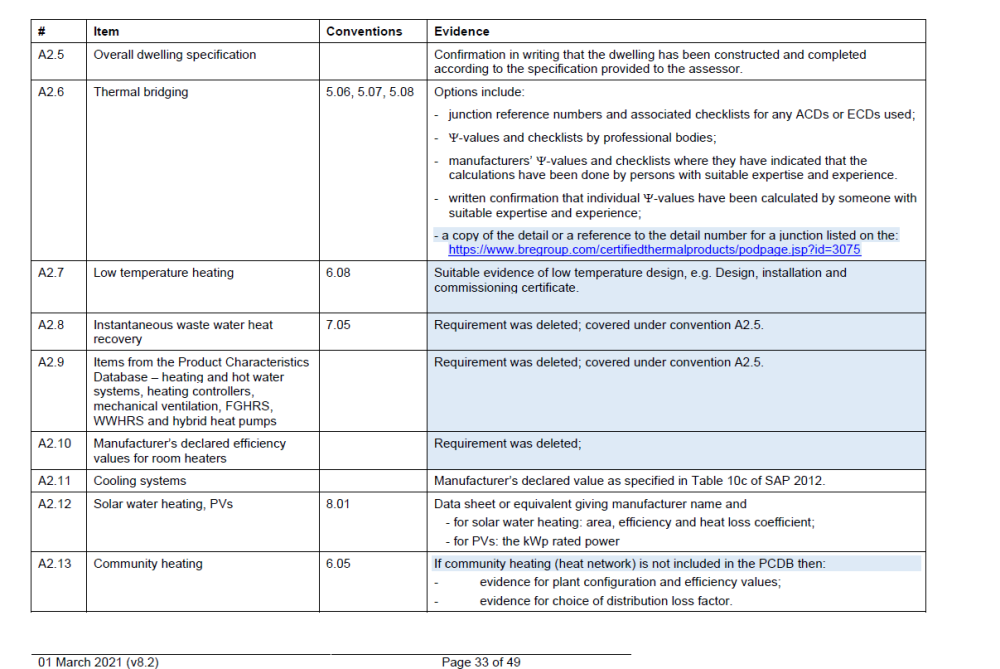
Your assessor needs to read the SAP conventions. Section A2.12 here (depending which version of the conventions this number may be different but this evidence requirement has been valid for many years)
-
Make and exact model number of panel along with number of panels installed is normally sufficient if not installed under mcs
-
Graphite in eps is an infra red blocker (absorber?) used to improve thermal performance.
-
You will not find a DIY option here as its notifiable work under the Building Regs. Injected cavity wall insulation must be certified/approved (BBA or similar) and be installed by an approved contractor.
-
Newer glass wool products (not yellow in colour) are normally much nicer to handle especially compared to stone wool. Underside of water storage tanks normally left uninsulated but this can introduce a route for thermal bypass to occur.
-
Mineral wool is a general term covering both glass wool and stone wool products. Knauf loft insulation will be glass wool
-
Thermal conductivity of geocell is 0.08W/mK and for PUR 0.022W/mK so geocell needs to be almost 4 times thicker than PUR. Read the certificate very carefully as depending upon ground conditions a dpm will probably be required. Sheets of foamed glass are a very different product, expensive and not very pleasant to handle
-
A cartel or price fixing involves competitors actively discussing pricing and is highly illegal. It is very unlikely as most companies now have strict anti competitive practice policies under the threat of fines equal to 10% of the companies world wide turnover and fines/imprisonment for local directors if found guilty. Price rises are normally started by the market leader, they must give their merchants/distributors notice, normally 3 months, of a planned price rise. Once the proposed price rise is known in the market then other manufacturers will simply follow suit. Remember in many sectors there are only a handful manufacturers (plasterboard has 3?).
-
SAP rating is based on energy costs under standardised conditions (and not all energy use in the home is included in it). It allows comparison to be made between house types. As an example take a 2 identical houses, one occupied by a family of 4 or 5 people and one occupied by a single person - they will have very different patterns of heating and hot water use so very different energy costs. Liken SAP to the mpg rating of a car - it allows a comparison between cars but different drivers are unlikely to hit the same mpg figures quoted by the manufacturer
-
That was part of the reason. The other was 2 particular pur insulation manufacturers competing for the same business and ‘engineering’ fire their test data to get their products into this market.


