


Crofter
-
Posts
3484 -
Joined
-
Last visited
-
Days Won
11
Everything posted by Crofter
-
What needs done to add an elec shower?
Crofter replied to Crofter's topic in Consumer Units, RCDs, MCBOs
Hadn't heard of those, ta, but we have pretty impressive water pressure- we are directly downhill from the Scottish Water tank, with about 30m of head. When we first moved in I gave myself a fright when I turned the tap on! -
What needs done to add an elec shower?
Crofter replied to Crofter's topic in Consumer Units, RCDs, MCBOs
What's a TT supply? -
What needs done to add an elec shower?
Crofter replied to Crofter's topic in Consumer Units, RCDs, MCBOs
Thanks, Dave. Something like this? http://www.toolstation.com/shop/p14865?utm_source=googleshopping&utm_medium=feed&utm_campaign=googleshoppingfeed&mkwid=s3Z3fpJI3_dt&pcrid=99808204703&pkw=&pmt=&product=14865&gclid=CPaSkKXtvNACFcsV0wodTSQMUg -
What needs done to add an elec shower?
Crofter replied to Crofter's topic in Consumer Units, RCDs, MCBOs
Erm, I may need some of this translated What do you reckon I need to buy, and is it expensive? Will probably get the sparky up the road to do the job (legal requirement anyway for this sort of job, no?) but as this is potentially only a temporary setup don't want to be forking out too much... -
What needs done to add an elec shower?
Crofter replied to Crofter's topic in Consumer Units, RCDs, MCBOs
So the problems are threefold: - extortionate electricity bills (have had £500 for a quarter before, this is for two misers in a 90m2 house who use a woodburner as much as possible and do not expect to wander around in shorts and t shirts in the middle of winter. The water heater is the culprit, as when I have got away with turning it off and just boosting the water an hour before it was needed, the bill dropped hugely. I'm not allowed to do that anymore for, uh, domestic reasons, so the system stays on all the time. - poor flow rate and pressure at the shower. It's a gravity fed TMS coming from a loft header tank and vented cylinder. Exactly the same setup as I installed on my previous house (except that was oil fired) and the only difference is the make of shower. The previous house installation, with a Mira, was perfectly acceptable. This house has, if anything, more head, but some cheap unbranded TMS. I've switched to full bore valves on the pipes which helped a little, but still very poor. - insufficient quantity of hot water. We have the thermostat on the tank turned as low as we dare, to keep the bills down, and now that the weather is turning colder we find it is running out of hot water before the end of a single shower. And this is despite the poor flow rate of the shower itself. I'm sure there are lots of all singing all dancing solutions to this, UVCs and whatnot, but I have decided that spending a weekend and £150 installing an electric shower will let me turn the damn tank off and will give lower bills, more consistent showering, and probably a better flow rate. Even as a temporary solution it has to be worth a try. All my energy needs to be focused on the other house (the new build) so I am not getting bogged down improving this one at this stage. Remember I have 24/7 access to cheap rate electricity so there is not need for me to be paying for standing losses. Anyway, I wasn't really after a discussion on all the various options, just the specifics of installing a leccy shower. -
What needs done to add an elec shower?
Crofter replied to Crofter's topic in Consumer Units, RCDs, MCBOs
Even a rubbish little electric shower will be better than what we have, believe me. Water pressure is excellent. Was assuming around 9kW, but whatever the supply allows me to do, -
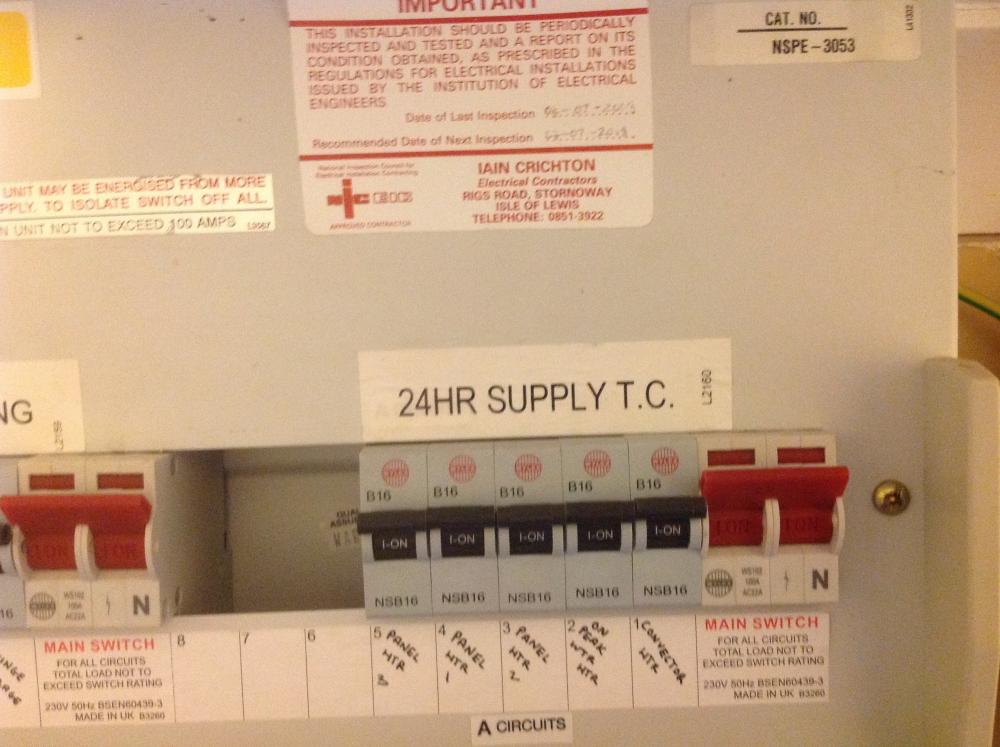
Our (current) house is all electric, on the 'Total Control' system. This means that we have two rates, one for space and water heating, and one for everything else. Currently we heat DHW using an electric immersion, but this is horribly inefficient as the small tank sits in a cold loft space and loses heat quickly. It also leads go a rather unpleasant showering experience. With SWMBO's words ringing in my ears ('dearest sweetheart, might you perchance be able to put your mind towards installing an electric shower, just when you get the chance.'- OK I'm paraphrasing as her actual words are not printable) I would like to install a basic electric shower. Question is- can I just buy a big enough breaker and stick in the existing CU? In our previous house there was a mini CU especially for the shower. I know these aren't that expensive but just wondering if it's needed or not?
-
Thanks for all the input everyone! All points in one direction. Will be ordering a bunch of 25x50 first thing in the morning...
-
Brilliant, thanks. Is your cladding 19mm sarking boards? I've got 20mm larch, it seems fairly stiff. I was advised to go for 50mm by a joiner mate who said he had done lots of cladding and always used that. TRADA say a minimum of 38x38 (been googling since I started this thread). I'm leaning towards 25mm battens and perhaps beefing them up with some intermediate verticals, which would have to be fixed by screwing through the sheathing from the inside. That'll mean pulling out some of the rockwool insulation but I've only done about a quarter of the area in question (I knew there was a reason I never finished that job!) Edit: @Tennentslager have you got everything on 600 centres?
-
Today was one of those 'b*gger b*gger b*gger' days. Offered up the various bits of wood, sill, etc, to the window to work out how I was going to do the reveal detailing, and it turns out my sills are not deep enough. Nobody's fault but mine- at some point in the build I had switched from using 25mm cladding battens to 50mm, and this has eaten up the overhang. If I press ahead, the sills will just, barely, clear the edge of the cladding, with around 10mm overhang. I think I have three options: 1- Buy new, deeper, sills- obviously the most expensive option. They are Aluron profiles, roughly how much would these be per metre? 2- Re-install the windows (must be a computer joke in there somewhere). I am quite reluctant to do that knowing how long it took me to put them first time around. I could probably do the job in two or three days but it's a psychology thing- would feel like I was taking backwards steps. Moving them 25mm towards the outside of the wall would be enough to restore the overhang and would make the faces match the counterbattens, which could simplify some of the detailing. 3- Alter my cladding design. I have vertical board-on-board 20mm larch planks, nailed to horizontal 50x50 battens which in turn are screwed to vertical 25x50 counter battens. If I change the horizontal battens to 25x50 that solves the problem (it was the original design) but will it make the cladding too prone to flexing? I don't really want the wall to bend when you lean on it! How much would it help if I doubled the number of battens (easy) or halved the centres by installing more counterbattens (less easy, and these would not be nailed onto studs, just the 11mm sheathing). Any other options? I'll just have to console myself that this is probably the silliest mistake I have made so far, which is not bad going given I have designed, drawn, and built this house completely singlehanded so far...
-
What about some sort of v lining or shiplap? Should gain strength through the interlocking.
-
That sounds a good offer! PM incoming...
-
I have a mate who builds Linux and dual OS machines. He offered to do me a recon Toughbook set up for boaty stuff (charting software etc already installed). Because one day I will have finished the house and get to go sailing again! Somewhat tempting, would certainly be good to try it out first.
-
Thanks for that. I'm on the lookout for a basic laptop- current one dates from 2009 and despite doing a complete system reinstall last year it still runs like a lame donkey. About the only mildy taxing thing I do with it is Sketchup, everything else is internet, word docs, excel, and similar boring stuff. I'll keep an eye on these Dell deals, if anybody spots anything similar give me a shout
-
And 'move in in time for Christmas'
-
My best quote so far has been from Excel, who @Rattyjohn used, but I haven't asked them about delivery yet. @ProDave Did you bother with the anti condensation lining at all?
-
Looking at different options for making good the hole that I am going to have to cut in my roof for the stainless flue from the woodburner. Basic plan is to have a single wall black stove pipe exiting the stove and going up to the vaulted ceiling (this will throw more heat out into the room, look neater, and save a fair bit of money). Just before reaching the ceiling I will switch to insulated twin wall stainless pipe, which will continue up to above ridge height. I will need to seal around the flue at three points: the airtightness layer, the roof membrane, and the corrugated steel roof covering. There appear to be several options for the final flashing. I'm leaning towards the 'Dektite' silicone flashing as a cheap and easy to use design. Perhaps I could just use more of the same for the other two flashings? There isn't much space to play with of course, especially for the seal to the membrane and to the corrugated roofing, which are only about three inches apart.
-
Erm, yep, only a numpty like me would build a 42 degree roof. It allowed me to clad the building in available lengths of timber without joins. I suppose it has made things a little more difficult but it just requires a little bit of head scratching at times.
-
Finally started de-construction
Crofter replied to dogman's topic in General Self Build & DIY Discussion
Ah. Speights... have had my fair share of that when I spent a year doing farm work in NZ. High time I went back... -
Whats normal practice for protecting Rockwool during build?
Crofter replied to readiescards's topic in Heat Insulation
That sounds like far from ideal conditions for drying out Hope you get some good advice from the manufacturer. -
Thanks for that- it's quite a different application though; my roofing is above a ventilated and drained cavity.
-
Whats normal practice for protecting Rockwool during build?
Crofter replied to readiescards's topic in Heat Insulation
It's quite vapour permeable stuff so I would expect that once it stops getting wet, it will dry out given a clear pathway for the water, and sufficient time. In other words, it depends on where the rockwool is, i.e. is it enclosed between fairly impermeable materials? -
+1 to the Makita 18v range. When you buy a new bare tool (I have a bit of an addiction) they send you a pamphlet with all the different tools that the 18v batteries work with. It's mind boggling. I don't know whether to go for the bicycle or the coffee maker next.
-
Does anybody know anything about using sealant on a metal roof? On the Accord website there is an an option to have them supply butyl tape but there wan't any advice on why it might be necessary. They don't suggest where to use it but from the suggested quantity it appears to be enough to seal all the overlap joints. I wouldn't have thought that this was necessary, but wondering if anybody else could comment? It'd be just one more fiddly job to do and I'm tempted to dispense with it, especially given my relatively steep roof pitch which should help runoff.
-
Another happy user of the Lidl corded one here, cannot compare to any other makes. In my experience it's the sort of tool that's invaluable for the occasional odd job but not one that I find myself using all day long, so I'm perfectly happy with a cheap and cheerful one.

