


Crofter
-
Posts
3484 -
Joined
-
Last visited
-
Days Won
11
Everything posted by Crofter
-
boulder mvhr any good?
Crofter replied to Alexphd1's topic in Mechanical Ventilation with Heat Recovery (MVHR)
Another bump. Had a good quote from Boulder for an all in system (90% efficiency, automatic controller working off humidity and/or temp, CO2 etc) with auto bypass. BUT the power consumption seems higher than I'd expected, at 50-60w. That should work out to around £50 a year so it's not exactly a deal breaker, but just curious to see how this compares to other systems? (I've been loking at single room units that draw 2w so a thirty-fold increase in consumption wa a bit higher than I'd expected) -
Static Caravan V Low Cost Rental Accomodation
Crofter replied to Appleco's topic in General Self Build & DIY Discussion
Yes, you want to box in around the base of the caravan to help stop wind scrubbing and taking away all your precious heat. Something like sarking timber would be perfect for this, I've also seen people scavenge some concrete blocks if they have them on site already. I've spent a fair bit of time living on my boat, and a caravan would be pretty luxurious compared to that. Especially if y have mains electricity and can whack on a bit of heating and maybe a dehumidifier. Prodave is spot on about condensation though- try not to leave things packed away at the back of cupboards where it will get damp. On the boat, we've used those vaccum bags for clothes storage, where you suck all the air out with a hoover. Saves spacea nd stops them from getting damp. -
Static Caravan V Low Cost Rental Accomodation
Crofter replied to Appleco's topic in General Self Build & DIY Discussion
Good installation! What type/size of stove is that? Looks dinky -
Static Caravan V Low Cost Rental Accomodation
Crofter replied to Appleco's topic in General Self Build & DIY Discussion
Not done this myself but have extensively researched fitting a stove to my boat, and have seen several installations in both boats and caravans (although I ended up going for a diesel drip feed heater instead). You will need a *very* small stove- 4kW maximum probably. Normal considerations about distance to combustibles will apply, but due to space restrictions you will probably need to install heat shielding- this can be simply a plate of thin metal with an airspace behind it, which you use to protect the wall behind the stove and flue. At the roof, a 'dektite' silicone flashing will keep the rain out. Don't skimp on the length of the flue, most stoves want 4m+ so a lot of this is going to be above the caravan roof. -
Single Room MVHR
Crofter replied to Crofter's topic in Mechanical Ventilation with Heat Recovery (MVHR)
Thanks all. My main concern is about the building sitting at the vapour barrier stage for a while and it becoming an uncomfortable environment. I may well find that simply leaving a window cracked open will provide sufficient ventilation, of course. The attraction of the single room unit over a dehumidifier is that I would have a use for it afterwards. And it would be interesting to get my hands on one and thereby be able to make an informed decisin about multiple SRHRV vs centralised MVHR. I presume the central unit wins out in noise and over efficacy, but as I mentioned on another thread nobody is making decent high efficiency ones for houses the size of mine. -
Bit of a double question here. Does anybody have experience of those single room heat recovery units, e.g. the HR25 from Vent Axia? I've read Damon HD's comments about it on GBF, and you see them come up on eBay from time to time for about £100 or so. What I'm toying with is getting one of these units, ostensibly to install in the bathroom of my existing house, which has no extractor fan at present and a single glazed window which is perpetually running with condensation. However my new build is at the vapour barrier stage and I could 'borrow' the unit to temporarily install and help tackle condensation within the shell. At only 43m2 it is not far outside the rated capacity of one of these units. Once I am ready to install the proper multi-room ducted system, I can whip out the single room unit and put it in my bathroom (OK, put it in a box in the loft for a few months till I get round to it!). A final thought: would it be stupid to kit out the new house with two or three of these little units? It is very tempting indeed, as it saves running ducts everywhere and would work out much cheaper. It would require one in the kitchen/lounge, one in the shower room, and one in the bedroom. Mostly worried about noise, aesthetics, and any performance issues if they try to 'fight' each other.
-
Tax Break for pre fab construction
Crofter replied to Triassic's topic in General Self Build & DIY Discussion
Can't be faffed with registering to read the whole article, but just wanted to ask- what sort of tax break are they talking about, that doesn't already apply to new builds? -
I've never heard of a shed that was too big...
-
You could try Russell Timber Tech, based in Glasgow- I would have gone with them but I was able to get a good deal on some windows directly from Poland, thanks to @iSelfBuild
-
How can we make homes affordable?
Crofter replied to Crofter's topic in General Self Build & DIY Discussion
It would be interesting to compare materials costs in different countries. Land and labour costs will and do vary between different countries, but materials should in theory be more or less the same everywhere. If land and labour costs are driven by the market, in theory a (relatively) high wage country like the UK should be able to afford new housing, and everything else, more easily. We ought to have to work fewer hours to buy a bag of cement, a length of timber, etc etc. Somehow I don't think this is the case though- although I have no data to back that up. -
How can we make homes affordable?
Crofter replied to Crofter's topic in General Self Build & DIY Discussion
+1 It's really not a good idea to shackle yourself to an inefficient jobs market. The longer you cling on, the worse the pain in the end when you realise that it's time to catch up with the rest of the world. -
How can we make homes affordable?
Crofter replied to Crofter's topic in General Self Build & DIY Discussion
Well that would be an improvement on being stuck in rented accommodation, paying out every month yet accruing no equity. Which, IMHO, is the bigger problem. -
How can we make homes affordable?
Crofter replied to Crofter's topic in General Self Build & DIY Discussion
Lenders can be very risk averse. For example, when a property is repossessed, it seems to go on the market as a cash sale and at a reduced price. Presumably because all the lender is interested in is getting back their outstanding loan as quickly as possible, and they don't want the delays or hassle of the normal surveys, EPC, conveyancing procedure. It's infuriating in some ways because it is a destruction of value, by rendering a property unmortgageable, and it only benefits those who are already cash rich and who are willing to take a bit of a risk. So I have absolutely no expectation that I will be able to secure a mortgage on the house I am building. 'Non standard construction' sends banks running. Perhaps some form of warranty would have enabled this, but I don't know because it wasn't my plan. The portable building exemption is, IMHO, a bit of a niche interest. You still need planning, which for most people is a far more important hurdle. Exemption from BR is only of benefit if you want to build something unusual, something that would not comply, or in my case where I wanted to do all of the work myself without having anybody breathing down my neck. It allowed to me avoid various fees and inspections. But most people will get professionals to design their house (in which case the BR drawings and submision is not a large extra cost, in the scheme of things) as well as to build it (and a pro builder will be a lot less daunted by the BCO than I would have been). I think that for most people the easier mortgagability would be well worth it. -
How can we make homes affordable?
Crofter replied to Crofter's topic in General Self Build & DIY Discussion
It comes from the Caravans Act IIRC, your particular council should have a policy on it- here's Highland Council's: http://www.highland.gov.uk/downloads/file/1346/bst_018_caravans_and_mobile_homes I must thank @ProDave for suggesting it as this is my build route. It allows me to do everything myself, but the major downside is that without a completion certificate it would have been difficult/impossible to finance this in the conventional manner. And I fully expect it to be considered 'non standard construction' and thus not mortgagable on the open market, which could knock maybe a third off the value, at a guess. Edit to add: I presume that the point of the exemption is that there must be a cutoff somewhere between a house and a caravan. And the definition of 'caravan' is pretty simple so as long as your building fits within the dimension constraints, and is monolithic or assembled from no more than two sections, you can meet it. -
How can we make homes affordable?
Crofter replied to Crofter's topic in General Self Build & DIY Discussion
That is the disconnect between desirable and necessary. I have lived my entire life in houses with radiators, at best, or storage heaters at worst. Likewise, I have never lived in a house with anything better than UPVC DG- and my current house is 50% single glazed. I grew up in a house with an open fire and back boiler- not really 'central heating' in the modern sense. I have never lived in a house with anything other than a bottom of the range B&Q type kitchen. None of these things killed me. I suppose you don't miss them until you have had them. If you were to offer somebody from 'generation rent' the chance of paying off their own mortgage, not someone else's, I think they wouldn't really give a hoot about the standard and spec of the building. One area where there may be a case for government intervention is to put a thumb on the scales and promote the installation of technologies that make long term financial sense- so a subsisdy for the ASHP vs a penalty for the oil boiler. I guess we have things like RHI and FiT already but they seem pretty complex and benefit those with the capital to spend, which is of little help to the first time buyers/buillders. Absolutely!! And another place where there could be an argument for the government/LA helping rather than hindering. Perhaps things could be simplified by the provision of 'deemed to satisfy' standards that people could design to. Or automated online tools where you submit your design details (wall buildup for example) and it spits out pass/fail/info. I came across a very detailed and useful technical document produced by the Scottish Government, basically telling you 'if you build a house like this it will pass building regs' but it was only applicable to standard masonry skin builds, not timber clad, so I couldn't use it. One word: mortgageability. -
How can we make homes affordable?
Crofter replied to Crofter's topic in General Self Build & DIY Discussion
Just to return to my original premise/question. @ProDave What do you think you would have had to do differently, or sacrifice, in order to build within my suggested budget of £100k for a starter home (I realise that you're not trying to build a starter home obviously). Changes to spec, size, design, materials? What if the land cost was zero? Is it in fact the case that in the current climate it is not possible to build a house cheaply enough for an average person to afford to buy it, without historically high mortgage multipliers. Putting to one side land costs, because these obviously vary hugely according to location and demand, are material and labour costs currently too high to allow starter home to be built? -
How can we make homes affordable?
Crofter replied to Crofter's topic in General Self Build & DIY Discussion
Average UK wage is, what, £26k? Historically you'd want to only have to borrow about 4x that to fund a house, so anything over £100k is no longer 'starter home' territory. -
It will make a bit of a difference, but you really need to do the whole house. Heat loss will be greatest where there is the greatest temperature difference- hot walls lose more heat. So you effectively shift the heat loss to a different point. A 100mm layer of EWI on one wall won't have anywhere near the same impact as that same material spread more thinly across every wall. A bit like how you can wear as thick a wooly hat as you like, of the rest of you is naked you'll still freeze your nuts off.
-
How can we make homes affordable?
Crofter replied to Crofter's topic in General Self Build & DIY Discussion
It's worth having a look at the H&R article- it features a number of designs looking at 66m2 for £50k. I am presuming there are land and service costs on top of that. Some are also 'self finish', so final price will depend on how much DIY the buyer/owner can do, and what spec they aim for. My own project is both smaller and cheaper, at 43m2 gross internal, for a total project cost of about £38k, which includes a lot of site prep work and services. The actual fabric cost of the house is in the region of £20-£22k. I am doing everything myself so materials cost is all there is. This is for a house with TG alu-clad doors/windows, u values around 50% better than building regs minimum, MVHR system, woodburner (not a cheap one btw), and a kitchen costing around twice the cheapest option. So I could have pared the budget down here and there by going for cheaper options on the above. The pre-fab issue is interesting, I think all the H&R projects had this. If time is money then it might make sense to do as much construction off site as possible, especially with smaller houses where the sections or panels will be relatively easy to transport. How much can a joiner do in a day working in a factory, as opposed to on a site, constrained by weather? @SteamyTea Finance is undoubtedly the key, but probably a topic for another thread. Likewise the issue of LA charges- some of which IME do seem to take the mick slightly, and that's without having CIL. I have paid nearly £2k in fees to the council, for a house that has no building warrant, so apart from a drive past the site before they gave me PP they haven't had to lift a finger. If we were to try and focus on the actual build route and design, what would we find? Are different build methods going to be cost effective in different areas, due to predominance of certain types and thus availability of workers familiar with that system? For example, it's easy enough to get a TF builder up here, as it is the most accepted build method, but perhaps down south it's easier to get a brickie? Are there any features that we unthinkingly 'need' that could be done away with? E.g. Fireplaces/stoves, too many en suites. Perhaps we are too insistent on putting everything within the heated envelope, and should instead build cheap lean-to utility rooms to house our washing machines and freezers, thus freeing up the more expensive floor area of the house proper. Where do we see money being wasted, or spent inefficiently, in new builds? -
Prompted in part by the discussion in this thread, and in part by an article in this month's Homebuilding & Renovating mag about '£50k starter homes', I thought it might be interesting to see what our members here think can be done to minimise the cost of new builds, whilst maintaining basic features including mortgageability and market desirability. The target buyer would be first timers, as couples or with young families. (Although it would be great to imagine that lower cost housing and/or easier access to finance might allow people to buy earlier in their lives- to counteract 'generation boomerang'). So realistically a minimum of two bedrooms. Land cost is a whole can of worms in itself so if we want to tackle that one, best done in its own thread, IMHO. Just curious to see what factors people might suggest towards lowering build cost?
-
How best to sell a carvan?
Crofter replied to Bitpipe's topic in General Self Build & DIY Discussion
How quickly do you need shot of it? Another self builder is presumably a good option. Perhaps worth mentioning to your builder to spread the word. Whatever you do, don't let me get my hands on it. The last caravan I bought ended up looking like this: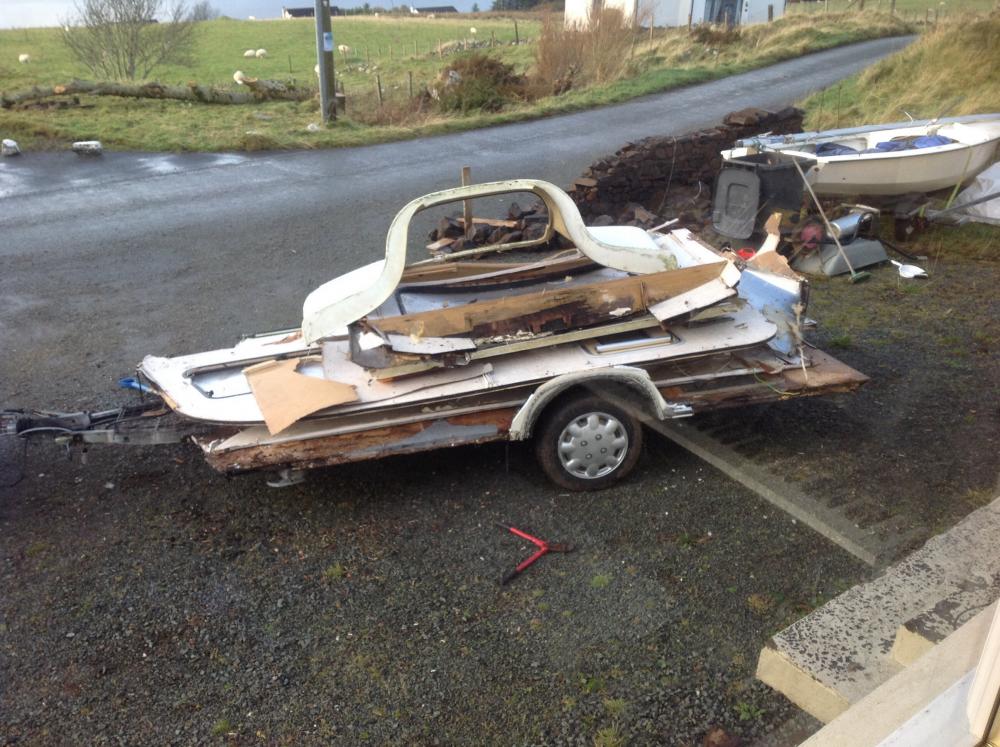
-
Material / design for non-slip footpaths?
Crofter replied to Ferdinand's topic in Landscaping, Decking & Patios
If budget allows, how about that heavy rubber matting that they sell for use in stables or in swing parks? -
By the way, would there any practical reason not to use something like terram as an insect mesh? It ought to do the job of keeping flying beasties out, whilst allowing water to escape. Just that I have some lying around and it would sabe me from buying something else.
-
@Trw144 I think I used Glidevale Protect TF200 in black (not TF200 Thermo).
-
I'll see if I can find out what I used. Was just cheap stuff from Rembrand (local BM).

