


Tosh
-
Posts
176 -
Joined
-
Last visited
Everything posted by Tosh
-
I too thought this and given our remote location and good neighborhood relations maybe we could've got away with it. But it's a big risk if it turns sour and could prove very expensive. I was told by one planning consultant that on some part Q jobs he'd done they even had to leave 'viewing windows' in strategically placed points in the wall so that anyone wanting evidence could see that the frame was still within the construction. Thankfully we don't have to do that. It's all bonkers I know but I took the view it only takes one call from someone to the planners and, well, who knows. Depends on your risk appetite I guess.
-
We've done something very similar though ours had full planning, not Part Q. The key is the word 'conversion'. We submitted a variation to try and remove the frame but the planners refused it as they said removal and building afresh from the ground up would constitute a 'new build' which was against policy in the open countryside. So we had to keep the frame and the concrete slab but could remove all the cladding etc. So we've designed it such that the frame will be hidden within the ICF walls and fortunately we have enough building height to build up from the slab and not compromise head room. If I were doing this again I wouldn't bother putting myself through the pain with the planners, it just isn't worth the time and effort IMO. WRT the steel stanchions there's no underpinning as the stanchions are not carrying any significant load so the pad foundations are more than adequate for the conversion. We plan to dig trenchfill between the columns which will take the bulk of the external wall loadings. Hope this helps.
-
We bought our place with a scheme to install water source heat pump but like you the costs were ridiculous and hampered as well by the fact that the pool was 80m or so from the house. When speaking to the companies they were very keen to highlight how important the design was i.e. depth at which the pipes lay in the water, flow rate of the water, volume of water etc. CIBSE have a code of practice apparently but I think you have to pay for it! We've dismissed the whole job mainly on 1. cost and 2. the volume of water didn't appear to be large enough but I don't think you'll have that problem. We're probably going with an oil boiler instead now ?
-
Your building is very similar to the one we're converting. The scheme our SE drew up was based around Durisol (we've subsequently changed to Nudura though) however we still had to significantly brace the steel structure predominantly for wind loading. We are pretty high up in the welsh hills - not sure where you are so may not be such a factor for you. They ran all the calculations through software to produce the scheme however I did challenge it as it seemed massive overkill. They reigned it back a bit but were very adamant on explaining the wind forces affect on these structures even though they're stiffened up by the floors etc. Hard to tell the dimensions of those steel elements but I would say you'll definitely need to replace the purlins if you're planning on making up the roof say via a SIPs or quadcore panel, possibly the rafters as they look too small but may just be the photo. And it's anyone's guess if the stanchion pads are sufficient until they're exposed. These buildings look great to begin with but as we're finding out they're a bit of a nightmare to work around. Easier to knock the damn thing down and start from scratch if you can.
-
@DreamHouseDreamer Your DNO will take care of wayleaves. After you apply for a new connection a planner will come out and look at the routes available from the pole to your temp/final termination point. If that route crosses over a 3rd party then they'll have to get permission from the landowner via a wayleave. It therefore makes sense to test the water with that party beforehand so that the planner has an idea of what route options they have when they come out to survey.
-
You could do a search on ftmrc.co.uk but these are specialist metalwork contractors so they come with a premium regardless of the material they're working with. You need to ask yourself if you'd get value for money from those guys especially if it's a relatively straightforward design. It might be worth dropping into a local steel fabricators as they're often a good source of contacts for various types of cladding installation.
-
To register our address we had to pay £150 to Powys LA via the building control office. This enabled them to inform Royal Mail so it appeared on the Royal Mail database. However Royal Mail would only deliver as long as there was a postbox and they didn't have to come onto site i.e. put themselves at risk. Load of all baloney when you think about all the farms they deliver to around our area that have farm dogs on the loose, heavy machinery on the move constantly, etc. Ridiculous amount of money to pay for this though.
-
I'm sure you've covered it in the conversations with your SE but the barn we bought had a SE report saying precisely the same i.e. that it was suitable for conversion BUT we still had to bring it up to a domestic dwelling spec. I was a bit suspicious of the SE claim of twisting under wind loading at first until one windy day I put a magnetic laser level on the columns and could see all the movement going on. Quite an eye opener. It will be interesting to see what the SE comes back with.
-
As @kxi says just use a mixture of standard dense concrete blocks and timber studding for internal walls. For the roof: We had the option to bolt flat bar to the existing 175mm deep timber purlins or swap them for metal z purlins. We're going with the later as it actually worked out cheaper believe it or not. It will also be easier to fix the Quadcore roof panels to. We did look at SIP roof panels but the quadcore you can cut penetrations for flue, windows etc more easily as they're a structural deck. Also for the standing seam you can fix direct to the quadcore whereas with a SIP you'd have to counter batten and fix another layer of OSB all over to act as a vent. Just a few things to think about maybe. I should've mentioned previously but we bought our place with existing PP that said we had to reuse the 'olive green' agri bldg profile or material of same colour/profile like yours. As soon as we purchased though we put in a variation to the LPA to alter the cladding to a to a zinc standing seam roof and timber clad elevations. Planners passed it without issue.
-
Ours was broken down into non/contestable works as well. Western Power however were cheaper that the contestable element of their works. They supplied the duct and meter box. We installed it then they came along and pulled the cable through. It was a 100A supply from around 50m plus a new transformer - all in £2.5k. No streetworks though.
-
I'm doing a steel portal frame conversion of almost identical nature. The SE will be critical to the type of build you go with. The issue your SE will likely raise, at least the ones that we invited did, is the wind loading. We ended up having a design with a significant amount of additional bracing to overcome the twisting of the steel frame that he said the building would have to resist. We tried to argue that the floor and stairs (steel fixed to floor) would offer this restraint but the SE argued that wasn't enough. I didn't have a huge issue with the additional bracing but because we wanted a vaulted ceiling (the roof pitch is too low to make it worth while having a ceiling) it becomes an issue of aesthetics. We will work around that issue when we get to it though! Unless you've investigated already the other thing to be mindful of is that the pad foundations that the stanchions sit on is an unknown. They may need underpinning! Check the building for plumb on all the columns and that they are in line. Check the floor levels. A lot of agricultural buildings are built with a fall on the floor - ours had 80mm from e2e. Also check the depth of the concrete floor and that it can take any internal load bearing walls - ours varied between 100-125mm but SE specified 200mm. It often measured 200mm at the edge of the building but when we trialed a meter or so in the depth reduced as well as being inconsistent - jack hammer and sthil saw time and then pour new foundations!! Another pita job will be digging the external foundations between the columns as the columns get in the damn way! A digger with a knuckle boom would be ideal solution. I did consider at one stage of just taking the whole lot, frame n all, down and selling it so we could start from scratch. However I was advised against this and tbf I'd already had some successes with the LPA in changing some of the conditions of our planning so didn't push any more. I guess you wouldn't want to try this either having the battle you've had. We're using ICF because we can straddle the columns (column is 203 deep so a Nudura unassembled module of 200mm will fit nicely either side of it). It overcomes the cold bridging and any issues of detailing the blocks/timber frame to column fixing as well. You'll probably need to use debonded fixings if you go with blocks.We looked at SIPS and TF but both were around £70-80k. The ICF solution is simpler and around a third of the price - yes we have to put a floor in and a roof but still will works out £10-20k cheaper.
-
Wow thanks @Nickfromwales for this really useful advice. All this plumbing wizardly fries my brain! Can you explain what you mean by an air break? Also the pipe sizing - are you saying it's better to run in 50mm for all the bath/shower/basin or mix it up between 40 and 50mm.
-
I'd be inclined to do as @Mr Punter says just build up from the existing floor if you can, that's what we're doing. Things we encountered are: are you having any internal load bearing walls? If so then check suitability of the floor with SE to carry those walls and you may need to dig strip foundations. We done a couple of test cuts in our floor which revealed that it varied between 5-8 inches. SE spec was 8 inches so we dug the strips out. Even though at the time it seemed pointless to take concrete out only to put it back in I'm glad we did as in some places it was only 4 inches thick! are the external walls on the concrete slab or do they have their own foundations? We had to cut the perimeter of the slab to install trenchfill. be careful with ceiling heights! It's surprising how quickly the vertical space disappears once you start adding floor insulation/screed etc. check plumb and level of the walls and floor. We thought our floor was level - it was only once we took some levels of our floor that we realised it had a fall of 80mm end to end! So we have to compensate for that in our floor build-up. I would try and avoid digging down if you can. Removing the floor can get quite awkward (which equals expensive) sometimes if access is tight and there's obstacles to negotiate inside the building.
-
Thanks @Temp. Any views on running them down through the concrete core of the ICF. Must say makes me nervous wrt access if anything went wrong but maybe that risk is so low that I'm worrying over nothing. In all the houses we've lived in over the years I can't recall a single issue where we've had to access a stack but then I'm no plumber and maybe it's more common than I realise.
-
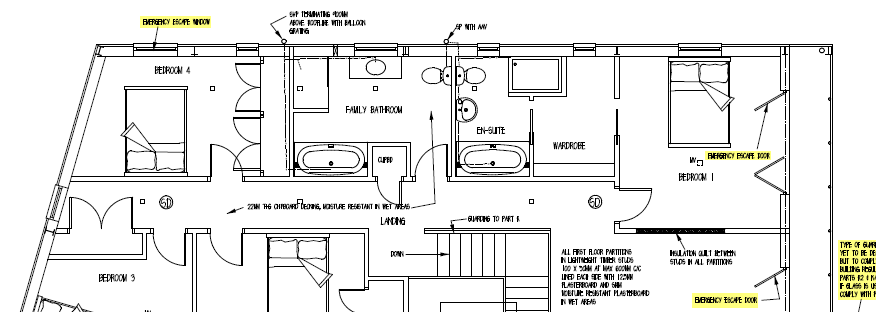
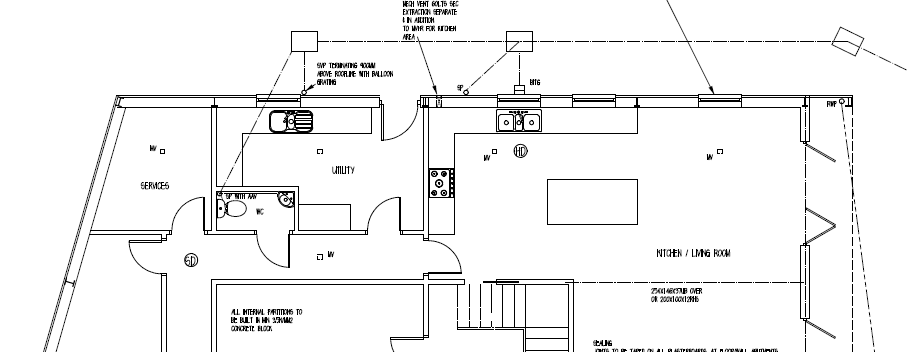
Evening all! After some advice wrt the pipe layout that our draughtsman has proposed. The drawings show pipework going to 2 x external stacks. I'm not particularly keen on these being external as I think they'll spoil the clean building lines. Can anybody suggest a better layout? For instance do we need the SVP that connects to the first IC as I read that the vent on the treatment plant may suffice (appreciate I may have got that wrong though). We're using ICF and the thought has crossed my mind about running the stacks down between the EPS forms. Would/has anyone else done that? Thanks.
-
We rented a static on a caravan park for six months as we'd sold our old house before completing on our new plot. The original plan was to then put a 'van on site but the experience living in this van prior to our completion was not good. We'd come from a house where the two kids had their own rooms and plenty of space to one of turning sideways every time we passed each other. And then of course you have to put a sign up 'don't come knocking when the caravan's a rocking' ? So we decided to rent a place, albeit small but is luxury compared to the van, and a price worth paying for the kids well-being and our sanity!
-
If you intend tracking around site a lot you may get bored very quickly with a tracked machine and may wish you went with an old jcb. Also bits can get expensive for say Kubota (which is what I have). Beauty of a JCB is the front loader to move stuff around. Sometimes wished I went for that instead. If maneuverability in tight spaces is not an issue you envisage I'd go for the old faithful.
-
ah right of course, so just put them all in line, downstream of each other?
-
Just getting to the point where we will be having our connection to Welsh Water.......... @ProDave I like the idea of splitting the supply across site as we have a holiday let, workshops all going in different directions to the supply that will feed the house and it would save supply going to house and then back again along virtually the same route. How did you actually break out from the single supply from meter to your 3 x boxes i.e what connectors etc? Tks
-
We intend to use the Kingspan benchmark insulated panels. We were drawn to it as the standing seam can be applied directly to it rather than having to cover the roof with an additional layer of OSB to create a ventilation gap under the substrate.
-
Actually starting to build something after waiting for what seems an eternity for a green light for all the paperwork.
-
@rich080487 are you certain it's asbestos? A lot of these fibre based roof sheets are difficult to assess even by the experts hence why they 'assume' asbestos. If you're approaching companies to remove it then may be worth asking if they undertake testing or if they now anyone. A quick google search may turn up trumps as well. For the sake of approx. £15 you would know for certain. That's what we intend to do and I know an architect down the road did just that. He was converting his agri shed and that had fibre roof sheets but wasn't sure if they were asbestos - got it tested and had a certificate to say it was ok so he sold it to a local farmer. Would've cost him £300/ton to dispose of if it had proved positive asbestos! I do appreciate though that the scale is different and your area looks pretty small so may not be worth the research however if you start getting silly quotes then something to fall back on maybe.
-
Basic advice of block construction and timber cladding please.
Tosh replied to Tony99's topic in Brick & Block
There's nothing wrong with a preference though @Tony99. If he/she is pushing b&b simply ask why in preference to other methods. Good luck. -
Basic advice of block construction and timber cladding please.
Tosh replied to Tony99's topic in Brick & Block
@Tony99 I would've thought the architect should be drawing up plans in line with your brief i.e. if you want the house to have certain performance characteristics then he should choose a construction method which satisfies that along with any other factors e.g long spans, curves, etc which in themselves often drive a particular construction method. -
Our best quotes for standing seam were for Falzinc which came in around £71/sqm as well as VMZinc which was £79/sqm. Some quotes were similar to yours though at around £100-120/sqm. Beware that ridges, drips, flashing etc etc will be priced by the linear meter and will range from £22-70/lm (drip flashing cheapest/ridge flashing dearest). We looked at Tata, Euroclad et al but we were put off by the fact that should the plastisol coating get scratched or you cut the sheets e.g. for penetrations, then the steel will rust unless sealed properly. We found most manufacturers difficult to talk to regards design details though most were amenable to supply samples.


