
Iceverge
-
Posts
4383 -
Joined
-
Last visited
-
Days Won
31
Everything posted by Iceverge
-
One side expansion foam and the other half mortar. Then report back to the forum after a thorough test!
-

Keystone lintels how much !! Alternatives?
Iceverge replied to Ronan 1's topic in RSJs, Lintels & Steelwork
yup. -
I discounted stonework very early on at its close to €100/m2. I couldn't say really re the size
-
Getting advice on airtightness
Iceverge replied to Helen2's topic in Mechanical Ventilation with Heat Recovery (MVHR)
Correct. 532m³ I don't know if the leakage scales proportionally. If it did I guess you would be about 80cm2 for 0.6ACH -
Getting advice on airtightness
Iceverge replied to Helen2's topic in Mechanical Ventilation with Heat Recovery (MVHR)
It depends on the size and shape of the house. For us it was 50cm2, slightly more than the size of a credit card. If you look at leakage areas below you'll see the ELA F50 at 0.0000277m2/m2. This equates to a 6mm diameter hole drilled per m2 of building envelope or 1 part per 36000. If you had a less square building with more surface area but the same volume and floor space this number allowed per m2 would drop. Typically large buildings with low amount of external surfaces are easiest to get good ACH figures on mathematically (and practically). Small ones with complex forms are the worst.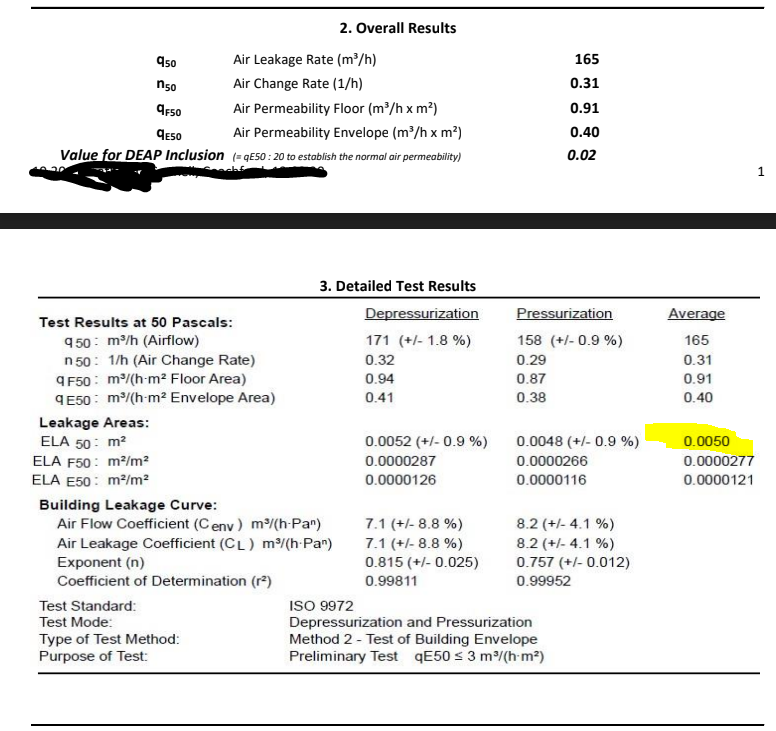
-
Have you had any vapour flow analysis for the walls done?
-
Getting advice on airtightness
Iceverge replied to Helen2's topic in Mechanical Ventilation with Heat Recovery (MVHR)
I don't know. I suspect it was an aggregate of pin holes in the scratch coat of wet plaster in the external walls. I couldn't find any more leaks myself. I'd be interested to redo it since the final layer of sand cement and skim was applied. Also one shower tray was just open to the insulation below as it hadn't been installed. The 400mm of cellulose pumped into the attic since should help also. Also there is a small leak from the corner of the window that I had the DIY blowerdoor installed as I couldn't pretest that. -
Getting advice on airtightness
Iceverge replied to Helen2's topic in Mechanical Ventilation with Heat Recovery (MVHR)
Why not? It's achievable with a little forethought. Watch the Denby Dale videos on youtube. Here's the first one. We did all our own airtightness with no training or prior experience, wet plaster and block built. Materials were probably under €1000 including membranes for the ceiling. Key point, swere having a very exact plan from the outset and attention to detail but we got 0.31Ach. Beware the " close enough is good enough" method with this as missing just a few key details will leave you disappointed. Forget @SteamyTeas expensive suggestions. He must be made of money!! This taped into a sheet of osb sealed into an opening, connected to your car battery with cable and crocodile clips will depressurise your house to a level that far exceeds a blower door. Then ram a candle into a length of electrical conduit and you have a £3 super sensitive leak detector.
-
Need help on concrete floor underfloor heating
Iceverge replied to SDUGoten's topic in Underfloor Heating
@Nickfromwales beat me to it. In general, UFH is unsuitable for houses without very good insulation and airtightness. Unless you tackle these first the UFH heating will be very expensive to run as it'll need to be on long before and after you need it due to it's slow response times. If you concentrate on heating the house only when you need to via high temp radiators or air heaters or similar with quick response times it'll be much cheaper to run. -
I was going to suggest they should be displayed. What a great find.
-
When figuring this out for our house I looked no further than some old farm buildings. Sand cement sponged finish. It's lasted 70 years with zero maintenance or paint on a cow stall grandad built. No cracks and still as level as the day it was applied. Also materials are hella cheap. €2k buys a tremendous amount of plastering sand, cement and lime. Some planting near the house softens up the look nicely thereafter.
-
Need help on concrete floor underfloor heating
Iceverge replied to SDUGoten's topic in Underfloor Heating
You would need to alter all the doors ( internal and external ), the stairs would have a dangerous half step at the bottom, all the countertops would be the wrong height. Your windows may be too low for Bregs. Unfortunately it's normally not a practical solution. Like @Conor says UFH is enormously wasteful without a well insulated floor. A u value of 0.16 is mandatory to install it in a new build in Ireland. This is about 150mm PIR. The concrete below the floor is probably only 50mm thick and could be removed very quickly. Otherwise stick to rads. -
Cold bridging at cavity reveals and floor slab detail
Iceverge replied to ruggers's topic in Brick & Block
Robustness, membranes get torn by careless follow on trades. You can use a membrane j beads and just plasterboard as per https://www.edmondodonoghue.com/build-it-better-window-door-detailing/ This can happen if you build the inner leaf before the outer and install the window boxes first. The ply greenbuilding store used on denby dale delaminated before the windows were installed and the outer leaf was finished. It's not an issue with fitting the OSB post windows. No window straps were used. The windows were bolted to the outer leaf with 90deg angle brackets. Screwed, but either should be fine. I'm not sure what you're referring to here. do you mean the osb window bucks and the bricks? In any case you would need to use proper airtight sealant, not off the shelf mastic as that can dry out over time and crack. Airtight sealant is like trying to work with bubble gum. It's very sticky and messy. Tape is clean and easy. Having seen the bond by sealants, airtight paint and airtight tape I would rate the tape best for adhesion. Expanding foam is another pet hate for me. Messy, it shrinks unless you get very good stuff, it's expensive. I think you're referring to Compriband which is an expanding foam strip. Very clean and robust and will last as long as the windows. Also overlapping the frame with the brick and using this will create very sound proof windows. https://www.sealantsonline.co.uk/ProductGrp/002a005a0001 I don't follow you here. What wouldn't work? Maybe a diagram would help me see it. Glued onto the OSB base of the window box. Thermally it's preferable to bury as much of the frame in the insulation as possible. With the revised method I've shown the gap should be equal 3 sides and maybe slightly less at the bottom as sills are normally thinker than plasterboard. This thinking is based on old narrow cavities. To enforce the tray to fully cross the cavity suggests that the insulation will be wet right to the inner leaf. If this is the case you've got much more serious problems, Practically I cannot see any issue with an angled profile extending 50mm-100mm in from the outer leaf and a gap to the inner leaf. I can't see the benefit of weep holes. How much water are they expecting to make inside the wall? The outer leaf should be well pointed such nothing more than the smallest drips form on the inside of the outer leaf. These will be directed to either side of the window by my PVC profile and drain harmlessly to the bottom of the cavity. If you are in a very exposed location and wind driven rain is really such a large factor, right above the window is the last place you want to introduce more holes. Are you working from the revised detail? I wouldn't build it again the same as we have done. Yup. Rent one as people say. You could do the whole thing in a few hours if you had your OSB pre fixed to the frames. https://www.olympustoolhire.co.uk/product/cartridge-fixing-tool-nail-gun-steel-masonary-concrete/ -
Welcome welcome. You look to be making good progress. When was the house built?
-
Designers are often presented a nice "system" from a manufacturer's rep and just paste it verbatim into the plans. It saves them a lot of research time and reduces their personal liability as the big boys (dupont/tyvek) in this case will have approved the design. There is a risk of altering a system without consideration or understanding (Greenfell) but if you know what you're doing and run it by the designer you'll often get a better and cheaper solution. An email to Glidevales technical department in this situation might put your mind's (and your Architects) at rest. Reflective membranes are primarily for heat protection in sunny climates. With a good level of insulation and a build-up of high decrement delay they're of limited value in this regard. They can help to keep the interior a little bit warmer but the effect is very small. They need an airspace of about 50mm to reflect any radiated heat back towards the house. The improvement in thermal performance would be hugely outweighed by putting in an extra 50mm of insulation. What is your total wall build up as it stands?
-
@RedMango Have a read of this. @Hanksy has some good posts.
-
I bought protect vp400 from Screwfix for the garage. Very impressed. Better than the tyvek supro used on the house I think.
-
First year Heating Energy Use in Passive(I hope) House
Iceverge replied to Iceverge's topic in Boffin's Corner
So we just left the house unoccupied for a few days. Nothing remained running except the MVHR at normal occupied levels, the fridge freezer, the waste treatment plant blower and the borehole pump. Total background load was about 87w. ( only rough calcs, 6kWh over 69hrs). This is about €120 per year on our current tariff. €0.22 per kWh from 09:00-00:00 and €0.11 from 00:00 to 09:00. I suspect the waste water treatment plant is the chief suspect. I will revisit the next time we take a few days out of town. -
Very little in the grand scheme of things. I would just concentrate on getting a membrane that is tear resistant, and does a good job of keeping the rain out.
-
We have no remote controls. I just play with the front panel controller in the utility on the very rare occasion anything needs adjusting. No shower boost either. It does get steamy but clears quickly. RH the house is a pretty construction 55%.
-
Temporary opening in a brick wall
Iceverge replied to oldkettle's topic in Bricklaying, Blockwork & Mortar
Why don't you just let the digger make its own hole? -
200mm EWI, rewire and new 3g windows. 300mm + attic insulation. Mineral wool batts in suspended floor supported by membrane drooped between. 2 X split unit A2As. One upstairs and one downstairs. ESHP for DHW. No wet CH. You can include a spur for a spare electric rad if you think you'll need it. (I bet you won't) It's the cheapest "proper" solution I can think of.
-
A friend of mine had it done on his new build about 10 years ago. No complaints.
-
Good quality uPVC for me. Twice the performance at half the cost. Enjoy the next 30 years.
-
Blocks are normally 225mm courses. Work on multiples of these at design stage if you're really bothered but brickies deal with random window spacing every day of the week. Masonry is very accommodating to this. Maybe consulting a SE to ensure you don't go beyond standard lintel sizes would save more money. I would push the cavity to at least 150mm and not consider anything other than full fill batts or beads.