Iceverge
-
Posts
4487 -
Joined
-
Last visited
-
Days Won
32
Everything posted by Iceverge
-
One should always include a set amount of typos, spelling and grammatical errors. It lays a ready trap for the deviants to expose themselves.....😁
-
Maybe start a new topic with a request for a trusted roofer in the area you are hoping to move to. There's a big network of folk here. They can reply by PM too if preferred. There's a chunk of me that thinks you could probably just build a proper apex if you were on good terms with the neighbours and planning would never bother you. Either way a fiberglass cap would work fine too.
-
 Do the sums on an A2A split unit for the lions share of the heating. Maybe topped up locally by a few electric rads. You sound like you have a similar heat load to us and I think it's the way forward. Have you considered switchable ducting on the ESHP ? It could be useful to cool the house during heatwaves if you extract and flow to inside the thermal envelope. Noise may need to be considered however. At 10mm and 3bar we see 5-6 l/min at the hot tap. A 15mm cold pipe to the same tap is 10 l/min. It's a 13m run and time to hot is about 9 seconds to hot. It works for us as the reduction in wasted hot water balances out the lower flow. I did attach the hot manifold vertically to the top of the tank which preheats the water before it gets in the pipe. I recently used 10mm for replumbing my parents house for everything except the bath and showers and cold taps in the kitchen. Its very easy to cable through tight spaces, almost like a wire, and does the toilets fine in my experience. Similar trick with the manifold from the thermal store. It isn't as fast as a hot return for the one distant basin but for the sake of a 5-10 second wait it isn't worth the hassle I think.
 -
Deary me, It's an inherently compromised design, but not beyond salvage. Nothing is really it's just a matter of cost. I would advise getting a your own roofer to have a good poke at the timbers in the roof and existing construction. It may be a couple of hours labour out of your pocket for their time but it will be well worth it to have an independent quote. It may be a simple fix of initially unblocking the gully and then later fiber glassing a new ridge or taking the roof to an apex and putting a proper ridge on it. Worst case the roof timbers are rotten, the whole thing needs to come off. Then you're in a position to negotiate something on the price or walk away.
-
Insulating under block and beam floor with perlite
Iceverge replied to Patrick's topic in Heat Insulation
I wonder is this a factor also. I don't think they would perform well where wind-tightness isn't done well. -
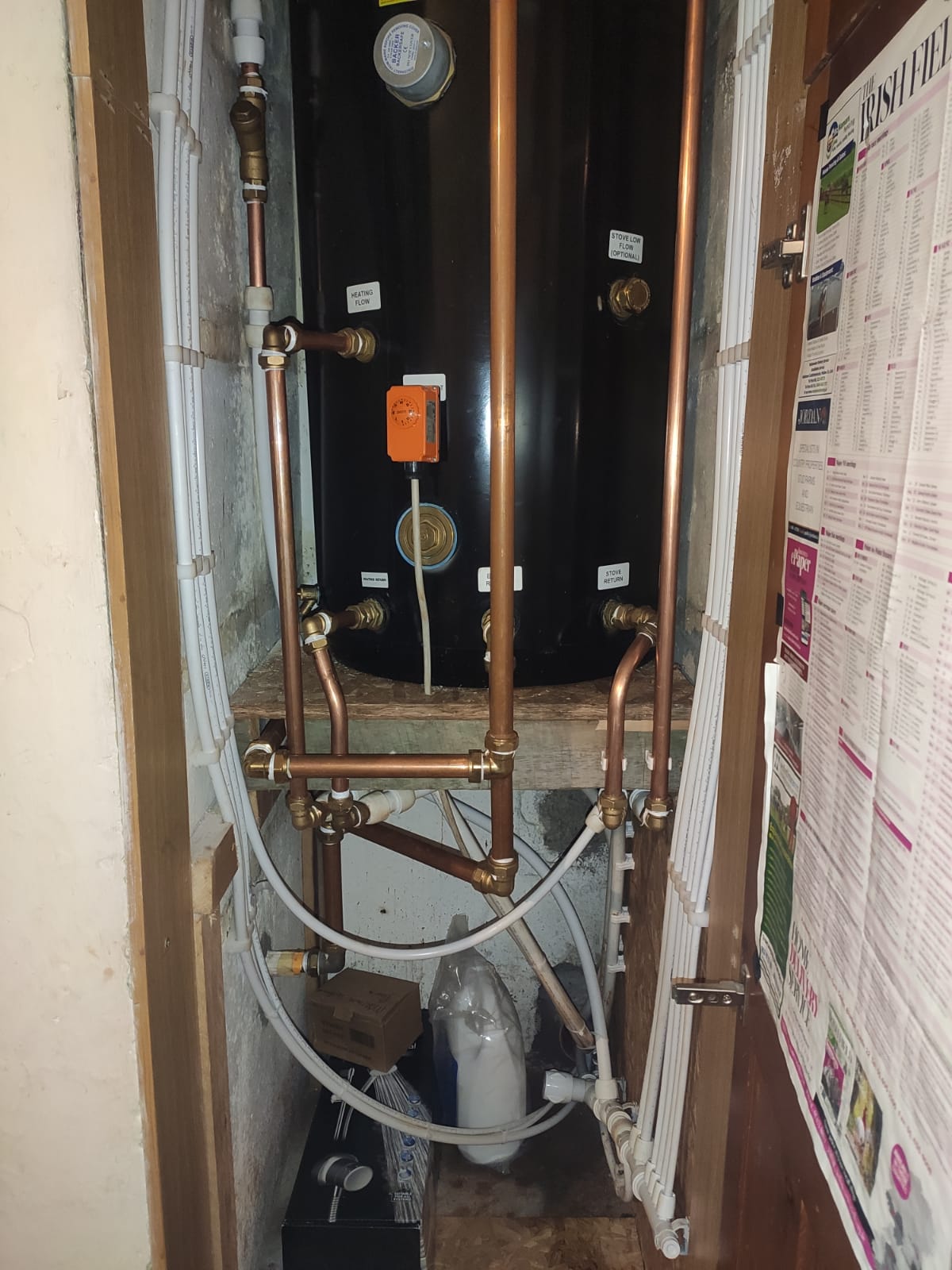
Managed to get this done just before Christmas. Used a 250l Maxipod from copper industries . Not cheap at about €2k but it seems to be well made and has a 25 year guarantee. I installed a new galvanised tank in the attic as a header tank, this leaked at a corner but I plugged it with a small bit of silicone. I was keen to avoid any joints in the pipes, especially in inaccessible areas so it looks a bit messy where I've curved them into the ceiling space etc. As I was limited on time and skills I didn't want to pull down any ceilings or dig up floors. All pipes were routed behind cabinets etc except across one ceiling where I put them in conduit. I used Hep20 manifolds and a radial layout for the hot water with 10mm to the kitchen tap and all basins. It results in a very quick time to hot. About 6l/min at the kitchen tap which is fine. 15mm everywhere else and the flow rate is about 10l/min at the bath taps. Picked up a Triton mixer from Screwfix which works very well. In fact the DHW performance is as good as the UVC in our own house. I don't know how long the DHW lasts but it seemed to satisfy 5 adults over Christmas so it can't be too bad. The hot tap is fresh water also which is nice and there's no servicing as per UVC's etc. I think I may consider one when the SS cylinder in our own house gives in. The store is mainly heated by a Rayburn 355SFW burning a mix of soft and hardwoods on a thermosyphon/gravity circuit. It burns for about 12hrs a day so no shortage of input. I just used one pump for the CH which turns on when the bottom of the tank gets hot to circulate the water through the radiators. Thermosyphon is proportional to the temp difference between flow and return and height of the tank. I really had nowhere else to put the tank so it's base is only about 150mm above the top of the cooker and 2m horizontally away. This limits the amount of heat transfer we can get from the cooker so the rads typically never get much above lukewarm. This is fine as the long duration of burn has made the house very comfortable for the first time ever! The oil boiler is just on a timer and heats the tank directly. When the bottom of the tank is hot the CH pump kicks in on a thermostat. As the oil boiler is probably about 3 times more powerful than the cooker it has no problem with the rads but there is a lag between it coming on and heating the house, it has the benefit of heating the DHW proportion first however. Any other questions fire away.


-
Looks similar to this one. Not many for sale online in Ireland vs the UK and retailers are uninterested in selling direct here in my experience. Are you satisfied with it re noise and running cost? How does it perform at temps below 0?

-
Sounds like an excellent opportunity for some EWI as the render is the majority of the cost anyway.
-
100kPa should be fine. We used EPS with a compressive strength of 70kPa
-
Is this under a concrete slab or for a suspended timber floor? Assuming it's under a slab. You can use layers to build up to the required depth. I think using at least 2 is a good idea to allow joints to be staggered. Just adjust the substrate or covering slabs depth to compensate for variations in the insulation depth. Second hand stuff is fine so long an your building control can see it is a certified product. That kooltherm is k8, for cavity walls. I'm not sure of it's compressive strength. It's probably fine.
-
Calculating for the use of sand for a thermal store.
Iceverge replied to Marvin's topic in Boffin's Corner
The annoying thing about this is that if proper nett metering was a thing no silly complex domestic mechanisms would be called for. Excess solar could be used in summer to offset any carbon based power generation. When all that headroom was used up we could use the power for electricity hungry industries like steel making to boost capacity. Maybe @Marvin you could install an industrial electric arc furnace in the back garden and use the spare power that way😂 -
Calculating for the use of sand for a thermal store.
Iceverge replied to Marvin's topic in Boffin's Corner
Ah, months of storage. Not going to happen at a reasonable cost I'm afraid. @tonyshouse did a borehole to dump excess solar thermal I think. Not sure of the most recent results. Scanhome and University of Ulster did a project. A year in the life of a passive house with solar energy store V0.9 (energyexpertise.net) Whilst it was successful it was expensive. Stored heat was 0.79€/kWh. -
Calculating for the use of sand for a thermal store.
Iceverge replied to Marvin's topic in Boffin's Corner
I'd start with something like this. Then line the inside with foam boards with all joints crossed and foamed. Then something like dense mineral wool like that which is used for EWI that would happily take hundreds of degrees of heat. Next part is tricky, Maybe a thin steel liner, tech screwed together. Electric heating elements embedded in the sand then. Run a copper coil through it back to the house to small radiator and pump to extract the heat. 300mm of PIR plus 100mm mineral wool should give a U value of about 0.06w/m2K. Assuming the volume remaining inside is about 1.8mx1.8mx3.6m you would have an internal surface area of about 32m2 and a volume of 11.7m3. Sand with a specific heat capacity of sand at 800j/kg/K and a specific density of 1.6 would give about 1.5 Mj of storage per degree or 0.4KWh/K. If you were to assume the lowest useable temp to be 40 deg and you wanted to raise temp to 100 deg it would take 24kWh of input. Not undoable. The losses however ( assuming an average temp inside of 70 deg and 10 out side would be 32m2 x 0.06 W/m2k x 60 DeltaT would be 115w or 2.76kWh per day, say 3kWh with pipe losses. Assuming this system was charged and discharged over a 2 day period it sounds like 24kWh in and 18kWh out = 75% Efficiency. Not nearly as bad as I expected.
-
Seems the easiest thing to do if you're on good terms with your neighbour so, just knock a hole in the fence onto the lane.
-
Wood stove (for cases of great cold) or not?
Iceverge replied to Garald's topic in Stoves, Fires & Fireplaces
That's a sad way to die. You can buy a 3kw bioethanol stove for about €1,000. Its another option. I would prefer the €10 fan heater to be honest but I'm tight! -
Calculating for the use of sand for a thermal store.
Iceverge replied to Marvin's topic in Boffin's Corner
A very interesting project. How much space do you have to play with and how much excess energy do you have to use? Is this a budgeted project with a payback window or a fun experiment?. In commercial systems they're claiming about 50% round trip efficiency and storage temps of up to 500 deg C. -
Wood stove (for cases of great cold) or not?
Iceverge replied to Garald's topic in Stoves, Fires & Fireplaces
Maybe fill them with insulation. And cap them off. Otherwise I have always thought that a vertical service void would be very handy for wires, ducting etc. Cap the chimney off, block the fireplace and go from there. Buy a small gas or kerosene stove. This particular debate has been had a few times . Many are happy to live with the localised elevated particulate levels confident that they're not harming any neighbours. Scientifically there's no doubt as to the risks to health. Shame really, I quite like a nice fire. -
Wood stove (for cases of great cold) or not?
Iceverge replied to Garald's topic in Stoves, Fires & Fireplaces
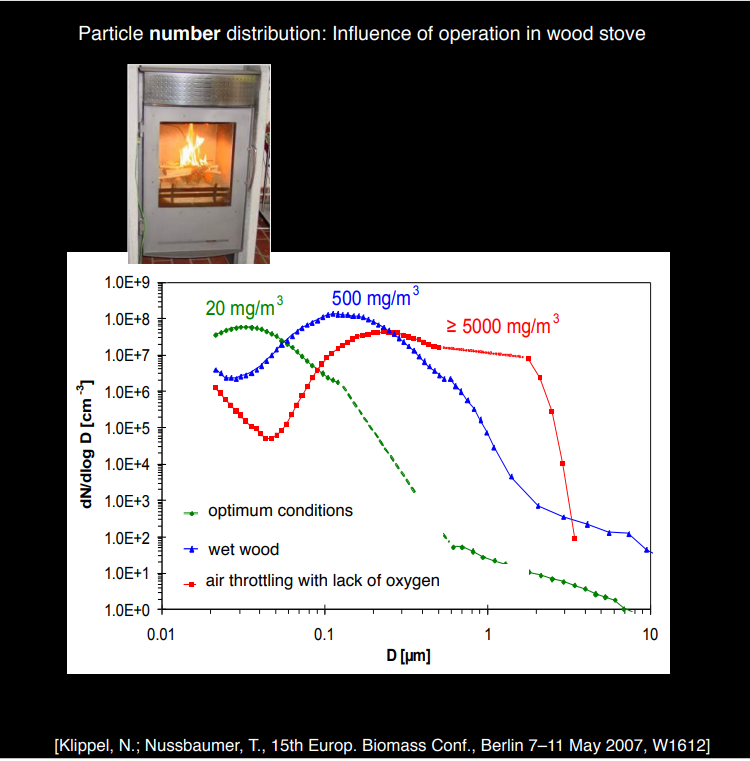
0.12% carbon monoxide is 1200ppm. Typical values in flue gas: Oil burners: 80 ppm - 150 ppm and Gas burners: 80 ppm - 100 ppm. Typical values for an oil boiler might be 1.8 mg/Nm3 and 0 for gas boilers. The stated figure of 23 is lightly to be the optimal combustion conditions for the given stove. Highly difficult to achieve in real life. Look at the below graph to see how bad it gets if you are a bit off with your burning. Over a hundred times worse if you throttle the fire. Note the exponential scale. Buy a couple of €10 electric heaters and hide them away for the unusual cold day if you're concerned about polluting the air.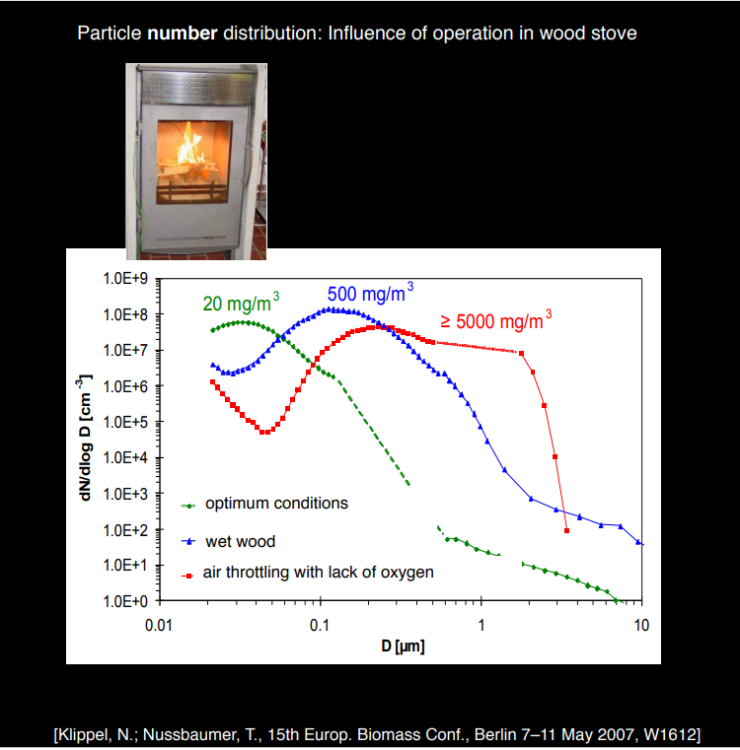
-
Exactly the converse. If you are aiming for a minimum cost house you may be able to spare extra insulation and 3G windows if you achieve excellent airtightness. Airtightness is the single cheapest and best thing you can do to reduce bills and improve comfort. Passivhaus is 0.6ACH and probably the best standard although many on here have beaten that by quite a margin. Good design and about €900 of tape and membrane got us to 0.31ACH. The execution took thought however.
-
Trench block or cavity with infill below DPC advice required?
Iceverge replied to ruggers's topic in Brick & Block
The PIR manufacturers have tremendous marketing. Every merchant and builder in the land cannot seem to see beyond it. Saved €1300 from memory in our floor insulation by using EPS. -
Trench block or cavity with infill below DPC advice required?
Iceverge replied to ruggers's topic in Brick & Block
Here Here, With SE's thumbs up just install more insulation to mitigate the wall floor thermal bridge. -
Brill. What airtightness and ventilation strategy did you opt for?
-
Correct, this way they "pinch" the membrane nicely between the battens as well as providing a good thermal break. Yes. Some providers have a k value of 0.038W/mK- 0.04W-mK. The one we used (Ecocel) has a NSAI cert of 0.034W/mK. In practice it's probably more important to ensure its installed correctly rather than the last 0.00X W/mK .
-
This is where it's at. From memory about double the cost of mineral wool but it includes install. Similar to spray foam I think. Ask your engineer about decrement delay if you want to see their knowledge come to an abrupt end. Slates, 38mm slate battens. 22mm counter battens along the rafters. Breather membrane taped at all joints. (Optional 11mm OSB sarking) 220x44mm joists full filled with cellulose @600cc. 47x44 battens run at 90deg and full filled with cellulose. Airtight membrane. 47*44mm battened service void full fill with batt insulation. Plasterboard and skim. I value about 0.12-0.14 depending on whose cellulose you use.
-
Welcome, welcome. Passive house in Cork here, glad to share any experiences we've had. Plans plus pics are always appreciated.