Jeremy Harris
-
Posts
26430 -
Joined
-
Last visited
-
Days Won
360
Everything posted by Jeremy Harris
-

Rust Removal Adventures: Electrolysis, Acid etc
Jeremy Harris replied to Onoff's topic in Tools & Equipment
Pretty easy to just swap the chassis out for a galvanised one. I'd guess a fair few 2As are already running around with replacement galvanised chassis, given the propensity for the originals to shed outriggers from rust. -
Is there a Rule of Thumb for estimating the ....
Jeremy Harris replied to ToughButterCup's topic in Electrics - Other
Just some low power lighting stuff. Could have run 1.5mm², really, but 1mm² was more than adequate. They are LED panels that are rated at between 3 W and 6 W each, so 1.5mm² seemed overkill, given the very small voltage drop. -
Is an electric combi boiler acceptable now for a new build?
Jeremy Harris replied to ProDave's topic in Other Heating Systems
I suspect there is a fairly wide variation in the pattern of use between different households, even ones that outwardly seem similar. We have friends who never shower, but take baths in the evening, so almost all their hot water use is then, whereas we both shower early in the morning. For us, using E7 to heat the water in winter works fine, as there's enough left over after the morning showers for hand washing etc through the day. We're fortunate in that our pattern of use fits well with both summer and winter energy availability, as during the winter the E7 will have heated the water a few hours before use, leaving spare capacity for any boost it might get from excess PV generation, and in summer the hot water is pretty much always recharged completely by lunchtime, and stays hot, so doesn't use much, if any, grid electricity during the overnight off-peak boost. -
As many here know, we had a big problem with the heat from our old thermal store, which was in a service area adjacent to a bedroom. That made the bedroom too hot. Our fix was to remove the thermal store and replace it with a Sunamp, which has much lower heat losses. This completely fixed the problem, and freed up space, as the Sunamp is a lot smaller than a hot water tank. Hot water tanks give out heat pretty much 24/7, irrespective of the temperature outside, so on a hot summer night the additional heat from the tank might not be very welcome.
-
Is there a Rule of Thumb for estimating the ....
Jeremy Harris replied to ToughButterCup's topic in Electrics - Other
The general rule of thumb is that, as cable usually comes on 100m reels, the amount you will need is about 1m longer than a whole number of 100m reels... On a more serious note, I've just checked and for our 130m², 6 habitable rooms, plus two bathrooms, a utility room and WC, it looks like I bought: 200m of 2.5mm² T&E 200m of 1.5mm² T&E, 100m of 1mm² T&E 50m of 1.5mm² 3 core and earth, 25m of 10mm² T&E 25m of 6mm² T&E I know I had to buy another reel of 2.5mm² T&E when I came to wire up my workshop, though, but I have more than half that reel left over. -
Is an electric combi boiler acceptable now for a new build?
Jeremy Harris replied to ProDave's topic in Other Heating Systems
It would, as SAP weights electricity heavily (and unfairly, IMHO) based on the state of UK power generation when most of it came from burning stuff like coal and oil. Now much of our electricity generation is from gas and renewables* SAP needs to change, so that it better reflects reality. * As I type this, this is the split of fuels being used to generate electricity in the UK: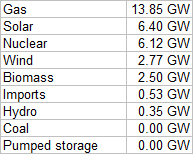
-
Rust Removal Adventures: Electrolysis, Acid etc
Jeremy Harris replied to Onoff's topic in Tools & Equipment
For a short time around 40 years ago I owned a Capri. A 3000GT. Sort of OK in a straight line, but it handled like a bollock on roller skates in corners. Massive amounts of understeer, followed by ludicrous power-induced oversteer. One thing it was exceptionally good at was producing clouds of tyre smoke... -
No, it only ever runs during the cheap rate period, and often only comes on once every two or three days during the heating season (around October to March). It's only in cold weather that it comes on every night. Most of our electricity goes on hot water and other stuff, rather than heating.
-
Yes, we're on their normal variable E7 tariff, Vari-Fair, currently 15.729p/kWh peak, 8.148p/kWh off-peak and 20.44p/day standing charge. We're currently paying about £48/month, which covers all our heating, hot water etc, and I anticipate that will reduce a bit when I get the battery system installed.
-
Is an electric combi boiler acceptable now for a new build?
Jeremy Harris replied to ProDave's topic in Other Heating Systems
I guess this works fine for a relatively modest hot water demand, but the tank size does need to be increased a bit to allow for the lower temperature (less cold gets mixed with the hot for things like showers and baths). For a house with a high hot water demand, there's some merit in increasing the temperature, so as to reduce the size of the hot tank that's needed. -
Variable can mean two things. Most commonly it means that they can vary the tariff from time to time (so it may well go down soon, as the regulator is pushing suppliers to reduce prices). Fixed means the rate won't change at all for the fixed duration of the contract. In the context of the Octopus Agile tariff, variable seems to mean that the tariff can vary throughout the day, so it can go up and down more or less in line with the variation in wholesale price. AFAIK, this is the only truly variable rate tariff around at the moment, although I suspect that there will be more before long.
-
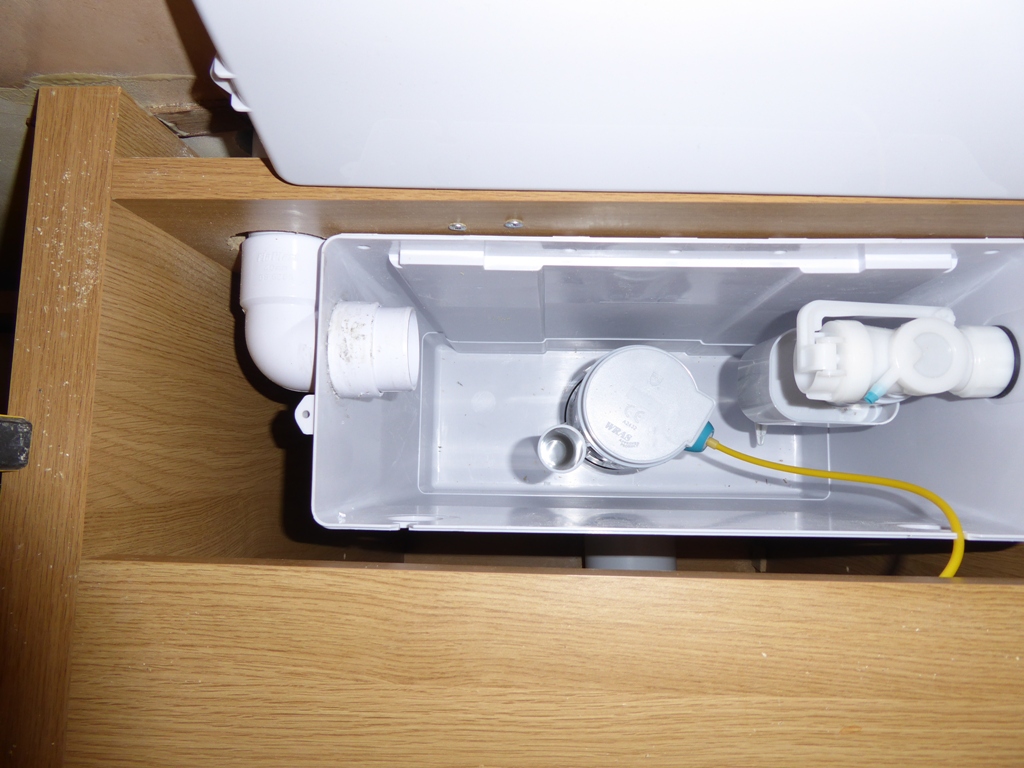
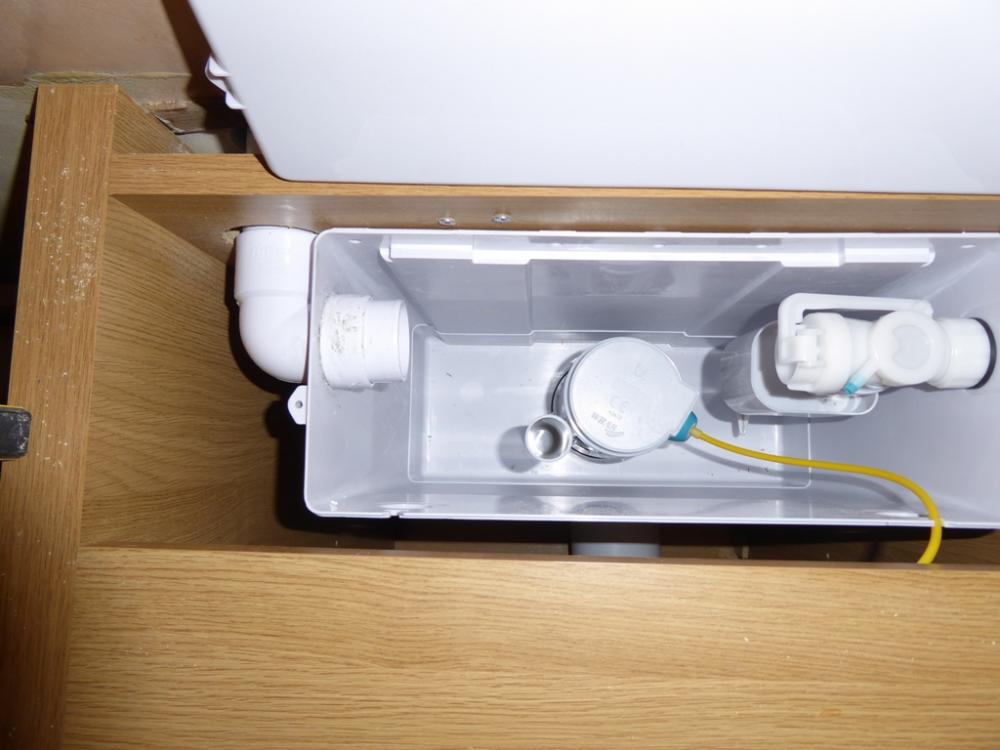
Some may recall that I fitted an odour extraction system to our bathroom toilets, to suck air directly from under the seat, using the flush holes in the rim. The effectiveness of this has just been commented on again, so I thought it worth doing an update. For those that didn't see the original posts on this (I've a feeling they may well have been on this forum's predecessor, so now lost) I decided to plumb the space above the cistern on each WC to the MVHR extract ducting, using 40mm waste pipe. This air space is directly connected to the flushing water outlets under the rim for any WC that has an overflow that discharges to the pan (as the majority of newer ones do). It was an easy modification, just a hole cut in the side of the cistern, well above the water level, and a bit of pipe fitted: Although the air flow rate is pretty low, it's remarkably effective. Literally no odour escapes from the pan at all. In our case, it was very easy to install, as both cisterns backed on to the wall where all our eaves services run, so running a length of extract duct along there and plumbing it in to both cisterns was just an hour or so's work. Well worth it, in terms of the benefit this system gives, IMHO.
-
Rust Removal Adventures: Electrolysis, Acid etc
Jeremy Harris replied to Onoff's topic in Tools & Equipment
As the old saying went, years ago, "If you can't afford a car, you can afford a Ford"... -
I fitted two taps to the same standpipe, one for the irrigation system, one for normal use. This seemed easier than using a splitter, as it allowed turning either outlet on or off independently. You can get splitters with reasonably good ball valves fitted to either leg, though, so one of those might be an easy fix: https://www.ebay.co.uk/itm/2-Way-Brass-Hose-Pipe-Valve-Splitter-Quick-Connector-Adaptor-Y-shaped-Garden-Tap/312642465094?hash=item48caf16d46:g:zDIAAOSwRjxc9ecM
-
Is an electric combi boiler acceptable now for a new build?
Jeremy Harris replied to ProDave's topic in Other Heating Systems
Worth looking at just how much electrical energy a house needs. Heating is now a relatively low demand, with better insulation and airtightness, so hot water usage seems to dominate. A shower typically uses around 2.5 to 3 kWh. Hot water for washing hands, dishwashing, etc might use another 1 kWh per person. A household of four might use around 15 kWh worth of hot water over 24 hours, so an average power of around 625 W. Clearly storage capacity might be limited, but it's not hard to store 10 to 15 kWh worth of hot water, or its equivalent as heat stored some other way, like with a Sunamp. It's hard to see why anyone would ever need a high power electric water heating system. A standard 3 kW immersion heater will only take maybe 5 hours to heat up the hot tank, so could easily do this during the cheap off peak period. I've wondered whether using a cheap ASHP to provide the bulk of the heat into a heat storage system, say up to about 40°C to 45°C, and then having a direct electric heating element that boosts the temperature up to around 55°C to 60°C might not be a pretty good compromise. Over 50% of the hot water would be provided at a cost of well under 3p/kWh, with the remainder costing around 8p/kWh. I reckon it should be possible to have loads of electrically heated water for not much more than the cost of heating hot water from mains gas. -
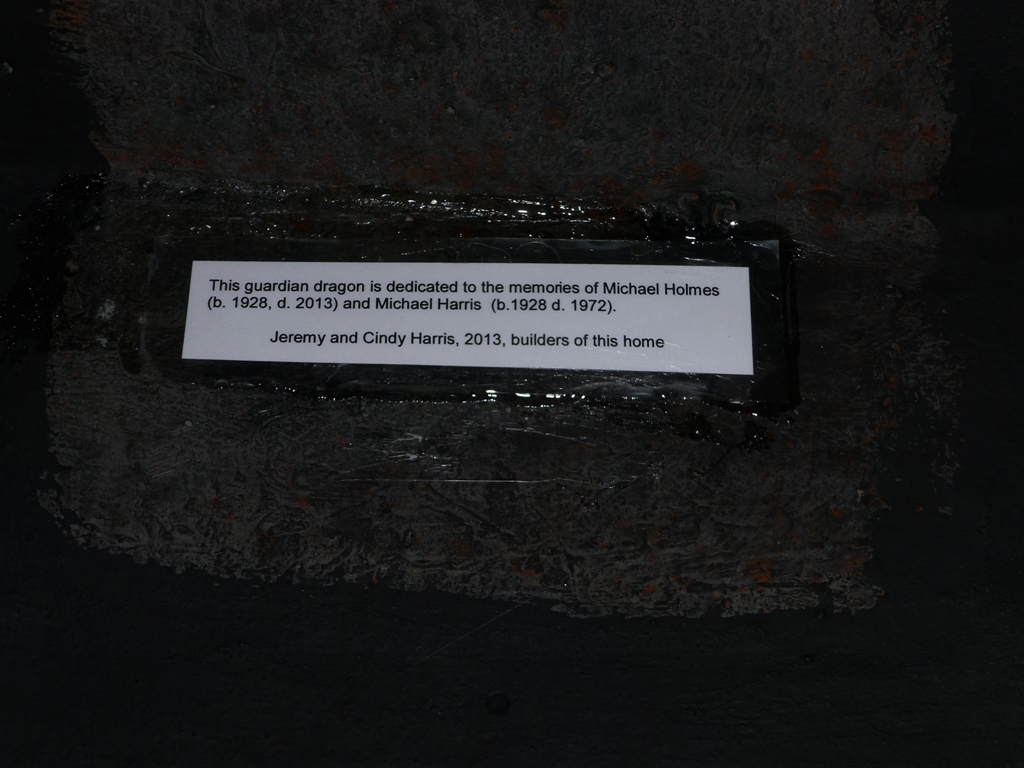
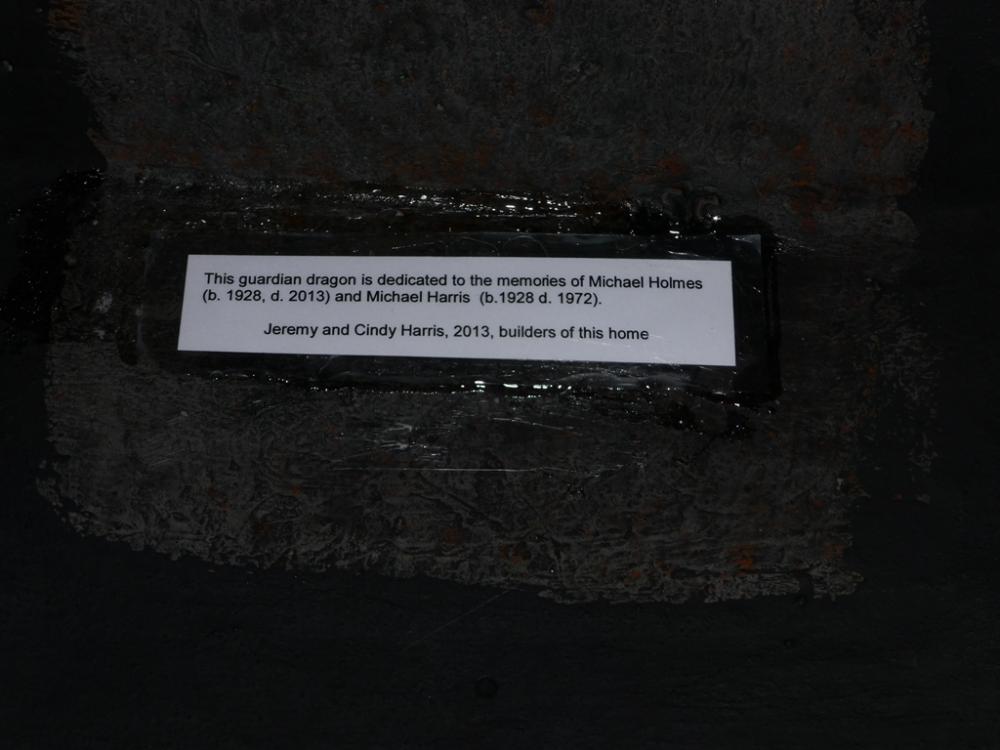
We fitted this, with a memorial message underneath, to top-out our build:

-
Strimmer head replacement
Jeremy Harris replied to Triassic's topic in Landscaping, Decking & Patios
Just because it doesn't need soaking in boiled linseed oil once a year. The boat I learned to sail in was built in the 1880s/90s and had galvanised wire rope standing rigging. It was lighter in gauge than a modern stainless equivalent, but needed regular treatment with boiled linseed to prevent corrosion in the core (where there is a chance that the zinc might be worn off as the rope flexes). -
Strimmer head replacement
Jeremy Harris replied to Triassic's topic in Landscaping, Decking & Patios
Stainless isn't commonly used on aeroplanes, it's too damned unreliable, and in the case of wire rope, a heck of a lot weaker. Typical light aircraft control wires will be around 3/32", maybe 1/8", 7x7, galvanised wire. The rigging wire used in old biplanes was usually single strand high tensile steel piano wire, really because it could be thinner (so less drag) than wire rope for a given strength. For use in a strimmer, then I suspect something like 1/16" 7x7 might be a good starting point. -
Strimmer head replacement
Jeremy Harris replied to Triassic's topic in Landscaping, Decking & Patios
Wire rope might work OK ("aircraft cable" is really just galvanised wire rope), as it would eventually corrode. The snags would probably be wear on the eyelets, plus jamming in the bump feed head. Might be that there's no need for a bump feed head, as wire rope might last a lot longer than nylon line. -
Strimmer head replacement
Jeremy Harris replied to Triassic's topic in Landscaping, Decking & Patios
Are there any strimmer lines that don't end up as very long lived shredded micro plastic particles, I wonder? -
IIRC = If I Remember Correctly Sorry. Just trying to help by giving the info that they requested from us when we applied, which is what I thought you were after.
-
IIRC, they wanted the normal ID checks, plus proof of earnings in the form of pay slips and bank statements. I don't think they needed loads of stuff about income, maybe three months worth. They did do an employment check on my wife, IIRC, for me they were happy with my annual pension statement. It didn't seem any more onerous than a normal mortgage in most respects. This was from the Ecology Building Society.
-
Combined material orders / Purchase power of The Buildhub.
Jeremy Harris replied to Patrick's topic in Building Materials
I bought our ASHP from a UK supplier, but did buy the MVHR from a Danish company. We paid DKK1,250 for shipping, which at the exchange rate that applied then was equivalent to £140.13, so not that expensive (we were quoted a delivery charge of £240 for exactly the same unit from a UK supplier). -
No, I didn't cost my time at all, and at a guess the cost per m² would be a fair bit higher if I had included it. The problem then becomes one of how to put a value on my time. Technically there was no cost to me for my time, as I'm retired, so being "paid" whether I do something constructive or not. I'd intended all along to do as much work as I thought I reasonably could, but ended up doing more than I'd originally planned to do myself, mainly because we ran out of money to pay someone to do it. One big problem with costing DIY time spent is that it took me very much longer to do things, both because I was working single-handed (slows things down a lot) and because I had to learn stuff as I went, so quite a few jobs got done more than once, when I didn't get them right first time. I probably spent three or four times longer doing things than someone skilled would have done, so just costing my time at normal rates doesn't seem reasonable.
-
The problem with including the cost of things like tools is that some may start off with pretty much all the tools they need, others may end up buying most of the tools they use during the build. I had pretty much everything I needed in terms of tools, but did buy a few extras, mainly additional Makita battery packs, plus a new circular saw to replace an old one that burned out when cutting the last of our bamboo flooring. Not sure about including the whole cost of that, though, as the saw that burned out was more than 15 years old, so could have gone at any time, and the replacement saw has had a fair bit of use since the build has been finished, as have the Makita batteries, which now get used mainly to run the lawn mower, hedge trimmer and strimmer. One big tool purchase that was dedicated to the build was a scaffold tower, but I sold that on to our plasterer after we'd finished with it, and I included the difference between the purchase and sale price in our build cost. Like @newhome, I kept a spreadsheet with every cost detailed, and updated this at the end of each week, so the costs I've recorded are pretty accurate. There may be the odd fiver here and there that didn't get written down, but I doubt that it changed the overall price per m² to any significant degree. Our build did cost around £100 or so per m² more we'd budgeted for, plus our budget was reduced at the last minute due to unforeseen circumstances (Santander refusing the mortgage they had agreed and promised when I tried to draw down on it), so we ended building for not much less than the market value of the house, although house prices here have carried on rising, so now the house looks to be better value than it did when almost complete.