
Jeremy Harris
-
Posts
26430 -
Joined
-
Last visited
-
Days Won
360
Everything posted by Jeremy Harris
-

MVHR DiY install?
Jeremy Harris replied to gc100's topic in Mechanical Ventilation with Heat Recovery (MVHR)
No, there's no need for any third party involvement. I wrote a brief report covering it for building control, but frankly they weren't interested in it at all, so I think I may as well not have bothered. -
I built a new house today...
Jeremy Harris replied to NSS's topic in General Self Build & DIY Discussion
Interesting that others have spotted a regular pattern to hedgehog activities. We have one that triggers the wildlife camera by wandering across the lawn every evening at around 11pm, then wanders back about 2 hours later. Unfortunately the camera usually only gets a glimpse of it in the distance. There's some evidence that it uses the path around the back of the house (droppings) so I'm guessing it may come in through the hedge between us and our neighbour. -
This is a classic bit of BBC reporting, written by someone with little understanding of English (it's not political): https://www.bbc.co.uk/news/uk-49344152 Headline and first paragraph of the story (my emphasis): One assumes that the NHS had perfected the art of repeatedly bringing people back from the dead by 1964, then... This was just a random story from this morning's headlines. There are similarly poorly reported stories every single day on the BBC, just like there are on pretty much every media outlet.
-
MVHR DiY install?
Jeremy Harris replied to gc100's topic in Mechanical Ventilation with Heat Recovery (MVHR)
Yes, I did, but ideally not using the MVHR, but using separate fan coil units. The snags with using the MVHR are that the air flow rate is low, so not much heat can be moved, and it is always cooling warm air from outside in hot weather, whereas it's more efficient to just recirculate partially cooled air from inside for cooling. I do wish that I'd run pipes from the downstairs UFH up to the bedrooms, along with condensate drains, as I could then have fitted a couple of fan coil units that could cool the bedrooms down, in much the same way as the split air con I recently fitted (that also recirculates air). -
MVHR DiY install?
Jeremy Harris replied to gc100's topic in Mechanical Ventilation with Heat Recovery (MVHR)
Adjustment depends on the parts chosen. Ours uses throttle plates fitted in the distribution plenums to throttle down each duct, other systems may use adjustable ceiling terminals. Adjustable ceiling terminals may possibly be slightly noisier, as the flow velocity ends up increasing, but they are a lot easier to adjust. The throttle plates are a PITA to adjust, but in theory reduce flow noise, because the local velocity increase they create is in the plenum chamber, so well away from the rooms. The total background rate often dominates, and is the rate that the system needs to deliver when on its normal setting. The total airflow in and out should be equal and can either be the background rate or any other setting. In addition, the system needs to be able to achieve the required extract rates for the kitchen, bathrooms, WC and utility room. Often this rate may be met in background ventilation mode. -
MVHR DiY install?
Jeremy Harris replied to gc100's topic in Mechanical Ventilation with Heat Recovery (MVHR)
Commissioning is mainly getting the system balanced. There are a couple of airflow meters in the forum tool loan scheme for doing the flow measurement at each terminal. The process is a bit iterative, but really just needs patience, going around every ceiling terminal, measuring the flow rate and then adjusting it up and down to get the required extract rates from specified rooms (kitchen, bathroom, WC, utility, as in building regs), making sure the sum of the fresh air supply equals the sum of the extracts and also that the total background ventilation rate meets the figure in building regs. Forget about trying to run air conditioning via MVHR, the flow rate is way too low to make any useful difference. We have an MVHR that cools the air, but it's not very effective in warm weather at all. -
MVHR DiY install?
Jeremy Harris replied to gc100's topic in Mechanical Ventilation with Heat Recovery (MVHR)
Yes, several here have done DIY install and commissioning. Not a difficult job, but the commissioning and balancing is a bit tedious. Better to DIY simple and tedious stuff, IMHO, rather than pay someone a lot of cash. I probably spent around three or four days on the MVHR installation and commissioning. -
No, I was a civilian flight test scientist. Spent around 20 years flying in all sorts of stuff, doing flight trials work.
-
12mm OSB should be fine. I've used a fair bit of Multipanel, both here and in our old house, and it's pretty stiff. When doing the bathroom at the old house I had to level up a badly out of shape wall, and bonded the Multipanel directly to thin battens that were screwed to the wall and it still ended up really rigid.
-
English Electric Canberra B(I)6
-
Sadly not, it's my old single seat aeroplane. No guns or missiles. This one (a much younger me...) had a fairly big bomb bay, though

-
MVHR external vent location
Jeremy Harris replied to Conor's topic in Mechanical Ventilation with Heat Recovery (MVHR)
Yes, as there will be a slight tendency for the exhausted air to rise, although I'm not wholly convinced it's that critical. -
Sadly, like every other media outlet, they do report what they are given, and lobbyists (on all sides) are very adept at pushing out stories that support their own political and economic views. For example, over the past few weeks there have been a plethora of "no deal means this" stories. Dig around a bit and much of the time these are pure speculation, with little or no basis in fact. I'm not convinced that these stories emanate from wholly politically motivated sources, either. There is a great deal of heavy betting going on by those trying to profit out of uncertainty. If someone can nudge the market (doesn't matter which way) in a direction they want, then they can make money from that. I take the view that all stories in the media are at best exaggerations and at worst just plain wrong, until I can see enough solid evidence to convince me one way or the other. Journalists in general, including those working for the BBC and the Guardian, are getting increasingly sloppy about fact-checking before publication. Some of that is driven by the time pressure to get a breaking story out ahead of the competition, some is just lazy journalism. Holding a media outlet to account way after an event has near-zero effect, as the primary impact of any story is in the minutes and hours after publication. Few people even remember later corrections, let alone change their views as a consequence.
-
MVHR external vent location
Jeremy Harris replied to Conor's topic in Mechanical Ventilation with Heat Recovery (MVHR)
Optimum is probably as far apart as you can get them, on the same wall, but not near a corner, I suspect. Genvex MIs have the following diagram which seems pretty reasonable: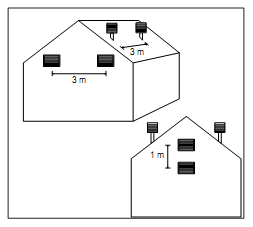
-
MVHR external vent location
Jeremy Harris replied to Conor's topic in Mechanical Ventilation with Heat Recovery (MVHR)
I'd say there's probably a pretty high risk of some recirculation by having the external terminals under a covered area. The main issue might be drawing in cooking smells, plus having cooking smells trapped under the covered area, I think. I don't think there's an issue with having the fresh air intake under cover, the main concern I'd have is with the exhaust. Is there any way you can somehow extend the exhaust beyond the covered veranda, or maybe up through it somehow (might look a bit messy, though)? The ASHP will be fine under a covered area that's fairly open, but it may well locally cool the air a fair bit in winter (ours does, and that's in an open pathway about 2m wide, especially on still days). Having the MVHR draw in air that's cooler than ambient is going to reduce its effectiveness a bit, so my inclination would be to try and position the ASHP as far away from the MVHR fresh air intake as you can. -
Excellent idea to link all the drawings/documents so that updating is easier, @Ed Davies. Even whilst I was writing the initial version of the heating, cooling hot water and ventilation guide I made several changes to embedded drawings. Making sure the drawings in the documentation pack match the current version has been a PITA, especially as I've tended to make small changes to things, amended the drawing, but then forgotten to update the copy that's embedded in the printed document.
-
Looks like the oak has been finished with something already. Most people would probably just let it weather, I think. It will then go grey, darkening over the decades. It doesn't need treatment, there are quite a few big lumps of oak in buildings that have been there a few hundred years with no treatment.
-
I've made a start at writing a documentation pack for the house, but it's been time consuming pulling all the stuff together and writing something in reasonably descriptive terms. This is my first draft of the heating, cooling and hot water system documentation (it's in a folder together with the MIs, warranties, etc from the various manufacturers of bits of kit): Heating cooling hot water and ventilation systems.pdf
-
You should be OK using that. Might be wise to include the location/site plan drawing you've got, too, so they know exactly where it is.
-
I just drew it in AutoCad, not because that was the best application for this sort of stuff, really because it's on this PC and I've been using it for years, so it was the easiest option. Pretty much any vector drawing application would do the job OK, preferably one that has a "grid snap" drawing option, as that makes it easier to get a reasonably tidy layout.
-
Seems a lot more faff than the simple two page form from your LABC to me. I'd have been inclined to just print off the local form, fill in the half dozen fields and then post it off to your local authority. All your local authority seem to need is your name, address, address where the work will take place, very brief description (type, number of storeys, total internal floor area), a site/location plan, the fee and details of how surface water will be disposed of.
-
That looks to be a different form to the one your local authority use. I'd just say "no", as all this stuff is irrelevant to a building notice application, really.
-
The fix I've adopted was to fit the Aico alarms that take a PP3 backup battery, and as the batteries have failed I've replaced them with a lithium PP3, that has a very much longer life (maybe up to 10 years). Hopefully lithium PP3s will still be around when the current ones need replacing.
-
I'd put "yes", as the new doors and windows will have to comply with building regs, whereas the chances are that your existing ones don't (regs have tightened up a fair bit of doors and windows in the last couple of decades or so).
-
Hard to know, as there are very few self-build plots around in that general area. However, we're in an area with roughly similar house prices, and self-build plots are between 1/2 and 2/3rds the price, but often have fairly tight planning constraints on the design. For example, the planners wanted our house to be built from (very expensive) Chilmark stone, and I had to fight a battle to get timber cladding accepted. They wouldn't have accepted a rendered or brick exterior.