


Jeremy Harris
-
Posts
26430 -
Joined
-
Last visited
-
Days Won
360
Everything posted by Jeremy Harris
-

Wind spinners/ mini turbines?
Jeremy Harris replied to Moira Niedzwiecka's topic in General Self Build & DIY Discussion
You can work out the power for a given wind speed fairly easily, the main variables are the efficiency (doesn't change by much, though) and the true wind speed (may be less than it seems due to turbulence and the effect of ground friction). The formulae for power is: Power (W) = CP·0.5· ρ ·A ·V³ where: CP = the efficiency of the wind turbine (typically between 0.25 and 0.45) ρ = air density (typically about 1.25kg/m³) A = the swept area of the blades, in m² V = the wind speed, in m/s For a 2m diameter wind turbine, with an efficiency of 0.3, in a wind of 2.5m/s (about 4.9kts) the output power would be about 0.3·0.5· 1.25 ·3.14159 ·2.5³ = 9.2 W Increase the wind speed to 5m/s (about 9.7kts) and the power increases to about 73.6 W Increase the wind speed to 10m/s (about 19.4kts) and the power increases to about 589 W -
Inside the door of our water treatment shed: I've also put together a folder with diagrams and explanatory notes for pretty much everything in the house. Taken a fair bit of time to do, but I suspect it would take longer to try and work things out by reverse engineering them at a later date.
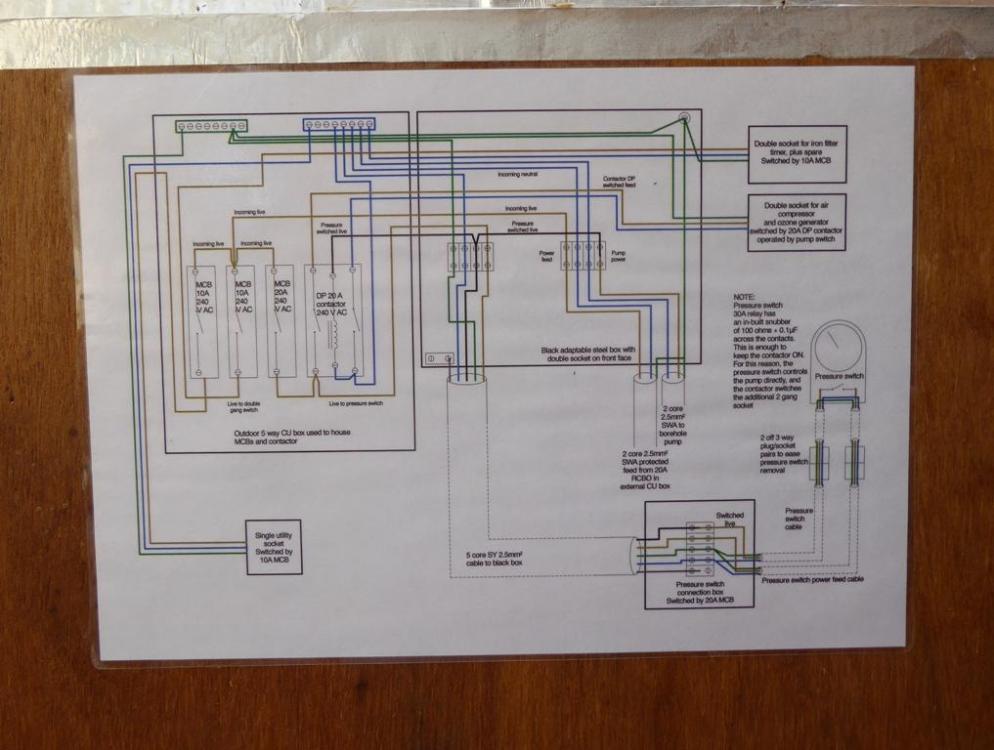
-
I suspect the VAT saving has ended up well and truly down in the noise, given that the costs that seems to get added on to the Golden Brick package are so high. Back at the start, Graven Hill seemed to get themselves wrapped around the axle when thinking of ways around the VAT issue, and almost certainly anded up incurring much higher costs because of this, which have then been passed on to buyers. It took them something like two years to work out how to sell plots, and that delay must have added a fair bit of cost. Time will tell as to whether the houses will end up with a value that's equal to the build cost. I would guess that it may well take some years for house prices to rise to that point. Having said that, I don't think that Graven Hill is about getting a good value house, really, it seems to be mainly about getting a custom house that isn't like others nearby. I guess there is some value in that to the builders, even if it doesn't add much in terms of market value.
-
There's normally no need to attach plans to a Building Notice application, that bit's usually for a full plans submission, I think. Probably wouldn't hurt to attach the planning drawings, just in case, though. The only design aspects that building control will be concerned with are those mentioned earlier.
-
2m from the road should be OK - should be able to get a scaffold in that space OK. The inner skin being timber frame doesn't affect anything; it's only the outer skin that may have to be fire resistant/able to resist the spread of fire if close to a boundary, and then only normally if that's a boundary to a neighbouring property. If your outer skin is masonry (i.e. brick or rendered block) then that's fine.
-
Building regs is really just a check that what's been built complies, nothing more. The only real design aspects building regs impacts in this case are the structural design (which in your case is just using standard details), the escape from fire regs (fine in your case, as you have a large opening on the first floor), the pitch angle, rise and going of the staircase, plus the height of the handrail and ensuring there is no gap larger than 100mm either between the treads or between the parts making up the balustrade (headroom isn't an issue in your case) and the width of the new external door, together with the height of its threshold. This is all just bread and butter stuff, which your builder will have dealt with many times before. As I understand it you already have planning consent, and the only thing you need to clarify is the means of disposal of surface water (rainwater from the new roof) which I'm assuming will be to an existing soakaway. There is no change to foul drainage and no change to the water supply, as neither room in the extension has any plumbing.
-
I've just opened it in Word 2007 and it seems fine, although some of the text formatting isn't very tidy (different fonts scattered around the place etc)
-
It's the internal floor area of both floors. Each floor has an internal area of 14.43m² (3.7m x 3.9m), so both floors added together = 28.86m²
-
The form seems to be a normal Microsoft Word document, rather than a .pdf. I've just opened it and it seems to be easy enough to fill in.
-
I believe so, yes. By doing enough work to be able to lock in the planning consent they can zero rate the sale. Unfortunately, they just pass on the cost of the foundations, services etc, with little attempt to do this work for the best price. For example, the foundation work quoted above is roughly three times the cost of our foundations and service connections, for a foundation area that's only about 10% larger and the soil conditions at Graven Hill aren't particularly challenging.
-
The floor area is just under 29m² (the figure to use is the sum of the internal floor areas of all floors), so the fee looks to be £636 inc VAT (6th row down in Table B).
-
It's a rather complex and expensive way of getting around a VAT problem, that involves selling plots complete with the foundation, ground works,services etc all in place. It's the main reason that the plots are a bit expensive for what they are, as the foundation costs are pretty high for what is a fairly benign site.
-
The web site for Drawing Express says that it is .dwg/.dxf compatible: http://www.trial-systems.co.uk/products/drawing_express/ That means there should be an option to either "save as" .dwg/.dxf of perhaps "export" as .dwg/.dxf. I'd expect these options to be in the "file" menu somewhere.
-
It does. We live in an area of chalk downland, with several large chalk emblems carved in the escarpment overlooking our village (https://en.wikipedia.org/wiki/Fovant_Badges ). Chalk is used for building walls around here, as cob, and it behaves just like clay. When wet, it turns into a very slimy mush. It only works for chalk cob walls by being built just like any cob, with "good boots and a hat", so that the stone foundation stops water damage at the base and a thatched (or sometimes tiled) roof above keeps the rain off.
-
U Values for Opaque Windows - different to clear?
Jeremy Harris replied to Adam2's topic in Windows & Glazing
I've just checked the spec for the one window we have with an obscured glass centre pane. It's exactly the same as all the others, no difference in Ug, and has two low e coated panes. Looking at the orientation of the glass, it looks to me as if it's the flat face of the obscured glass that has the coating, which makes sense. I did this check using a laser pointer held at an angle and looking at the relative brightness of the row of internal reflections. Our windows are mainly 4 - 20 - 4 - 20 - 4, and Ug is stated as being 0.55 W/m².K I can't see any reason why obscured glass cannot be low e coated on its flat face, as it's no different to any other pane in that respect. -
You usually need to submit a building notice application directly to your local building control body. You may be able to do this online, or they may require it to be done by post. A quick look suggests that this might be your local authority, and it looks as if you need to contact them: https://www.ceredigion.gov.uk/resident/planning-building-control-and-sustainable-drainage-body-sab/planning-building-control/building-control/applications-for-building-regulations/ Looks like this is the fees document:https://www.ceredigion.gov.uk/media/5112/building-regulations-fees-and-charges.pdf and this is the application form: https://www.ceredigion.gov.uk/media/3883/building-regulations-application-form.docx
-
Best chat to your builder, confirm he's OK with working under a building notice, then submit the notice.
-
You need the build to be approved as being compliant with the regs either way. Both methods will end up with you getting a completion certificate, which is proof of compliance. It really comes down to whether or not you prefer to pay for someone to produce a set of drawings and documents to show compliance before you start work, or whether you prefer to rely on a builder to demonstrate detailed compliance with the regs as he builds the extension. A good builder will have done many similar small jobs before, will probably know all the local building inspectors, and so be familiar with everything that they require. A poor builder might be a bit of a cowboy who cuts corners and tries to pull the wool over the building inspectors eyes, and that may well cause problems during the build. Why not have a chat with your builder, explain your concern about the different ways to demonstrate building regs compliance, and see what he says? You could ask him outright whether he thinks that working under a building notice is preferable to working under a full plans approval or not.
-
First off, the extension needs to be built to comply with the building regulations, and in your case that covers things like the structural integrity, insulation levels, means of escape from fire, prevention of spread of fire and the dimensions of the staircase, plus things like the electrical installation. Your job is to demonstrate that the extension complies with these regulations, and you can do that in one of two ways: You can choose to produce a set of detailed drawings, plus documents outlining how the extension complies with the various regulations, and submit them for full plans approval, before you start work. The inspections you have during the building work will then focus mainly on whether the extension is being built exactly as is in the approval. This is the way houses are usually built, and you can get an idea of what is needed from this page in my blog, which has all the drawings and documents I produced for our full plans submission: http://www.mayfly.eu/2013/09/part-fifteen-the-site-is-finally-ready/ Or, as your extension is just a pretty simple two room one, with no complications, you could choose to use the Building Notice approach. This means notifying building control that you intend to demonstrate compliance with the regs this way, then relying on your builder to get things right. There will be building inspections, much as with the full plans submission, but these inspections will sign off that the build is compliant at each stage, so there will be more detail gathered during each inspection. There are advantages and disadvantages with both methods. For a simple job, the full plans submission may be more costly and time consuming, as an experienced builder may well not really need much in the way of detail, as most tend to use standard details that they know are OK (the exception being the cowboys). The building notice approach does mean taking a bit more risk, in that you are trusting your builder to get things right at each inspection stage.
-
Yes, the Compasses is still going, we had lunch there last Sunday. There's a new landlord who took over a few months ago, who's improved the menu a fair bit.
-
A quick look suggests that the Ecodan 11 kW monobloc is around £4,750, including VAT, delivery and the controller etc. A decent 300 litre UVC is going to be around £600 inc VAT and delivery. That adds up to around £5350 inc VAT, so around £4,460 exc VAT (and you should be being quoted ex-VAT prices for a supply and fit contract). Even if you add on a bit for accessories, like mounting feet, pipework, filter, etc it's hard to see how the price for the heat pump and cylinder could be over £5,000 ex-VAT. That's a fair bit cheaper than the £8,600 you've been quoted, and installation of a monoblock and cylinder is going to be a day's work at most..
-
Fovant, about 3 miles North of Ebbesbourne Wake, maybe 6 miles North East of Donhead. Our place is a couple of hundred metres downstream from those bridges (the brook runs along the front of our place, on the opposite side of the lane).
-
Re: the cost of an F gas installation versus the cost of antifreeze in a monobloc. I can directly compare the two, as I recently has a quote to vacuum, leak check and gas a split. The comparison is: Cost of F gas chap coming out to vacuum, leak check , gas and commision a 2.5 kW split (would be much the same for a larger one) £300, inc VAT Cost of antifreeze/inhibitor £42 (enough for a system with a primary circuit volume of 40 litres, mine's about 25 litres)
-
Hard to say whether that's good value or not, TBH. In the cheap seats I can give the cost of our heating, hot water and plumbing, although I did most of the labour (this is for a 130m², two bedroom, house). 7 kW ASHP (Glowworm Envirosorb 2) £1,700, inc VAT and delivery (bought as new, old stock, so around 2/3rds of full price), plus about £300 for installation stuff. Ground floor UFH, ~300m of 16mm pipe, included in slab cost, but would have been about £200, plus manifold, pump and all pipework to connect it up, about £350 70 litre buffer tank about £200, plus another £250 for hot water pre-heat plate heat exchanger, pipework and pump Sunamp UniQ 9 kWh electrically heated hot water system, including all pipework and TMV, ~£2,000 All plumbing, waste and soil pipes etc for two bathrooms, kitchen, utility room and WC (excluding cost of WCs, sinks, basins, cabinets, shower bath etc) ~ £400 I did all the labour except for installing the UFH pipes in the slab, and I probably took at least twice as long as a plumber would, as I'm not the fastest worker. I would estimate that I spent a total of two to three days installing the ASHP, heating system and hot water system. I probably spent around another 2 weeks or so doing all the plumbing, first and second fix, including connecting up the WCs, putting in the soil and waste pipes, etc. I may have spent as long as 15 days in total on everything related to heating, hot water, plumbing etc, spread over a fair time. A professional could probably have done the lot in no more than 10 days I'd guess. Assuming 10 days at £220/day, then that adds about £2,200 on for labour. Adding up this lot comes to about £5,400 for materials, plus a notional £2,200 for labour, so around £7,600. I'd agree with @ProDave's point about the hot water cylinder capacity. We have the equivalent of about 210 litres of hot water capacity from our Sunamp, but that has significantly lower heat losses than a hot water tank and runs at a higher temperature (it starts off at around 65°C). That's fine for two of us, but is roughly equivalent to a 300 litre tank that's being heated to a lower temperature by the ASHP (we heat our water via either E7 or excess PV generation, and only use the ASHP to pre-heat the water a bit). I think we'd struggle a bit on just two thirds of the hot water capacity, especially as the ASHP won't be able to recharge the tank very quickly.
-
I had to deal with an old school building inspector who came in right at the end of our build. His first comment was that he'd never have accepted our passive slab, as he didn't like the fact that the house was sat on EPS. Thankfully that bit had already been signed off, but it does seem that inspectors can be both opinionated and ill-informed.

