
Jeremy Harris
-
Posts
26430 -
Joined
-
Last visited
-
Days Won
360
Everything posted by Jeremy Harris
-
Another thing to watch is that postcrete is fine when a single bag, or maybe two, is used in a post hole, but if you try and use three or four bags the chances are that it will end up cracking. I found this out when fixing one of our fence posts. It was on a slope, and the hole ended up larger than I wanted, so I just chucked a couple of extra bags in. It cracked quite badly, perhaps from the heat build up (postcrete gets pretty hot as it cures).
-
Same as above, I included everything except the plot, but as our plot was discounted because of the need for extensive ground works to level it, and those ground works were the difference between what we paid for the plot and what it was worth, I didn't include them. I did include the cost of services, drainage, foundations etc in the total build cost, along with surveyors fees, planning and building control costs (we didn't have any architects fees, but if we had I'd have included them).
-

Strimmer head replacement
Jeremy Harris replied to Triassic's topic in Landscaping, Decking & Patios
I really like the idea, as I hate the idea of shredding very breakdown resistant plastic into the environment. Be nice if a head like this was available for the lower power cordless strimmers. Perhaps someone needs to highlight the potential damage to the environment from shredding plastic from these things? -
I'd put it above the shower, as the shower produces lots more water vapour than the bath.
-
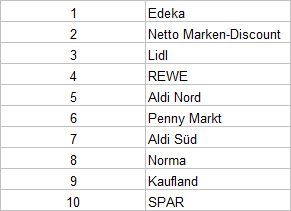
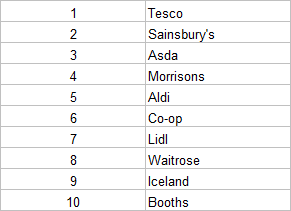
Just been looking at other markets. Supermarkets have been mentioned previously, so here are the top 10 supermarkets in Germany: And here are the top 10 supermarkets in the UK: The pattern seems broadly similar to cars, in that Germany seems to have a strong preference for German-owned brands.
-
Where would you put one sqm of extra space?
Jeremy Harris replied to Ferdinand's topic in New House & Self Build Design
We have a trussed garage roof that was designed to give a usable storage area. The roof trusses are simple A frames, two rafters plus a deep combined ceiling joist and loft floor joist. Not a massive amount of headroom up there, but adequate as a storage space. I've carpeted the central area, so that it's a bit easier on the knees when crawling around up there. I made a large loft hatch in the garage ceiling, fitted a loft ladder, plus an electric hoist, so getting stuff up and down is fairly easy. -
There is a strong tendency in countries like Germany to buy stuff that is made in their own country, unlike the UK. For example, take cars sold in Germany by manufacturer: Now look at the same data for cars sold in the UK in 2018:


-
The general rule for all MVHR terminals, either extract or supply, is to make the path length that the air has to travel across the room as long as possible. This allows the best chance of there being no "short cut", where the ventilation air only crosses a part of the room, leaving corners less well ventilated. For example, if the fresh air to a room like a kitchen enters through a door (more likely under a door) then fit the extract terminal as far away from the door as possible, whilst making sure it's not tight in a corner (around 300mm to 400mm away from the walls is about right). Our kitchen door, where fresh air comes in, is near one corner, so I fitted the extract terminal diagonally opposite it, in the corner. The same goes for other rooms, so the living room, which has a door to the hall in one corner (which is the air extract point for this room) has the fresh air supply terminal in the opposite corner, so air has to flow diagonally across the whole room. Try not to have terminals in the centre of a room, as you have shown, unless it's a small room like a WC, as they may not work as well, in terms of ensuring even diffusion, as ones where the air path length is as long as it can be. For a shower, I fitted our extract right above it, as far from the door as possible, and that works pretty well.
-
Where would you put one sqm of extra space?
Jeremy Harris replied to Ferdinand's topic in New House & Self Build Design
The snag is that there is some sort of universal law that dictates that stuff expands to fill the volume available. Add an extra cupboard and it will just end up full of stuff, so needing another extra cupboard, and so on, ad infinitum... -
A great deal of the stuff sold in B&Q is imported from outwith the EU. Much of it seems to come from China and the Far East. Interesting to see which countries we import from, in order: Value Year Germany $91.57B 2018 China $63.38B 2018 United States $63.25B 2018 Netherlands $55.19B 2018 France $37.68B 2018 Belgium $34.65B 2018 Italy $26.55B 2018 Norway $25.23B 2018 Spain $21.07B 2018 Ireland $18.78B 2018 Poland $14.39B 2018 Canada $13.66B 2018 Japan $12.91B 2018 Turkey $11.54B 2018 India $9.67B 2018 Russia $9.44B 2018 Sweden $9.40B 2018 Denmark $8.91B 2018 South Africa $8.05B 2018 Czech Republic $7.84B 2018 Switzerland $7.41B 2018 Vietnam $5.93B 2018 South Korea $5.19B 2018 Austria $5.15B 2018
-
Suppliers outside the EU can also choose to pre-pay UK VAT and include it in their price if they wish, to eliminate delays and VAT collection at the UK customer end. We recently saw this working first hand, when buying some stuff from the Channel Islands (which are outside the EU). It arrived quickly, with a label on the package stating that UK VAT had been pre-paid.
-
MVHR DiY install?
Jeremy Harris replied to gc100's topic in Mechanical Ventilation with Heat Recovery (MVHR)
Looks like they misunderstood that WC1 and WC2 are really bathrooms, so those need to be a minimum of 8l/s. I'm guessing they've just not bothered to work out boost flow rates, perhaps because they have tried to show that the minimum required extract rates can be met at the normal background ventilation level. The design figures are generally a bit "finger in the air", IMHO, as there are so many installation-related variables that I doubt any initial design calcs can be accurate at the room level. I found there was a bit of interaction between room terminals, in that when I throttled back our kitchen extract rate, just to get it within the sort of range needed, the extract rates on all the other terminals increased. I found this almost the most tedious bit of balancing the system, alongside dealing with the fairly big variations created by gusts of wind. -
MVHR DiY install?
Jeremy Harris replied to gc100's topic in Mechanical Ventilation with Heat Recovery (MVHR)
No, not your fault, as the regs are just a wee bit obscure. There are two different requirements, the most significant one (in terms of sizing the unit) is the background whole house ventilation rate. This is no less than 0.3l/s per m² of floor area, and refers to either the fresh air supply flow rate, or the extract flow rate, for the whole house (extract should be equal to supply). So, using our 130m² house as an example, the whole house ventilation rate should be no lower than 0.3 x 130 = 39l/s The other criteria that have to be met are the minimum extract flow rates from the kitchen (13l/s), bathrooms (8l/s), utility room (8l/s) and WC (6l/s). In our case we have a kitchen, two bathrooms, a utility room and a downstairs WC, so the sum of the extract rates from these rooms needs to be 13 + 8 + 8 + 8 + 6 = 43l/s. However, it's allowable to have the MVHR on boost to meet the extract flow rates, (whole house rate has to be at the background fan speed), so if you can't quite meet the minimum extract rates at the normal background fan speed it is acceptable to boost the unit to show compliance. In practice I found that we got around nearly 46l/s when running at the background fan speed, after I'd balanced the system, and this exceeded the figures required for the rooms with an extract. Balancing has two aims, to match the fresh air flow rate for the whole house to the extract rate for the whole house (ideally within about 5% or better), and to set the extract flow rates in order to obtain the building reg minimums for each extract room. I found the latter the hardest part, as I needed to throttle our kitchen extract down a lot, as well as the downstairs WC and utility room, in order to get enough extraction from the bathrooms. -
MVHR DiY install?
Jeremy Harris replied to gc100's topic in Mechanical Ventilation with Heat Recovery (MVHR)
I think the primary advantages of balancing are getting the best heat exchanger performance (this will drop off a fair bit if the extract and fresh air flows don't match well) and getting the lowest energy consumption for an acceptable ventilation level. Our MVHR seems to use about 60 W when running at the normal background ventilation rate, which seems to be pretty much in line with the specification. As the fans and control board all run from 24 VDC it's a pity there isn't an easy way to just power it from DC, as it wouldn't be hard to make a small PV system that could keep a battery charged up and so run the MVHR for free. I reckon a single standard solar panel would be enough to do this, coupled to a battery rated at maybe a couple of kWh capacity. -
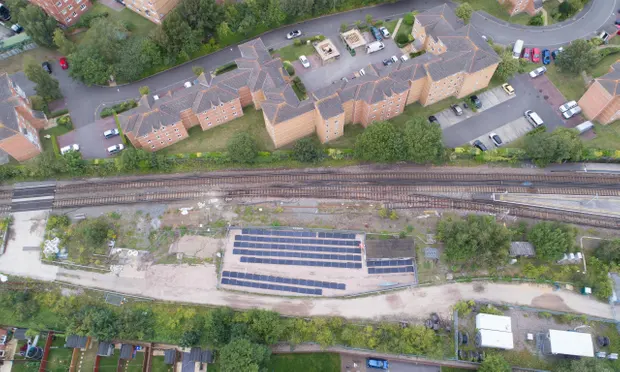
Doesn't look like it from the photo - looks to be around 5 times the size of our in-roof installation:
-
MVHR DiY install?
Jeremy Harris replied to gc100's topic in Mechanical Ventilation with Heat Recovery (MVHR)
I didn't really get a chance to sense how well, or otherwise, ours ran before I balanced it, as I started to balance it pretty much as soon as I first turned it on. It was out a fair bit (about 20%) in terms of the flow from all the fresh air feeds not equalling the flow from all the extracts, as most of our extract ducts are a fair bit shorter than the supply ducts. I also had a fairly big imbalance from the kitchen extract, as I fitted two runs of ducting to it, anticipating that this would be needed to meet the 13l/s extract requirement, and this proved to be a bit much, so I had to throttle kitchen down a fair bit. -
What do you call a thingy that ...
Jeremy Harris replied to ToughButterCup's topic in Tools & Equipment
Looks to be just the job! For under a fiver ( https://www.ebay.co.uk/itm/E-ON-POWERDOWN-Energy-Saving-Intelliplug-Surge-Protect-Plug-TV-PC/254328378873?hash=item3b372715f9:g:pWMAAOSwijhdUTp5 ) you can't really go wrong. Tempted to get one myself. -
MVHR DiY install?
Jeremy Harris replied to gc100's topic in Mechanical Ventilation with Heat Recovery (MVHR)
Same here, I wrote up a commissioning report, printed it off and had it lined up on the kitchen work top, ready to be checked and taken away by the inspector during our completion inspection and he wasn't at all interested in it. -
What do you call a thingy that ...
Jeremy Harris replied to ToughButterCup's topic in Tools & Equipment
It'll be some sort of current sensing relay I suspect. These can turn on (or more commonly in industrial applications turn off) a load at a set current. In this case a current sense relay set to turn on when enough current flows from the power tool outlet would do the job. I'll have a poke around and see if there's anything around that's cheap and easy to fit. -
My concern is that the majority of people will make decisions on important things, based on fake stories that have been reported by the media. For decades we've had increasingly poor, even outright untrue, stories about the EU. Most can probably recall some of the funniest fake stories, like the EU dictating that cucumbers or bananas had to be straight, or that UK passports had to be red (these were all made-up stories by the media, UK passports could have been rainbow coloured with a flowery border as far as the EU is concerned). Like wise we've recently had a flurry of media stories along the lines of "this disaster will happen if we leave the EU with no deal". The majority of this sort of reporting is, as POTUS might say, "fake news" (it's about the only thing he's ever said that I largely agree with). Sometimes there are half-hearted attempts to try and set the record straight on stories that have been reported. Radio 4 has a short programme that sets out to fact check stories, More or Less ( https://www.bbc.co.uk/programmes/b006qshd ), but I doubt it has a significant impact on the way most people interpret media news reporting. This short snippet from More or Less highlights one aspect of Brexit reporting: https://www.bbc.co.uk/sounds/play/p04fq3sp
-
It's just the average figure for UK railways, AFAICS. It seems a bit lower than I would have thought, as my car averages about 4.1 miles/kWh, which works out at about 0.39 kWh/km. My ~1.35 tonne car apparently uses about 2.2% of the energy of a train per km, yet is only about 0.6% of the weight. Rolling resistance is a fair bit lower for a train, but train aerodynamic drag is probably greater, and drag makes up a significant part of overall power consumption, especially at high speeds. I'd have expected train and car energy use to scale reasonably well with mass, but it seems this isn't the case. Makes me wonder how accurate that 18 kWh/km figure is. Might need to do a bit more checking around.
-
MVHR DiY install?
Jeremy Harris replied to gc100's topic in Mechanical Ventilation with Heat Recovery (MVHR)
That assumes that a "professional" undertaking system commissioning would actually do a competent job. I doubt that would be the case, TBH. Commissioning is pretty easy, but a bit tedious, and from the limited evidence I've seen of badly setup MVHR systems I really doubt whether many are set up properly. At least if you do it yourself (not at all hard; easier than the installation work) then you can be confident that it's working properly. As an example, take a look at this thread, where @lizzie had problems with her MVHR being very badly commissioned initially: -
The point really is about the fake headlines, both in this bit of Guardian reporting and in the BBC story. Both are essentially untrue. London to Penzance and back is a total distance of around 900km. British trains seem to average around 18 kWh/km (source: "Estimating emissions from railway traffic"), so 900km would need around 16,200 kWh. A 30 kWp array, situated near Aldershot, and positioned to get maximum output (which I doubt this array will be, as it's track side) would generate about 31,100 kWh (source: PVGIS), so, if this PV array were powering electric trains ( which it isn't) then it could almost power two return trips from London to Penzance.
-
MVHR DiY install?
Jeremy Harris replied to gc100's topic in Mechanical Ventilation with Heat Recovery (MVHR)
https://www.gov.uk/government/publications/ventilation-approved-document-f -
Just to be even-handed, and show that the other media outlet quoted earlier is just as bad, take a look at this story (untrue headline: "Rail line in Hampshire is world's first to be powered by solar farm") and then apply a modicum of common sense to it: https://www.theguardian.com/business/2019/aug/22/rail-line-in-hampshire-is-worlds-first-to-be-powered-by-solar-farm As a hint, the motor in my (fairly small) car is rated at 125 kW, so it isn't hard to guess that 30 kWp of PV isn't going to have any significant impact on the power drawn from the grid to run a train (a very quick check suggests that trains on this line generally have motors rated at around 2,000 kW: https://en.wikipedia.org/wiki/British_Rail_Class_444).