


Jeremy Harris
-
Posts
26430 -
Joined
-
Last visited
-
Days Won
360
Everything posted by Jeremy Harris
-
Probably similar in construction to ours: https://www.doordeals.co.uk/products/internal-doors/solid-internal-doors/oak-hagan.aspx
-
I used Osmo Door Oil and found it to be very good, but expensive. Looking at a spare tin here, it's labelled "3060 Clear Satin", so the same as the stuff in your link. I believe that our doors are very similar to yours.
-
Not missed anything, looks like a fail to me. My guess is that the oil heating is one reason, as a high fuel factor for oil won't be helping. The space heating requirement is pretty massive for a house of this size, it's around ten times higher than ours, so improving insulation would help a fair bit. The wall, floor and opening U values look high, should be pretty easy to get the floor and opening U values down to something a bit more reasonable, I'd have thought. I'd not contemplate fitting UFH with that high a floor U value, either, as the losses to the ground will be relatively high.
-
I believe one of the motivations for introducing stop-start systems wasn't fuel saving, but a reduction in air pollution. The test cycle for emissions included time spent stationary, as this is considered to be a significant cause of urban air pollution, and the manufacturers realised that having the engine turn off during the idle periods of the ECE test cycle reduced their overall emissions. The fuel saving argument was put forward to sell the stop-start feature to consumers. Whether fuel is really saved will depend very heavily on the pattern of use, but there are definitely some cases where there is a significant fuel saving, like hybrids, where the ICE can remain off for long periods when driving on congested urban roads. The EU emission test cycles are: Characteristics Unit ECE 15 EUDC NEDC† Distance km 0.9941 6.9549 10.9314 Total time s 195 400 1180 Idle (standing) time s 57 39 267 Average speed (incl. stops) km/h 18.35 62.59 33.35 Average driving speed (excl. stops) km/h 25.93 69.36 43.10 Maximum speed km/h 50 120 120 Average acceleration1 m/s2 0.599 0.354 0.506 Maximum acceleration1 m/s2 1.042 0.833 1.042 † Four repetitions of ECE 15 followed by one EUDC 1 Calculated using central difference method
-
There's some stuff on my blog that may be of help: The passive slab: http://www.mayfly.eu/2013/10/part-sixteen-fun-and-games-in-the-mud/ The start of the frame erection: http://www.mayfly.eu/2013/10/part-seventeen-day-one-of-the-build/ The end of frame erection: http://www.mayfly.eu/2013/10/part-eighteen-a-house-in-4-12-days/ Blowing in the insulation: http://www.mayfly.eu/2013/11/part-twenty-one-putting-in-the-insulation/ The stuff I submitted to BC, which includes a section drawing: http://www.mayfly.eu/2013/09/part-fifteen-the-site-is-finally-ready/
-
From what I remember the rock up there is solid granite, but quite deeply fissured and cracked. It's the edge of a large volcanic dyke (the Beaufort Dyke) that is around 1100ft below sea level just a few miles offshore. The survey suggested that further erosion was likely following the collapse of the ravine, due to wave action being funnelled up it. All along this coast there are examples of similar erosion patterns, where cracks have opened up and caused narrow inlets to form, followed by small bays.
-
Yes you can, it's how our roof is insulated. We have 22mm OSB sarking as the outer skin, and VCL membrane as the inner roof skin, with ~400mm of cellulose blown in between the two. The cellulose was blown in by making cross cuts in the membrane that were a tight fit around the pump hose (which is roughly 75mm in diameter, I think) and then when the void was full the cross cuts were just taped over with Siga tape patches. Seems OK, but because of the weight of the cellulose I'd be inclined to use a pretty strong VCL. Ours is Isover KM Duplex UV, which seems to be pretty tough stuff.
-
I, and others, have found that some of these points may not be true. The thermal time constant of our house (and others here that have used a similar timber frame construction) is significantly longer than that for many common masonry construction houses. The decrement delay exceeds the diurnal temperature change period, so virtually no heat from the outer skin ever makes it into the inner skin. What solar gain issues there are come from solar gain through the glazing. The thermal time constant for our build is over 24 hours, compared with around 3 hours for our old block and brick house, with solid concrete floors. Likewise with sound insulation. External noise is incredibly well attenuated, to the point where it feels a bit eerie inside at first. Several here have visited our build and can confirm this, as the silence as soon as the front door is closed is something most people notice straight away. Both the noise attenuation and the high decrement delay of the structure is primarily due to the use of blown cellulose insulation, I believe. The main point I'd agree with is the need for accuracy when constructing the foundations. This led us to use the same company for both the passive slab and frame, as that ensured the two mated up perfectly. It was my greatest concern during the early stages, given the tight tolerance needed for the type of prefabricated panel timber frame we wanted to use.
-

Gulf between TER and other 2013 building regs.
Jeremy Harris replied to epsilonGreedy's topic in Heat Insulation
My experience was that little attention was paid by building control to the design EPC, they solely focussed on examining the as-built assessment in terms of compliance with Part L1A. The DER/TER has to be right, or you just won't get an EPC at all. The regulations that you have to comply with for the as-built assessment are those that were in force on the date of your building regs submission, so if you applied for full plans approval, or submitted a building notice, before 2016 the older set of requirements apply (principally those in Part L1A in this case), and if you submitted your building regs submission after this date then you need to comply with the 2016 amendments. Worth noting that Part L1A was due to be amended to ensure all new homes are "nearly zero energy" by 2019, but I believe this has been delayed still further. -
Yes it would be, as the meter anti-creep threshold is usually about 1 Wh, so if you want to bounce energy back and forth when running water heating from excess PV generation then you need to meter to a fair bit finer resolution than 1 Wh.
-
How to fit rigid insulation in the footings cavity.
Jeremy Harris replied to epsilonGreedy's topic in Heat Insulation
That £500 is more than our total energy bill for a year, including charging my car... Exactly. This is a very long overdue change that brings UK housing part way up to the standards used in places like Ireland and other parts of Western Europe, although it's still not exactly great. -
Gulf between TER and other 2013 building regs.
Jeremy Harris replied to epsilonGreedy's topic in Heat Insulation
I'm not convinced that the regs are in any way demanding, TBH. We found it pretty easy, and not at all expensive, to exceed the requirements by a significant margin, and many others here have done much the same. The key thing is to ensure that the design of the house, from the ground up, is optimised to improve thermal efficiency. There are lots of details that literally cost nothing, but can reduce heat loss and contribute to improved performance, including some fairly easy wins, like reducing or removing thermal bridges, ensuring that airtightness is better than the regs require, etc. -
Curiously, I know a chap that doesn't have opposable thumbs (he has triphalangeal thumbs, that are in the same plane as his fingers). It wasn't until I saw him struggling with things that most of us take for granted that I realised just how useful opposable thumbs are.
-
It's 1 pulse per Wh
-
One thing to bear in mind is that the inverter will shut off when the supply voltage reaches 253 VAC, so if the local supply is around 250 VAC you only have a little bit of headroom. We're in the same position, in that our local supply voltage is often up around 250 VAC, and we do end up with the inverter limiting from time to time, even though I used 6mm² to reduce the voltage drop. Losing a volt through a 4mm² cable might not seem worth bothering about, but if that extra volt causes the inverter to reduce power or shut off due to hitting the 253 VAC limit, it may be a bit of a nuisance, especially for us, where we get paid for electricity generated and exported. Depending on how the inverter limits this may or may not cause a problem for a new system, as if it soft limits (ours does) then it will probably continue to offset consumption in the house. There are, I believe, some inverters that just shut down when the voltage at their output reaches 253 VAC, so it may be worth asking the supplier how the inverter they intend to fit will behave. Also worth monitoring the supply voltage to see if it gets close to 253 VAC and then trying to get the DNO to reduce the supply by dropping a tap on the transformer, although I've been trying in vain to get our DNO to do this for a long time now. The lowest supply voltage I've recorded is 244 VAC, the highest 253 VAC, for a supply that is supposed to be 230 VAC, +10%, -6% (so 216.2 VAC to 253 VAC).
-
Sunamp UniQ HW+i experience? Charge via ASHP?
Jeremy Harris replied to oranjeboom's topic in Energy Storage
Funny you should say that, but back when we were having problems with the Sunamp controller misbehaving (now fixed, they changed the design to eradicate the problem) I fitted an 8 litre/minute flow restrictor to the shower. It just replaces the normal rubber washer where the shower head connects, and after several months the slight reduction in flow rate, from around 10 to 11l/m to 8l/m, hasn't been commented on, so I've not bothered to remove it. -
How to fit rigid insulation in the footings cavity.
Jeremy Harris replied to epsilonGreedy's topic in Heat Insulation
I'm a bit surprised you've not already got a design SAP, TBH. BC asked for my as-designed EPC as a part of the full plans submission. The design stage assessment will have picked up if there's a DER/TER issue, so as long as the build meets or exceeds the spec used for that then it should be OK. I have to question quite why anyone self-building would deliberately choose to build to the minimum allowable spec, basically the same as a crap volume build house, though. The standard in building regs isn't high, and it's pretty easy to exceed it, and get a more comfortable and easy to heat house, for barely any increase in build cost. -
How to fit rigid insulation in the footings cavity.
Jeremy Harris replied to epsilonGreedy's topic in Heat Insulation
Good cavity batts have a λ of around 0.036 W/m·K to 0.037 W/m·K. Decent bonded blown beads have a λ of around 0.033W/m·K, so out perform batts by around 10% or so, but there's not much in it. As @PeterW says, your probably not going to even scrape through with batts in a 100mm cavity. Not sure you would even if you used blown beads, either, TBH. In real-world terms, batts probably perform worse than their spec indicates, as fitting them so they have no gaps is challenging, and any gaps will promote air movement from the warm to the cool side, reducing the insulation effectiveness. -
Should be able to, but I think an optosolator might be needed, as the pulse output may not be isolated from the supply. It seems to be a 80ms pulse, that's within 5 to 27 V, with a maximum current of 27 mA. The pulse rate is the standard one, 1000 pulses/kWh.
-
You can complain to LABC (strictly speaking they are separate from the local authority, and are a self-funding entity, managed centrally by their own executive): https://www.labc.co.uk/
-
4mm² T&E clipped direct is OK for up to 37 A, or 26 A if enclosed in conduit. This translates to about 8.5 kWp for clipped direct or just under 6 kWp if run in conduit. Both these figures are subject to voltage drop limitations. I opted to run 6mm² T&E for the AC run from our inverter to the meter and CU, even though it was only a short run (maybe 2m or so), just to reduce the voltage drop a little bit (our system is 6.25 kWp). In general, it's a good idea to try and keep the voltage drop as low as possible, as this gives the inverter a bit of extra headroom to keep going when the local supply voltage rises.
-
Presumably the issue is because you are on London Clay, and therefore they need evidence that the foundation design complies with the requirements in Part A, and that the site plan shows the exact location, species and size of all nearby trees (as trees can cause significant problems with heave in London Clay). As well as being mentioned, the pack needs to include the size, species and distance from the foundations for each tree, hence the reason for them asking for more information, I suspect. Usually some form of tree survey may be asked for if there is any doubt at all about the location or species of trees within 30 metres of foundations in this type of soil. You can just choose to use another building control body if your LABC are being slow, there are several to choose from usually, although you will then be effectively starting again from scratch.
-
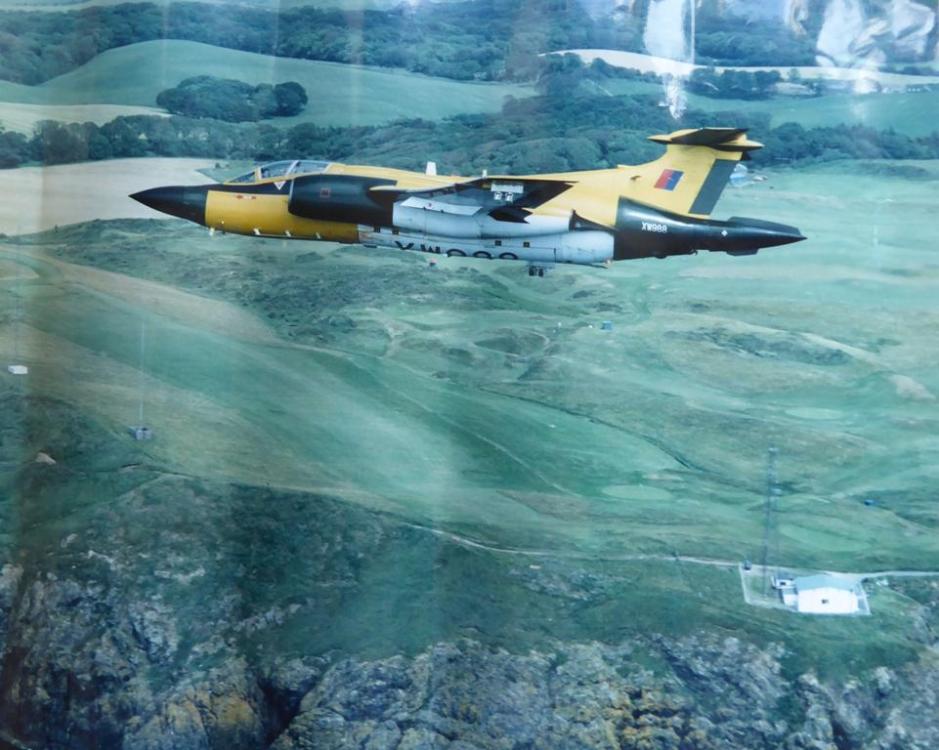
It's one of our trials Buccaneers, and the paint scheme was designed to show up well on black and white high speed cine film. For some reason black and yellow gives the best contrast on FP4 film, which is what we used much of the time (usually pushed from 125 ASA to 400 ASA in developing).
-
Just found an old photo taken before the ravine collapsed (sorry for the crap quality, it's about A3, so wouldn't fit in my scanner): If you look to the South (right) of the GMS building, alongside the access track, you can see where the ravine was starting to open up, although it was just a grassy depression when this photo was taken. One night during a winter storm in the early 90's a large section fell into the sea there, allowing big waves to surge in and up to the access track, a bit like a big funnel.
-
Surprised me they were building there, TBH. When that ravine opened up in the early 1990s it was pretty dramatic, half the village must have walked up there to take a look at it, so it was common knowledge locally. The golf club would definitely have known about it, as would the radio station, as I know that both were involved when we had it surveyed to assess the risk of further collapse.


