Jeremy Harris
-
Posts
26430 -
Joined
-
Last visited
-
Days Won
360
Everything posted by Jeremy Harris
-
Really, it's the fact that the term has no formal definition that is recognised by any international standards body, has no internationally recognised units of measurement and is misleading in the way that it tries to conflate two well-understood terms into something that is only a unusual definition (in general measurement terms) of an already well-defined material property, heat capacity. A quick look at the OED tells us all we need to know about these two words: In the context of building science, the first definition "relating to heat" is clearly the one that applies here. Equally clearly, as we are discussing the physics of buildings, it is the fourth noun definition that applies, "The quantity of matter which a body contains, as measured by its acceleration under a given force or by the force exerted on it by a gravitational field." Heat capacity, either specific (i.e. relative to mass) or volumetric (relative to volume) seems to be a much easier term to understand (happy to be corrected if most here find this concept confusing). Most people would probably be OK with the concept that a mass or volume of something is able to store a given amount of sensible heat (specifically sensible heat here, as it is energy in the form of heat). In everyday terms, most people would probably be able to accept that a bottle filled with water heated to a particular temperature (above room temperature) would cool down to room temperature more slowly than the same bottle filled with air heated to the same temperature. Clearly the volumetric (in this case) heat capacity of water is significantly greater than the volumetric heat capacity of air. Using something that is a part of a house as another example, I would imagine that most people might be able to readily accept that a block of concrete of a given volume, heated to a particular temperature, would be able to store more heat than the same size block of foam insulation. Note that both of these examples use volume, rather than mass. I believe that the use of mass, i.e. "The quantity of matter which a body contains, as measured by its acceleration under a given force or by the force exerted on it by a gravitational field" is really the term that is less than useful when considering the ability of the component parts of a building to store useful amounts of sensible heat. Leaving aside structural engineering concerns, and alternative meanings for mass (as in the verb, "Assemble or cause to assemble into a single body or mass"), most people will, I believe, consider elements of a building in terms of dimensions, i.e. how big stuff is. Given this, then volumetric heat capacity is probably a more easily understood term. Most can visualise the size of a wall, or the size of a floor slab, so relating that to the ability of that part of the fabric to store sensible heat seems to me to be more logical. Taking this one step further, and considering that we know that only a modest thickness[1] from the surface of most materials has a significant effect in terms of the impact of its heat capacity, then it becomes, perhaps, easier to visualise the likely heat storage capacity, and hence the likely impact on thermal stability, of most elements within the house, or, taking the limited view SAP uses, those elements that make up the external skin of the house, excluding the insulation layer. I would suggest that there are good reasons to think of the effect of elements both within the thermal envelope of the house, and immediately outside it, in terms of volumetric heat capacity, as a first order approximation as to how effective they may be at helping to stabilise temperature[2]. 1 BRE have settled on 100mm from the surface for SAP, my measurements suggest that a 50mm thickness from the surface may be more appropriate for a low energy house, as do the conclusions reached by Jae Cotterell (an architect and director at Passivhaus Homes) 2 This ignores thermal conductivity, just as the BRE definition of "thermal mass" ignores thermal conductivity. This is a reasonably valid simplification as long as the insulation layer is ignored (just as it is in the BRE/SAP "thermal mass" expression). I agree, it is of no use at all in modelling either the thermal inertia, or thermal time constant, of the house. It cannot provide a meaningful contribution to any of the standard equations for calculating thermal behaviour, such as calculating: how much heat it takes to raise the temperature of a building to a specific internal temperature for a given heating requirement how long the house will take to cool down when the heating is turned off under given external conditions (both temperature and wind speed and direction) how quickly the house will heat up under specific conditions (i.e. elevation and azimuth of the sun in clear sky conditions) how much cooling may be needed to remove excess heat from solar gain what capacity the heating and cooling system may need to be, how effective solar gain reduction or enhancement schemes may be, etc. There is a reason that PHPP[3] is a pretty complex spreadsheet, and that is because thermal modelling of a house is fairly complex. It is not impossible to model, though, and as the energy requirements for new houses are gradually reducing, the importance of more detailed performance modelling will increase. Just from anecdotal comments and observations from members of this forum we are beginning to see that overheating, especially in houses with fairly large areas of glazing that may not have adequate solar gain control, is becoming an issue. Modelling will help to reduce this, and help house designers gain a better understanding as to how well-insulated and airtight houses behave as our climate gradually warms up. 3 PHPP = PassivHaus Planning Package, a spreadsheet model developed by the PassivHaus Institut in Germany, that is recognised as being a powerful house energy and thermal performance modelling tool.
-
The only known problems with MC4 type connectors are that there were once some dodgy ones floating around, that originated in the Far East (pretty sure these are now easy enough to avoid - just buy from reputable suppliers) and there were some dodgy crimps made by incompetent installers using cheap and nasty crimp tools. A decent MC4, fitted to the proper size cable with a decent ratchet crimp tool, that is properly set for that type of connector, will be a very reliable connection, that should last for decades if it isn't subject to mechanical damage. Microinverters are a good solution for a system where panels are subject to variable levels of shade, but I'm not at all convinced there is any merit in fitting them to a system that doesn't suffer from patchy shading. Having an inverter that is easy to access, keep cool, or replace if it fails, is a big advantage. The single biggest cause of inverter failure, bar none, is heat, so fitting an inverter in as cool a location as possible will significantly extend its lifetime.
-
Thermally, the best place for the windows is smack bang in the middle of the insulation layer, usually, as highest thermal conductivity element of a window is almost always the frame. Having insulation abutting the frame all around reduces heat loss in the peripheral, (radial) direction, leaving just the thermal path perpendicular to the wall. This can make a significant difference over having the window further out, where the periphery of the frame is in a cold layer, like the external skin.
-
150mm of decent insulation is probably fine, there is a law of diminishing returns, where adding more insulation only makes a modest difference. If the loss is under about 10% then realistically that's about as good as it's reasonable to expect. Worth just doing a quick check to see how hot the floor is likely to run and how much heat will be lost. I wrote a simple spreadsheet to do this that may help: Floor heat loss and UFH calculator.xls To put our floor heat loss from the UFH into perspective, in very cold weather (as in -10°C outside), then that ~8% represents about 128 W, so about the same as us leaving most of the lights on in the house, which isn't a lot to pay for the convenience of not having radiators cluttering up the walls.
-

Can anyone turn a pdf into a CAD for me?
Jeremy Harris replied to Powerjen's topic in Surveyors & Architects
I'm afraid that one of the snags when converting .pdf files to CAD format is that most of the data that was in the original CAD file just isn't there in the .pdf, so cannot be recreated. All any of the .pdf to CAD format file converters can do is convert the lines on the drawing into vectors that may or may not make sense in the converted CAD format. I recently converted some .pdf files to .dxf format, then opened the .dxf files in AutoCad to work on them. All of the material properties were missing, and every single converted vector had dimensional errors, with lots of the vectors not even closing at junctions with other vectors (typically there would be a few mm of positional error at the start/end of every vector). Also, when text in a .pdf is converted to a CAD format, it ceases to be text, and just ends up as loads of individual vector objects making up each letter, often with no connections between the various objects, so the easiest fix is just to retype every label in the CAD package, deleting all the old vector objects that were trying to be text. The final problem is that all the layers in the original CAD drawing just aren't represented in the .pdf format, so when a .pdf is converted back to a CAD file every single object ends up on the same layer, which is a real pain when trying to work on a complex drawing. It is possible to tidy up a converted .pdf file, but it takes a few hours to check every single element in the drawing, correcting the small positional errors, adjusting scaling factors to get the drawing to be accurate, and tidying up objects that have been split into multiple parts during the conversion process. I'd guess you could pay someone to do this tidying up work for you, as it's not hard, just pretty tedious, especially for drawings with a lot of detail. -
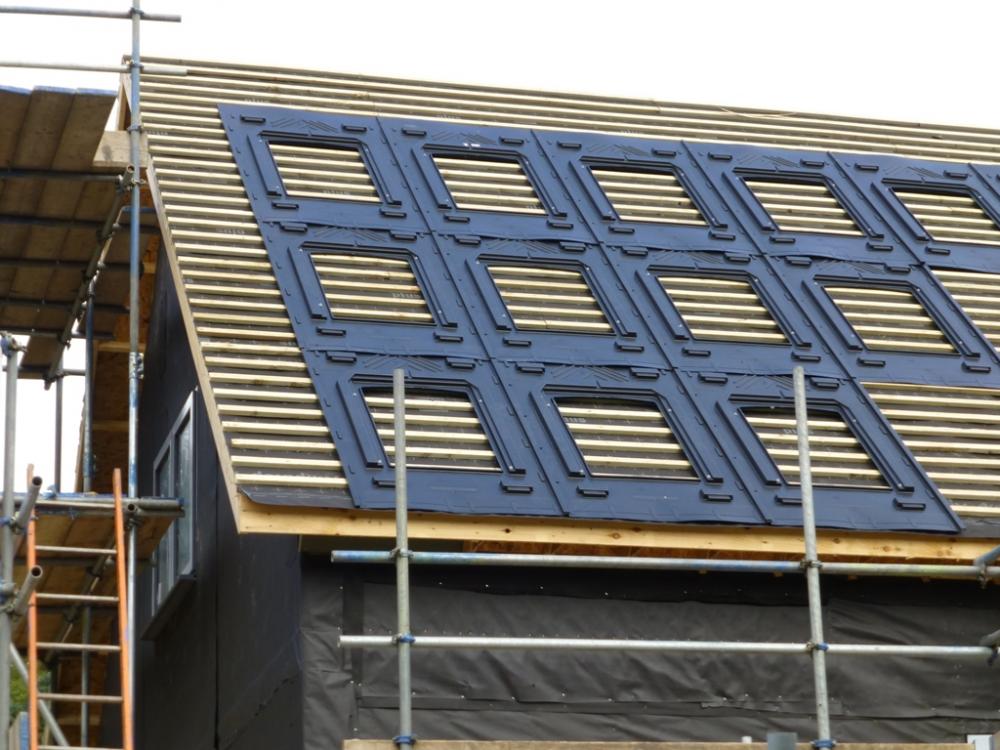
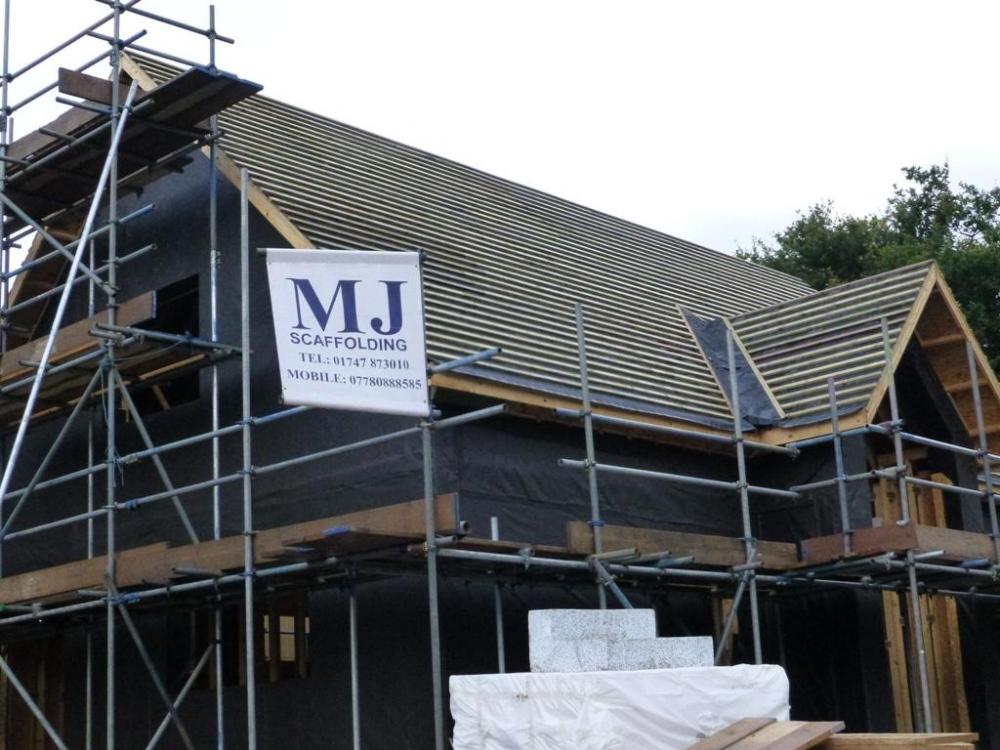
Probably unknown beyond about 25 years. There's no real change to the roof structure needed to fit in-roof PV, though. Our roof was just battened at the pitch needed for the slates: and then the GSE frames were fitted to the battens (with a few extra battens added where needed): The roof was then slated and when that was completed the PV panels were installed.
-
The sequence we used for installing our in-roof PV, using the GSE mounts, was to have the mounts fitted first, with all the wiring put in place for each panel. We then had the roofers in to fit the slates, and once the roofers had finished we had the PV people back in to install the panels on to the mounts and wire them up. I'm glad we opted to do it this way, as I wouldn't like to have roofers mucking about up there with the panels in place.
-
+1 We had a requirement for our build to be at least CfSH level 5 initially. When the government scrapped CfSH before we actually started building that went away completely. The only thing I removed from the design was the bike shed, which was added to gain CfSH points. The planners had no isue with this, but it did create a minor snag when it came to the VAT reclaim, as the bike shed was still shown on the approved plans. I had to send HMRC copies of the correspondence we'd had with the planners to show that there had been agreement to just not build it, before HMRC would process the claim.
-
There was no problem at all with heavy muddy boots tramping over the steel fabric and insulation whilst laying the pipes. The fabric was stood on 50mm chairs, the pipes were clipped to it with cable ties, and the insulation underneath is 300mm deep EPS. The slab is 100mm deep, so the pipes are just above the centre of the slab, which in practice works very well indeed. We still get around 8% heat loss from the UFH to the ground through the 300mm insulation, but that's pretty typical for UFH; there's always an efficiency hit from increased heat loss to ground, just the price that has to be paid fro getting rid of radiators.
-
Bosch induction hob fitting in quartz worktop
Jeremy Harris replied to dannyboy123's topic in Kitchen & Household Appliances
It just has springy clips around the edge that both grip tightly and pull the thing down tight enough for the rubber seal around the edge to squidge down on to the surface. I really didn't expect this to work as well as it does. -
Bosch induction hob fitting in quartz worktop
Jeremy Harris replied to dannyboy123's topic in Kitchen & Household Appliances
Believe it or not, our AEG induction hob is just a push fit in our Silestone island worktop. I was very sceptical that this arrangement would both hold it in place and be a good enough seal around the edges, but it seems to be fine. -
@Dreadnaught posted a link earlier to an article that was pretty interesting, and I followed another link from that discussing the relevance of "thermal mass" to passive house design. This quote struck me as interesting, in part because if accurately mirrors things I've measured, particularly the absence of any significant stabilising effect beyond a depth of about 50mm in any internal material (50mm was, coincidentally, the exact figure I'd come up with): The only issue I have with this is terminology, as I believe that the author really means heat capacity, and specifically the inclusion of about 50mm thickness of high heat capacity materials within the thermal envelope, that have a sufficiently good thermal conductivity to be able to work as a thermal buffering system. My experience suggests that the effect of such materials is modest. It is worth having, but control of incidental heat gain, and particularly solar gain through glazing, has a massively greater impact than just increasing the heat capacity of internal structures. Part of that is due to the relatively small ∆T, as you want any thermal stabilisation system to start working quickly, and all internal surfaces within a low energy/passive house tend to be at equilibrium, so any thermal buffering effect doesn't start to take effect until after the internal air temperature has changed to a level a fair bit above, or below, that which feels comfortable. In short, I think we need better ways to control solar gain through glazing, and, in part, that needs planners to be prepared to accept external features that may not be commonplace, such as large overhangs, the fitting of brise soleils, external blinds or shutters, or the adoption of variable transmissivity glass solutions, like Sage glass. As I've mentioned before here, I wish that we'd bitten the bullet and fitted Sage glass. Given that fitting external shutters or blinds was not an option, I feel sure that Sage glass would have been a cost-effective way to control solar gain, without adversely impacting on either the small winter benefit it gives, or affecting the external appearance of the house to any significant degree.
-
A couple of tips if you are thinking of a DIY PV install. Firstly, have a read as to how @ProDave sourced his panels, mounts etc, as documented here: Next, if you live in England or Wales, where Part P applies, then get an external cable run from the consumer unit to an external connection box, and have that tested as a part of the main electrical installation. That way you can then do an entirely DIY installation without needing any additional sign off etc. The additional cost when installing an electrical system for a single run of cable to an external connection point will be peanuts compared with the cost of getting a Part P person to come along later and connect things up. Connecting an inverter to a terminal box is no harder than wiring a plug, just needs a modicum of common sense and care. The same goes for wiring up the PV panels and connecting them to the inverter, it's not rocket science, and just needs the same care as making the AC connection, with the slight added complication that the panels cannot be turned off. The easy way around this is to make off all the panels connectors without plugging any of them together (safe, as the voltage from each will be too low to be hazardous) and then wait until late evening to connect the panels up, or chuck covers over the panels to stop them generating whilst the connections are made.
-
Source: https://www.linkedin.com/pulse/timber-passivhaus-unforeseen-consequences-jae-cotterell/. Three or four years ago I was besieged with requests from architects to come and have a look at our build. I've no idea why this happened, I can only assume that it may have been mentioned on an architects forum or discussion group somewhere. All told around ten of them came for a wander around, and most were really useful people to chat to, as my understanding of architecture was necessarily pretty limited. A couple stood out because of the questions they asked, and one, in particular, kept coming back for further visits and discussions, and those discussions focussed entirely on building science, mainly thermal properties, the impact of thermal bridging, heating and ventilation systems, trade offs between cost and performance, etc. I've since discovered that this particular architect has a very strong interest in low energy house design and construction, and has gone so far as to volunteer to provide free labour on a couple of low energy builds. I did hear remarks from several of those that came to visit that they had little experience with designing low energy homes, and one thing that stood out was that most of them had very little understanding as to how sensitive a low energy home can be to fairly small heat gains. This was well-illustrated whilst I showed one group of four around, as after they had been in the house for about 30 minutes or so, the MVHR automatically switched to boost and full cooling mode, as their body heat had warmed the house up by a degree or so.
-
Cross Laminated Timber and other Engineered Materials
Jeremy Harris replied to puntloos's topic in Timber Frame
You weren't alone, everyone that visits for the first time remarks on the quietness inside. It's a bit eerie at first, but we love it now we're used to it. A large part of the sound attenuation comes from the thickness of the walls and roof, the relatively high density of the cellulose insulation and the high degree of sound attenuation it provides. We had no idea it would be like this until the house was built, as it wasn't something I'd given much thought to, as the village is pretty quiet anyway, but it is definitely nice to have as a bonus feature. -
|I would, but to qualify that I would hope that the methods of measurement I have used are at least one order of magnitude more accurate than needed, so that errors in measurement do not compound to create larger errors during analysis, and that the definitions of the units used, are several orders of magnitude better, primarily to minimise the probability of errors caused by measurements taken with different apparatus compounding other measurement errors. For example, I have a couple of NPL calibrated reference thermometers, that I use to calibrate other temperature sensors (primarily DS18B20s). I need to be confident that whichever of the NPL thermometers I chose to use will behave in exactly the same way as the other. That is key to the different perspective we have on this, IMHO. When designing our house I wanted more than architecture, I wanted the very best understanding of the behaviour of the house as a complex system as was possible. The architecture part of the overall system design was just one element of the house as a system, I needed to understand the thermal response parameters in detail, so that I could design an appropriate ventilation, heating and cooling system, and provide controls that were easy to use and effective. The control challenge proved to be far and away the most difficult, as when the thermal time constant of the house increases, the temperature control system can no longer just be wholly reactive. Traditional, rather crude, weather compensation doesn't work at all, and anyway heating control is not the difficult part. I have partially addressed the control challenge by just reducing the switching hysteresis to +/- 0.1°C, but that is not a 100% solution. It works very well for heating control, but not so well for cooling control, and a small degree of manual intervention is required, by looking at the weather forecast and making minor adjustments to try to pre-empt external weather changes. Heating isn't an issue because the rate of change of decreasing external temperature is not sufficiently rapid as to cause the control system any problems. However, the cooling requirement can change very rapidly, and a bit unpredictably. Even with solar control film on much of the glazing, and deliberately designed in overhangs to shade some windows, solar gain through the glazing remains an issue. Had the planners allowed us to fit external shutters or blinds that would have been a near ideal solution, as automating those to control solar gain quickly would be easy. The key point I'm trying to make is that we have a timber frame house that is very thermally stable in cold weather and has a very low heating requirement, yet that makes it very susceptible to small increases in incidental heating. Just having guests around inevitably causes the cooling system to come on after a short time, just from the additional body heat. The impact of even small amounts of solar gain is much the same, and all of that solar gain comes in through the glazing (I've yet to be able to detect whether it's day or night by just looking at the temperature sensors on the inner surface of the external walls). Our house could just as easily be a brick and block house, with similar thermal performance and a similarly long thermal time constant, and it would have the same system design challenges. The method of construction isn't really relevant, as it's the thermal time constant, together with the means by which the house is ventilated, heated and cooled, and the level of incidental heat gain, that matters the most.
-
One problem here is that I think we may have clash of disciplines, and different, but equally valid, viewpoints that different professions have when debating a particular topic. Two or three of us in this thread have scientific qualifications that relate directly to measurement and the use of defined units. Whilst architecture training imparts a wealth of knowledge and experience in building design, fundamentally based on the three cornerstones that Vitruvius laid down Firmitas, Utilitas et Venustas (strength, utility and beauty) I doubt that there is a strong focus on the careful and precise use of units of measurement and their definitions.
-
From the same source, and making the same point that I've repeatedly made: I'd also add that just rearranging the terms for heat capacity does not magically create a new property, much as it might be considered useful, within the context of a limited view assessment process like SAP, to do so, really just to indicate that what was being described was not a complete expression for the property. I'd add that it is very useful to look at the SAP worksheet and see exactly the limited purpose for which SAP uses this parameter they've made up. It's not what many might assume when hearing the term, as I'm sure you already know.
-
It depends on how you define "retain heat". If you use mass and heat energy, then timber has a specific heat capacity of about 1.8 J· g-1·K and concrete has a specific heat capacity of about 0.88 J· g-1·K, so timber holds about twice as much heat for a given mass as concrete. If you ignore the "thermal mass" thing, and switch to thinking in terms of "thermal volume" (I made that up, just to match!), then things change the other way. Timber has a volumetric heat capacity of about 935 kJ/ m²·K, whereas concrete has a volumetric heat capacity of about 2,112 kJ/m²·K
-
Not at all. I stand by what I wrote all those years ago; "thermal mass" is a myth. It has no meaningful units of measurement that are internationally recognised (those quoted so far are just units for heat capacity, rearranged, nothing more). When someone can come up with a meaningful way of measuring "thermal mass" using internationally recognised SI units, that makes coherent sense, then I am more than happy to consider reviewing that old post from 2016. Right now, it's very easy to pick apart the arguments put forward for using the term, as it seems to mean different things to different people. For example, many assume that more mass in the structure = more thermal mass. The comparison between silica aerogel and concrete disproves this. SAP uses the term as an analogy for heat capacity, which begs the question as to why SAP didn't just stick to using heat capacity, as it is units of heat capacity that are being used to denote "thermal mass" in their definition. It doesn't seem to make any sense to invent a new term to describe something that has been understood and rationalised into our system of units for a century or more. On a positive note, I would really like to see someone come up with a meaningful term to help describe thermal stability. I believe that many think that adding mass to a structure increases thermal stability, when in reality it's more important to add heat capacity and adequate thermal conductivity to materials inside the structure to enhance thermal stability. It is most probable that volume and surface area, rather than mass, are the most important factors after heat capacity and thermal conductivity in this regard.
-
The snag is this isn't actually that accurate, as has already been shown in the other thread. It's largely folklore, and widely accepted as being true, when the reality is that it isn't really. The ability to retain heat is given by the heat capacity, and if we use mass as the measure (as the term used is "thermal mass") then timber holds a lot more heat per unit mass than concrete. Plasterboard holds a lot of heat per unit mass too, and I've found that it is the largest contributor to stabilising the internal temperature of our house, just because there is a lot of it and it has a large surface area, so it can absorb or release heat out of or into the house relatively easily.
-
I did give the variability in density exactly as quoted in the Warmcell data sheet, nothing made up on my part. The data sheet states that the blown in density varies from 30kg/m³ to 48kg/m³, with some of this variation being due to the blowing pressure and some due to the natural variation there will be from top to bottom of any wall or roof (just because of the effect of gravity tending to compress the lower layers slightly). I suggested using 40kg/m³, although I know that the pressure setting on the machine was set to deliver at 45 kg/m³. 40kg/m³ seems a reasonable estimate for the likely mean density. I gave a very clear and unambiguous set of comparative figures, and stated that the ratio (uncorrected for the limiting values in SAP) between the calculation method you used for each material was 24.7 : 1 in favour of limestone marl. I don't think I could have been more open and honest than that. Not at all, I'm just highlighting that SAP is both inconsistent and a crude measure when applied to this specific parameter, that is all. It seems clear that the SAP methodology tries to only measure the specific heat capacity of the first 100mm of the outer skin of a structure, or the thickness of the outer structure outside the first layer of insulation,and use that to derive an analogy for what they refer to as "thermal mass". SAP ignores thermal conductivity, and it is clear from simple physics that thermal conductivity plays a very significant part in helping to regulate the internal temperature of a building. To be fair to BRE, SAP is not intended to be used for building design, it is very much a simplified method that enables an assessment of the approximate performance of a dwelling, for the purposes of compliance with Part L1A. I think that most people who have compared a SAP assessment result with the real-world performance of a house will have noted that there are often disparities, sometimes fairly large ones, between the two. It is for this reason that I personally would not rely on SAP to give an accurate assessment, particularly for any house that is slightly unusual in terms of construction. I stick to that view. "thermal mass" is a myth, from the standpoint of being able to make any meaningful measurement of the effect it may have. For example, we had an earlier comment in this thread suggesting that adding a large masonry hearth would add "thermal mass". Under the SAP definition, or your own definition, this would have no effect at all. Similarly, I noted that the effect of a 100mm thick concrete floor, laid as a passive slab, would have a far more significant stabilising effect than a very much higher "thermal mass" (in SAP terms) than a beam and block floor with insulation laid internally. I'm making no attempt to distract this thread from the original point raised, which was a comparison of different build methods, specifically the thermal performance, as this might relate to thermal inertia, or thermal time constant. That seems to me to be key to the questions raised by the OP, when comparing block and brick construction to timber frame construction. It seems very clear that timber frame construction can have a high level of thermal inertia, or a long thermal time constant. Equally, it seems clear that a block and brick house, with a low decrement delay construction, may well have a much lower thermal inertia, or shorter thermal time constant. Neither of these are universal truths, and it would be just as possible to build a timber frame house with a low level of thermal inertia as it would to build a block and brick house with a low level of thermal inertia. The point I set out to make originally was that the type of material chosen for the primary structure need not determine the thermal performance. Both block and brick and timber frame can be used to build houses with a long thermal time constant, that will be equally comfortable.
-
Sorry, but I spent a bit over half my working life measuring things, and there is no way I could just use my experience as even an extremely crude substitute for calculation, even when I though I knew roughly what the result would be. In this case (design stage of our house) I needed accurate data to be able to compare one structural configuration with another, in order to be able to make a reasoned decision as to which best suited our requirements, and to inform our choice of heating system, as heating response time is as critical to comfort as thermal inertia (or the thermal time constant). Without having hard data this would have been impossible, and we could easily have ended up with an uncomfortable house, or one that failed to meet our performance requirement. First off, the density of cellulose is a lot higher than the figure you have used, plus there are some major arithmetic errors in your calculations. Each m² of a wall that is 0.3m thick will have a volume of 0.3m³, so using your incorrect figure for cellulose density the mass per unit area would actually be 2.016kg/m². This is a moot point as the data used is massively in error anyway. The Warmcell data sheet gives the blown in density for cellulose as being between 30kg/m³ and 48kg/m³, depending on the pressure with which it's blown in and the height within the structure (it will tend to be slightly denser at the base of walls and slightly less dense towards the top, due to gravity). Let's assume that the mean density is around 40kg/m³ for the sake of this discussion. For 0.3m thickness, and a density of 40kg/m3, cellulose will give a mass of 12kg/m2 wall area. The "thermal mass" (using your definition), ignoring the other elements in the structure, will be ~19.2 kJ/m² SAP includes a limiting material thickness of 100mm, so in reality this comes down to 6.4 kJ/m² for cellulose and 158 kJ/m² for limestone marl, an apparent ratio of 24.7:1 in favour of limestone marl. Technically there is also another limiting factor that applies in SAP when calculating k, and that is that it is only layers outside the first layer of insulation that are included in the "thermal mass" calculation. In the case of our cellulose wall, that means that only the external larch cladding and the OSB outer skin should be counted as "thermal mass", not the cellulose insulation layer. This rather makes a nonsense of the way SAP works, though, as in the case of our construction we have near-zero "thermal mass" as far as SAP is concerned, yet I know from measurements that the house has a very long thermal time constant. This is similar to the question I posed earlier, "if we have two 1m² squares, that are dimensionally identical, and have roughly the same specific heat capacity, one made from silica aerogel and the other made from concrete, which has the greater "thermal mass"?" However, the real problem with your comparison is that it completely ignores the very significant impact of thermal conductivity. The rate of heat flow through your limestone marl walls will be around 1.1 W·m-1·K-1 That through our cellulose filled walls will be around 0.038 W·m-1·K-1 . This has a massive impact on the temperature stability, as when there is a step change in temperature differential heat will flow through the limestone marl walls around 29 times faster then it will though a similar thickness cellulose filled wall. This makes it less capable in terms of stabilising the internal temperature than a similar thickness cellulose wall, as the rate of heat loss or gain will be greater. For completeness, we should also be looking very seriously at thermal admittance, or the heat transfer coefficient, as it is a good measure of the way fabric elements absorb and release heat, and this is key to thermal inertia. It's easy to assess this, from the known physical properties of the materials used, and the behaviour of their junctions, all that is needed are measurements of the heat gained or lost per unit area and the temperature differential across the structure.
-
OK, that corrects the error in the previous comment, and we are now in agreement that specific heat capacity and mass heat capacity are the same thing, and that combining two different expressions for the same property does not create a new property. The area argument still doesn't make any logical sense, though, without including thermal conductivity in the expression. Taking an extreme example to illustrate this, the specific heat capacity of silica aerogel is around 0.84 kJ/kg⋅K−1 Concrete has a roughly similar specific heat capacity (typically concrete is about 0.88 kJ/kg⋅K−1). So, if we have two structures, one made from silica aerogel insulation and one made from concrete, of equal area, which has the greater "thermal mass"? How could you have told me this? The approach that you have previosuly outlined could not possibly have determined this at all, as it ignores key material properties that are essential to the calculation. This may be the case for some timber frame properties, but also may not be the case for other timber frame properties, so it's not really a reliable general expression of relative thermal properties. For example, many of us here have built timber frame houses that use relatively high specific heat capacity insulation. One popular choice here, and the one I made, is to use blown in cellulose. The fairly popular twin stud construction method has the depth of the walls, from the inside of the inner skin to the inside of the outer structural skin, completely filled with insulation. In our case we have a fairly typical wall and roof build up for this type of timber frame, so have 300mm of cellulose in the walls and 400mm of the stuff in the roof (between I beam rafters). The cellulose has a specific heat capacity of about 1.6 kJ/kg⋅K−1, almost double that of concrete.
-
Just to be absolutely clear, I will repeat that specific heat capacity = mass heat capacity. The two are exactly the same thing, so it is not possible to combine them to create a new term. Mass heat capacity, or specific heat capacity, are both measured in units of J⋅g⋅K−1 I cannot understand how any measurable parameter can be a "cause", it is either a property that exists, and can therefore be measured and assigned units, or it does not exist, in which case it can neither be defined or be assigned units.