Jeremy Harris
-
Posts
26430 -
Joined
-
Last visited
-
Days Won
360
Everything posted by Jeremy Harris
-
 The sort of cars people drive can often be an indicator as to their income. None of the architects that popped in to our build were driving new cars, or expensive ones. From chatting to the couple of local ones I've got to know reasonably well now, I'd say they probably weren't earning anything near as much as some might think (don't know for sure, but that's the impression I've gained).
 -
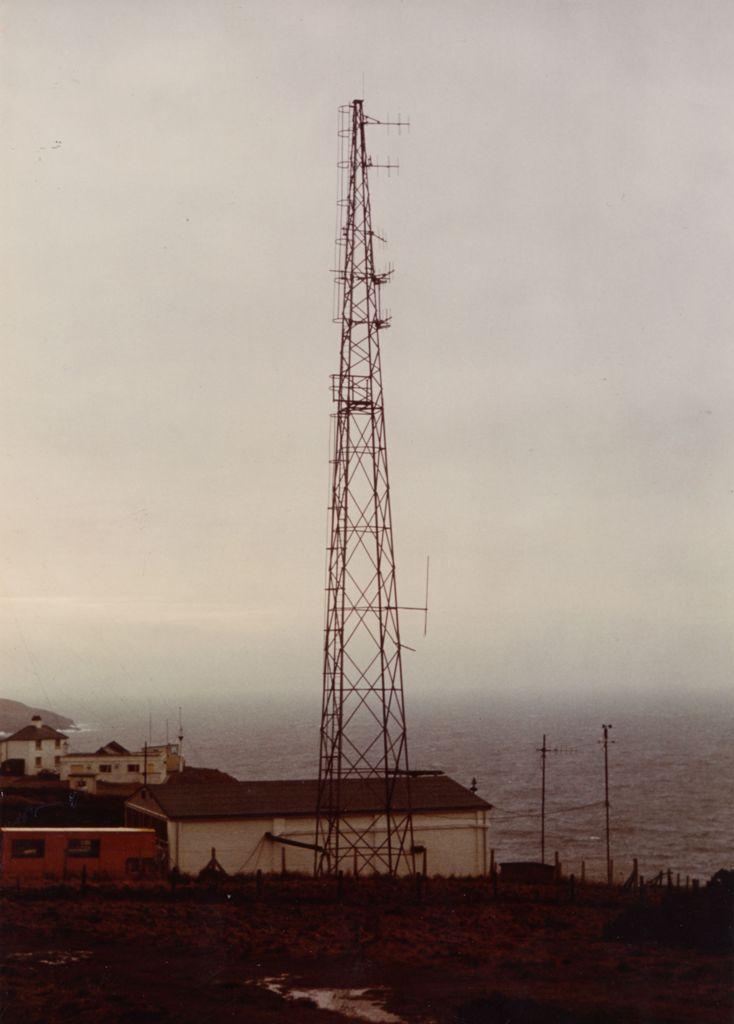
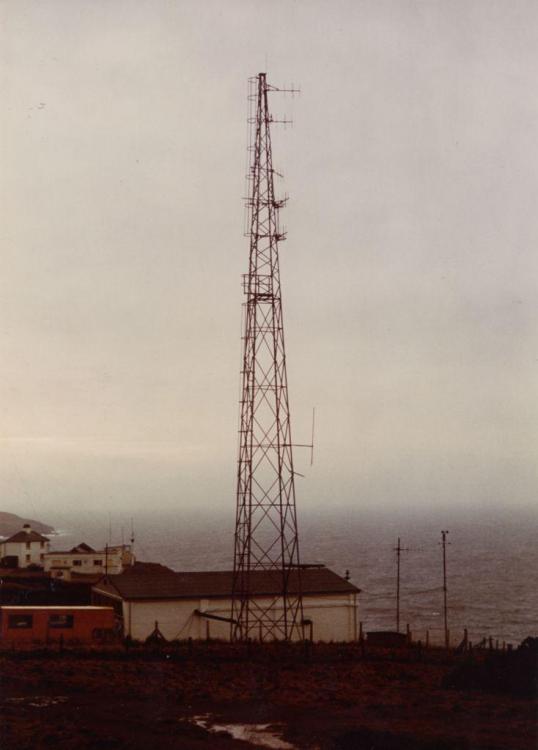
I've been trying to find another photo of that mast, taken when the aerial chap was up there checking the cables etc. The mast has a flat steel plate on the top, about a foot square, and the aerial rigger's party trick was to stand on the plate, balancing on one leg. One of the guys that worked at the GMS took a photo of him doing this, imitating Eros (the statue at Piccadilly Circus). I had the photo on my office wall, just to wind up the H,S & E chap when he popped around...
-
Going back to the Portpatrick build from the week before, I've just dug out a couple of other old photos from the 1990s, showing the site of the house. They aren't great, but they do show how the place sits out on a pretty exposed bit of cliff. I'm actually in this one, although you can't see me (right hand seat of the Jetstream T2). The GMS is at the extreme centre left, if you look closely you can just make out a group of my staff standing at the fence in front of it, to the left of the Doppler wave radar antenna array (the vertical things near the cliff edge). This photo shows the ravine I mentioned earlier, that cuts deeply into the cliff to the South of the building. This photo was taken after the rock fall, the previous one was before. If you look closely you can see where the cliff is still falling in, with the soil sliding downwards, just underneath the Jetstream: This photo was taken on a fairly typical wet day, and shows the GMS building, the Portacabin we had in the parking area to the left and the main antenna mast (for scale, that mast is 100ft high):

-
SIPS for roof only
Jeremy Harris replied to connick159's topic in Structural Insulated Panels (SIPs)
I looked at using SIPs, and one of the concerns I had was that all of the roof panel systems I looked at included substantial thermal bridges, in the form of internal rafters within the panels. The panels are also pretty heavy and difficult to manhandle, so a crane would be needed to put them in place I suspect. -
Interesting. The project in question completed in late 2008, and I think we had this particular post-completion review with the architect in early 2010, so a few years before the change to the RIBA Plan of Work. Initial satisfaction is something that we found challenging to be confident about. There were the usual haul of post-completion snags, but 90% of these related to construction stuff (which, I have to say, SRM were pretty good at sorting out). The BMS was also a bit of a disaster, and we spent a lot of time and money getting the heating, lighting and ventilation to work as designed, but that wasn't really the fault of the architect. Trying to sift out building design and function concerns from building defects was pretty difficult, but overall most things worked OK, and once the snags were sorted the building pretty much worked as we wanted it to. I'm sure self-builders wouldn't want to go this far. We did it for our own reasons; we wanted to improve interdisciplinary working, and the building design was one element of that (along with a host of others). Giving feedback to the architects was really just incidental to the work we were doing to improve the effectiveness of the service we deliver, and probably isn't something that many businesses would need to do.
-
I had an interesting time working with a commercial architect. My last job was managing a rationalisation programme that included building a new office and lab building (a ~£96M project). The architects had included elements in the design that we wanted, areas where we hoped that people would be encouraged to meet and interact (a big problem with science is that people tend to work tightly within their own discipline). The large central atrium that divided the lab part from the office part, and included things like a cafe and DIY refreshment areas, had small groups of comfortable seats, but was, in the main, a pretty open space. It gave the building a nice light and airy feel. We wanted to be able to measure how well all the various parts of what was a major rationalisation programme (it included closing several fairly large research establishments and relocating ~1200 staff) had worked, once we had settled in to the new building. I had a small team of in-house psychologists devise ways of measuring the effectiveness of interdisciplinary interaction. They took a baseline from a couple of years before everyone moved, then again at 6 monthly intervals through and after the move process. Part of their findings were that the main building didn't work as designed. People tended not to use fairly large areas of what had been designed as a space for interaction, so we arranged a meeting with the architects and invited them to review our findings. The rather surprising thing was that the architects expressed amazement at being asked to review our research on how their building design was working in practice. They commented that no client had ever come back to them, after completion, to give feedback on this aspect of a building's design. To their credit they not only took the feedback on board, but asked us if we could provide them with more detail, so they could review how they looked at the social aspects of building design for future projects.
-
How significant are these thermal bridges? We have a fairly big glulam ridge beam that penetrates both 300mm thick gable end walls to the outer skin. This doesn't create a significant thermal bridge, though, as it's surrounded by internal insulation, right out to the outer wall skin. IIRC, the thermal conductivity of these beams along their "grain" is around 0.22 W/m.K, so their equivalent U value for the ~300mm length through the wall is around 0.73 W/m².K, about the same as our windows.
-
Nothing in the 18th Ed AFAICS from a quick scan, either. Not sure that this would be something that would get into BS7671 though.
-
The creative element was far and away the most difficult for me. The practical side, laying out rooms so they made practical sense, suited what we wanted and fitted with the need to meet passive house energy performance requirements, was relatively straightforward. Getting the design to hang together so that it looked OK within the setting was a lot harder, as I simply don't have an artistic eye, or any experience as to what makes a house "look right".
-
I remember reading somewhere that the majority of houses in the UK weren't actually designed by architects. Using an architect to design an ordinary domestic dwelling is something that seems to be a relatively recent phenomenon. I've lived in around fifteen houses over the years, and suspect that only a couple of them may have had input from an architect. Looking around our village (population about 500) there are a handful of buildings that an architect had a hand in, the manor house and the old school, perhaps a couple of the grander houses and one recent conversion, but that's about it. The two "new" (now ~20 years old) houses fairly close to me were designed by an architectural technician, as I have copies of their plans (they were a part of our boundary problem). Most village planning applications that I've seen in the hast few years have been drawn up by architectural technicians; the only one that an architect designed was the conversion of the old school to a small development of houses, a tricky one, given the sensitivity of the surroundings. I've not seen any plans that have been drawn up by the applicant.
-
FWIW our house is timber frame with a larch-clad exterior and hasn't caused any issues with either the self-build mortgage we had or insurance.
-
The bottom one looks like the back of my old 1960's Vox AC30...
-
I suppose an interesting question to ask is, "is it worth fitting sprinklers if they don't save lives?" Having read through a lot of fire statistics this morning, the evidence seems to suggest that fire alarms and multiple occupancy are far and away the most significant things that save lives. Sprinklers may play a small part, but they will also (unless of the mist type) cause a fair bit of water damage, plus they may cause more damage than some minor fire would otherwise. If a house end up having to be demolished because of water damage, then perhaps it's better to just take the view that getting people out of the house in the event of fire is far more important than trying to suppress the fire. Perhaps the main argument against this is preventing the spread of fire to other properties.
-
It's perfectly possible to do everything yourself, it's what I ended up doing. I will say that it's pretty damned time consuming though. I had about a year's delay, caused by the plot boundary problem, and used all of that year reading up on design, building regs, researching methods of construction, doing drawings, making scale models, tearing the models up and making new ones. The only transferable skill I had when I started was a background in design (albeit of light aircraft and boats) and around 25 years or so experience of driving AutoCad (a significant benefit, as I didn't need to learn how to produce drawings). I've no idea how many hours I put into the house design in total, but it must have been several hundred, spread over the best part of a year. I wasn't working, either, so I had pretty much all day, every day, to dedicate to research, learning and designing the house. If I'd had to pay myself a reasonable rate I wouldn't have been able to afford my services...
-
Out of all the house build/renovation TV shows, I think George Clark is the only presenter that's actually an architect. IIRC, Charlie Luxton is an architectural technician, and probably the only other presenter with any form of architectural qualification.
-
I think that Kevin McCloud may have something to do with people having that view!
-
Things seem to have eased a fair bit in recent years, I think. We bought a house that had been a self-build, using a Scandinavian timber frame kit, back in the 1990s, and had problems getting a mortgage from our building society at the time, as it was considered to be non-standard construction. As we were living in Scotland, where timber frame is probably more common than any other form of construction, we shifted to the Royal Bank of Scotland, who had no problem at all with giving us a mortgage (this was before they grew and went out of control). Our self-build here in South West England is definitely non-standard construction, it's all-timber, for a start, sitting on a foundation of polystyrene foam. We found that getting a self-build mortgage was easy, as was getting insurance. In fact the insurance premium is lower than that for our old smaller, brick and block built bungalow. I can only conclude that lenders and insurers are more open to newer methods of construction than they used to be. We did have to fill in a lengthy questionnaire for our insurer, as we didn't fit any of the categories on their web-based application form, but there were no difficulties other than that.
-
One of the four we went to see initially did suggest doing something similar to me, during our initial meeting. The difficulty I had was that he felt we should use lots of glazing, and when I expressed some reservations about excessive solar gain, he was just a bit dismissive. As it turned out, even my caution about keeping the glazing areas modest, having large overhangs etc for shade etc, wasn't enough, and we needed to reduce the solar gain a lot more after we'd built the house.
-
We didn't use an architect, not because I didn't want to, in fact not finding an architect that understood the type of house we wanted to live in caused me a heck of a lot of additional work that I hadn't planned to do. During the process of building this house I have now met well over a dozen architects, the four that we initially went to see, and that just didn't seem to be able to grasp the idea of a passive house at all, a handful that have visited the build at various times that I really can't pass judgement on one way or the other, as they were just interested in the construction method we'd used, and three that were really enthusiastic about passive house design, two of whom I got to know fairly well, and either of which I would have gladly worked with (one, in particular, stays in touch and comes around with potential clients from time to time). My impression from talking to all these very different architects is that very few did much in the way of one-off commissions for self-builders. I'm pretty sure that the four we went to see initially all fell into this category. It doesn't really surprise me that some self-builders have problems with their architect, and perhaps part of this is that there just aren't many self-builders around in the grand scheme of things, so we aren't a big target market. My guess is that, for an architect, working for a self-builder is a real mixed bag. It's inevitable that a self-builder is likely to need a lot more help than a volume builder, as most self builders just don't have much experience of building a house, and probably don't fully understand where the boundaries of various responsibilities lie. When we failed to find an architect locally (and I felt, rightly or wrongly, that we needed someone local) I did build a very good relationship with an architectural technician. He was someone I felt we could very happily worked with, and this was backed up by some really good feedback from other clients of his. Unfortunately, we had a long delay caused by legal problems with the boundaries of the plot we were buying (exacerbated by inaction by the vendor), and so by the time we came to start the planning process for real, the architectural technician had retired. He did still give me a lot of advice, though, which was very nice of him, as we'd only paid him a nominal fee initially.
-
Yes, full fill cellulose pretty much stops fire dead, as the stuff won't sustain flames, and it tends to stop air getting to stuff that could burn. I did a couple of tests on some left over cellulose, using a blowtorch, and all it seemed to do was go black and char, it wouldn't actually burn when I took the blow torch away.
-
Worth noting that some TF houses have cavities fully filled with fire-resistant insulation, plus plasterboard provides a bit of protection from fire reaching the timber frame. Offhand I seem to remember plasterboard as lasting about 20 minutes or so before fire started to break through. BRE did some tests years ago, and I remember reading through them back when we were looking at build methods.
-
As a first step, it might be an idea to try and make a vee notch flow weir and calculate how much flow you have. Knowing that, and the head, you can calculate the potential power, and halving that is probably pretty close to what you might get from a small hydro system. There is an online calculator for measuring flow with a vee notch weir here: http://www.meracalculator.com/physics/fluid-mechanics/v-notch-weir-discharge.php
-
+1 to the above. Our 100mm thick structural slab has a single layer of A142. The only place we have thicker rebar is in the 200mm deep ring beam around the edge, but that's just bars, not fabric. We just have overlaps where sheets join, saves cutting. Just wire the overlaps tight together to keep them in place tidily.
-
Today's delight: making holes in concrete
Jeremy Harris replied to ToughButterCup's topic in General Construction Issues
Or hire a big diamond core drill. That won't care what it's cutting through, I suspect. -
One problem is that there are loads of fake chargers around, that externally are pretty near identical to name-brand stuff. These all have switched mode power supplies inside, and the drive to make them smaller has meant that they handle quite a bit of power for their size. A company like Apple can invest in ensuring that the design and manufacture of their very tiny USB chargers is safe, but do any of the multitude of, mainly Chinese, knock-off manufacturers put the same care and attention into their products?