Jeremy Harris
-
Posts
26430 -
Joined
-
Last visited
-
Days Won
360
Everything posted by Jeremy Harris
-
Sadly mine didn't come with any warranty as far as I know. Sunamp seem to have washed their hands of it, anyway, and I'm not sure I have the strength of will to do battle with them over it.
-
Thanks Dave, I must admit that having spent a day or two looking around it does seem that this type of catastrophic failure isn't exactly unknown. I've no idea yet what it's going to cost to put right the damage it's caused, there is a solid mass of sodium acetate stuck in the ceiling void, so I'm going to have to rip down part of the kitchen ceiling to get at it, then make good. No idea what sort of damage there may be up there, either there's quite a lot of cable runs in that general area, and I've no idea if there is any sort of interaction between sodium acetate and PVC. I'm hoping not, but until I get a good look in there I won't know for sure. It seems clear that Sunamp's installers are keen to rip people off for all they can get when these things fail, too, replying on the fact that it seems a lot of general plumbers and heating engineers won't touch them. I'm seriously looking at replacing it with a slimline UVC, simply for future proofing as much as the much lower cost. It's easy to get someone to work on a UVC if anything goes awry in future, and that may make more sense than the modest efficiency gain from using the Sunamp. The real problem with the Sunamp is as your say, it's just not in any way repairable. When it fails it's a write off, with the added problem of trying to get rid of it. How do you dispose of ~160kg box full of leaking sodium acetate?
-
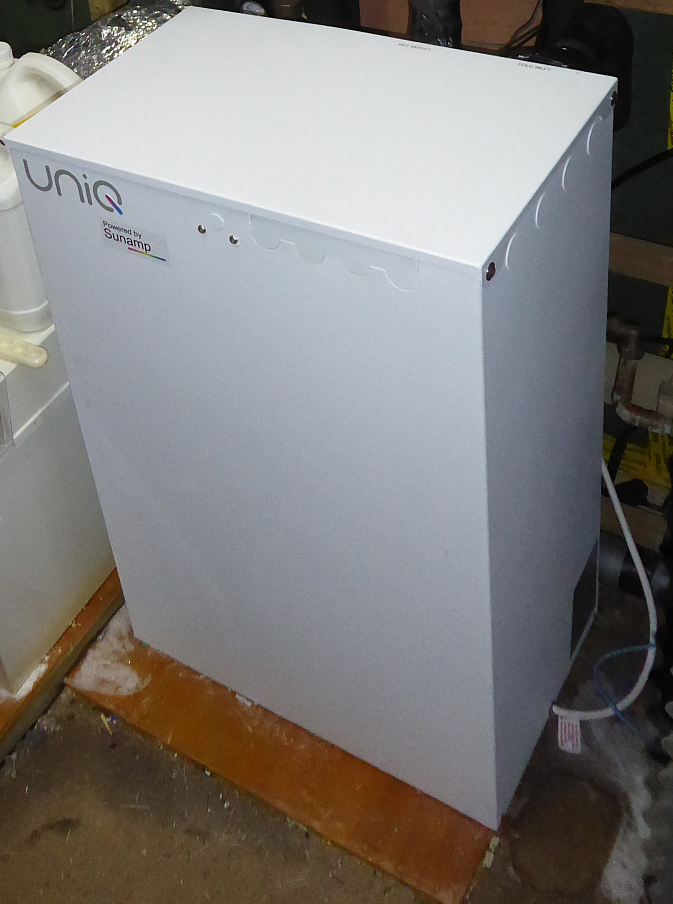
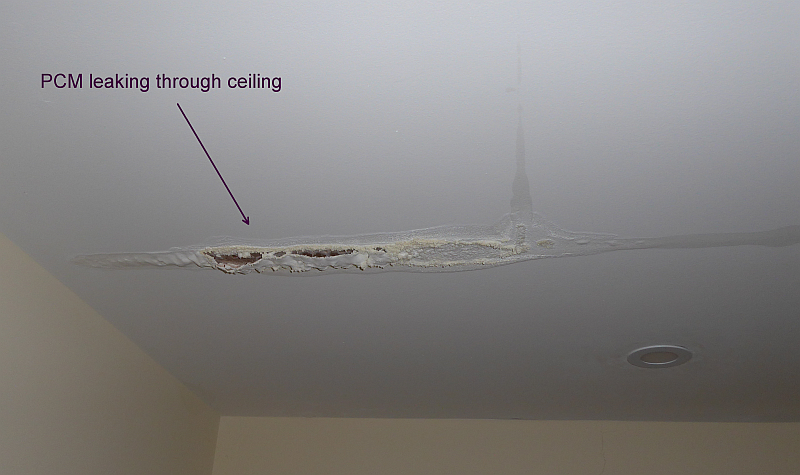
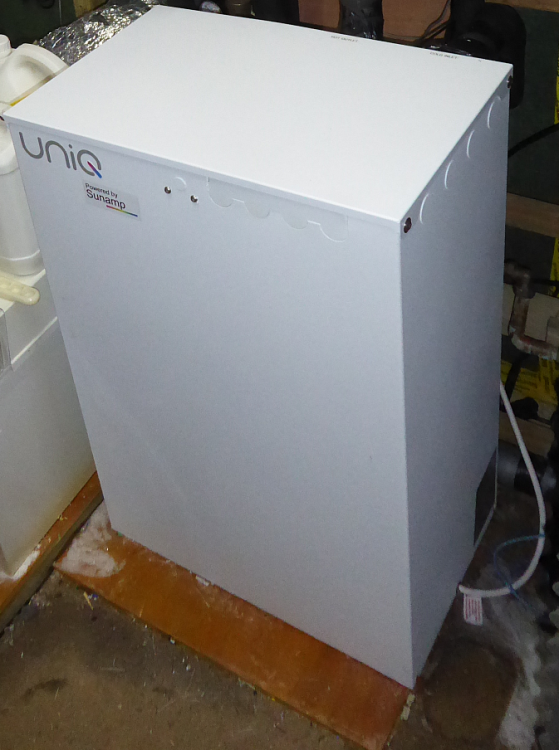
First of all, my apologies for being silent for so long. TBH, having finally settled here in our new home I needed a break from self-build. Not for any particular reason at all, just that I'd been living and breathing it for so many years that I needed some time out, a bit of breathing space if you like. Old age seems to do this, creep up on us almost unnoticed (and I'm now in my 70's). Also I was spending way too much time here, to the exclusion of other things I should have been doing. Anyway, thought I'd post here to hopefully shed some light on how things have gone with our Sunamp adventure, and give a bit of a gentle warning. Those who've been here, and on Ebuild before this place, may remember that we bought a Sunamp PV right back in the early days, before this place existed. We ran that for well over a year, with a few minor teething problems, but it was enough to convince me to swap it for a larger Sunamp UniQ eHW 9, which I did in September 2018. That also had a few teething problems, but Sunamp sorted them out quickly and without fuss. Since then I've been more than happy with the Sunamp. It's provided reliable hot water, mostly heated by excess solar generation, in fact far more hot water than we have ever needed as it turned out to be a bit over-sized. The first time we went away on holiday I turned everything off and was amazed to find that when we got home a week later there was still piping hot water available. I cannot complain at all about its performance, it has been significantly more efficient than a hot water cylinder, which was the reason for me being so enthusiastic about it back in 2016. Sadly, our Sunamp died on Saturday morning, and ejected its phase change material all over the floor, down through the ceiling in the kitchen below: A check upstairs in the services room confirmed that it's death had been spectacular, with PCM all over the floor and a long icicle of sodium acetate crystals down the back of the unit, from the burst casing inside: To it's credit, despite this it had delivered two showers that morning before we spotted the problem. Sadly this was to be its dying endeavour. I contacted Sunamp, not because of any warranty claim (there was no warranty anyway) but to ask them to put me in contact with a local installer for a replacement. I spent the weekend looking at the specs of the newer Thermino models and, given that the 9kWh (11kWh) UniQ was overkill for just two showers a day I decided its replacement would be the smaller Thermino ePlus 150, with the PV02 key to better match it for PV heating via the Eddi (when summer comes back). I found a couple of online suppliers, price, including VAT looked to be around £1,800 or so, plus delivery, which sort of seemed OK. I'm not up to getting the old unit downstairs and the new one up stairs, so I contacted a few local plumbers. All said they wouldn't touch this job. No idea why, it's a pretty straightforward swap, as the PRV, TMV etc is all there, just a matter of re-jigging two 22mm pipes. Seems the technology just scared them off, or, perhaps, it might have something to do with dealing with Sunamp? After a lot of delay, Sunamp customer services came back to me, asked for photos, then went silent. I got on to them again and they gave me contact details for a couple of installers. I contacted them, first one got back to me saying it would be around £6k to swap out our failed unit for a new one. I questioned this. He said it was about a day's work. Now, I'm all in favour of paying a fair rate for a job, but I know how long this job is going to take and I know the cost of all the materials. I am not going to pay a bloke £800 plus per hour, no matter how damned good he is! So, looks like I have to fall back to hiring a stair climber and doing it myself. PITA, as I'd have happily paid someone a few hundred quid to do this (over and above the cost of the bits) but I point blank refuse to stuff over £4k in someone's pocket for a job that is so straightforward, especially when there are installers advertising prices of around £4k to replace an existing hot water system and cylinder for a Sunamp, a job that is a heck of a lot more work. Sorry for the rant, thought it was worth posting here as a warning to others thinking of going down the Sunamp route. I can't fault the performance, but if the cost of repair and maintenance by a Sunamp approved company is so crazy then it may give some pause for thought. I've half a mind to bin the Sunamp and just get a high efficiency 150 litre cylinder installed. No idea what that might cost, but I doubt it would be over £6k. PS: Seems I have hundreds of PMs that have accrued in my time away. Sorry, but I doubt that I have a hope in hell of answering them all!
- 242 replies
-
- 20
-

-

kill grass and weeds permanently
Jeremy Harris replied to deuce22's topic in Landscaping, Decking & Patios
If you've got a spare hour or two we could do with a water feature. I've had a pond liner sat here since just after Christmas, but the chap that was going to dig the big hole has stopped working because of the lockdown. We were hoping to get the pond finished before Spring arrived, too. -
Log store roof: Onduline/Coroline vs steel
Jeremy Harris replied to Crofter's topic in Garages & Workshops
My limited experience has been that onduline is easy to cut and fit, and seems to last a long time. It's only real weakness is that it's relatively easy to damage, especially when installing it (it doesn't tolerate being stood on a corner well), but once installed it seems as robust as anything, really. I'd opt for it, just because it's much easier to work with (although it does make a mess of saws and drill bits). -
Our PP included a GSHP initially, but when I costed it up it was more than 4 times more expensive to install and would have taken several decades to recover that extra cost from the saving in energy use through life. There was also a much higher maintenance cost, because the antifreeze in the ground loop needs changing every few years, and the stuff costs a fortune, as it's a special environmentally safe mix. I had planned on a DIY GSHP install, too, to save money, using the units supplied by Kensa, down in Cornwall ( https://www.kensaheatpumps.com/ ). They were very helpful when I spoke to them, and had we decided to go for a GSHP I would almost certainly have used them. I had to get a minor amendment to our PP to switch to an ASHP. but this was pretty quick and easy, and the planners had no problem with it. It seems that planners have now realised that ASHPs are very quiet, with the advent of inverter driven units, so there is no appreciable noise nuisance (I think this may have been the reason for needing PP for and ASHP).
-
kill grass and weeds permanently
Jeremy Harris replied to deuce22's topic in Landscaping, Decking & Patios
Could do with a cool spell right now. Just come in from sawing very, very hard oak sleepers and screwing them together with 150mm stainless timberloks, to make a couple of raised beds. Managed to finish one of them, but the combination of the heat, and the embuggerance of trying to work with rock hard oak has almost finished me off. Found the torque limit of my cheapo Makita clone brushless impact driver though. The local sawmill let me have the sleepers at a discount, and delivered them the same day, as they'd had them sat in their yard for a few years, and they were a bit grubby. What I should have realised is that oak gets very hard as it seasons, and these seems to have reached peak hardness. Even pre-drilling the holes I was twisting up timberloks like corkscrews. After trying a few lubricants, it turns out that the best was silicone grease. No idea why, as I don't think of silicone grease as a particularly good lubricant normally. Still, the technique is honed now, so with luck, making the second one tomorrow should be a bit easier. -
kill grass and weeds permanently
Jeremy Harris replied to deuce22's topic in Landscaping, Decking & Patios
Sorry, @jack , I genuinely didn't mean to cause offence at all. At the risk of unwittingly causing more anger, I'll just repeat that it seems that they are just expressing the forms of glyphosate salts in their formulation. The answer is in that quote from Wikipedia, specifically this key bit (perhaps I should have highlighted it to make it clearer, I thought it better to include the whole paragraph to give context): This product contains a mixture of glyphosate salts. FWIW, lots of products, including many drugs, are sold as salts, or mixtures of salts, of their active ingredient. The reasons for doing this are almost always related to stability, storage, ease of handling and packaging and safety when used I think, it doesn't usually change the way the stuff works very much, if at all. It may be that sometimes the formulation, choice and mix of salts, etc is driven by IPR issues, although I think that many of the patents might have expired by now. I don't know for sure, but it seems that many companies are now selling glyphosate in various formulations, whereas years ago Roundup was pretty much the only one available, I think (was back when my mother used it on the farm a lot). -
kill grass and weeds permanently
Jeremy Harris replied to deuce22's topic in Landscaping, Decking & Patios
There's a reasonable explanation as to why glyphosate is sold as a salt, rather than the acid, in this paragraph lifted from Wikipedia: -
kill grass and weeds permanently
Jeremy Harris replied to deuce22's topic in Landscaping, Decking & Patios
The full name of glyphosate is glyphosate isopropylamine, the isopropylammonium salt of glyphosate. -
That definitely looks a bit odd! Looks as if there had possible been a board there at some time. that's since been removed (goodness only knows how). Best bet is probably to scrape out a couple of inches or so and fill it with a mortar mix I think.
-
kill grass and weeds permanently
Jeremy Harris replied to deuce22's topic in Landscaping, Decking & Patios
Seems to be just another very expensive version of glyphosate: https://www.progreen.co.uk/fileuploader/download/download/?d=0&file=custom%2Fupload%2FKurtail_EVO_Safety_Data_Sheet.pdf It annoys me a bit that the marketing deceivers think they can increase profits by selling a standard product with a new name that deceives people into thinking it's something other than it is. In this case, they are charging £34.79 for 0.5l of glyphosate at a strength of 240g/l, whereas Gallup 360, a general purpose agricultural glyphosate, in more concentrated form (360g/l) is only £30 for 5l, so less than 1/10th of the price. -
I can confirm that streaming definitely doesn't stay in sync! We have a Roberts portable internet radio, plus a RPi Zero W that streams R4 into the ceiling speakers in the kitchen. The two are never in sync.
-
We had a complaint about the height of our ridge once the house was up. Luckily I still had access to a Total Station and the OS steel pin from when they surveyed the lane was still visible by the drive entrance. The planning chap came out, we set up the Total Station over the pin and showed that the ridge height was slightly lower than as shown on the approved plans. During the course of the conversation with the planning chap, I asked him what sort of leeway they allowed and he reckoned that anything up to about 100mm out would generally be absolutely fine. No idea if that's a widespread rule, or just his personal judgement, but it seems reasonable to me.
-
My view was that there were some tolerances that were super-critical and some that really didn't matter too much. A factory manufactured panel timber frame build needs more thought than block and brick. I think, as there's not much scope for being able to change things once the frame is built. This is what caused my soil pipe problem, as this poked up through the floor slab it needed to come up into a clear space close to a wall, but it ended up about 20mm too close to the wall, just because the tolerance wasn't tight enough on its position. My experience with window openings was that the window company didn't start making them until the house was up and they could come around to double check the sizes of all the openings. My guess is that they do this because they have learned over the years that the as-built dimensions may not tally with the drawing dimensions.
-
I had much the same problem with tolerances, and when I set a 2D positional tolerance on the position of our soil pipe, where it comes up through the slab, of +/- 30mm the ground works chap thought I was joking. I should have made the tolerance even tighter as it turned out, as it ended up being too close to the inside face of the wall and caused me a fair bit of work putting in a small offset to allow the internal soil stack to fit OK. Our window openings were specced to be 5mm bigger all around than the frames, something that the window supplier came around to check.
-
Interesting, as we live in a very quiet rural village, have extremely good soundproofing, triple glazing etc and our MVHR is completely inaudible when running normally. It can just be heard when in boost mode in the bathrooms, kitchen and utility room, but even then it doesn't make more than a very quiet hum in the bedrooms or living room. As boost only comes on for ten to fifteen minutes when the shower is running, or where there's a lot of steam from cooking, the very slight noise increase isn't an issue. If an MVHR system is making audible noise then that indicates a poor installation, perhaps without adequate silencers on the ducts and without vibration isolation on the unit itself (anti-vibration mounts for the unit and short lengths of flexible vibration isolation duct at the unit). It's also essential that the system is correctly balanced during commissioning, so that the extract and supply air flow rates are set to be equal overall, and that the individual terminal flow rates are correctly set for each room. As commissioning is a bit tedious, and needs a sensitive air flow measurement device, it seems this is often skipped by some installers, even though it's a mandatory requirement to show compliance with the regs. Finally, our bedroom supply terminal is in the wall, rather than the ceiling (not ideal, but we have vaulted ceilings) and is about two feet from my head. My hearing is still fine, yet I cannot hear any noise from it at all. Our house is timber frame, too.
-
Very common technique when patching up wooden boats to just fit a graving piece, or Dutchman. Works well, and unlike filler it tends not to show later, as the graving piece with move in pretty much the same way as the underlying timber. To make a Rolls Royce job it's best to make the cross grain part at an angle, but I doubt it's worth it for something as easy to fix as this.
-
kill grass and weeds permanently
Jeremy Harris replied to deuce22's topic in Landscaping, Decking & Patios
Thanks, but that just seems to be 160g/l glyphosate. The stuff I have is Gallup 360, which is 360g/l, so doesn't need to be diluted as much: https://www.hygienesuppliesdirect.com/products/prod251006-gallup-biograde-360-5-litre -
Welcome, There may be two issues, here: The first is whether or not replacing the window with a patio door needed planning consent, or whether it falls within permitted development rights. The chances are it probably doesn't need planning consent if it's not at the front of the house, but you can check on the Planning Portal: https://www.planningportal.co.uk/info/200130/common_projects/14/doors_and_windows The second issue relates to building control, and you almost certainly do need building control approval for the work done. Getting this retrospectively shouldn't be a major issue, if the work done complies with the regs, I think. The regs are slightly different in Scotland, though, so probably best to give your local building control people a call and ask what they need. One of our members who's more familiar with the quirks of Scottish building regs may be able to provide more info.
-
kill grass and weeds permanently
Jeremy Harris replied to deuce22's topic in Landscaping, Decking & Patios
I'm not sure, TBH, it'd be a fiddly job, though, as the stems aren't very thick. From what I've read, part of the problem seems to be that it has a fair bit of silica in the outer coat of the "leaves", which makes it hard to get enough weedkiller contacting the surface to work well. The other issue seems to be that it's a very ancient and primitive plant, that's part-fern, part plant, and spreads both from spores and from very deep roots that can cover wide areas, a bit like knotweed. Repeat spraying it is supposed to get rid of it, but pretty much everything I've read suggests that it can take several years of doing this to completely get rid of it. I'm pretty sure that ours is only propagating from the root system, as it seems unlikely that spores will be able to take hold, given the bark and weed fabric, so the tactic seems to be to keep killing back any new growth until the root system gets too weak to last through another winter. -
kill grass and weeds permanently
Jeremy Harris replied to deuce22's topic in Landscaping, Decking & Patios
Looks like we're doing much the same, and having much the same experience! This is the third time I've treated it, not quite three years of doing it yet. Maybe this will be the last year I have to do it, and it'll finally keel over. I can but hope. -
From this hire website, for £70/week: https://www.hirestation.co.uk/tool-hire/Compaction/Trench-Rammer-Hire/050050/
-
Minimising Overheating on Room-in-Roof Bungalow
Jeremy Harris replied to Nethermoor's topic in Heat Insulation
The tricky bit is sealing it up and getting it airtight. With a ridge beam hung rafter arrangement you have a completely free internal face that makes fitting and sealing the VCL very easy. With attic trusses the VCL has to be cut and taped very carefully around dozens of timber projections through the membrane, creating a lot of work to get right, and using up a lot of airtightness tape. Our roof just has a layer of VCL stretched from one end of the house to the other inside, fastened to the inner face of the rafters with 50 x 50 battens, with the only taping being the joins between the runs of VCL and to the membrane coming up from the walls. The plasterboard vaulted ceilings are just fastened to the 50 x 50 battens, with the void behind being used for wiring etc. -
Minimising Overheating on Room-in-Roof Bungalow
Jeremy Harris replied to Nethermoor's topic in Heat Insulation
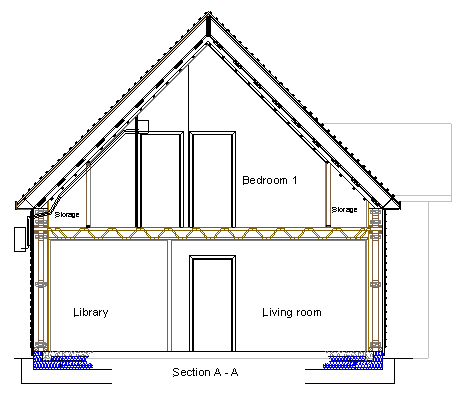
That's a shame, as we have a roof similar to the one @ProDave has described, with a ridge beam and rafters hung from it. Our's has 22mm OSB sarking outside, and just a VCL inside to hold the insulation in place, and the design gives the same sort of space as yours, but is very much easier to both insulate well and make airtight: