Jeremy Harris
-
Posts
26430 -
Joined
-
Last visited
-
Days Won
360
Everything posted by Jeremy Harris
-

Boiling Water taps. What and where to buy.
Jeremy Harris replied to ProDave's topic in Kitchen & Household Appliances
Sounds way too much to me. Ours just lets a few drips out for maybe 10 seconds, once every hour or so, probably as the boiler comes to the boil. Is there a pressure reducing valve on yours? On ours, this is combined with the pressure relief valve and outlet to the tundish, and is adjustable to set the required flow rate at the tap. You can just see it in this photo, the relief valve knob is right above the tundish, the pressure reducing valve control knob is the smaller one to the left: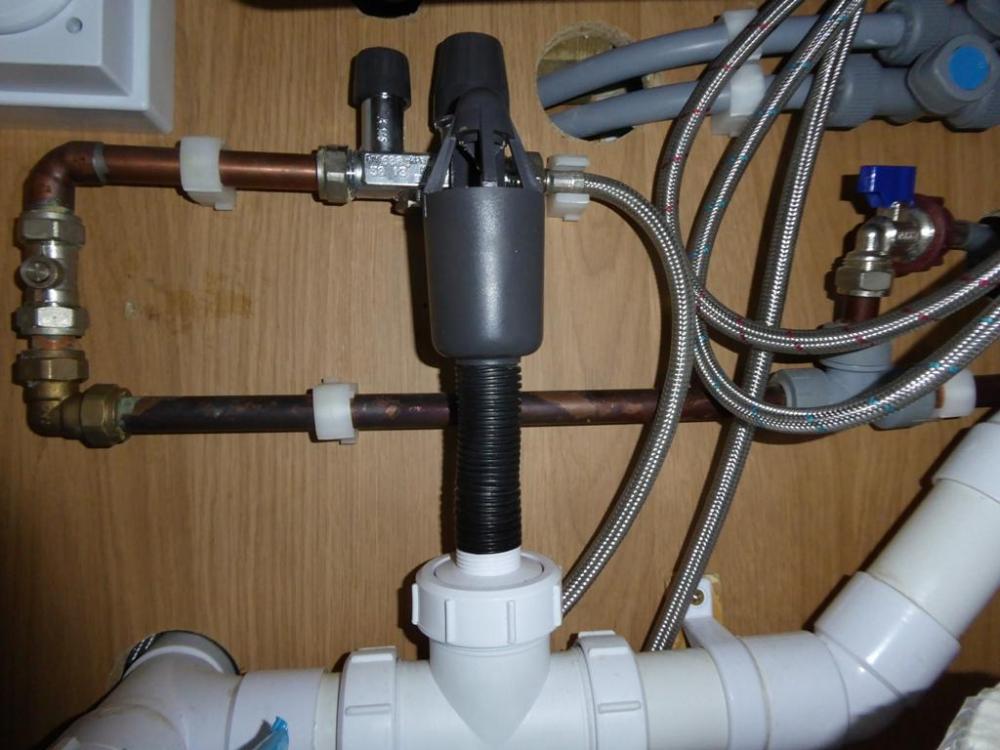
-
Boiling Water taps. What and where to buy.
Jeremy Harris replied to ProDave's topic in Kitchen & Household Appliances
Ours periodically spurts a bit into the tundish, just before the thermostat shuts off, I think. I reduced this a bit by turning down the pressure, as ours came with a adjustable pressure reducing valve on the input. Reducing the pressure also reduces the amount of spitting from the tap. One thing I did add to ours was a time switch (just a standard immersion timer) in the supply, plus a shut off (holiday) switch high up right at the front of the cupboard. The timer means that the boiler is only on during the day, and the shut off switch makes it easy to go around turning stuff off when we go away. -
From reports here and elsewhere is seems that any of the very well known brands are pretty good, so Panasonic, Samsung, Daikin, Carrier (often re-badged as some other make), Mitsubishi, etc. My general advice would be to steer clear of unknown brands, not because they may be iffy, but more because they may be a bit of an unknown quantity.
-
volume of water required m3 per hour
Jeremy Harris replied to scottishjohn's topic in General Plumbing
On a Windows PC, Alt+252 is ³ Alt+253 is ² Alt+0176 is ° Alt+0181 is µ There are loads more, plus another whole set for unicode. Memorising the most common ones saves having to use the (sometimes) flaky superscript options of the forum. The snag is that laptops don't consistently handle keyboard shortcuts in the same way. -
volume of water required m3 per hour
Jeremy Harris replied to scottishjohn's topic in General Plumbing
The Grundfos is our main borehole pump. I did fit a Polish Ibo pump for a time, after we had all the borehole problems, but pulled it out and replaced it with a new Grundfos, supplied FOC by the borehole people, as the orginal got a bit buggered up pumping sand for ages. The Ibo pump still works fine, and is sat stored as a standby, in case we get a pump failure. Finger trouble on my part, hit the wrong key shortcut sequence... Now fixed. -
volume of water required m3 per hour
Jeremy Harris replied to scottishjohn's topic in General Plumbing
Just work it out. For example, assuming 4 people, at 200 litres each per day, gives an average of 0.8m³/day, or 0.0333m³/hour, assuming there's a holding tank or accumulator to save the pump needing to operate very often. Just change the numbers for more or less people. Bugger all pumping requirement, really. I use a ~650 W Grundfos pump that can deliver around 20 to 30 litres per minute at our normal working pressure, way more than we ever need, given that it feeds two 300 litre accumulators, so we have about 300 litres of water stored at ~3 bar ready for use (accumulators store about half their volume as water). -
volume of water required m3 per hour
Jeremy Harris replied to scottishjohn's topic in General Plumbing
The usual target figure used is 150 litres per person per day, but that's perhaps a bit on the low side for some households. I'd be inclined to work on the basis of 200 litres per person per day. On top of that you may need to make allowance for fire fighting, depending on how close the house is to the nearest supply of water for that purpose, and how accessible the site is. We were OK as we had a source of water for for fire fighting and accesibility (within 45m) for fire fighting vehicles, so didn't need to factor this in to our borehole capacity allowance. -
TBH, I doubt that's wholly accurate. There are some companies assembling heat pumps in the UK, from parts manufactured elsewhere, and there are some badge-engineering heat pumps made by other overseas manufacturers that are made to look as iof they are wholly UK made products. To the best of my knowledge there are only two UK manufacturers of heat pumps, and both use sub-assemblies from other manufacturers. My money is on it being made from imported major assemblies, might even be an entire imported unit, painted a different colour and with different badges, like the products from another well-known "British" heat pump company. In order to qualify as being "British made" all it needs is something like a British control system, and it seems likely that this company may well have designed, or adapted the design, of the control system, particularly as they are able to fix it when it fails. They seem to be a micro-company, from their accounts filing history, which suggests that they most probably aren't really manufacturing heat pumps from the ground up: https://beta.companieshouse.gov.uk/company/06705069/filing-history
-
Hard to be sure, but the screw looks as if it is to lock the nut in place. So I'd be inclined to loosen the screw, and try to tighten the nut, and then, once it's tight, tighten the screw to lock the nut in place.
-
Just for info, although the lamp socket you have seems to be safer than many, one major flaw in the design of E27 ("Edison") screw base lamps is that it may be possible to touch the threaded part of the lamp whilst unscrewing it. If this is connected to line, then it will be at 230 V if the power is on (and with some types of light switch it can be hard to determine on and off if a lamp blows). With the screw part connected to neutral, it will be at, or very close to, earth potential, so the risk of an inadvertent shock is a great deal lower.
-
The brass coloured bit with the hole in the end is the line, the silver coloured bit that contacts the side of the lamp with the thread is the neutral.
-
The key safe was really useful, as was having a combination padlock on the Heras fencing gate into the site. It meant I could let contractors have the combinations and didn't need to worry about having to be on site at the crack of dawn every day. As each contractor finished their work on site, I just changed the combinations for the next ones due in. Probably not foolproof, and I did advise contractors to not leave any tools on site (and had a notice up on the fencing saying this), but it seemed a fairly good way of keeping the place reasonably secure, yet still allowing easy access. It also meant I could just give someone the combination over the 'phone if they needed to get into the site to make a delivery.
- 40 replies
-
- 2
-

-

-
- herefordshire
- infill site
- (and 2 more)
-
Yes, it is critical that this is connected the right way around. The line connection is to the base "pin" of the E27 fitting, the neutral has to go to the part that connects to the outer threaded bit where the lamp screws in. If this was a bayonet fitting, then the polarity doesn't matter, as either of the pins in the base can be line or neutral.
-
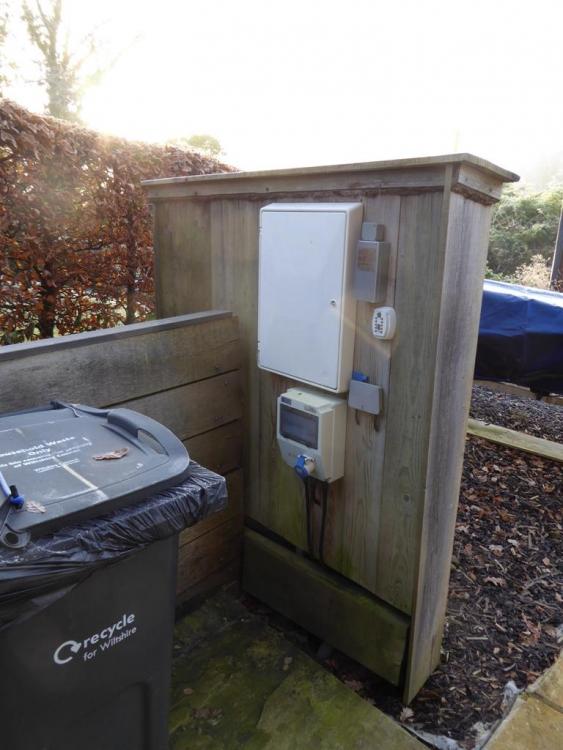
Just been out and taken a photo of the meter box side: The caravan box we used as a temporary site supply, with it's 16 A commando is still there. The small grey box is because Openreach originally insisted that their underground cable had to terminate outside the house - by the time they came to install it their rules had changed and they would have preferred to bring it into the house (too late, the duct was sealed up!). The old key safe we put in to give contractors access to the house keys is still there, but no longer used. The silver box is my energy/power measurement system, that transmits data by RF link to the house, and also transmits the on and off signals to the Sunamp heater (for excess PV generation Sunamp charging).
- 40 replies
-
- 2
-
-
- herefordshire
- infill site
- (and 2 more)
-
Not at all easy to pull a new cable behind capping, but can be done with care, if it's a straight run. Chased and capped is pretty much the universal way to fit cables into brick/block walls, and if you think you may need extra cables in future, then why not put some spares in, and leave them coiled up in accessible locations?
-
if it were me I'd just chase and then fit galvanised capping, as it doesn't need such a deep slot in the walls. Probably cheaper, too, plus plaster sticks well to capping, and doesn't stick at all well to PVC.
-
There are really only two ways, use a one-time-use, pre-charged, ion exchange resin (exactly the same as a water softener, but without the regeneration system), or use phosphate dosing, like the Combimate. From the description that @vivienz has given, I'd say that it's probably a phosphate dosing unit, as phosphate dosing doesn't reduce limescale, it just stops it sticking to anything to form hard scale, so all that's left is a powdery precipitate that will leave white marks if water dries on a surface.
-
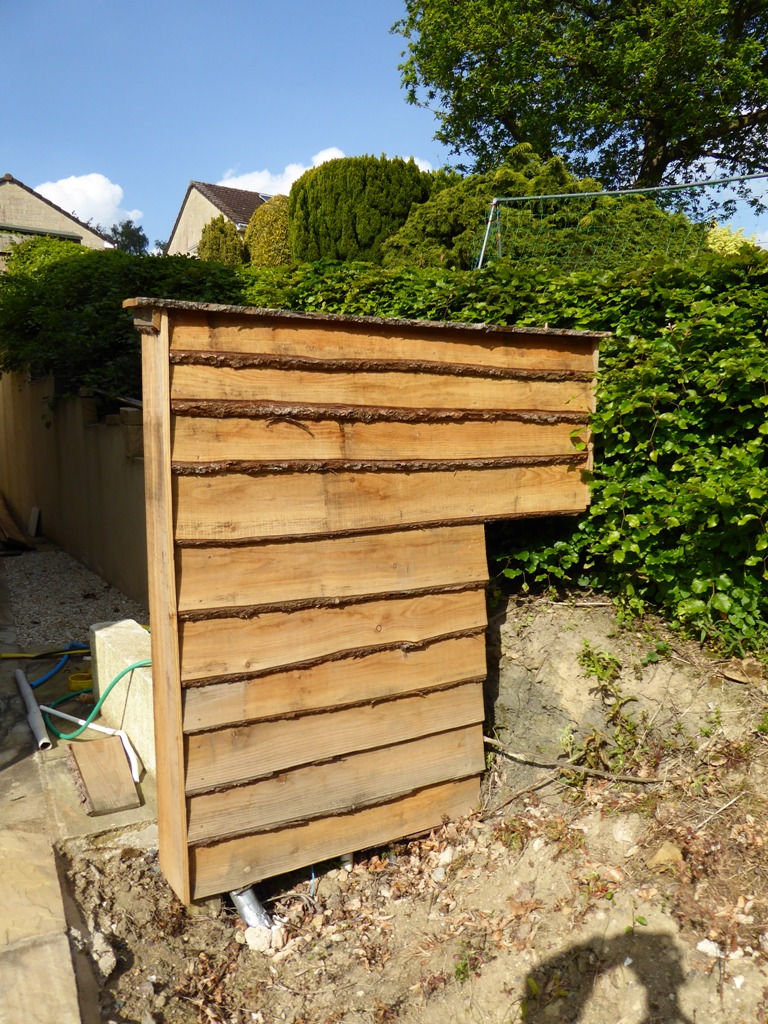
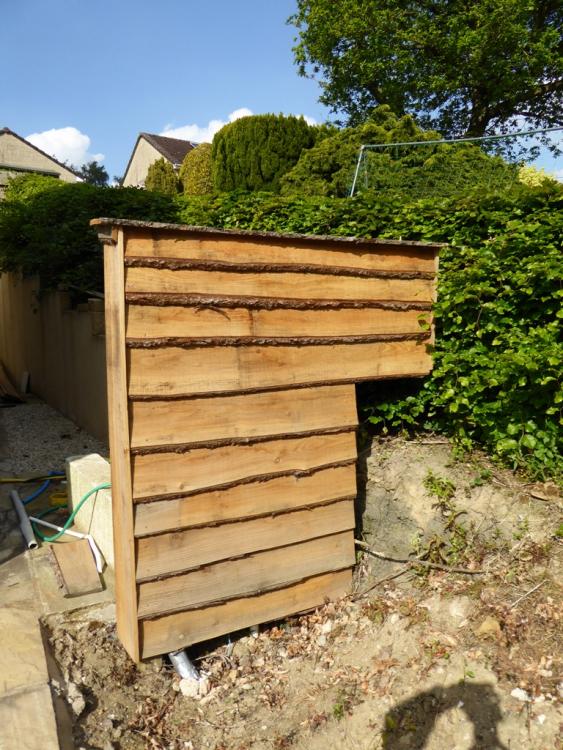
No, as the box is still in the same place now as it was when installed. I knew that we needed to have a small screening fence to hide the wheelie bins, so just had this put in when we were doing the ground works. I fixed a caravan site box, with a 16 A commando outlet, on the fence below the meter box and used that as the site supply (the caravan box is weathertight and has the required RCBO etc for a site supply, as caravan sites have to follow the same regs). I made the fence deep enough to take the box, and panelled it on both sides. I fixed timbers to go down the sides of the box, so that I had something to screw it to, and fitted blanking plugs in the couple of unused cable holes (with a bit of sealant around them for good measure). I also added a "roof" across the top of this fence. This is the front view of that fence, the meter box is let in to flush vertical planking on the other side:
- 40 replies
-
- 1
-
-
- herefordshire
- infill site
- (and 2 more)
-
To charge at 32 A with the Tesla UMC you may have to buy the optional 32 A commando adapter. Some cars came with this, some didn't (mine just has a 13 A plug adapter and a 16 A commando adapter). Not a major issue, as Tesla sell the 32 A commando adapter lead for ~£40, I think.
-
No need. Ed Jnr just works, either Edwina or Edward...
-
I used exactly the same No Nonsense stuff from Screwfix. There shouldn't be a problem mixing different brands, as they are probably all much of a muchness.
-
Complete U turn from approved design
Jeremy Harris replied to Coops's topic in New House & Self Build Design
We did much the same. Bought a plot with consent for a stone-clad bungalow, put in a new application for a timber-clad 1 1/2 storey house. We're in a conservation area, opposite a listed building and our planning application was the 7th one for the plot. Took a bit of negotiating for some features, but we got PP first time around in the end, with no objections. I found this a bit surprising, as the previous application for our plot had attracted 14 objections, all of which were read out by the chairman of the Parish Council when they considered it at their meeting. -
All that's needed is an approved meter box, mounted where you want it, and where it can be accessed by meter readers, etc. This company sell a wide range of them: https://www.meterboxesdirect.co.uk/ We used a standard in-wall mounting one, and fitted it into a double sided timber fence, that was later going to become our mandatory wheelie bin screening fence (not allowed to have the things on show here...). The box I used was this one: https://www.meterboxesdirect.co.uk/uk-standard-electric-meter-box-recessed-595x409x210mm.html but there are surface mount ones as well as kiosks that will fit on a concrete pedestal.
-
Initially go to the water company and get them to quote. With all the utilities (except Openreach) you should get a quote that's broken down to contestable and non-contestable work. The contestable work can be done by any approved contractor, the non-contestable work can only be done by the utility. This means you can sometimes save money by getting one contractor to do all the trenching and making good, for all the services.
-
They use a sprayed on adhesive, rather than mortar. Looks a bit like the thin joint system: