Jeremy Harris
-
Posts
26430 -
Joined
-
Last visited
-
Days Won
360
Everything posted by Jeremy Harris
-
For her, I think it's the "feel" of wood more than anything else. She never has liked plastic seats, and in every house we've owned I've had to fit a wooden seat, just to keep her happy.
-

Making a *love* bench
Jeremy Harris replied to Tennentslager's topic in Landscaping, Decking & Patios
Sadly, yes........... All I could afford at the time was a 1959 Triumph T110, with an open sidecar, that, IIRC, I bought for £25. I did add Bonneville barrels, pistons, head and twin Amal carbs to it, though, so it was near-enough a Bonneville in terms of power. Sadly, the sidecar was not really as big a "pull" as owning a "proper" car................. -
MVHR extract in plant room?
Jeremy Harris replied to jamiehamy's topic in Mechanical Ventilation with Heat Recovery (MVHR)
I keep counting the ducts and it looks to me like ten ducts going to each manifold. (edited to add that we cross-posted!) -
The seats thing seems to be a potential problem, now that there are so many "non-standard" shapes of pan around. We've bought pans that have a rectangular shaped opening, and don't particularly like the plastic seats they were supplied with. SWMBO wants me to fit an oak seat to the one in our bathroom, but a hunt around all the usual suppliers hasn't come up with one the right shape. I'm right on the point of trying to have a go at making an oak seat, and incorporating the hidden fixings and soft close mechanism from the existing seat, but can see that it's going to be a lot of work to do, and I'd rather just buy one.
-
Making a *love* bench
Jeremy Harris replied to Tennentslager's topic in Landscaping, Decking & Patios
Well, the sort of friend who would, if adequately rewarded, lend you his car so that you could take a girlfriend out with the wild hope that you'd get a chance to make use of the ankle hoops and floor cushion with her................ (never happened on the couple of occasions I borrowed his car!) -
We have won our planning appeal at last
Jeremy Harris replied to joe90's topic in Planning Permission
I built a Marlin Roadster around 1984, can't post a photo as at that time I was in to only taking slides, for some odd reason, and I don't have a slide scanner. In 1995 I built a road going single seater, though, a Hudson Mystic, powered by a Renault Gordini engine. With an empty weight of around 400kg it tended to be reasonably quick. Here's it parked in front of another one of "my" toys at the time:
-
Making a *love* bench
Jeremy Harris replied to Tennentslager's topic in Landscaping, Decking & Patios
A school friend's first car was a Morris Minor, when we we still in the sixth form. He was the first of us to get a car, most of the rest of us were still riding motorcycles back then. One of the first modifications he did was fit some straps, like the old hoops hanging from the roof of tube trains for standing passengers, under the dash and make up a knee cushion that fitted neatly into the passenger side foot well................................ -
And, although our house is smaller, I did all the first fix plumbing in no more than three days (I think it was less) on my own, with no labourer. All that was plastic, and was just running all the pipes, including waste pipes, into the service spaces under the floor and in the walls before the plasterers came to start boarding the house out.
-
I'd have a careful look at the cost comparison between a GSHP and an ASHP. ASHPs now make no more noise than GSHPs, are only very slightly less efficient if installed properly, cost around 1/3rd the price (installed) and have virtually no ongoing maintenance (whereas just an antifreeze change in a GSHP every few years could set you back several hundred pounds) We were originally going to install a GSHP, but even with me doing most of the labour we would never have come close to saving 1/10th of the additional installation cost from energy savings over the lifetime of the unit (which I assumed to be about 20 years). As an idea of costs, the very cheapest GSHP install for us, including the unit, pipes, antifreeze etc, was around £9k. Our ASHP cost £1700 and was installed by me in half a day, with around £100 worth of extras. It's almost completely silent, and we're in a very quite rural area. The noise of air being drawn in the nearby ventilation intake for the MVHR, plus the faint hum from the wall-mounted PV inverter. make more noise than the ASHP.
-
No, I think it just reflects that a lot of plumbers have a pretty high labour rate. Around here, starting at the bottom, labourers are around £60 to £80/day, brickies around £140 to £150/day, electricians and joiners around £160 to £180/day and plumbers between £220 and £250/day. I think it's just a supply and demand thing, there are far more of the other trades around down here, and if you find a plumber that's half decent you'll probably have to wait 3 to 4 months for him to fit you in.
-
MVHR extract in plant room?
Jeremy Harris replied to jamiehamy's topic in Mechanical Ventilation with Heat Recovery (MVHR)
I used to extract from the plant room, because our extract manifold is around 1.5m up on the plant room wall, so I just fitted a duct adapter with a restrictor ring, rather than a blanking plate. It works fine in winter, but for most of the year it was putting too much heat back into the house, as our plant room was getting very hot (over 40 deg C) due to heat leakage from the double-insulated thermal store we had in there. I stuck the blanking plug back on because of this and haven't tried the experiment again, not that room is a lot cooler because of the Sunamp PV, but it might be worth doing again now. -
It's prices like that that make me glad I decided to DIY the plumbing! Including the Sunamp PV and the ASHP in the price, together with all the UFH stuff and the hot and cold water manifolds, instant water heater, pipe, fittings, taps (including the boiling water tap in the kitchen), shower mixer, wastes, waste pipe, traps etc I think we probably spent around £6k, excluding the bathroom and toilet furniture, toilets, basins etc. The actual pipe work cost was pretty small, probably around £600 tops. The big money items were the ASHP, Sunamp PV, boiling water tap, UFH manifold, pump, valves etc and the instant water heater, that together cost a bit over £4.5k.
-
Graf waste water treatment plant, any thoughts?
Jeremy Harris replied to joe90's topic in General Self Build & DIY Discussion
The pump is Japanese, a HiBlow, made by Techno Takatsuki. The majority of these pumps seem to be Japanese, as they were almost all designed for aerating Koi ponds. I don't think I've seen one that isn't a pond pump, re-purposed for use as a treatment plant pump. Not sure whether the HiBlow is any better or worse than the market leader in these things, Secoh, another Japanese pump manufacturer. -
We uncovered a few old clay pipe land drains, the type that were just loosely butted sections of clay pipe, with leaky joints. Our site had been an orchard for a couple of hundred years, with a stable and cart shed at the bottom, and these drains were almost certainly running under those old buildings (built around 1800) to take run-off from further up the side of the valley (where there are a fair few springs) down to the stream that runs along the front of our plot. In our case, none of them we uncovered were wet, and I suspect more recent developments further up the side of the valley had dealt with the original source of the water. We did run a perforated drain behind our retaining wall to a soakway, just in case, but I'm reasonably sure the water that used to come down that way now runs to another drain. It's usually easy enough to make sure the area where your foundations are going to go is drained, in our case we have what amounts to a large French drain all around it that connects to our main SUDS-compliant underground storm surge tank, made of Aquacell crates, that takes all our surface water run-off.
-
Graf waste water treatment plant, any thoughts?
Jeremy Harris replied to joe90's topic in General Self Build & DIY Discussion
I've been doing some digging around about air blowers and oxygenation levels needed to maintain an aerobic environment in these plants. It seems that pretty much any blower-based system can be run with the blower cycled on and off, to reduce the power consumption and increase the pump diaphragm life. The key is to make sure that the sludge settling time is always a lot longer than the pump off time, as that makes sure the aeration holes don't get blocked by settling sludge (the problem Peter S reported some time ago). I've prototyped, but have yet to install, a combined treatment plant alarm and pump timer, that uses a solid state relay to turn the pump off for 15 minutes every 30 minutes (so 30 minutes on, 15 minutes off, with it defaulting to being on for 30 minutes immediately after a power cut). Combined with the lower power JDK-60 pump, that will reduce the energy used by the treatment plant by around 50% or more over the older pump, and should bring the running cost down to around under £35/year (233 kWh/year energy consumption). 15 minutes is too short a time for the sludge to settle, and 30 minutes if more than enough to ensure about 50% more aeration than needed at full capacity. I've a strong feeling that manufacturers have just picked a pump on the basis of price, availability and the pressure needed for the depth of their tank, rather than the actual aeration capacity needed. One consequence is that I think a fair few of these plants are over-aerated, as that's always going to be the safe option, and few customers are going to be that worried about the thing costing another £30 or £40 a year to run. -
Beat me to it! I'm just back and was going to say the same. Taping some polythene sheet down well should protect the polished concrete; polythene is not affected by HCl. I think those scouring pad things that Mike linked to should be ideal, then just a bucket of water and a sponge to rinse the brickwork off. If you just let the dilute HCl evaporate off it won't leave any toxic residue behind, but rinsing with a damp sponge will just remove the dissolved mortar. With a bit of luck, using is sparingly like this you shouldn't get the discolouration you saw outside, as I suspect that was most probably the HCl dissolving out the white pigment, which may well have been something like hydrated lime, which is highly soluble in HCl. If you have the patience, it might be and idea to just try and clean each slip one by one, trying to keep the HCl off the mortar joints. I have a feeling that this white mortar is probably pretty soluble in it, and so may just almost wipe off.
-
I'll have a look at the ingredients list later, as I have a 5 litre can of the Wickes stuff. I'm near-100% sure that it's only diluted HCl, with nothing added, though, as I remember checking before using it to re-balance the pH in our well.
-
I have the opposite problem now, although I always used to be awake at the crack of dawn, full of energy, now I have a real struggle to wake up at all! I'm pretty sure it's medication-related in my case though, and am going to try and see if I can get my GP to suggest something else for a long standing problem I've had. With regard to the thing about iPad screens, I think there's some truth in it. I've a friend who used an iPad as a book reader and had similar problems with disturbed sleep. I've used an old Sony Ebook reader for years, and never had the same problem, and mentioned this to her a while ago. She switched to an Ebook reader and the sleep disturbance went away. It could be coincidental, but there's a fair bit of evidence that our sleep patterns can be affected by the spectrum of light we're exposed to.
-
I'd not use detergents, as you've no idea how they will react, just use the stuff sparingly, and rinse off with a damp sponge. One thing to watch will be concrete polished floors, as the stuff probably attacks them too, as it dissolves cement pretty well.
-
LED replacements for halogen work lights
Jeremy Harris replied to joe90's topic in General Construction Issues
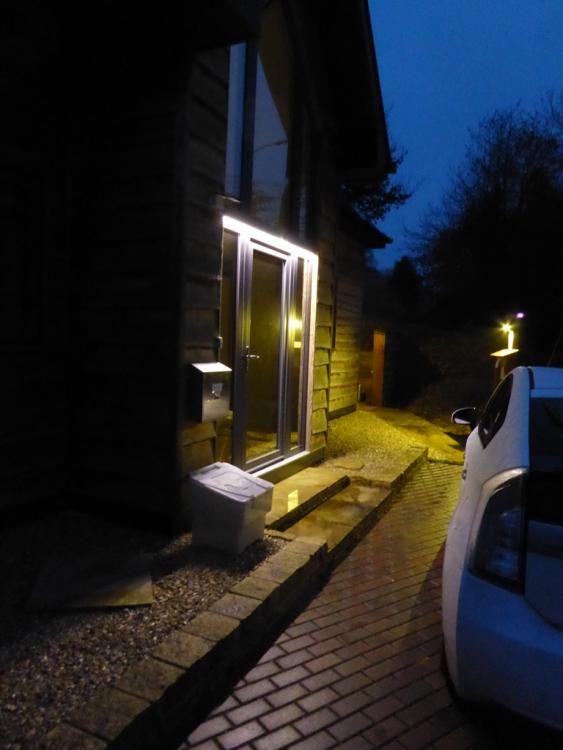
Glad you like it! It was a pure fluke that the high power waterproof LED strip I already had was an EXACT fit into the groove in the alloy cill! The neat thing is that no one ever notices the light until is comes on, plus it sends all the light downwards, so keeps our "Dark Skies" inspectors happy...................... I also like the idea of having exterior lights that have no running cost. There are plans for more solar powered lights around the edge of the drive, as being such a steep slope, and with a tight curve, it's really difficult to tell where the outer edge is when reversing up it. -
Discount Offers of the Week
Jeremy Harris replied to Ferdinand's topic in General Self Build & DIY Discussion
'twas indeed me, but to give credit where credit is due, it was our electrician, Nick Ryan, who tipped me off about them, and I then relayed it on after I bought a stack of them and found them to be a heck of a lot better, and cheaper, than the Bosch blades. -
LED replacements for halogen work lights
Jeremy Harris replied to joe90's topic in General Construction Issues
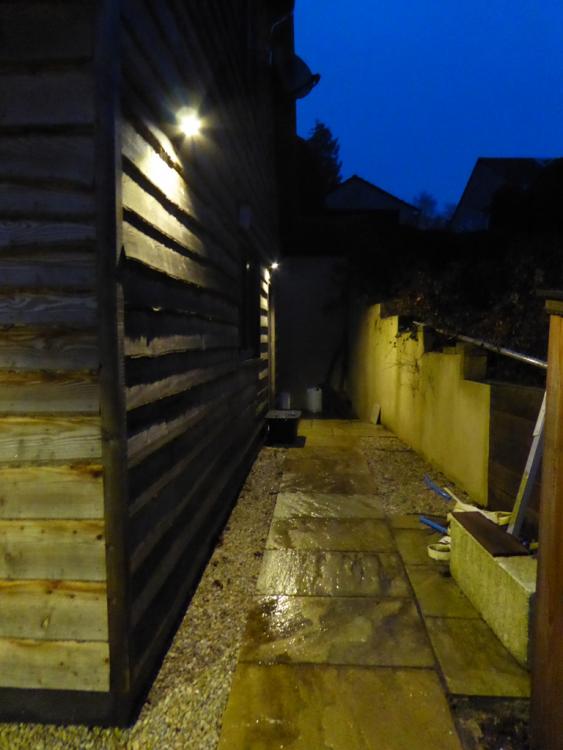
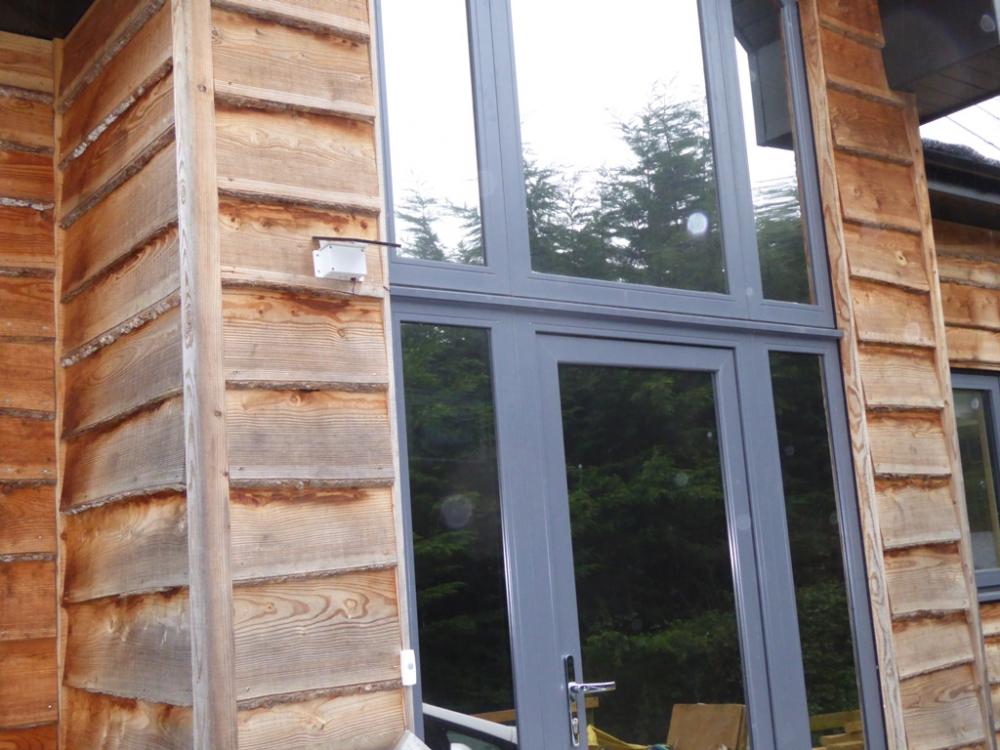
Right, had a chance to take some photos, unfortunately in the rain, so not the best. First off, this is the side of the house, where I have two "10 W" LED floodlights running from a solar-charged 7Ah sealed lead acid battery in the box on the wall: I have one light over the back door and the other pointing more or less at the wheelie bin storage area, The battery box is a bit big and bulky, and I may change it later to a lithium battery, like the one I've more recently fitted at the front, as that seems a bit less conspicuous. This is what the lights look like when on. They point downwards and really just light the path and that junk-filled area at the front right which is where the wheelie bins will go (when the Council get around to sending them............). The spread of light is pretty even, with no real dark spot between the two lights at all at ground level. This is the newer lithium battery powered system at the front of the house, it has the same solar panel as the one at the side, but uses a very much more compact battery, so is less intrusive looking. You can just about make out the LED strip stuck on inside the drip rail groove, on the stacking cill above the front door. And this is what the front lights look like when on, they light up the area aroudn the front door steps well. There is some light coming from the 240V PIR switched "10 W" floodlight I have fitted above my electric car charge point, that lights the path from the end of the drive to the path at the side to the back door, lit by the first set of lights. I could use a 240V LED here as I already had power to the charge point. Hope these give an idea of the sort of light output these things put out.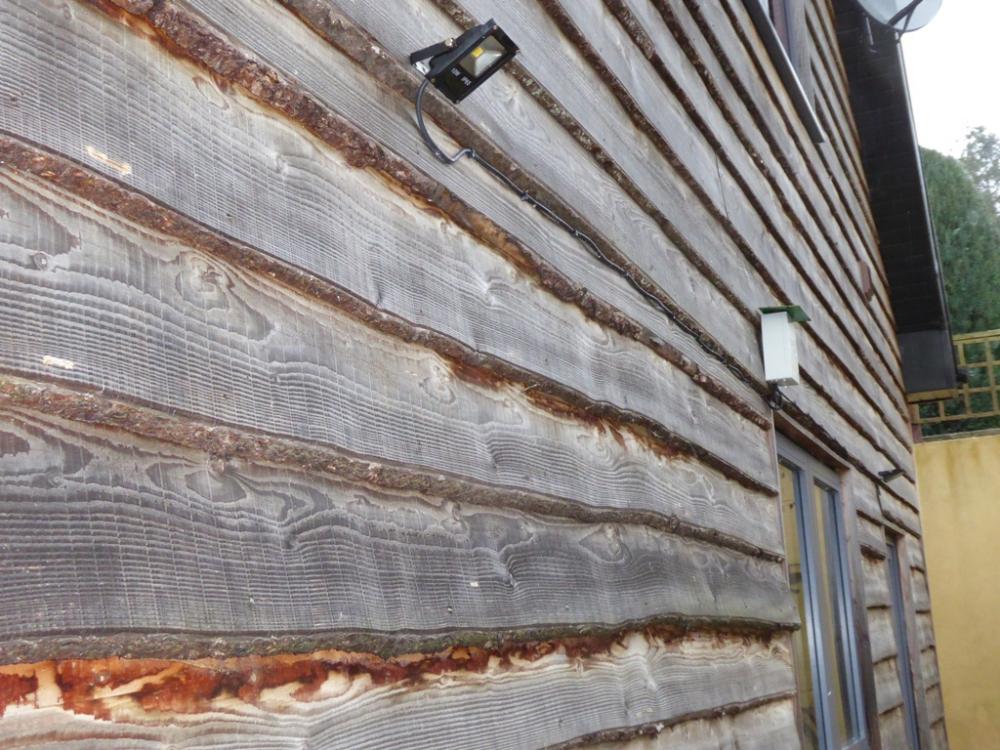

-
Also, don't get it anywhere near bleach! When shock chlorinating our borehole (to kill off anything in there that had got in when I was faffing around cleaning it out etc) I had a problem with the Sodium Hypochlorite granules (the stuff that is dissolved in water to make liquid bleach) raising the pH of the water and so both limiting its solubility and decreasing the release of chlorine, needed to disinfect the well. The standard fix for this is just to add an acid to lower the pH, get the solubility back up to what it should be, and all should be OK. Now, it would have been safer, and far more sensible, to use something like acetic acid (distilled vinegar) or citric acid solution (distilled juice from lemons or other citrus fruits), but all I had to hand was a few litres of brick and mortar cleaner (dilute HCl). So, I measured the pH of the well water, estimated the volume, calculated the molar mass and poured in just enough HCl to get the pH back to around 7. The result was a fairly large release of chlorine gas, to be expected, but on a somewhat larger scale than I'd anticipated. Rather than stand at the well head, with the pump running and me holding a hose to wash the disinfectant down the side of the well liner, I had to just stuff the hose down the well and run for cover. It took around ten minutes or so before the chlorine stopped coming out of the well head, and at one point it was actually visible as a pale green cloud, drifting across the garden.............. It did make sure the well was well disinfected though!
-
Extractor hood
Jeremy Harris replied to Pocster's topic in Mechanical Ventilation with Heat Recovery (MVHR)
No, it won't cause any issues at with the MVHR, as it's not changing the air flow at all. They suck from surface level to remove cooking smells, vapour etc, filter the air then blow it back out into the kitchen, with the smells and vapours etc mostly removed. Most use a mixture of washable filters to trap oil and fat vapour, plus an activated carbon filter to remove most of the smells. The manufacturers would like you to always fit new filters, but on the conventional recirculating hood we have in our old house I found that the two filtration units were easy to clean/rejuvenate. The mesh oil and fat filter cleaned up well by just sticking it in the dishwasher and the activated carbon filter was just carbon granules between two bits of stainless mesh. I found that it was dead easy to take one of the mesh sides off and bought a big bag of activated charcoal granules very cheaply (the stuff is used in pond filters). empting the carbon out and filling the filter with fresh stuff was clean and easy to do, and a fraction of the price of replacing the filters. I still have a bag of activated carbon I bought several years ago, left over. -
Extractor hood
Jeremy Harris replied to Pocster's topic in Mechanical Ventilation with Heat Recovery (MVHR)
Not sure, TBH. They were outside our budget range when we were looking, plus SWMBO had already decided on the induction hob. There's one model that we could have fitted in our island (where the hob is) that sucks down, filters and then blows out at a lower level. Still expensive, I think, and hard to retrofit if you have stone work tops, I should imagine.