


Jeremy Harris
-
Posts
26430 -
Joined
-
Last visited
-
Days Won
360
Everything posted by Jeremy Harris
-
My experience of rented places when I was a student were that landlords were often very creative with using space. A ground floor flat I rented in Harrow was advertised as having a living room, kitchen, bedroom and bathroom (the toilet was shared and accessed from the hallway). A feature that was advertised prominently was that the flat had it's own private entrance. The reality was that a large lean-to shed had been built on the side of the house to form the "living room", with the carpet laid directly on what had been a concrete yard, complete with inspection chamber under the carpet. The "private entrance" was a door in the shed that opened directly on to the pavement. The door from the shed to the kitchen was the old back door of the house. Part of the kitchen had been partially partitioned and the bath was behind the partition. The only thing in the "bathroom" was the bath, that filled the floor space. There was a curtain between the kitchen and the bath, so to step into or out of the bath (about half of the bath's length was in the "doorway") you had to pull the curtain aside and step out of, or into, the kitchen.
-

Some basic plasterboard questions
Jeremy Harris replied to Crofter's topic in Plastering & Rendering
The top of our hall ceiling is around 6m above the floor and the plasterers did a good job of boarding and skimming that OK. I bought a scaffold tower for that job and a few others, and sold it to the plasterers a few weeks later. It was a lot cheaper to buy a tower and sell it for half price a few months later than it was to hire one for the time needed. -
Because the UFH pipes are deep in the slab, the heat will tend to just spread until the whole slab is very close to the same temperature, whether there are pipes there or not. I've found that the floor area under our stairs (which has no UFH pipes) is the close to the same surface temperature as the adjacent hall that does have pipes in. In the kitchen, the boiler for the boiling water tap tends to make the under-plinth area very slightly warmer than the room, and we have bins in the unit next to the sink, so I expect that they will be sitting at around 24 to 25 deg C, not from the UFH, but from the small amount of waste heat coming from the boiler and waste pipe.
-
It really isn't going to heat up, though. UFH in a house like this doesn't even get the floor warm enough to feel as if it's heated when you're walking around in bare feet on it. The highest surface temperature I've seen is around 23 deg C, so only a couple of degrees warmer than the room, and not enough to worry about. Many houses will get to over 23 deg C in summer, anyway. The dishwasher will get massively hotter than this when it's running, and will heat the floor a lot, rather than the other way around.
-
Or a ZeroW and then you only need a power supply. My weapons of choice are PICs, but that's really just because I'm a hardware person, and I've been using microcontrollers for decades, so am comfortable working this way. This does mean I'm not a great help to anyone using a RPi! I'm afraid my whole house data logger uses around 6 PICs, doing various jobs, all talking to a master logger that stores data every 6 minutes to a USB stick, as a series of monthly, dated, .csv files. It does mean I have to physically swap out the USB stick to analyse the data, but I'm happy with doing that. I do display data on a couple of 20 character by 4 line LCDs, one in the hall and one in the services room, plus I have a GPS master clock and display up there that keeps everything in the house working accurately to a UTC reference time.
-
Insulation won't help, I'm afraid, as the temperature will just equalise both sides of it, as the heat loss through the kitchen units will be pretty low. Given that it's unlikely that your floor will get warmer than about 23 to 24 deg C, even in cold weather, I'd not be overly worried about it. 200mm spacing for the pipe is fine, and works very well at the sort of very low heating requirement such a house needs. Bear in mind that the floor will get a lot hotter in summer sun than it ever will from the UFH in winter!
-
Just a gentle warning about I2C; the bus length has to be pretty short. Anything over a metre or two may well get flaky - I speak from experience! SPI has the advantage that you can run it nice and slowly, if you bit-bang it, so it will often work over longer cables OK without drivers, but it does mean writing your own code to bit-bang the interface (not really onerous). Neither I2C nor SPI are as robust over long cables as the one-wire protocol, in my experience. Where I've used either SPI or I2C sensors I've used a remote interface, usually a small 8 pin PIC, to convert either I2C or SPI to low speed serial. Low speed serial at 1200 or even 2400 baud, with just a 5V swing, is surprisingly good. I'm running a bidirectional 2400 baud serial link at 5V from the display, temperature and CO2 sensor in the hall, up to the main data logger in the services room, around 15m of cable, and it works fine, even with no CRC, just a simple handshake. I2C, even at the slow bus speed, just won't work over that distance, which isn't surprising as it was designed for board to board data transfer within one item of equipment.
-
It's not a Carrier, as far as I can tell. It's not made by Baxi, either, I'm pretty sure. As Peter says, it's 10 years old and so isn't worth much, but as it's been stored well there's no real reason why it shouldn't be able to be put into service, after a few checks. The problem seems to be finding an installation and user manual. I've managed to find a parts list, but it's not a lot of help: http://www.ricambiclima.it/public/media/20121161722200.AMBIFLO-90.pdf
-
I suspect that it may be a re-badged Carrier, and is probably quite old, as I think that Baxi only dipped their toes into the heat pump market for a couple of years or so, around 2009/10. If it is really a Carrier, then it's likely that parts and manuals are available, the trick will be trying to find the exact model, and I suspect the only way to do that would be to compare photos. Edited to add: I found this very basic manual: https://www.mytub.co.uk/product_images/baxAmbiflo_brochure_Oct_10_comp.pdf and this list of prices: https://www.mytub.co.uk/baxi-air-source-heat-pumps-products-1
-
Vat reclaim
Jeremy Harris replied to johns's topic in Self Build VAT, Community Infrastructure Levy (CIL), S106 & Tax
My experience was that HMRC accepted a note from the planning officer (my printout of an email) stating that the bike shed requirement had been removed before the plans were approved. That plus a photo showing where the bike shed was supposed to be on the original plans, plus a copy of the as-built plans, satisfied them. The annoying thing was that they sent the whole large pack of receipts etc back, so I had to re-post them all back to them. -
Vat reclaim
Jeremy Harris replied to johns's topic in Self Build VAT, Community Infrastructure Levy (CIL), S106 & Tax
The solar panels aren't very clearly shown on our approved plans, but as the supply and installation were zero rated by the company that fitted them, HMRC weren't involved. I deliberately kept the plans that were submitted for PP as vague as I could reasonably get away with, really just to allow a bit of freedom to change minor details that weren't shown, not realising at the time that HMRC would pore over the approved plans with a fine tooth comb, looking for ways to refuse a claim! -
How to survive a tree falling on cabin
Jeremy Harris replied to Tennentslager's topic in New House & Self Build Design
It looked like a brilliant place to go and get away from it all, I'm a bit envious that there's nothing like that anywhere around here. -
Vat reclaim
Jeremy Harris replied to johns's topic in Self Build VAT, Community Infrastructure Levy (CIL), S106 & Tax
Unfortunately it doesn't, as far as HMRC are concerned. All they are really interested in is getting bits of paper that "prove" to them that everything is in order, and they will try very hard to refuse any and every claim they can if they can find a legitimate reason to do so. In our case I had to get a note from the planning officer saying explicitly that the removal of the bike shed from the approved plans had been agreed, because all we'd had was a verbal confirmation that we were no longer required to build it in order to get the points needed under the, by then defunct, CfSH rules. As soon as HMRC had a copy of the as-built amended plan (which was the one we'd sent out to tender) with the note from the planning officer to say that it was OK, they processed our claim. -
Vat reclaim
Jeremy Harris replied to johns's topic in Self Build VAT, Community Infrastructure Levy (CIL), S106 & Tax
Seems odd, but may well just be something picked up in their initial paperwork scan. Our reclaim was rejected initially, because our approved plans show a bike store on the side of the garage. It was only put on the plans because it was required in order to meet the Code for Sustainable Homes target, and that regulation was withdrawn between the time we submitted the plans and the date they were approved. We never built the bike store, and HMRC refused to validate the claim until I provided photographic evidence, together with a note from the planning officer, that all was OK. Once I did that, HMRC validated the claim and started processing it. -
What happens after Planning Submission?
Jeremy Harris replied to Gimp's topic in Planning Permission
I picked up quite a bit about the planning process when we were plot hunting, a process that took several years. One thing that stood out was that some planning consultants have a very much higher success rate than others, that was apparent by just reading the planning lists for the local authorities in our search area every week. Two examples that spring to mind, the second being our own plot: In the next village up the valley from where we live there is a pretty classic infill plot, part of the very large garden to a bungalow built in the 1970's, with a (now disused) track running through it from the lane to what used to be a chicken farm. The track belongs to the bungalow, but is now part of what is just a very overgrown area, covered in brambles. The owner of the bungalow (a local farmer) applied for planning permission to build two, four bedroom "executive homes" on this land. Given that the land is inside a conservation area and dead opposite a Grade I listed church, this plan was clearly doomed, and it was rejected because of the scale of the development and because the design would have had a negative impact on the setting of the listed building. A second application was submitted for a single 5 bedroom "executive home", and, surprise, surprise, that was also rejected for the same reasons. At this point I decided to approach the landowner, asking if he'd consider selling the land to us, dependent on me getting PP. He was a bit blunt, and asked what made me think I could get PP when his "expert" hadn't been able to? Despite this I went and saw the planning officer (this was back in the days when you could do this) and asked if there was a problem with the principle of development of this land. He said that there wasn't, and that the only reasons for refusal were to do with the design and scale of the proposals being out of keeping with the surrounding houses, and, in particular, the listed building. I sketched a proposal out, sent it to the planning officer and he said that he would almost certainly support it. I went back to the land owner, gave him the news, and he told me to bugger off. The land is still undeveloped now, some 8 years later. The moral of this tale is that a competent planning consultant could have definitely gained PP for this plot, I believe, but that the rather incompetent firm that the land owner had used just hadn't read the reasons for refusal, and spotted that there was no objection in principle to developing the plot. Our own plot had a very chequered planning history; it took the original owner 4 years and three applications to get outline approval, for much the same reason as described in the story above. When PP was eventually granted it was with some pretty onerous conditions. The odd thing is that when we bought it, and set about looking to see how we could get PP for the house we wanted, which was radically different from the outline proposal, we had no objections from anyone, and the decision went through without even going to committee. I'm convinced that most of the reason for this is because I made a scale model of the site, which clearly showed that the house was going to be set down ~2.5m into the hillside, so would be far less prominent that local residents had thought. I'm convinced that a lot of people struggle to read plans and visualise how something will look, and assume the worst. -
How to survive a tree falling on cabin
Jeremy Harris replied to Tennentslager's topic in New House & Self Build Design
Out of interest, was that your hutting community on Countryfile last night? I kept looking to see if I could spot your hut anywhere! -
Good point, now you mention it the multipoint in my old flat had a pilot light, not electric ignition.
-
Not legal now, but it wasn't uncommon to find arrangements like this years ago. I rented a very small flat in Shepherds Bush in the early 70's that had a multipoint fitted in exactly the same place.
-
@Ferdinand, I'm not sure where in the regs the sampling regime is specified, I didn't realise that this was how things worked until I found out from a building inspector (and LABC one, who was very good, in my view). His comment to me was that on big developments one house of each type would be subject to an inspection, by the house builders own inspector, and I think he mentioned a figure of up to twenty houses could be included in the "inspect one and assume the rest are the same" rule. I'm sure it's buried in the regulations somewhere. I've related my very negative experience with trying to make a claim from NHBC before, so won't repeat it, but I do not think that NHBC adds any real value, they just tick a box for lenders. Lenders aren't really at risk, because the risk is almost entirely laid off to the homeowners insurer, with the lender usually insisting that there be adequate buildings insurance cover. What we have is a system that can be, and definitely is, gamed by the big builders, yet which is applied rigorously to small builders and self-builders.
-
MBC timber frame and cedar cladding closing the gap
Jeremy Harris replied to lizzie's topic in General Joinery
Just found a photo that shows our larch cladding with the black uPVC over the EPS, for the ~150mm or so below the DPM level: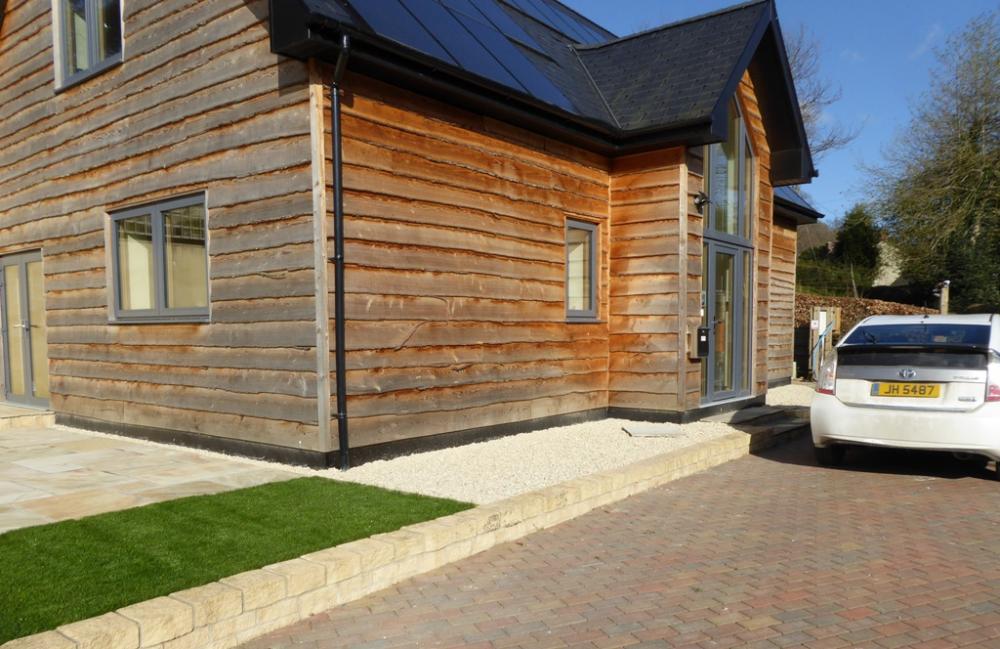
-
Bowed walls and cracked tiles
Jeremy Harris replied to jack's topic in Bathrooms, Ensuites & Wetrooms
I can fully appreciate the challenges of finding people that you can trust to do a job that meets your own standards; we had a couple of people that were bloody awful, and I did find it difficult to just tell them that I wanted them off site and didn't want them back. From talking to others locally, I think we were just very, very lucky. After having been let down by three brickies, in desperation I rang around everyone local I could find and came across one guy who was a real perfectionist. So much so that he carefully pointed up a block wall that we were going to render, and when I said that he didn't really need to bother with how that wall looked, his reply was that he couldn't go home, knowing that the wall didn't look spot on, out of pride in his own workmanship. He recommended a chap to do the rendering, saying he was the only person he would trust to do a good job, and he was spot on, so not only did we get that chap to render the big walls around the house but we also got him to board and plaster skim the whole house, and he was damned good. In turn, the plasterer recommended a tiler and decorator, and he was another perfectionist (I reckon he would probably be a good match for Nick, in terms of his attention to detail). The tiler, in turn recommended the landscaping guy, who was so good that we've had him back about three times now to do more work around the place. So, for all of the "finish-critical" stuff that I wasn't doing myself we used people that had, indirectly, been found as a result of employing that first-class brickie. I'm near-certain that this is the best way to find good people, as anyone who is good and takes pride in their work will not recommend anyone that has lower standards than their own. The challenge is getting into that network of good people! -
The deregulation of building inspection brought about a massive relaxation of inspection requirements for big builders. So it's a problem that's been around for many years now. It's getting more attention now because, I think, there's been a shortage of skilled workers available, following the big downturn in new building a few years ago. The big builders are now just using the fact that the majority of their new houses will never be inspected as a cover for poor workmanship, and I'm not convinced that it's wholly as a result of pressure to drive down cost, I think a lot of it is because they just don't care. The regulations at the moment only require a small sample of a particular design on a new development to be inspected, with the majority of houses of the same design not even being glanced at by an inspector. Also, the builder can select which sample houses will be subject to inspection..................
-
Any one else have problems with Jewsons?
Jeremy Harris replied to Leaway's topic in Building Materials
I get the feeling that there is a great deal of variability from one branch to another, depending a lot on the local branch manager's attitude. Locally I can choose between several of the big names, all on the same industrial estate, plus one independent. The distance between any of these BMs is less than 1/2 mile, so you'd think they would compete with each other, both on price and service. The reality here is that all the big names are generally poor with both price and service, but the independent is great, will try and price match online prices and, best of all, they employ drivers who take the time to drop stuff exactly where you want it on site, with a smile. The independent has had the lions share of our business, not just because they are good value but because they provide a better service. FWIW, I have to add that Screwfix here are pretty good, and certainly easy to use, as their click-and-collect service makes it easy to order stuff when you find you need it and pick it up on the way home or way in. My experience with Toolstation hasn't been as good, so despite the fact that I almost drive past their place every day, I rarely use them. The main issue I've had is poor quality and messed up orders, rather than service. -
I agree that consumer laws should be improved when it comes to houses, but that's really only going to sort the defects that are either immediately obvious, or that become obvious within a reasonable warranty period. My concern is that we have a pretty comprehensive set of building regulations, yet they are ignored by the majority of new house builders. Even my own building inspector agreed with me, and reckoned that around 60% of all new houses were not compliant with building regs. Frankly this is a ludicrous situation. New cars are 100% inspected, not because the law demands it, but because the manufacturers know that quality is key to their reputation and so directly impacts their sales. For around 5 years I managed a small fleet of aircraft, and for a year or so was responsible for the whole of the Lynx helo fleet (around 300 A/C at that time). Inspections were part and parcel of life, with everything being independently inspected and checked, often several times, by different people. Self-builders are 100% inspected and checked, yet we only make up a tiny part of the UK house building market and we're the sector with a vested interest in making sure our homes are well-built. It's barking mad to have a system where the lowest risk of non-compliance sector is 100% inspected and the highest risk of non-compliance sector is barely 10% inspected.
-
In terms of regulations, then an ELV/SELV light doesn't need to be protected. All that matters is whether the light will have a reasonable service life. IP20 is only protection from things the size of your finger getting in, so when tucked under a soffit I'd suspect that spiders and the like are more likely to cause problems than moisture. Our incoming 'phone connection has a junction box under the soffit that's certainly not water proof, but does have a tight enough fitting lid and cable entries to keep spiders out. A bit of sealant to keep bugs out would be fine. Where's the power supply going to go? The IP65/66 ones I've used in a couple of locations have a fairly short mains lead, so the connection has to either be made inside the house (in a suitable environment) or they need a cable joint that offers the same degree of protection. The ELV LED panel lights I used in our kitchen and hall would almost certainly be fine under a soffit, I think, as although they only have an IP20 rating it's clear that they are better than that, as they look pretty dust proof to me. I suspect that rating them at IP20 is just an easy way of avoiding an expensive set of environmental approval testing, as IP20 only requires a quick visual check.

