Jeremy Harris
-
Posts
26430 -
Joined
-
Last visited
-
Days Won
360
Everything posted by Jeremy Harris
-
I can confirm that, beyond any doubt, the definition of "business", in law, is exactly as Peter has described. Having read through the SIs (both CDM2007 and CDM2015) several times in the past week or so, my main observation is that CDM2015 is not very well worded. It was clearly written without adequate thought being given to how it might impact on a domestic self-build client, but the conclusion I reached was the same as Peter's. It is the reason I've been making the point that this particular legislation does not place an additional burden on the majority of self-builders, and even for those self-builders that are required to take on a role under CDM2015 (those that do their own design, for example) the responsibilities are no more onerous than applied before CDM2015 came along - in essence the liability remains the same.
-
An excellent analysis and summary, Peter, and one that strengthens my view that there is a significant amount of scaremongering going on, to try and intimidate people into believing they have to spend more money with "experts" in order to build their own home. I can't find a single prosecution brought against a self-builder, and that, to me, indicates that what we have here is a solution that's trying to create a problem, in order for someone to profit from it.
-

Do you ever ask yourself?
Jeremy Harris replied to Triassic's topic in General Self Build & DIY Discussion
Pretty much mirrors my experience, with the sole exception of the hot water system, where I just didn't foresee the problem created by the higher than anticipated heat losses. The one thing I'm really thankful for is the problem I had initially in trying to find an architect. That experience, albeit indirectly, pretty much forced me to spend about a year learning about house design and building regulations. I didn't really intend to get quite so involved, but once I'd got a design that worked, in terms of internal spaces and performance, and more importantly, met with approval from SWMBO, I felt competent enough to tackle other things that I'd originally intended to outsource. In the end, it became a bit of an intellectual challenge to see just how much I could do, without using any paid "expert" help. I have to say that I would never have had the confidence to take on all this additional work if it wasn't for the help gleaned from everyone here, directly and indirectly, and including all those on this forum's predecessor. Much of that help didn't come from questions I asked, but from reading the replies to the questions of others, and I'm extremely grateful for all this help. I'm certain I wouldn't have been able to tackle anywhere near as much myself without all this help and support, both practical and emotional. -
But this is a self-build forum!!! Everything here relates to non-commercial, non-business, construction, this forum is a not-for-profit, no advertising or commercial promotion allowed, self-build forum. No one would argue against there being many prosecutions for poor practice in the commercial sector, after all, it's the very thing that created all the legislation! The point I was making and which has been snowstormed by the above completely inapplicable quote relates to self-builders, and I did make that very clear. How about listing all the HSE prosecutions against self-build clients, as that is all that matters here?
-
I'm a bit surprised at the £3k for battens and counterbattens. What sort of area is the roof? The last lot of 50 x 25 roofing battens I bought were about 40p/m +VAT, IIRC.
-
Best check the space available in the bathroom after taking away the door swept area. The required spaces are here: https://www.gov.uk/government/uploads/system/uploads/attachment_data/file/506503/BR_PDF_AD_M1_2015_with_2016_amendments_V3.pdf Note that the regs also normally require an outward opening door.
-
Not sure about the "nib". The bathroom door is possibly to meet the requirements of Part M, specifically wheelchair access from the entrance level to the WC on that level. Our downstairs WC has an outward opening door for the same reason, as it avoids having to make the space larger to accommodate the requirement to be able to get a wheelchair in and close the door.
-
A few questions including the obligatory plastic vs copper
Jeremy Harris replied to Crofter's topic in General Plumbing
Normally you have the PRedV on the incoming cold supply, so that both the hot and cold supplies run at the same pressure. Doing it this way makes life easier for things like mixer taps and thermostatic shower mixer valves. -
They don't. Once a condition has been applied and published in a Planning Decision Notice then it is fixed, and cannot be changed without the agreement of both the applicant and the planning officer.
-
To better put all this in perspective, it's worth looking at the process of evolution that has resulted in the latest incarnation of CDM. CDM came about long before the EU invented the Construction Sites Directive that led to CDM2007, and goes back much further, to a previous EU creation, the Temporary or Mobile Construction Sites Directive. CDM1994 arose out of that, and has been around since 1995; the big construction project I mentioned was still working to this, plus the C(HS&W) regs. CDM2015 isn't, as such, wholly new regulation, it's an evolutionary change to regulations that have been in place for over 20 years. What has changed with each evolution of this particular regulatory change is that the scope has broadened. Arguably the step change from CDM2007 to CDM 2015 is, perhaps, greater than that from the change from CDM1994 to CDM2007, in terms of this breadth of application. One could read CDM2015 and draw the conclusion that it is extremely onerous and places a substantial additional cost burden on clients, which it does, without question. However, it needs to be read within the context of the general application of health, safety, welfare and environment legislation in general, more specifically the number of additional prosecutions that might arise, as they are a reasonable measure of effectiveness. Clients have always held responsibility for the systematic application of H&S, since long before CDM2015. This was recognised in the past and one of the roles of the now defunct Project Coordinator was to inform and help the client to understand their responsibilities. A problem arises in terms of definitions; under what circumstances does a "domestic client" become a "client"? CDM2015 is not absolutely clear, but it does have some guidance as to what might be reasonable, and, as with all law, reasonable is not mentioned and is therefore undefined; it's the "Man on the Clapham omnibus" test. What we do know is that the HSE rarely pursues a criminal case against the client, and never has against a domestic client, as far as I know. If a self-builder uses (that sometimes rare commodity) common sense, and can show that he/she has acted reasonably in considering how HSW&E risks can be mitigated, then there is a near-zero probability of them being prosecuted. The very fact that there are very few construction-related notifiable accidents on self-builds indicates that self-build is probably a safer environment than general construction. My own view is that I suspect the biggest problems are in the medium sized construction sector, small to medium sized projects, undertaken by companies of a modest size that don't have a strong safety culture. Both self-builders and the very large construction companies probably think about, and manage, H&S more than most. I should add that CDM2015 was not in force for our build, so I worked under CDM2007. I also chose to ignore the exemption for domestic clients under that regulation, and treated the management of HSW&E as if I were the client, coordinator and designer. At no time did even I see that I could possibly be the principal contractor, as I clearly didn't have the expertise or degree of control over day to day activity, plus the main contractors I employed all made it clear that they were the principal contractor for the duration of their work. There was never a clash, because, like a lot of self-builds, we never had more than one main contractor working at any one time, so the responsibilities were sequential. It has been said that if a self-builder was to follow the letter of CDM2015, making no allowance for common sense, and not putting these regulations into the context of the wider regulatory framework, then it is probable that their overall project cost would increase by between 10% and 20%. For many, this would make a project non-viable; I know it would have for us, as we only just scraped in with a cost slightly lower than the market value as it was. 10% more and the house would have cost more than it was worth and we'd not have built it.
-
It's mainly panel performance. The one disadvantage with in-roof PV panels is that they can run a lot hotter than on-roof panels, unless there is really good ventilation behind them to take away the heat. Panel performance falls off dramatically as they heat up, and even on-roof system performance will dip a fair bit on a hot day, with the panels reaching around 40 to 50 deg C or more. Getting the best ventilation you can behind the panels reduces the performance penalty from having them mounted in-roof. When I measured the surface temperature of our panels and compared it with the measured surface temperature of a neighbours on-roof panels I found that our were only about 5 deg or so hotter, which suggests that the ventilation does help.
-
A few questions including the obligatory plastic vs copper
Jeremy Harris replied to Crofter's topic in General Plumbing
That sums up my feelings, too, as before this build I was very against the idea of using plastic. Part of that was the stories I'd heard of failing push-fit fittings, but I'm sure that many of these were a consequence of the fitting not being correctly installed. The main problem with push-fit is that it seems too easy, when the reality is that the depth to which the pipe has gone into the fitting has to be physically checked, to make sure it is fully home. I found that relying on "feel" wasn't good enough, and that it was essential to put a Sharpie mark on the outside of the pipe at the correct insertion depth. This depth was the same for all the fittings I used, so I made up a tool (a bit of bent aluminium) that could be put on the end of a cut pipe and used as a guide to mark the insertion depth. From then on it was very quick and easy to check that fittings were properly installed, and I had no leaks at all from any of them. The only slight leaks I had were from a couple of compression joints, both a consequence of them being in a very restricted area, where access was poor. -
A few questions including the obligatory plastic vs copper
Jeremy Harris replied to Crofter's topic in General Plumbing
Mice would find it pretty hard to get into an airtight and pressure tested house, I think. About the biggest air leaks we had were through five keyholes. It depends a great deal on where pipes run, though, and if I had pipes running through an area outside the sealed and insulated envelope, where the little blighters could possibly gain access, then I think I'd avoid using plastic pipe there too. The problem then seems to be that the little blighters will just chew through all the pipe insulation................. -
If someone can point me to the specific clause in CDM2015 that creates an additional responsibility for a self-builder over and above the requirements of CDM2007 then I would like to see it. As far as I can see nothing has changed for self-builders. What has changed for those commissioning construction works (but not domestic clients) is the change from having to have a CDM Coordinator to other, better defined roles, plus the client (specifically not a domestic client) now being accountable (which does not necessarily mean being fully responsible) for HS&W during the project. This does not in any way remove the long-standing responsibilities that other individuals have for HS&W. Frankly, the level of misinformation about CDM2015 is worrying, particularly some of the scaremongering that seems to be going on. I strongly suspect that those who've jumped on this latest "consultancy gravy train" are probably helping to muddy the waters a bit. The bottom line is that the criminal law with regard to liability in the event of an accident has not changed, and that it is extremely unlikely that a self-builder would be considered to be anything other than a "domestic client". I've seen enough accident and incident evidence, and seen the outcome of enough liability cases, to have a pretty good feel for the way the law works in reality, particularly with regard to the degree of responsibility that may be applied when determining culpability. Sadly, the best way to avoid being held overly responsible may well be to avoid any form of formal training. I wish this were not the case, but the fact is that people who can be shown to have undertaken formal training in a particular subject are assumed by the courts to bear a greater degree of responsibility for any incident related to that subject than those that have not.
-
This sounds very much as if the Conservation Officer (CO) is pulling the strings. CO's are a bit notorious for not having a balanced view, and being pretty much against any form of new development, so I'm not at all sure that their view can be considered to carry significant weight, in terms of the validity of the condition. It might be an idea to collate information on where the evidence of Roman occupation is, as precisely as you can. If you can show that the adjacent site, without this condition, is closer to the known evidence of Roman occupation, then I think it would be worth appealing the condition. The advantage of an appeal is that it is considered on the hard facts that are presented, so the decision may be less likely to be swayed by personal opinions.
-
Sorry, but I strongly disagree that self-builders fall into any sort of trap. The law is clear, and has been for decades, and CDM2015 hasn't changed anything from CDM2007, as far as self-build is concerned. I gave examples earlier of the way we contracted for our build. This was before CDM2015, and so under CDM2007, but nothing has changed at all in respect of our responsibilities. Take the very first parts of our build as an example. A structural engineer designed and specified the major part of the ground works. He took full responsibility for that design. The ground works contractor had a firm price contract that included the breakdown of responsibilities, and he took full responsibility for the site, at his own request (as he had heavy equipment on site). I was most certainly not competent to "control the way construction work was carried out", and nor did I wish to be. I could only go on site with the contractors permission, in fact, because he controlled it. The contractor worked to the design and specifications that the structural engineer had produced, and I had no control over that, either. Had there been an accident during that phase there is no way whatsoever that I would have carried any liability. Once the ground works were completed, the site was handed to another contractor to drill the water borehole. Again, that contractor had full responsibility for the site and there is no way that I could be deemed to be in control of what they were doing. Apart from anything else, the responsibilities were clearly defined in the contract, as a part of the contractors standard terms and conditions. Once that work was completed, I again passed control to the next contractor on site, to build the foundations and supply and erect the house, again with a written contract that was clear as to where responsibilities lie. Once more I could not have been deemed to be "in control" at all, I was very definitely a domestic client. The same applies to the follow-on trades, they all controlled and managed their own work, working to a specification that they had agreed in writing. At no time did I ever "control the way construction work was carried out" once a contract had been placed. I certainly did bear responsibility for all the work I did on my own, but that comes within the definition of DIY and is well outside the scope of CDM. I'm not in any way knocking CDM, for the building industry it is a key way to ensure that work is controlled and managed safely. I in my last job before I retired I managed a programme that included a £96M construction project, and the main contractor (SRM) had a very well-structured safety management system, with rigorous control of all work and access on site. What I am saying is that self-builders seem to be being misinformed, perhaps by people trying to sell their services, as to what does and does not apply to them. The key point is that CDM2015 has not changed anything material for self-builders; things remain as they have been under CDM2007, despite all the stories circulating to the contrary.
-
Having been thinking about it, I think the answer is probably to get a cheap'ish window cleaning pole and just give the panels a clean once a year. It's taken about three years for them to get to this state, so an annual clean is probably enough. If cleaning them gets back the ~10% output that I think we've lost, then the pole would pay for itself in the first year.
-
A few questions including the obligatory plastic vs copper
Jeremy Harris replied to Crofter's topic in General Plumbing
No need for any form of converter fitting I found. The push-fit connectors work as well on copper as they do on plastic pipe of the same diameter, and as long as they are assembled correctly seem to be very reliable. -
As long as a self-builder remains a "domestic client" they cannot normally be prosecuted, as they would not, in law, be judged competent to over see the work of contractors. The moment a self-builder tries to directly "control the way construction work is carried out" they are making themselves liable to be considered to be the "responsible person", with an enhanced duty of care as a consequence. I would very strongly advise any self-builder to avoid getting into this invidious position. I've had the misfortune to be a witness in a double manslaughter case where a volunteer elected to be trained to provide a service, without reward, and then found themselves charged with manslaughter. It was not at all pleasant. If self-builders always contract on the basis that they are a domestic client, and refuse to have anything whatsoever to do with CDM, making it clear to those they contract to do work that the contractor is responsible for managing their own safety, then they are, in law, pretty much guaranteeing that they have no enhanced duty of care. For example, it is exceptionally risky for any self-builder to decide to get training that could cause a court to decide that they had a level of competency above that expected from a normal domestic client. By doing this, they could, perhaps unwittingly, place themselves in the firing line. This isn't at all new, it's been the case for as long as I can remember, and pre-dates even the original 1974 H&S@W act.
-
A few questions including the obligatory plastic vs copper
Jeremy Harris replied to Crofter's topic in General Plumbing
I chose to use plastic solely because it meant having no fittings at all inside the service void. I brought the plastic out through the plasterboard, almost always behind a cabinet, and then converted to copper for the connections to taps etc. I didn't like the idea of having pipe joints inside a closed space, that would be difficult to access later. With a 25mm deep service void I think the only thing to watch might be the depth of the pipe clamps. I used the ones with the flip over top catch, that latches down tight, but they might be a tight squeeze in a 25mm deep void. I don't have one to hand to measure, unfortunately, as I had a big clear out earlier this week and binned loads of boxes of stuff left over from the build. -
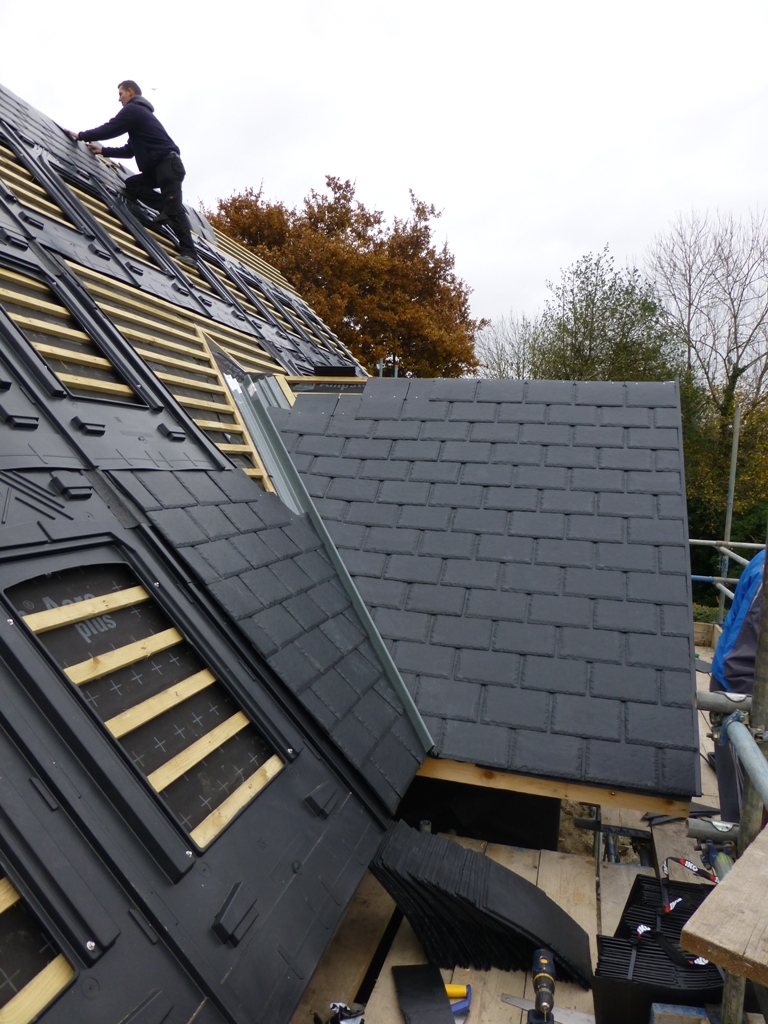
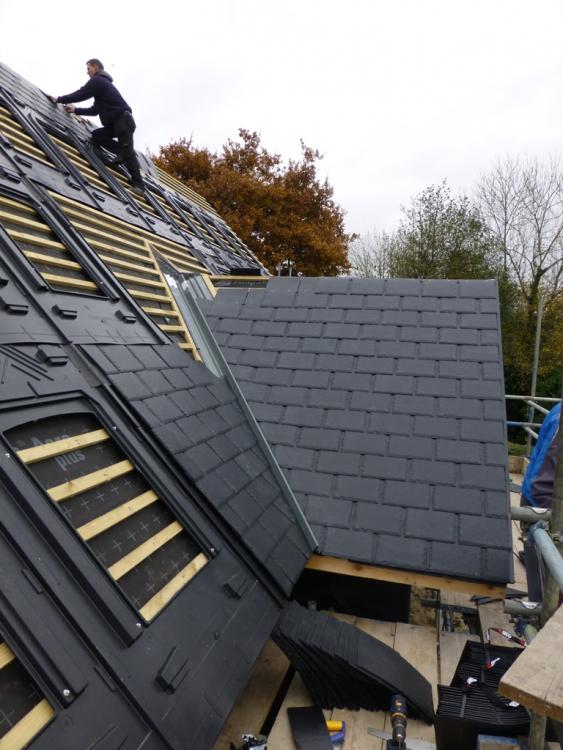
I looked at this carefully, and there is definitely an advantage in ventilating under the panels. We have 18mm OSB sarking, counter battens, membrane, then battens, then the GSE in-roof system (near-identical to the Easy Roof system) fitted to the battens. This arrangement allows a good airflow up under the panels to the ventilated ridge. Our roof is also "slate":
-
I agree. The one issue I had, time and time again, was people altering the scaffolding. This is forbidden, as it is the scaffolder's responsibility to erect and check that a scaffold is safe, and they certify it as such. I think I had the scaffolders back on site three or four times to put the scaffolding back as it should have been and make it safe. Given that working on unsafe scaffolding is a well-known significant risk, I'm surprised that few seem to worry about "just moving a few poles or planks". These alterations to a bit of key safety equipment weren't my responsibility, as in each case the contractor concerned was supervising their own work, as agreed in the contract. The worst offenders, by far, were a company I employed to erect a short fence on top of the retaining wall. Their quote included them providing, and being responsible for, their own access equipment, yet when I reviewed the security camera footage it was clear that they had partially disassembled the scaffolding and re-built it to give them better access to the wall. What was worse was that I found half a dozen "spare" scaffold clamps on site, where the original scaffolding hadn't been properly reassembled. Thankfully the scaffolders took this in their stride, as if it were something they saw every day, and quickly came back to put things right before the next set of contractors arrived on site.
-
Thank you @Triassic, that's exactly the point I've been trying to make. Nothing has changed as far as the majority of self-builders are concerned. What disappoints me is that this new version of CDM is being "marketed" to self-builders by some consultants, and some are being asked to pay for something they don't need to worry about, as long as they use common sense. Not many self-builders "control the way construction work is carried out", in fact I think it's probably a tiny percentage. We were pretty hands-on, but not once did I actually control the way any contractor worked, if anything, contractors controlled the way I worked, on occasion.
-
That's not the case, as stated clearly in the excerpt already quoted. If I contract with someone to undertake a part of our build, then they are, in law, the "responsible person". They have the expertise and understanding that makes them a competent person in terms of their duty of care to their client. A domestic client, can not, and is not, expected to have expertise in any particular trade, let alone all of them. A case against a domestic client would never get as far as court.
-
Nothing has changed in terms of HS&E law, or the way it is applied in the event of an accident. Someone doing work, such that they are, in law, a competent person, has always carried the additional duty of care when it comes to responsibility for HS&E. The law doesn't make someone responsible for the actions of another, over which they have no control. All that CDM has done, as far as domestic clients/self-builders are concerned is to create confusion, in my humble opinion, as it was intended to clarify responsibilities in commercial projects. There have been cases in commercial projects where finding the responsible person (in HS&E terms) has been difficult, because of the somewhat lax way that many sub-contractors have been employed in the past. For years now I've done occasional work as an expert witness, 99% of it being on behalf of insurers, usually because they are seeking to find a way to reduce their liability following an accident. I've never, ever, seen a case where someone who doesn't have control over an activity has been found liable. I've often seen cases where people have tried to claim they didn't have responsibility, whereas in reality they did. As far as self-builders are concerned, then they, as domestic clients in CDM-speak, cannot be expected to have the expertise to manage contractors, in terms of taking responsibility for their actions.