Jeremy Harris
-
Posts
26430 -
Joined
-
Last visited
-
Days Won
360
Everything posted by Jeremy Harris
-
Part of the reason I bought this was to keep it for the time when our vaulted ceilings need re-painting. The ceiling in the hall is over 6m up, right to the ridge, and the bedrooms are room-in-roof with ceilings that go right up to the ridge as well, so almost 4m high. Hopefully, spraying will be quicker and easier when the time comes to redecorate, especially if I buy the optional extension spray nozzle, that works a bit like a pole on a roller.
-
Thanks, Russell. Luckily I don't have a lot of masking, as I've held off fitting out the garage, so the only masking will be around the doors, the cable inlet box, earth rod box, consumer unit and a single metalclad socket (I'll just take this off the wall I think). We do seem to be lagging well behind other countries with stuff like this. I spent a good couple of hours searching YouTube and every single video I found about this kit was American.
-
Thanks very much indeed for the tips, much appreciated. I've watched a YouTube video where the guy (American) went through the cleaning and re-lubricating stuff, but hadn't realised that you could just reverse the nozzle to blow it out. I've just had a look and it seems the nozzle works like a key, and can be just turned through 180 deg, very handy. Painting the garage in an hour sounds like magic!
-
Not sure whether you can use this thing for spraying high gloss finishes or not. There's mention in the manual about using a "finishing nozzle" for fine finishes, but I've not heard of anyone using one of these for painting something like two pack. Both the cars I've built, and a couple of home built aircraft, were sprayed with my ancient DeVilbiss, that must be 40 years old by now. I'm comfortable using that, but this airless system is very different, especially as there are all sorts of dire warnings about not pointing the gun at skin, as it will blast paint into your bloodstream.......... It's the first gun I've seen that has a safety catch on the trigger, to prevent it being operated by accident.
-
Thanks, that supports everything I've read so far. This method seems very popular in the US, perhaps because American homes tend to be pretty big. The model I've acquired is a Spraytech, not sure of the model number, but it has an 800 W pump unit, with a gun that looks near-identical to the Graco.
-
It doesn't pressurise the paint can, the can sits with the lid off and two hoses going in to it, a pickup hose with a filter, plus a return hose that's used to prime the pump. The pump is a very high pressure unit, 250 bar maximum, or around 3600 psi, very like a low volume pressure washer pump. The hose to the gun is a high pressure hose that only contains paint. The gun is a pretty simple looking affair, with just a replaceable nozzle to vary the maximum paint delivery rate. The pump has a pressure adjustment that sets the amount of pressure at the gun.
-
Lots of good reasons why using a brick or block outer skin is problematic with a timber frame. The foundation detailing needed to ensure there's no thermal bridging isn't that easy, and adds cost. A block or brick outer skin consumes a lot of labour cost, probably around double that of a render board skin. Render board is well-proven and has been used for a long time in other countries, with no problems, as long as it's properly fitted. Finally, it increases the wall thickness by a lot, for no benefit at all in terms of performance or longevity.
-
Sounds like making a rod for your own back to me. It's dead easy to fix ties to the outside of the structural frame, as you build up the outer skin, so you get them in the right place. It's also dead easy to fit the cavity insulation as you build up the outer skin. I can't see any reason at all why you should try and do things the wrong way around.
-
Firstly, building it ass about face will mean you won't be able to fix the ties to the frame, as they are fixed from the outside. Secondly, an unsupported single leaf will be more liable to fall over under wind loading, when it gets above about a metre and a half high, unless it's propped. Finally, how are you going to fit the cavity insulation if you build it backwards?
-
By a stroke of good fortune, I've just acquired a nearly new very high pressure airless paint spraying rig, complete with gun, pump, hoses etc. According to the (rather basic) instructions, it looks to be fairly easy to use, but I've zero experience with this sort of spray kit; all I've used in the past is conventional spray guns and HVLP. I've had a look around YouTube, and there seem to be loads of American videos on spraying house interiors, but all the ones I've seen are a bit thin on detail. It seems that this method of painting is common in the US, but not used as much here. I want to use this to paint the inside of our garage with white emulsion, as it looks as if using a high pressure (as in around 200 to 250 bar) sprayer is a very quick way of covering a fairly large area. Has anyone here used one of these things, and if so, are there any words of wisdom that could be shared?
-
As above, the structural timber frame MUST be erected first, and almost certainly signed off as being in accordance with the SE's design by BC. Then you can start building the outer leaf, which is non-structural and only there to keep the rain off. The outer masonry leaf MUST be tied to the inner structural frame, at the approved tie spacing. Failure to do this will result in a failure similar to that which closed schools built in Scotland under a PFI, where the ties weren't adequate and the walls fell down in a wind. What's building control got to say? They presumably have the SE's design calcs and drawings, in order to have signed it off against Part A, so all you need to do is follow the SE's instructions and you should be fine.
-
As above, our 25mm2 SWA feed from the meter box to the house is run in blue duct, simply because I didn't have any black duct left over. Our DNO (SSE) specified that the duct from the meter to the pole, and the bit under the road, should be 100mm diameter black duct. No idea why they wanted 100mm, as the cable would have easily fitted in a 50mm duct.
-
Funny thing, but around 20 years ago I made a robotic lawnmower. Not very sophisticated, and very slow, but it worked OK. Mine was small, with very little intelligence, just a small microcontroller driving the wheel motors and cutter and controlling the solar charge system. That used a wire antenna that was hooked up around the edge of the lawn in a loop, with a modulated 50kHz signal on it. There was a receiver in the mower that detected the wire and caused the mower to back away and turn if it encountered it, the same avoidance action was triggered by buffer switches mounted around the outside of the thing, so it could avoid obstacles. It was a very low power mower, and ran (slowly) all the time, in a random pattern over the lawn. It only had a Stanley knife blade as the cutter, and relied on the fact that the grass would never get very high between passes, as it would cover the whole lawn about once every two days. If the battery got below a certain level the thing would just stop, and let the solar panel on top charge the battery back up, then it would set off again. It worked OK, but did tend to need a fair bit of maintenance.
-
 Our build started in October, with the base and foundation going down from Monday to Thursday in the first week. The slab was allowed to cure for a few days, and the following Tuesday the house arrived on a truck, at around 08:30. By mid-afternoon of that Tuesday the house looked like this: By midday on Saturday the house was weatherproof, with the roof membrane and tile battens fitted. From starting the foundations to getting to a weatherproof shell took 12 days, with four days where no work took place whilst the slab was curing.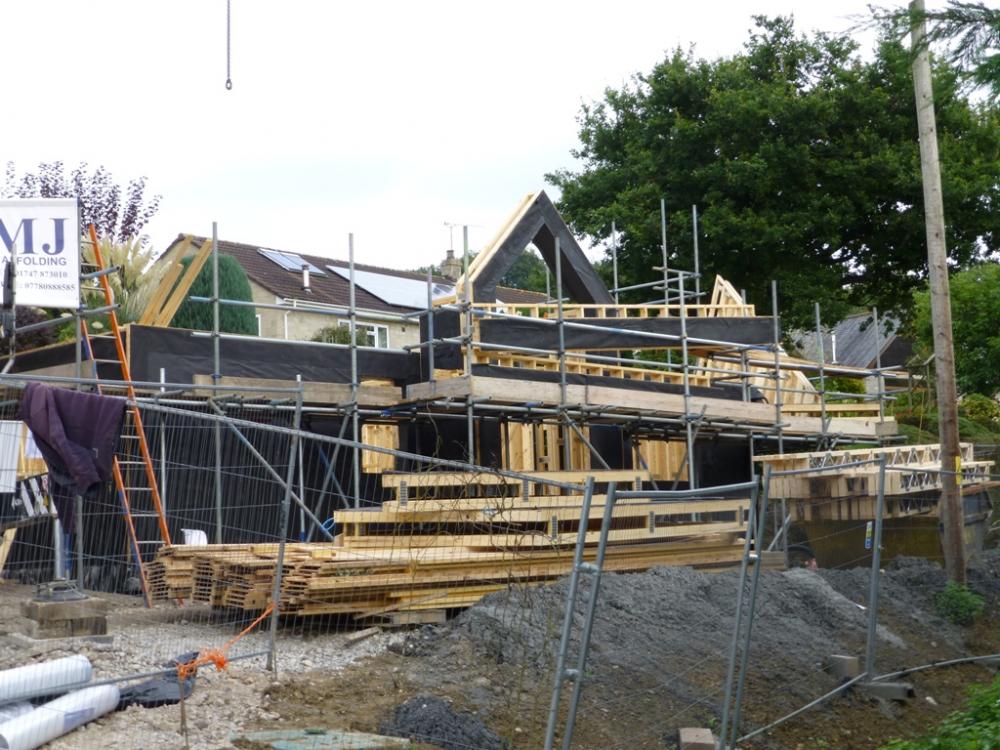
-
Moving from Outlook 2003 to Thunderbird
Jeremy Harris replied to Triassic's topic in Boffin's Corner
I managed to transfer all my emails (several years worth) from Outlook to Thunderbird OK. I can't remember exactly what I did, but there's some advice on the Mozilla site, here: https://support.mozilla.org/t5/Install-Migrate-and-Update/Switching-to-Thunderbird/ta-p/14582 -
Yes you can unravel them to form linear rolls of the stainless stuff that fits snugly in a 25mm batten space.
-
Can anyone explain to me why electric roman blind headers are so ludicrously expensive? I've fitted quite a lot of roman blinds in the new house, and have to say they are way better than curtains in just about every respect, including having the useful attribute of being able to block the sun when partially down, and they take up less room. Having read this thread I thought about adding electric actuators, thinking they would make life a bit simpler for the harder to reach windows. I looked at the price and was just gobsmacked. The rollers seem to use a smaller version of the same brand motor that operates my 3m wide garage roller door, but that motor is double the price. Seems insane to me to pay the best bit of £500 to motorise a £200 blind.
-
I'd avoid the insect mech, as it's a pain to position top and bottom, plus it's expensive. Commercial kitchen stainless steel pan scourers are both cheaper and easier to use.
-
If I'd owned a digger I'd have done just the same! We had a minidigger in for one day during the work the week before last, but it was the landscaping chaps own one, so a lot cheaper than hiring one. I hate grass with a passion, and if I'd had my way the whole garden would have been hard landscaped, but SWMBO was insistent about having a lawn, so we laid turf last year. My condition for laying the turf was that she would have to cut it regularly, and I even went and bought a lightweight, easy to use, Makita cordless mower for her (good bit of kit if you already have Makita tools and battery packs). Needless to say I've ended up doing the lion's share of the grass cutting...........
-
I've just had a look, and I'm pretty sure the one we're using by the front door at the moment is a Turtlemat, I'll ask SWMBO later. Having looked at their website, it looks like the one we have is the smallest, and that may well be why it sometimes gets the edge caught by the door. I see they do larger ones, and that could be the answer, as we have the space for one twice as big, and that would then mean the door would be opening over the centre of the mat, with no chance of catching the edge.
-
I found sorting the landscaping out to be a long and very drawn out task, and one that soaks up a surprisingly large amount of money. We had the same chap that laid the paths, patio, drive etc back the week before last to do another weeks work, really just doing a load of smaller jobs, like laying a small concrete hardstanding in the space behind the garage (where I'm going to stick a small shed), laying another sandstone path around the edge of the drive, putting in an area by the gate, paved with sandstone, to take the wheelie bins on bin day, sorting out the levels and tidying up the odd corners of the plot and doing some stone walling. I think we're probably around 90% complete in the garden, at least for now, but it's taken a long time.
-
Design Help - Plumber not helping
Jeremy Harris replied to DeeJunFan's topic in Other Heating Systems
Sadly I don't have time for another trip to NI in the near future, although my other half would leap at the opportunity to have another holiday there, I'm sure! I used AutoCad to do all the house drawings and just added the main plumbing and heating system layouts as layers on the master drawings, so I could print off plans that focussed on just one system at a time. I did the same with the electrical installation layout, the MVHR ducting and even the kitchen cabinets and the major items of furniture, which made planning where things could fit a fair bit easier. -
I think that may be what we have at the moment, a fairly thin, very absorbent, mat with a non-slip backing. The top surface looks like the mats they use in supermarket entrances to stop muck getting walked in.
-
Design Help - Plumber not helping
Jeremy Harris replied to DeeJunFan's topic in Other Heating Systems
FWIW, I think the shortage of decent plumbers is pretty widespread. I rang around when we were putting the schedule together and plumbers were the one trade that were fully booked up for months ahead (they were also the most expensive). This was the main reason I ended up doing all the plumbing and heating system installation, and the reason I did things in what was (at that time) a slightly unusual way. It's also the reason the majority of our plumbing is in plastic, as it was easier to DIY, with a lower risk of having a leak in an inaccessible location. -
We used 12mm travertine plus 12mm bonded-down bamboo on the ground floor, and both ended up being very close to 15mm above the (very flat) slab, so 15mm sounds about right to me. The bamboo is may be 1mm below the travertine, but the only place they met was at one door, and I laid a bamboo flush threshold in there that matched the levels both sides, and you can't see the slight slope on it. One thing worth thinking about now is door mats. It sounds daft, but the bottom edge of a Part M compliant inward opening exterior door will most probably only be 6mm to 8mm above finished floor level, barely enough to get even the thinnest door mat under. I wish I'd thought this through, and allowed for a recess in the flooring to take a thicker mat, as it's now proving to be a bit of a nuisance.