


Jeremy Harris
-
Posts
26430 -
Joined
-
Last visited
-
Days Won
360
Everything posted by Jeremy Harris
-
I seem to remember a very similar plan being offered a couple of years ago, might try and find the details, as I think it was posted here. The biggest problem with these plans is the impact they have on battery life, as they rely on being able to cycle your home battery a lot more, in order to provide a bit of local grid reinforcement. IIRC there were some estimates of the impact of this last time it was discussed, and they didn't look great.
-
The things are so quiet that I doubt anyone would know that you had one installed, unless it was on view. Our MVHR makes more noise outside than the ASHP does, and our old gas combi boiler was a lot noisier outside - that could be hear from across the street when it fired up.
-
Here I was told that it means that the installation must be by an MCS accredited installer, in order to show that it complies with the MCS spec. Not at all sure whether anyone would ever bother to check, though.
-
The planning officer wasn't the slightest bit interested in the ASHP change (our original consent specified a GSHP in the D&A statement). It literally went through on the nod, very quickly. For us, the premium for an MCS install would have more than doubled the cost, and we'd never have got even a fraction of that premium back through the RHI, as the RHI payments were only going to be roughly £80/year for 7 years.
-
That's my understanding too. I put our ASHP install through as a non-material amendment to our planning consent, as it was a DIY install. All DIY installs, in theory, may require planning consent because they will not have an MCS chit.
-
Installing a heat pump isn't a building control issue, so DIY isn't a problem. The only issue is that ASHPs may need planning consent, a hangover from the days when they used to make a bit of noise, I think. The reality is that modern ASHPs are often quieter than a gas or oil fired boiler.
-

VCL - Barriair vs cheaper polythene performance
Jeremy Harris replied to BMcN's topic in Ventilation
The major problem with ordinary polythene sheet is that airtightness tape will not remain adhered to it, due to it's very low surface energy. VCL materials are treated or formulated to have a high surface energy, so that their self-adhesive features or ordinary airtightness tape will adhere well to them and will remain well bonded for decades. -
The front panel on our Genvex MVHR is easy to remove for access, although it's pretty heavy, as it seems to be lined with some sort of very heavy rubber foam (at a guess it weighs around 20kg or so). I take it off about once a year, and that gives easy access to both fans, the heat exchanger and the stainless condensate tray. The latter has 15mm drain pipes at either end, that link together before feeding to the waste pipe. Every time I've had it apart it's been spotless inside, with the exception of the intake chamber, before the filter, which is always filled with dead flies, spiders etc. Next time I remove it I'll take care to look more closely at the drains, in case there's something similar growing in there. I wonder how much effect temperature has on this? On our unit, the drainage tray is right at the bottom of the unit, and the fans are right at the top. The heat pump sits on a plate above the drainage tray, and under the heat exchanger, so I suspect the drainage tray may stay fairly warm. I've seen this sort of bio gel/mould growing in the drain on our old fridge/freezer, so maybe it grows better in cold conditions?
-
Took me about half a day to install and commission a monobloc ASHP, and I'd never installed one before (and I'm not a plumber/heating engineer). They are dead easy to install. The hardest part is setting the things up well, as the manuals are often pretty damned impenetrable.
-
Scottish Water may be different, as you've not suffered as much up there as we have with the way the water companies here are stitching up consumers in whatever way they can. Wessex Water didn't even know about the pipe in our lane when we first contacted them It was only after they confirmed (via their check before you dig service) to us that they had no pipes at all in the area, and we then discovered their pipe when trenching across the lane for a drain, that they decided that the pipe in our lane was theirs, but we couldn't connect to it. The pipe in question was laid in 1934, and is well overdue for replacement. My belief is that as soon as they realised this they decided that we should pay to have their pipe replaced, to save them having to pay to maintain it.
-
Our plot is infill, with houses behind us and to either side, as well as over the other side of the lane. All have mains water and a mains water pipe, that supplies our neighbours on either side, runs along the lane in front of our plot. Could we get a mains water connection at a reasonable price? Simple answer is no, Wessex Water declared that the pipe running along our lane was a communication pipe, not a water main, and they prohibit new connections to an existing communication pipe. Their solution? Dig up over 100m of lane and lay a new communication pipe alongside the existing one, so that it could connect to the water main at the top of the lane. Cheapest price to do this? About £24k. . . Our solution? Poke a metaphorical two fingers at Wessex Water and have a borehole drilled in the garden. Cost about £8k. Definitely worth it at the time, as cash was tight during the build. TBH it's not ideal, though, as although we have a plentiful supply of cheap water, there is a maintenance overhead involved with having a private water supply. This was fine when we made the decision about 6 years ago, but as we get older we do find we think a bit harder about stuff that needs regular maintenance. Changing filters, checking and re-charging the pre-charge on accumulators, replacing the UV disinfection tube every year and keeping an eye on the overall health of the system isn't that onerous, but there may come a time when doing it gets a bit hard. We're beginning to think about getting a mains water connection again, and luckily I laid an extra run of water pipe to the boundary just in case we decided to do this, so it just (!) means getting the lane dug up.
-
Plumbing completed - what paperwork do I need?
Jeremy Harris replied to Weebles's topic in General Plumbing
The drain pressure test was one of the few things our inspector came out especially to check. He wasn't interested in the foundations etc, just wanted to witness the pressure test. Seems to be pot luck as to what actually gets checked. We initially had to jump through hoops about water consumption, with insistence that I had flow restrictors fitted. There was a refusal at first to let me fit them (even though I'd installed all the plumbing myself) and also a refusal to accept that we didn't need to meet the water consumption bit of the regs, anyway, as we have a borehole supply. Common sense prevailed in the end, though, and for the completion inspection I printed off reports covering everything I could think of, but the inspector wasn't really interested, and just walked around and said he'd sign it off, without taking any of the paperwork I'd spent hours producing. -
Not sure if the forum kit has already been up to Orkney yet, but it may have, as we have another self-builder here from the islands.
-
Looking at the wiring diagram for the indoor control box, there doesn't seem to be provision for getting the ASHP to operate in a hot water mode, just a relay that can turn the immersion on or off. As @ProDave mentioned above, running at a constant temperature seems to work well, it's how I've set ours up. You could try altering the heating curve settings to set the unit to a fairly high constant flow temperature, say 45°C, as a compromise that might get the hot water tank a bit warmer by using the heat pump. I'm struggling to see if there's a setting to adjust the temperature at which the immersion relay kicks in, but if there is, then increasing that, along with setting a fixed flow temp that's around 45°C might work OK. You have the advantage up there of a reasonable climate for an ASHP. Another member here, @Stones, lives on Orkney, and he has an ASHP that seems to perform well.
-
To set the system up is a fiddle, TBH, as you have to go around measuring the air flow rate at every terminal and then adjusting them to both get the right flow rate for each room, and, more importantly, to ensure that the total extract flow rate equals the fresh air flow rate. If this is out of balance the heat exchanger won't work as efficiently, and as a consequence the ventilation heat loss will be higher. The forum has a couple of sets of MVHR flow metering equipment that's been donated and is available via the tool loan scheme here, specifically so that people can DIY set up and balance their MVHR systems. There's often a waiting list for this, though, as it can be a time consuming task.
-
I think we spoke to them at the Swindon self-build centre years ago, when we were looking around. IIRC, we dismissed them because their spec was pretty basic, it just met building regs and was nowhere near the sort of energy performance we were looking for.
-
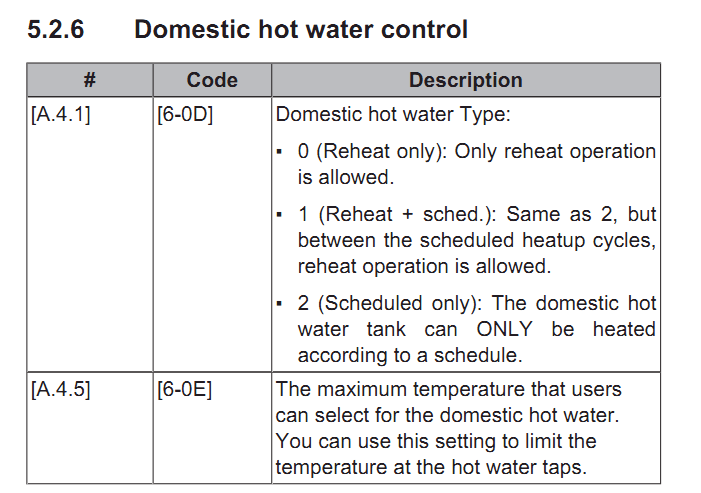
Usually there will be two main modes on an ASHP, heating mode, which will usually be set to deliver a flow temperature of around 35° to 40°C and hot water mode, which will usually be set to deliver a flow temperature of around 50° to 55°C. It's not clear from the manual whether or not the unit you have actually has a hot water mode. The manual isn't the easiest thing in the world to decode, either! All I can see on hot water control is this: And that's as clear as mud. . . It looks to me as if this model of ASHP doesn't actually have a hot water mode, and relies on using an immersion heater to boost the hot water up from the low temperature that the ASHP works at. That seems unusual, but then the unit is described as being a "low temperature monobloc", so it may be that this is a simplified unit that doesn't have an integral hot water capability, but relies on using an immersion heater for boost.
-
Again, just as @ProDave says above. Ours is on 24/7, and 99% of the time it runs at the trickle ventilation rate. If we run a shower, or are cooking, the humidistat in the extract side automatically switches the unit to boost ventilation for maybe 15 minutes or so, to extract the additional moist air.
-
We use an air source heat pump for heating and cooling, but not hot water. They do need careful setting up, I found that the default settings for our unit were way off what was needed to get it to run economically. The Daikin unit you have is a low temperature ASHP, in case you don't have it, the manual is here: https://my.daikin.eu/dam/document-library/installation-manuals/heat/air-to-water-heat-pump-low-temperature/EBLQ-CV3_EDLQ-CV3_4PEN403578-1C_Installation manuals_English.pdf The key settings will be the heating curve (page 15) settings and the hot water settings (page 16). Limiting the hot water temperature to 50° would be a reasonable start, assuming that your water cylinder has enough capacity to allow this to work OK. Just a 5°C reduction in flow temperature can make a marked improvement to performance.
-
Our house is much like @ProDave's, and as he says, you can't really feel the air coming in through the fresh air terminals. Our system is set up to change all the air in the house about once every 2 1/2 hours, which seems to be about right. If you can feel cool air blowing out of the fresh air terminals then it sounds as if it's not set up properly. MVHR is just mechanical, in that it's just two networks of ducts connected to a plate heat exchanger and a couple of fans. There are usually filters either side of the plate heat exchanger, to prevent dust from clogging it up (and these need cleaning/replacing every 6 months or so) plus some controls to vary the flow rate, so that it can be boosted when cooking, or when a shower or bath is run, then go back to the normal trickle ventilation rate. Sometimes the boost function is manual, and sometimes it is via a humidistat that sense when the extract air is humid. Worth having a good look at your system to try and see what you're dealing with. Perhaps start a thread here and post some photos of your set up, and with luck someone here will recognise it and be able to offer first-hand suggestions as to how to get it working properly.
-
Solar DHW with UniQ and PV Diversion
Jeremy Harris replied to DamonHD's topic in Boilers & Hot Water Tanks
One thing that I think we can probably be pretty sure about, is that in five years time the grid is probably going to be far less carbon intensive than it is now. We also can't be sure about what new products might become available as new housing stock gets weaned off gas and on to electricity for heating and hot water. I have a feeling that we may well see some new products emerge, as well as a price drop as niche products (like heat pumps and thermal storage) become more main stream. It could be that in five years time your decisions might be simpler/easier, especially if the move of house creates opportunities to further improve household overall energy performance. For us, reducing energy use was right at the heart of our reason for self-building, rather than anything else. It might be that your choice of future home could be driven by a similar wish. -
Solar DHW with UniQ and PV Diversion
Jeremy Harris replied to DamonHD's topic in Boilers & Hot Water Tanks
If the gas boiler is working OK, and is still supported with spares, then my inclination would be to leave it as-is, as that's probably going to be the least expensive option. Tempting as it is to look at replacing it to reduce your carbon footprint, there's also an argument for retaining it until the house gets demolished, as that way its manufacturing carbon footprint gets stretched out over a longer working lifetime. Always hard, these moral vs. economic decisions. -
Fingers crossed that the Biodisc keeps working! If it's not smelly then that's a good sign that it's working OK. The way that MVHR works is to extract some of the heat from the air pulled from rooms like the kitchen, bathroom and toilet, and use that to pre-heat the incoming fresh ventilation air via a heat exchanger. There's no mixing of fresh intake air with exhaust air, the two are kept separate. The air that comes out of the fresh air vents will always be colder than room temperature, but not as cold as the fresh air that would otherwise be needed to ventilate the house, so the heat loss is a lot less.
-
Welcome. It's far from unusual to find that MVHR systems, in particular, haven't been properly set up and commissioned. They only work well when the house is pretty airtight, and when the flow rates have been adjusted at each extract/fresh air supply. This is supposed to be done as a part of the commissioning process, but as it can be a fairly time consuming job, I get the feeling that lots of installers just don't bother to do it properly. We've had examples here before where new builds have had pretty poor MVHR installations, and all of us here that have set up and balanced our own self-installed MVHR system know how time consuming it can be to get it right. The BioDisc treatment plant isn't something I'd want to work on if it goes wrong! I took a look at a cut away of one at the Swindon self build centre and my first thought was "how the heck do you service the motor and disc drive system?" Both are down inside the unit, and looked to me to be something fairly unpleasant to work on if it ever went wrong. I think the general consensus here is that the air blower systems are fairly easy and straightforward to install and service. That's what we opted to fit, as it looked to be something that could be DIY fixed if it ever went wrong.
-
Adding a timer to an EV charging point.
Jeremy Harris replied to newhome's topic in Electrics - Other
Some do have built in charge timing of some sort, although some don't. My Prius Plug in had a built in charge timer, but I'm pretty sure that the Outlander that @newhome has doesn't. The effectiveness of the built-in charge timers is a bit variable. The BMW i3 I had used a really bizarre system where you could only set a scheduled charge if you also set a defined departure time. If you didn't need to depart at the set time (say, 07:00, the end of the winter E7 period here) then the car would waste power preconditioning the battery. Thankfully, the i3 worked OK with a charge point with a time switch, so I never had to use the pretty useless onboard timing system. The Tesla Model 3 has a scheduled charge timing system that's almost as bad. It allows the start time of a charge to be set, or the end time of a charge to be set, but not both. This can be very annoying, as if a start time is set for the start of the E7 period, but the car needs more charge than can be delivered in 7 hours, it carries on charging at the peak rate until it's charged. Likewise, if an end time is set the car may start charging before the cheap rate starts. The final annoyance is that the Model 3 doesn't comply with IEC61581, so won't respond to a timed or smart charger that tries to control when the car charges.
