


Jeremy Harris
-
Posts
26430 -
Joined
-
Last visited
-
Days Won
360
Everything posted by Jeremy Harris
-
The latest move here is that they seem to have now banned cars with trailers from using the recycling centres. They are also bringing in a requirement that everyone arriving at the recycling centre has to prove that they are paying Wiltshire Council tax before they will be allowed in. So far, Dorset doesn't seem to be imposing such draconian restrictions, and so I can easily just nip over the border at use one of their recycling centres instead.........................
-

Fault on Kingspan Air Source Heat Pump
Jeremy Harris replied to philiom's topic in Air Source Heat Pumps (ASHP)
One option (although not great one in my view) is to fit a low loss header in place of the bypass. The snag is that they work very well when there is a relatively high temperature differential between flow and return, as with a boiler system, but there will be an increased tendency for flow and return to mix in the LLH as the temperature differential drops. Having said that, some types of LLH have, I believe, been optimised to work reasonably well at the sort of temperature differential you might get with an ASHP, and a LLH does have the advantages of needing no adjustments and being maintenance free, so from an installer's perspective they look attractive. The small loss of heat pump efficiency as the system/house comes up towards target temperature and the flow and return start to mix in the LLH may be a price worth paying if it fixes the flow problem. -
Design SAP and sunamp
Jeremy Harris replied to vivienz's topic in Energy Efficient & Sustainable Design Concepts
Spot on. All you need to do is decide on an equivalent volume thermal store. I believe that Sunamp suggest around 120 litres, which I think is a bit pessimistic, based on experience, which is why I suggested 150 litres. In practice, the combination of 70 litres of buffer preheat plus a single first generation Sunamp PV outperforms our old 210 litre thermal store. Sunamp have already done the heat loss tests, hence the 0.6 kWh/24 hours I gave earlier. Whether this has changed with newer units I'm not sure, but this low loss rate will make a significant difference to the DHW heating requirement in SAP, I'm sure. -
M spec ramp to the rear door but not the front?
Jeremy Harris replied to epsilonGreedy's topic in Building Regulations
Not a problem, it's exactly what I did. I have stone steps up from the drive to the front door, but a gentle ramp that runs around to the back door. I put in a wheelchair turning area outside the back door (just a section of double width path) to deal with the 90 deg turn needed to get in, but that's primarily because one of my friends is paraplegic and uses a chair. For the same reason I fitted 33" wide doors everywhere inside the house, with flush thresholds. My father was a wheelchair user, so knowing first hand how much of a nuisance seemingly minor things can be if you're using one, I thought it sensible to just make a few design changes to allow for it. Who knows, it may well be that one of us needs to use a chair at some future date too, so it seemed daft not to try and make the house as easy to access as possible. A side effect of the back door Part M compliant entrance and the ramp is that it makes moving the wheelie bins out a doddle, and if we need to put something heavy in one of them it's easy to just wheel it up to the space outside the back door, load it up, then put it back in the wheelie bin storage space, part way down the ramp and off to one side, behind the fence that holds out meter cabinet. -
Fault on Kingspan Air Source Heat Pump
Jeremy Harris replied to philiom's topic in Air Source Heat Pumps (ASHP)
FWIW, I found that adjusting the bypass on our system was a bit fiddly. Setting it a fraction to high causes a flow error and shutdown, setting it a fraction too low and it bypasses when it should be allowing the flow and return to go via their selected circuits. I think I spent a good hour, adjusting the bypass, monitoring the start up behaviour on the Command Unit, checking that the bypass wasn't letting by once the UFH valves had opened, then repeating the exercise until the setting was spot on. I can't remember the make of bypass valve I fitted, but one useful thing about it was that it made a distinct "click" as it closed, which helped a lot when trying to get the pressure set. -
Sounds like all is well and the controller is doing it's thing OK. The "COL" reading is the temperature at the hot side of the solar collector ("COL" being the abbreviation for "Collector"), and will vary a great deal, from close to the outside ambient temperature at night, to the stagnation temperature when the system has heated the tank to the set point when the sun's out. The stagnation temperature can be between 120 deg C and 140 deg C, so the 127 deg C you had earlier was within range - the tank was just up to temperature and the controller had turned the solar system off, to avoid over heating the tank.
-
Design SAP and sunamp
Jeremy Harris replied to vivienz's topic in Energy Efficient & Sustainable Design Concepts
I wouldn't worry about the design SAP too much, but personally I'd enter the Sunamp PV as a 150 litre thermal store with an immersion and a heat loss rate of 0.6 kWh/24 hours, at this stage, as it's not that critical. The PV section should account for the generation from renewables side. Sooner or later Sunamp are going to have to come up with a way to get these things to have an appropriate means of including them within SAP, which doesn't look to be that easy to me. We did our SAP assessment when we still had a thermal store fitted, so didn't have to jump this hurdle, but in essence all I did when swapping the thermal store for the Sunamp was change the units over, so the main difference to the rating would have been the much reduced heat loss rate.- 18 replies
-
- 1
-

-
- heat storage
- design sap
- (and 5 more)
-
It depends a lot on whether the trees have really started to "come alive" from winter, with the sap rising up from the root system. From your description there seems to be a lot of sap, which suggests that they have and could take some months to dry enough to give a relatively smoke-free bonfire. How quickly the cut branches dry out really depends on how thick they are.
-
The sap from fig trees is a phytotoxin, and as you've found, some people are very sensitive to it, some aren't. There's no problem I'm aware of regarding arsenic, as the only possible way arsenic could get into a plant of any kind is if it was growing in contaminated soil. As arsenic is a pretty effective herbicide, soil that is contaminated with it tends not to have much, if anything, growing on it. So, put on some rubber gloves, pile the cut debris up, leave to dry and burn it. Normally I'd be dead against having a bonfire, especially in an urban area where the pollution could be a real nuisance, but I don't think that shredding this stuff is really an option, because of the hazard posed by the sap. BTW, if you do accidentally get the sap on bare skin, washing it quickly and keeping the area that was exposed out of the light (i.e. covered up well) should minimise the effect. The toxin tends to be a lot more effective when exposed to light. I believe that applying a high SPF sunscreen before touching the stuff should also work as an added protection layer, as the toxin needs the UV in sunlight, even diffuse sunlight, to be effective.
-
Sorry, missed this earlier. The solution would be to fit a surge suppressor in the feed to these drivers, so they don't see any spikes from anything else. Not hard to do, just fit the suppressor in a wago box across the line and neutral, in line with the feed to the lights. Something like this would do the job I expect: http://uk.farnell.com/roxburgh/xe0475/rc-network-250v-0-5uf-47r-pcb/dp/2336100 .
-
Looks very much like a sliding electric gate track to me, too.
-
Looks like the collector has stagnated at 127 deg C because the ST pump has turned off, and the ST pump has probably turned off because the stat has turned it off. My guess is that the stat that's set to 45 deg C may be the one that is controlling the ST, in which case it's satisfied, as the bottom of the tank is well over the 45 deg set point. It's not unusual to see pretty high collector temperatures in the ST system when it's turned off. Between 120 deg C and 140 deg C is about the normal max range in this condition, IIRC. When the experts have returned and recovered they will, I'm sure, be able to confirm or otherwise if this is the case.
-
Preparing to lift the roof beam without a crane
Jeremy Harris replied to ToughButterCup's topic in Roofing, Tiling & Slating
What's the plan then? Fit them all with little harnesses and get them to help lift the beam in place? -
That video is probably the worst wiring job I've ever seen, but I've seen a few that have come pretty close. The second house we bought was a typical 18th century Cornish stone cottage, that had been partially rebuilt in 1903 after a major fire, then renovated some time in the 1970's, with a single storey kitchen and garage extension added on to one end, and used as a holiday let for years (we bought it from the widow of the landlord). The wiring in that had to be seen to be believed, with sections of the house with no earth, exposed conductors on the panel in the garage, a mix of earthing and equipotential bonding systems that were totally ineffective in practice, and worst of all, a hot water tank with an immersion heater that was faulty, which I only discovered when I went to replace the very tatty insulation jacket around it and found that the tank itself was live. The only reason the rest of the plumbing wasn't live was because, for some reason (probably to do with the awkward access to the tank) whoever installed it in the small alcove in a wall, which had once been a bread oven I think, had used lengths of black alkathene farm pipe to connect it up to the rest of the house (saved using a pipe bender I expect, as it was a really tight space it was fitted into). I'd planned on refurbishing the kitchen and bathroom, but spent all the kitchen refurbishment money we'd set aside on rewiring the whole house, top to bottom. I never did get around to doing the kitchen, either, we lived with the tatty one for four years, until we moved up to Scotland.
-
Fault on Kingspan Air Source Heat Pump
Jeremy Harris replied to philiom's topic in Air Source Heat Pumps (ASHP)
A word of caution if you want to gain access to the main boards - there are live mains terminals that can be very easily touched, even by the outer cover as it's being removed (ask me how I found this out!) so always best to isolate the power, then take the covers off, then power the units back up. The area around the diagnostic LEDs and DIP switches is pretty safe, as it's mainly low voltage DC stuff in that area, it's just the poor protection around the mains power connections that's a potential gotcha (pun intended....). Quite why Carrier didn't just fit insulating shields over the exposed terminals is beyond me, as they really are very easy to accidentally touch, and the unit has to be powered up with the cover off to access the diagnostic LEDs. -
Fault on Kingspan Air Source Heat Pump
Jeremy Harris replied to philiom's topic in Air Source Heat Pumps (ASHP)
It definitely needs antifreeze if the units are ever switched off in cold weather, as there isn't a lot of insulation internally around the primary circuit to water PHE (at least there isn't in mine, it's just wrapped with maybe 25mm of neoprene inside the case). I can't see how losing the antifreeze/inhibitor would cause this problem, either, the filter(s) would tend to show if there was any potential corrosion product problem. If the pressure bypass is working, and was replaced anyway, it's unlikely to be that, either. There's a pressure switch on the flow side, inside the unit, that triggers the over-pressure warning on the Command Unit (lower left caution caption, then flip through the diagnostic sequences on the Command Unit to find the code). Alternatively, have you tried looking at the diagnostic LEDs on the main board inside the unit itself? There are a couple of DIP switches and a series of surface mounts LEDs, and there are two levels of diagnostic info available from the LED sequences. This photo nicked from the other thread shows the LEDs and DIP switches: and page 23 of the installation manual gives the codes: My guess is that you may have been through this process already - apologies if it sounds like I'm teaching grandmother to suck eggs, just trying to cover all the bases that I'm aware of (and bear in mind my knowledge was gained from installing and then reverse engineering how the unit works, as I use mine for cooling as well as heating, something that neither Kingspan or Glowworm refer to, but Carrier confirmed that the units are fully bidirectional). The photo shows the "case thermostat operation" which is a bit confusing by it indicates that the flow temperature, as measured internally, has reached the set point. Unfortunately this isn't a useful indication, as it will show that initial code when the unit has tripped because of a low flow condition - in essence the internal side is up to the set temperature even though that may be because the flow is restricted.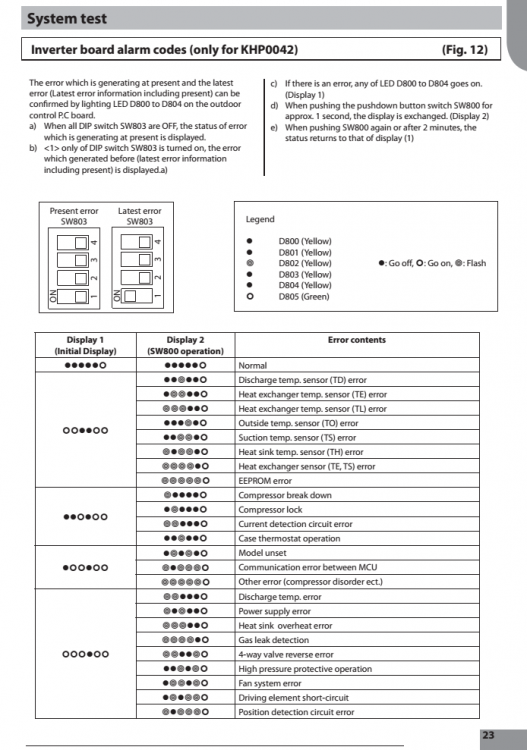
-
Brilliant job, guys, great to see the team effort that went in to fixing this. As @jack says, a summary of the problems and fixes would be very useful for others encountering stuff like this (although I sincerely hope no one ever does!).
-
Fault on Kingspan Air Source Heat Pump
Jeremy Harris replied to philiom's topic in Air Source Heat Pumps (ASHP)
That Carrier Command Unit is very useful, damned pity that Kingspan didn't supply it as standard with their version, as Glowworm did with their re-badged version of the same unit. I was lucky, and had the Command Unit supplied with my heat pump, and it's proved invaluable in getting the settings adjusted to better suit the UK climate, amongst other things. Is there a filter or strainer on the return to the ASHP as there should be? Just wondering if that may be partially clogged and reducing the flow enough to trigger the fault condition. Carrier recommend a Y strainer on the return, not sure what Kingspan recommended, but Glowworm just followed the Carrier recommendation in their MIs. -
Hello and yes, it's a renovation blog.
Jeremy Harris replied to AdamSee's topic in Introduce Yourself
As above re: the beam - almost certainly a later addition and not original, clearly put in by someone with little understanding of bearing stress................. With the uPVC windows and absence of lintels above the outer brickwork, this is a fairly common problem. A lot of older houses were designed with strong timber window frames that incorporated what amounted to a timber lintel within the outer frame itself in order to support the brick work of the outer skin - the window frames were built into the walls as the outer skin was built, then glazed later. Many after market uPVC installers just ignore this and slap a new uPVC window in without providing proper steel support to replace that which was provided by the timber window frame. If this is the case, then sometimes you can see signs of the outer brick skin bowing down. It's fixable, if it is the case with your installation, by several means, some more intrusive than others. -
Fault on Kingspan Air Source Heat Pump
Jeremy Harris replied to philiom's topic in Air Source Heat Pumps (ASHP)
Welcome to Buildhub. As you've probably found out by now, Kingspan didn't ever manufacture these heat pumps and, like Glowworm, who also re-badged the same Carrier range of heat pumps, their technical support wasn't great (but better than Glowworm, I think - they didn't seem to have a clue about "their" product - I bought one of the last old stock ones they had very cheaply). The good news is that the heat pumps are made by Carrier, one of the world's largest heat pump manufacturers, so all the technical guidance from Carrier will apply equally to to these re-badged "Kingspan" models. The LED diagnostic thing is pretty crude, and you can get a lot more information by using the Command Unit display. Unfortunately, Kingspan chose not to use the Carrier Command Unit, but instead just used an extension of the diagnostic LED that's on the main PCB, and frankly that isn't a great deal of help in tracking down the real problem. As a general rule, flow related errors are usually down to a restriction in the system somewhere. With the Command Unit the display will indicate this, and show the unit trying to restart, encountering a flow error, shutting down, then trying another restart a minute or so later. I had this fault on my system initially, because with the buffer tank/hot water tank valve closed and the thermal actuators on the UFH being slow to open (they take around 5 minutes or so to open) the flow resistance would be too great and the unit would stop with a flow error. In my case the fix was to use a normal boiler-type adjustable pressure bypass valve directly across the ASHP flow and return and then adjust this so it would just open when all the house-side valves were closed, so reducing the flow resistance and avoiding the flow error. As soon as the UFH valve or tank valve opened the bypass valve closes, as the flow pressure drops. This works a treat. You might want to have a read of this thread, as there are some documents and info there that may be of help: -
Acoustic Isolation of MVHR Unit
Jeremy Harris replied to MJNewton's topic in Mechanical Ventilation with Heat Recovery (MVHR)
I used the same semi-rigid in short lengths from the MVHR and found it easy to use and it also doesn't seem to transmit vibration. The very flexible stuff with the wire to keep it roughly round isn't great, IMHO, as it tends to have a pretty high flow resistance, which isn't good for overall efficiency. The semi-rigid stuff seems a heck of a lot better in this regard. -
I'd not worry too much about noise coming direct from the big ducts as ours was noisy when I tested it like that. I found silencers (home made) made a tremendous difference to the noise level once everything was installed, and our MVHR can be noisier than most because of the built in air-to-air heat pump. I doubt that any MVHR could be any noisier internally than ours with the heat pump running TBH, yet it's pretty silent with the silencers and ducting fitted.
-
I had this discussion with the BCO. His view was that as the EA had given me a consent to discharge to the watercourse it made this section void.............
-
Like this one? http://www.mayfly.eu/wp-content/uploads/2017/01/Fabric-and-ventilation-heat-loss-calculator-Master.xls
- 13 replies
-
- 1
-

-
- specification
- wish-list
- (and 1 more)
-
Having seen those videos, I wonder if I was a bit harsh to sack the first electrician we used for just leaving the collar off an SWA gland (so there was nothing clamping the armour), using a bit of blue neutral wire as an earth link (because he'd not got any earth sleeving), crossing the neutrals in the external CU (which is a caravan box, with just wired DP RCBOs), and leaving half the wire clamp screws loose, one being so loose that when I took the front off an outdoor socket the line wire just pulled out. Compared with whoever wired the house in those videos, the first electrician we used seems to have been almost a paragon of virtue. It even makes some of the bodges that @daiking has found look pretty tame. I don't think there's much doubt that the DNO would have refused to reconnect that installation in the first video - just the state of the cable runs alone would probably have been enough to be a dead giveaway that it was bloody dangerous. I'm still amazed that there are people around, calling themselves trades people, who can do work like this.

