Jeremy Harris
-
Posts
26430 -
Joined
-
Last visited
-
Days Won
360
Everything posted by Jeremy Harris
-

Quals to do an EICR?
Jeremy Harris replied to Jeremy Harris's topic in Regulations, Training & Qualifications
Thanks, it's a Wylex silver metal fuse box, with a mix of wired fuses and one 45A cartridge fuse for the cooker radial, c.1986, so 15th Ed, as that's when the house was built. My qualifications date back to the 15th Ed, and it's similar to the board I fitted when we rewired my late Mother's house years ago, probably the last whole house rewire I did. I agree it's every bit as safe now as it was when it was installed; all the wiring is in good condition, there are no dodgy mods, the only two changes seem to be an outside light that was fitted and the wiring bodged in the new switch (something now corrected, but it only showed up when I tested the loop resistance on that ring) and the old 16A immersion heater radial now feeds a single socket, as the hot cylinder was removed and I swapped the FCU for a socket. I think I'd agree with Dave and give it an unsatisfactory, because there's no RCD at all. The house is PME, so there wasn't a requirement for an RCD when it was built. As you say, though, there is a lot of room for interpretation with EICR coding, and it's quite possible that it could be C3. I couldn't agree more. It puts electricians in a difficult position, as there now seems to be an assumption that things should be looked at in a more critical light, with respect to the current regs, rather than those that applied at the time the installation was fitted. -
Nothing you wrote was in anyway condescending, @Russell griffiths. The problem is really with people who have little or no experience of working day in, day out, with mixers advocating something that's out of the normal safe way the vast majority use them. I was shown how to use a mixer by a builder, when I was about 13 or 14. It was a petrol mixer, and I can remember him giving me the same instructions about always starting it empty, and that was over 50 years ago. Not leaving a mix in a stationary mixer, but tipping it into a barrow was also normal practice, even back then. This has nothing to do with generators, either, it's just the standard, safe, way to use a mixer, always has been and always will be (until someone invents something else to mix mortar and concrete).
-
I tried slab temperature control initially, as I was convinced (still am) that controlling the slab was a better way of ensuring the heat input to the house was accurately controlled. After many iterations of the control system, I gave up. What I have now is a constant temperature flow into the slab when the room temperature stat is calling for heat (it's a low hysteresis stat, +/-0.1 deg C) that just turns the UFH valve on or off. If the buffer tank (used for DHW pre-heat) needs heat the ASHP stays on until the buffer tank stat is satisfied. This simple control works exceptionally well, and holds the house at a very even temperature, much better than I could get my slab control system to do. I was measuring flow and return temp with the slab control system too (still am, for data logging, as the sensors are still fitted). The key to getting the simple control system to work well was to use a low hysteresis room stat, and more importantly, to carefully control the UFH heat input. I found that conventional thermostatic mixers weren't great when turned right down to low flow temperatures, but luckily there is an off-the-shelf electrically actuated valve that does the job superbly. I have it fitted to the return line from the UFH manifold to the heat pump, and it acts as both the UFH on/off control valve and as a way of controlling the Δt between the slab flow and return. It is a motorised valve with two clip on temperature sensors that fit on the flow and return pipes and tries to maintain a 5 deg C differential. I've found this works surprisingly well, as it keeps the flow temperature down below 25 deg C all the time, and I found, by experiment, that allowing the flow temperature to exceed 25 deg C tended to lead to a higher than desirable room temperature overshoot after the UFH had turned off. It was my desire to try and prevent this "heat soak" overshoot that had prompted me to try using slab temperature control. I'm now using off-the-shelf controls, too, so when I'm gone someone else can still maintain and repair things if they go wrong, something that I think is worth thinking about.
-
Quals to do an EICR?
Jeremy Harris replied to Jeremy Harris's topic in Regulations, Training & Qualifications
Good point, Mike, but I've already done all the work needed to produce an EICR anyway; I did it a few days ago after the surveyor flagged up the old fuse box to me and said he'd be putting it in his report with a recommendation to the buyer to get it tested, and I told the buyer the results. The buyer said they'd been advised to get an EICR by their surveyor, I pointed out that it would be more cost effective to just get the fuse box replaced. The only real room for minor error between my test result and someone else's when they fit the new CU, would be the individual loop resistance measurements, but I doubt there would be more than a small fraction of an ohm difference between the measurements I made and those made by whoever fits the new CU, as nothing will have changed. The biggest likely error will be if the chap doing the measurements when he fits the CU doesn't null his leads (I'm in the habit of not relying on the stored value but nulling them every time I use them for something like this, but I've seen people who just rely on the stored compensation value). Even then, they will all be well inside the allowable limit, as it's a small house yet with two lighting and two power ring finals, so the rings aren't very long nor do they have lots of stuff on them. The earth system is TN-C-S and is OK. -
Air quality with mvhr
Jeremy Harris replied to lizzie's topic in Mechanical Ventilation with Heat Recovery (MVHR)
There are several different filter grades and which you choose depends on where you live, whether you suffer from any allergies and how concerned you are about particulate pollution. A G4 filter only filters to about 10µ and generally the most harmful particulates in urban areas (mainly from combustion processes, like vehicle engines) are less than 2.5µ, what are often called PM2.5s. To filter most of these out needs an F7 filter, which filters down to about 1µ. After market filters are generally just a good as the manufacturers own brand ones, and may even be better made in some cases. I've been using after market ones for the past couple of years with no problems at all. In my view, checking the intake filter every 12 months is too long a time interval. Our MVHR would almost certainly have virtually stopped working if I left the intake filter that long; it's bad enough after 6 months. -
Quals to do an EICR?
Jeremy Harris replied to Jeremy Harris's topic in Regulations, Training & Qualifications
Thank Dave, you've confirmed exactly what I thought. I've already advised the purchaser that doing an EICR now would be a waste of £100 to £120, as all they will get is an "unsatisfactory" because it's an old fuse box, with no RCDs, and that for about £60 plus labour they could have the fuse box replaced with a 17 Ed CU that would make the installation inherently safer, and they can put the money they were going to spend on getting an EICR done towards something that really will make the installation safer. The wiring and the rest of the installation itself is fine, I've checked it all now, fixed the one fault in the outside light switch and tested everything, so the only issue in terms of safety is the old fusebox. I think they want to keep their surveyor happy more than anything else, so being able to tell him they have an EICR that hasn't got any major issues on will probably tick that box and get them to relax about it. There's no way I want to change the fuse box for a current spec CU, but I know a young chap who'll do a good job for them at a fair price. -
Quals to do an EICR?
Jeremy Harris replied to Jeremy Harris's topic in Regulations, Training & Qualifications
No, not at all, it's just a pedantic surveyor that suggested the vendor get an EICR, and me trying to be ultra-cautious to make sure there's no reason for them to pull out. I've already done all the inspection and testing needed, and noted down all the measurements (well, downloaded them from the multitester), and can't, off the top of my head see why I can't just fill in an EICR and give it to her, -
Just had a thought (prompted by the vendor's request for an EICR for our old house). A far a I can see there isn't a requirement for Part P accreditation to do an EICR, only a need to be competent. It' not a notifiable job to building control under Part P, as far a I can see, so I can't see why I can't do one, can anyone else?
-
You did know that I used to be in charge of the entire Lynx fleet, as the Lynx Integrated Project Team Leader at Yeovilton, and the Programme Manager for Future Lynx (now Lynx Wildcat) didn't you? Some of my former colleagues being curious, I rather suspect, especially as a couple of them came over to see our build going up. IIRC, there's at least one other Lynx-connected individual with an MBC build, too.
-
Are pipe stats required for an ASHP with UFH.
Jeremy Harris replied to joe90's topic in Other Heating Systems
Happy to talk you through changing the settings as needed. The manual isn't as clear as it could be, IMHO. There may be a slight delay whilst I get back up to speed on the settings, as it's a while since I've played with ours - I got the settings right and have just left it alone since! -
Floor surface temperature is the standard parameter used for UFH design. The formula for heat output per m² is (8.92*Δt)1.1 if you want to work it out reasonably accurately, where Δt is the differential between the floor surface temperature and the room temperature. I'd treat guesstimates for flow temperature from UFH suppliers with caution, as they tend to fall over as Δt falls to passive house levels.
-
Indeed, it's why I have Aquacell Core blue crates under my drive, rated at 56 tonnes/m², which is "just" about OK for the axle loading of some of the trucks that have been up there. The point about being the first load off is a good one. More than one of our deliveries was from a HIAB truck that was well-loaded with other stuff. I remember getting a delivery of roof battens that were just tied on top of a HIAB truck that had the bed completely filled with pallets of blocks, for example.
-
Drainage design — right approach?
Jeremy Harris replied to Dreadnaught's topic in General Construction Issues
The ones I bought were the blue Aquacell ones, so fine under a drive. They are rated at 56 tonnes/m² so a bit of an overkill for a domestic drive. -
Drainage design — right approach?
Jeremy Harris replied to Dreadnaught's topic in General Construction Issues
Keep an eye on Ebay for crates. I managed to buy 20 off heavy duty Aquacell crates for a ludicrous price - I think I paid a fiver each for them. A local contractor had a pile of them left over from a highways job. IIRC, he charged me as much to deliver them as I paid him for the crates. You quite often seem to get soakaway crates come up on Ebay, probably worth also looking at places like Gumtree, too.- 60 replies
-
- 1
-

-
- foul drains
- surface water drains
- (and 3 more)
-
Are pipe stats required for an ASHP with UFH.
Jeremy Harris replied to joe90's topic in Other Heating Systems
If you install the control unit where it can work as a room stat, then you can also use it as the only heating programmer/stat, as it's got normally heating programming capabilities and a room temperature sensor. If you don't want to use the control unit as a programmable room stat, then you can ignore all the time/day programming stuff and just use another method to control the heating (which is what I've done). Sanitary hot water is DHW as far as we are concerned, and the ASHP has relay outputs to drive motorised valves to switch from heating to hot water mode and the heat pump can control the hot water temperature without a tank thermostat because it just limits the flow temperature to either 50 or 55 deg C in sanitary hot water mode, and has enough hysteresis to not need anything else to maintain hot water at that temperature without anything else. It's a bit either/or, in that if you opt to position the control unit as the main programmable thermostat, then you can set everything from there and only need to add a motorised valve to switch the flow from the UFH to the hot water system (if you're using it for hot water). If you're only using the heat pump for the UFH, then you don't need the motorised valve and you can ignore the sanitary hot water bit. Setting the temperature curves for the flow temperature is a bit of a pain, but worth doing if you want best efficiency from the thing. Depending on what you want to do I can give you settings for doing that, using the custom curve option. You can leave most of the installer settings at their default values, as there are only a handful that may need changing. -
Drainage design — right approach?
Jeremy Harris replied to Dreadnaught's topic in General Construction Issues
Interesting that the EA have set FFLs at +300mm above the 1:100 flood risk level elsewhere, yet seemed to go OTT with us. I've just checked and they actually made us build 2m above the 1:100 year level, according to their own data, not 1.5m as I thought. This is what they stipulated be a condition of our planning consent in their consultation response: The stream normally flows at about 80.9m AOD, and the EA provided me with a flood risk map showing that the 1:100 level was 81.6m AOD. The lane next to the stream at it's lowest point at the end of our drive is 81.45m AOD, so about 150mm below the 1:100 level. I argued strongly with them that we should be allowed to drop the house and garage down by at least 1m, just so we wouldn't have such a steep drive, which would still have had the house FFL at 82.6m AOD, 1m above their 1:100 level, but they were absolutely adamant that they would not accept that. It's another case of one set of rules being applied to some and another set of rules being applied to others, by the same government department. -
Drainage design — right approach?
Jeremy Harris replied to Dreadnaught's topic in General Construction Issues
The EA proscribed my FFL as well, and the level for the garage FFL and any car parking area. They seem to work to the house FFL being a minimum of 1.5m above the 1:100 year flood risk level, as far as I can tell from the planning conditions they imposed on us. It's completely OTT in our case, as our stream is spring-fed from a source about a mile or so away and is less than 1m wide and about 200mm deep at the most. It has been known to back up because of weed, debris etc getting stuck under the bridges after very heavy rain and for there to be an inch or two of flood water over the lane, but older residents reckon that has only happened a couple of times in the last 50 years or so, and even then the flood level was a good 2m below the level of our house. Quite what it would take for this small chalk stream to rise a couple of metres I don't know, but I suspect it's just the EA applying a standard "one size fits all" approach, rather than looking at specific circumstances. It's a nuisance for us, as it's meant having the house higher than it needed to be and that meant having a very steep drive, that continues to be a nuisance even now. -
Drainage design — right approach?
Jeremy Harris replied to Dreadnaught's topic in General Construction Issues
One potential gotcha with discharging to a watercourse or body of water is the vagaries of the Environment Agency. The people there dealing with surface water run off into the stream alongside our plot were a total PITA, and went so far as to insist on a planning condition that we didn't allow any water from the plot to run across the lane into the stream (a complete joke because in heavy rain the lane turns into a stream full of mud, horse poo, gravel etc all washed down from higher up the valley and straight into the stream). If you can avoid dealing with the EA then I would, but the chances are they will be consultees during your planning application (they were for ours) and so may well poke their nose in with regard to drainage. The bizarre thing is that the other bit of the EA I dealt with, that looked after licenses to discharge treated sewage into a watercourse were really helpful, and granted me a license to discharge to the stream within an hour or so of me contacting them.- 60 replies
-
- 1
-

-
- foul drains
- surface water drains
- (and 3 more)
-
Pressurising ground loops
Jeremy Harris replied to pudding's topic in Ground Source Heat Pumps (GSHP)
The LDPE hose I used is like this stuff https://www.ebay.co.uk/itm/LDPE-plastic-hose-tube-x-30m-6mm-ID-8mm-OD-pipe-irrigation-pipe-tubing/112949756566?hash=item1a4c548296:g:jGYAAOSwYtla2KcE - I had some lying around from another job (probably still have a few metres of it somewhere if you get stuck and need some - I could easily drop a short length in the post). The fill loop with non-return valve is one of these: https://www.screwfix.com/p/combi-straight-filling-loop/46605 fitted with one of these 8mm reducing sets: https://www.bes.co.uk/15-mm-x-8-mm-reducing-set that fits directly into the inlet side of the non-return valve. I slipped a bit of thin wall 6mm brass tube inside the end of the LDPE pipe to prevent the olive from crushing it (B&Q sell 6mm thin wall brass tubing). I permanently fitted the valve on the fill loop to our UFH filling point, but you could just discard it. You may need an adapter to fit your fill valves - they look as if they may have threads that are larger than the 1/2" BSP thread that the fill loop connector has. -
mvhr replacement filters
Jeremy Harris replied to ragg987's topic in Mechanical Ventilation with Heat Recovery (MVHR)
Sadly neither Filterworld or Filtermate can supply filters that fit our Genvex, so it's either buy them for around £50 the pair from the Genvex agent or get 5 pairs for under £100 from Jasun. -
Air quality with mvhr
Jeremy Harris replied to lizzie's topic in Mechanical Ventilation with Heat Recovery (MVHR)
The main issue is the incoming fresh air filter, not the extract filter. This has potentially dirty air flowing through it all the time, whether the flat is in use or not, as long as the MVHR is turned on. I find that 6 months is the absolute maximum limit for our filter changes - this is what a six month old fresh air intake filter looks like compared to a new one, and we live in a very rural area, with pretty clean air: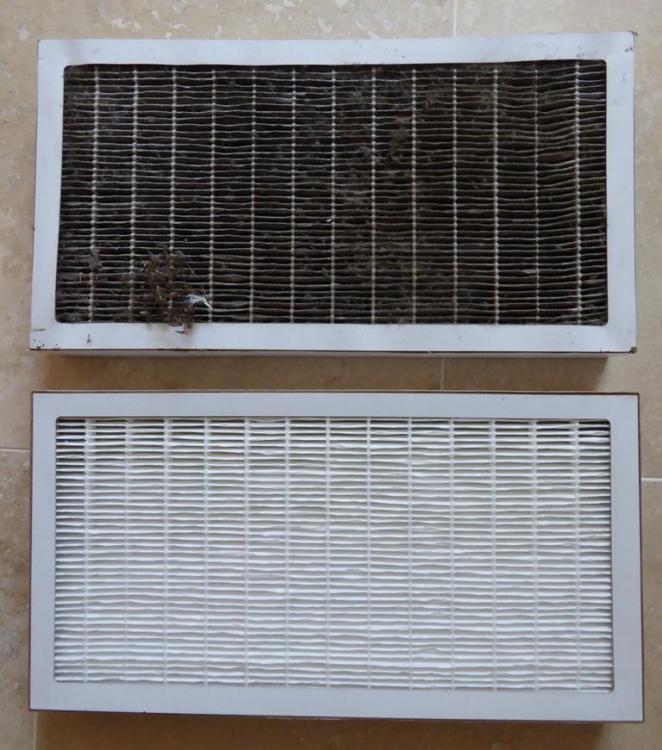
-
Pressurising ground loops
Jeremy Harris replied to pudding's topic in Ground Source Heat Pumps (GSHP)
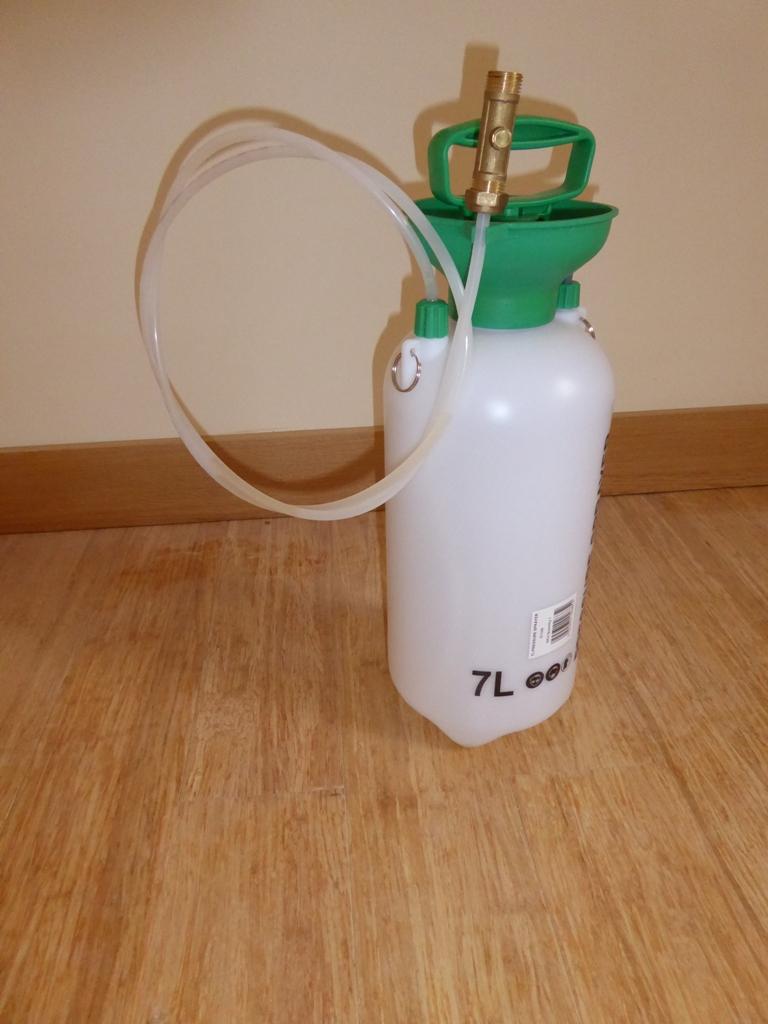
Just found a better photo of the whole unit - looks like I used a 7 litre pressure sprayer rather than the one linked to earlier, although I doubt it makes any difference in practice: The standard flexible fill loop hose just screws directly on to the non-return valve.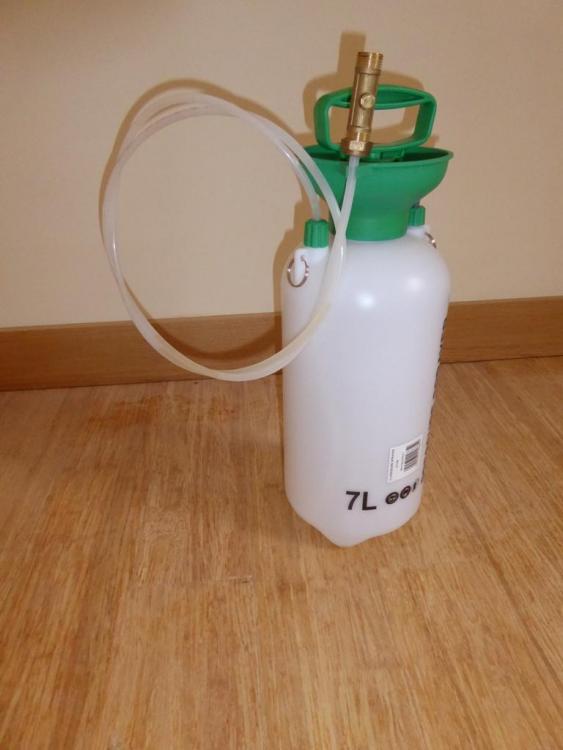
-
Making OSB air tight
Jeremy Harris replied to MikeSharp01's topic in Environmental Materials & Construction Methods
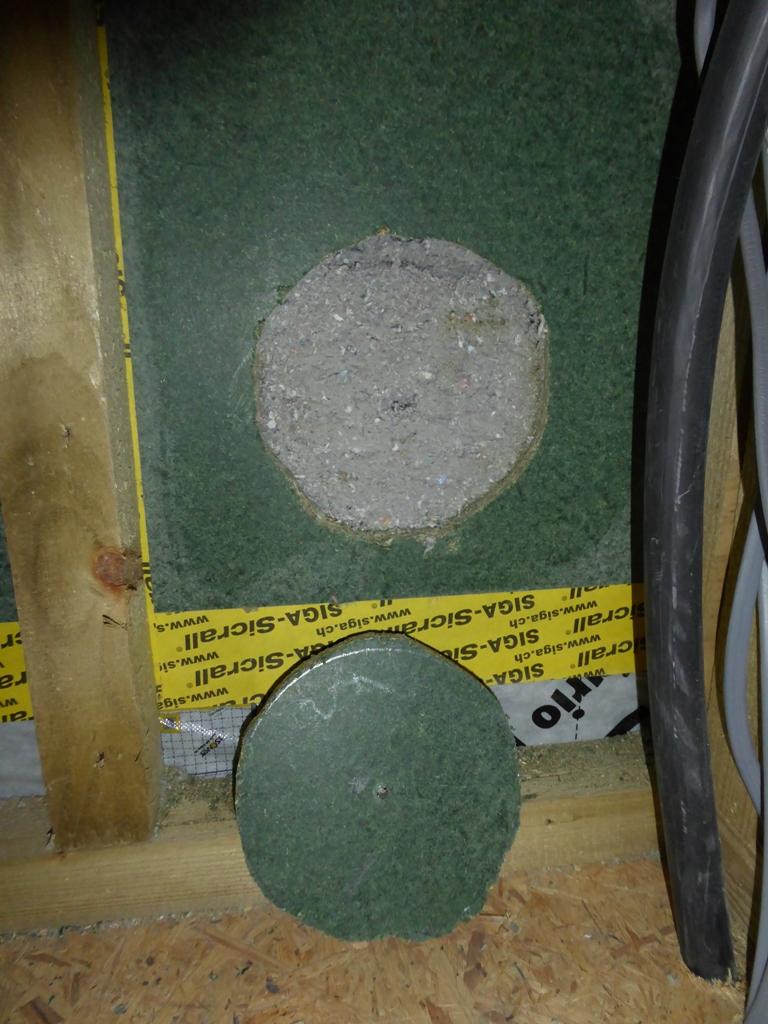
Usually the pressure on the fill hose should be a good indication that the cellulose has penetrated and filled every nook and cranny, but that depends on there being enough fill holes drilled at a close enough spacing. I remember chatting to the guys pumping our cellulose in and they reckoned that the cellulose seemed to flow a lot further than the distance between fill holes, but I'd guess that there is always the possibility that a particularly awkward area may not get filled completely, or that the installers could fail to spot that they needed to drill another fill hole in a critical area. The four holes I've had to cut through our walls were all very densely filled, and one of those was right in the top corner of a wall: This was awkward to cut out as it was right in a tight corner (hence the very ragged jigsaw hole) but it does show that the cellulose is normally very densely packed into the space, so densely packed that even the jigsaw blade hardly disturbed it and just cut it as if it were solid. This is where the fresh air intake duct for our MVHR goes through the wall - it comes out right under the eaves on the outside of the house. It was an afterthought, as I changed my mind about the type of MVHR we decided to fit so couldn't put the ducts through the wall before the walls were filled, which would have been the better option.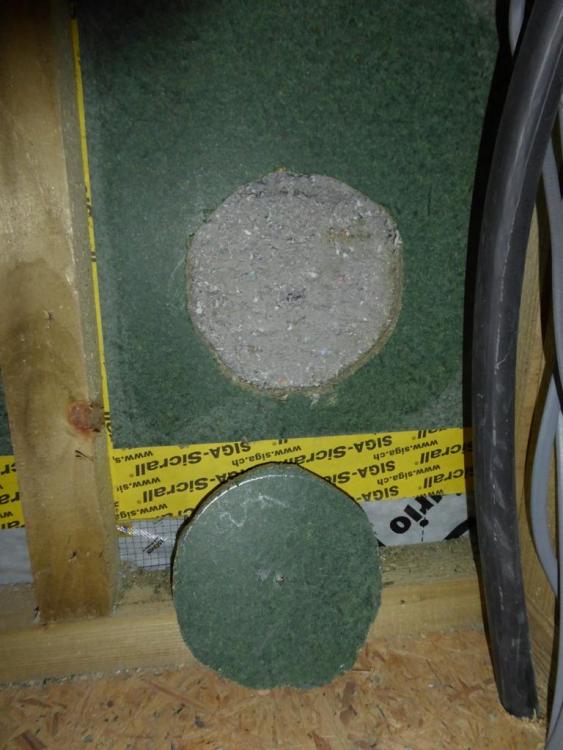
-
Pressurising ground loops
Jeremy Harris replied to pudding's topic in Ground Source Heat Pumps (GSHP)
I reckon you could adapt a garden sprayer, as I did to fill and pressurise our UFH system and as is sold by one or two companies for filling and pressurising solar thermal systems. All I did was buy a Screwfix garden sprayer (this one https://www.screwfix.com/p/sx-cs5-white-black-pressure-sprayer-5ltr/7490x I think), remove the outlet pipe and replace it with a bit of 8mm LDPE pipe, that I connected to a non-return valve and a fill loop flexi pipe, that screwed on to the filling point. @jack took some photos of the fittings I used when I lent it to him: The 8mm LDPE pipe fits the compression type fitting on the sprayer where the spray pipe normally goes perfectly, as that's also 8mm. IIRC these things will pump to around 3 to 4 bar, which was fine for filling our UFH to 1.5 bar, as your system needs a higher pressure then such a bit of kit may or may not do the job, but I think it would be worth a go for the relatively low cost. You do need to be careful when using it to not pump air in, although in my case there is an air bleed close to the fill point so any air could be bled out easily. If you don't want to make one, some of the solar thermal system suppliers sell them. At least one solar thermal supplier just modifies a hand sprayer as I did and sells it as a sort of kit of parts to fill up a system. -
Making OSB air tight
Jeremy Harris replied to MikeSharp01's topic in Environmental Materials & Construction Methods
No, just the VapourBlock boards with taped joints, but that isn't the airtight layer it's the vapour control layer. There's confusion in this thread about the two terms;they are different in practice. The idea is to have graded vapour permeability, so that the innermost layer is the least vapour permeable and the outermost layer is most vapour permeable. Airtightness is a slightly separate issue, as you want the outermost layer to be airtight enough to not cause "wind wash" through the insulation, but not to be vapour tight. In practice, much of the outer airtightness in a pumped cellulose frame comes from the cellulose itself, which in a thick layer that fills every nook and cranny forms a reasonably effective airtightness barrier. The OSB outer skin helps airtightness a lot, too, as does the protective breather membrane. There have been passive houses built with OSB as the airtightness and vapour control layer, with the edges sealed, and it apparently works OK if you get the design right, so the vapour gradient is from inside to out. You can do away with the internal vapour control layer if you make sure that the vapour permeability gradient is such that vapour will always want to move outwards over a reasonably long time period, and one house I read of did that by using thicker, denser, OSB with sealed joints as the inner skin and thinner OSB, or something like Panel Vent board, as the outer skin.