Jeremy Harris
-
Posts
26430 -
Joined
-
Last visited
-
Days Won
360
Everything posted by Jeremy Harris
-

IVT Ecolane ASHP - any owners out there?
Jeremy Harris replied to readiescards's topic in Air Source Heat Pumps (ASHP)
@moisescualex, the big problem with someone supplying you with a custom built controller is that it almost certainly won't have any form of approval, as required by EU regulations. I would be very wary of using an non-approved item of electrical equipment, as it may well not even be legal, let alone compliant with the relevant regulations (in this case the EMC Directive and the Low Voltage Directive, plus the ROHS regulations). I would personally strongly suggest that no one considers purchasing any non-compliant item of electrical equipment. -
As long as you follow the guidance in building regs you should be fine. The relevant details are in Part H, sections H1.29 to H1.33: https://www.gov.uk/government/uploads/system/uploads/attachment_data/file/442889/BR_PDF_AD_H_2015.pdf
-
You don't want a trap in a soil vent pipe either, as that also prevents the pipe from venting to atmosphere. Part of the function of a foul drain vent is to allow sewer gas to vent away to the atmosphere, and not build up in the unventilated section of drain.
-
The snag is that an external vent has to work both ways, so that it can release any pressure build up in the foul drain. An AAV only works one way and is only used to prevent a partial vacuum from forming in a vertical run of soil pipe.
-
Not sure why you'd want to fit an AAV externally. Why not just have a standard soil vent pipe grill?
-
We have twenty 200 litre Aquacell crates under our drive, these ones: They are fine as long as there is somewhere for them to drain too, as they aren't a drainage solution on their own; they need some form of soak away to work, as the crates just provide surge attenuation. They work by storing a large volume of run off in heavy rain, allowing it to drain away slowly over several hours. Ours drain to a thin layer of permeable soil we found deep under the surface clay in one corner of our site. That seems to slowly drain to the stream on the opposite side of the lane, as far as I can tell. To connect up all the rain water drains to the crates we used normal 110mm underground drain pipe. W did fit a length of the porous land drain pipe around the edge of the house, under a French drain, as a water collector, and fed that to the crates via another length of underground soil pipe. The crates need to be the same size and make, for the interlocking clips and tubes to work. To keep the crates stable they are all clipped together, once in the terram lined hole, and before the terram is wrapped over the top of the block of crates. They also have different load ratings, so it may be that it isn't that easy to "pick and mix" different types in the same block. You can pick them up for a good price if you hunt around, I bought all ours on eBay, from a local ground works chap who had a load of them left over from doing a highways job.

-
Should I get a regularisation certificate ?
Jeremy Harris replied to johndes's topic in Building Regulations
I think the key here is the date when you converted the garage to a habitable space, amongst other things. When first built the garage wouldn't have been a habitable space, so would not have been required to comply with the building regulations that then applied to habitable rooms. On the date when it was converted it would have been required to have been in compliance with the habitable room requirements in the building regs in force on that date. If, for example, the building regs that applied at the date of conversion required higher standards of insulation, then you would have had to make that room comply. Similarly, there would be a requirement for a means of escape from fire to be included at the time of conversion, as all habitable rooms need this. The same goes for the electrical installation and accessibility part of building regs; if the conversion was after the introduction of Part P then the conversion would have needed sign off on this as well. I think you will need to get retrospective building regs approval for the conversion, I'm afraid, Just because the regulations that apply to a habitable room have always been different to those that apply to an integral garage. -
What do home buyers want?
Jeremy Harris replied to Dreadnaught's topic in New House & Self Build Design
Give examples of any post here that denigrates average house buyers, then. Yes, those of us who have looked closely at (and in my case undertaken thermal imaging surveys of) new builds are sometimes highly critical of the often poor construction standards we've witnessed. However, that's supported by evidence, both from complaints by buyers and from published works by people like Paul Buckingham. The house market in most of the UK is unlike the market for consumer goods, cars, boats or whatever, in that customers have little choice. It is the big housebuilders who decide what gets built, and they don't need to worry too much about buyers, as many have to buy what's available within their budget in the area where they work, their family is, etc. We've had years of experience of having where we live determined by my employer, having to move house with 6 weeks notice when posted, so know full well how that severely restricts the range of houses that were available for us to consider buying. We're not that unusual, either, as the mass migration of people towards the South East of the UK in search of work, creating a significant element of the current housing crisis, shows. As @Construction Channel says, there is evidence that proximity to good schools is significant for a sector of those looking to buy, as are good transport links (both borne out by the way house prices remain high in such areas). The surveyor who valued our new build and the estate agent and valuer of our old house, were all of the opinion that, after location, kitchen and bathroom bling was one of the main selling points for any house. -
What do home buyers want?
Jeremy Harris replied to Dreadnaught's topic in New House & Self Build Design
Why??? Any evidence to support your prejudices? -
My point is that we have no evidence at all that thin, relatively inflexible, polyethylene DPM sandwiched between layers of concrete ever suffers from any degradation over decades of use, so I can't see any mechanism by which a layer of more robust and flexible EPDM could be a problem when protected this way. This is a drive/parking area, not just a roof, so any waterproofing solution needs to be able to tolerate that sort of wear and tear. In particular, EPDM is poor at tolerating point loads, as might be the case for pavers on pillars, something that seems to have been solved by spreading the imposed load over a wide area with the reinforced concrete capping layer. The architect's solution seems to be sound, in that the waterproof layer never gets exposed to wear and tear, as it's encapsulated within reinforced concrete. What wasn't sound was the implementation of the design; all the problems here seem to be caused by poor workmanship, I can't yet see any problem that is a consequence of the design itself.
-
Depends. If the damage happens near the concreted part than you may well not have a large enough overlap area for any patch to seal properly, which may mean taking up the concrete. It's hard to see how a membrane embedded in concrete could get damaged, especially given the flexibility of EPDM.
-
MVHR Smells
Jeremy Harris replied to AdamSee's topic in Mechanical Ventilation with Heat Recovery (MVHR)
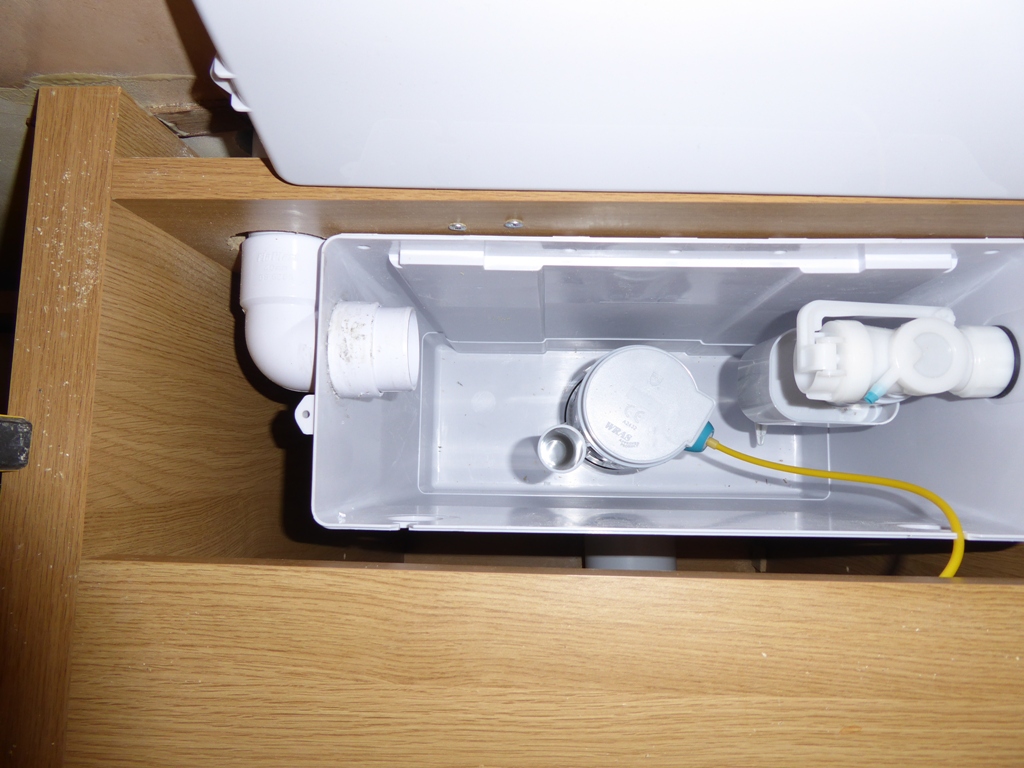
Our bathrooms are next to each other, and there was an area behind the bathroom walls where I could run an extra duct to the manifold, so that's what I did. The pan extract runs all the time, as there is an always-open air way from the space above the water in the cistern to the pan rim flush outlets, via the overflow pipe. This means there's a gentle extract from the pan 24/7. -
If it were me I'd want the EPDM well-protected from damage. Having it encapsulated under concrete makes it pretty much bomb-proof, and far less likely to be damaged than having it partially exposed. If it does get damaged in the exposed areas then I would guess that sods law says that the whole membrane will need replacing, including the area under the concreted bit in the middle, so just as much work to fix. There's no difference between an encapsulated roof membrane like this and the DPM under our concrete slab, that keeps the damp out. If our DPM fails then the whole house has to come down in order to fix it, as the slab runs under our walls. What's more, our DPM is a much thinner sheet of polyethylene, nowhere near as robust as a 1.5mm layer of EPDM.
-
MVHR Smells
Jeremy Harris replied to AdamSee's topic in Mechanical Ventilation with Heat Recovery (MVHR)
Yes, I fitted extracts above the shower in one bathroom and above the bath in the other, and they do most of the work in keeping the bathrooms well-ventilated, but the low flow rate extraction from the WC pan is enough to stop any odours from escaping from there. The key to making it work well is to make sure the seat is lowered immediately after use. -
EPDM has a pretty good reputation for long term reliability, and when encased in concrete I'm certain it would outlive you. The only slight risk is that the EPDM could get damaged when laying the concrete, but I think you'll find that all the EPDM underneath your layer of concrete is fine, and that the problems are all associated with the detailing at the upstands and edges.
-
I think you're in for a lot of work in ripping the existing concrete and pavers off, and, as the problem seems to be entirely a result of bloody awful workmanship by the "roofers" that laid the membrane I can't see any reason why you can't just lay a new layer of EPDM over the roof (after getting back to the existing EPDM), with proper detailing around the upstands and edges. This roof can be made to work OK, it just needs good workmanship. The chances are that the existing EPDM can just be trimmed back around the upstands and a new layer laid directly on top of it, I think. Heck of a lot of work, but with luck the concrete should come away from the EPDM without too much hassle. As I suggested earlier, cutting the concrete with a diamond disc cutter to just below the depth of the rebar may allow it to be lifted away in chunks. It'd need a proper disc cutter, with a depth stop, but you can hire one of those, like this: https://www.hss.com/hire/p/floor-track-saw-petrol-350mm
-
Looking at the photos of gaps in the EPDM joints, plus the running water tracking across the ceiling from the upstands, I don't think there's any real doubt as to where the leaks are.
-
MVHR Smells
Jeremy Harris replied to AdamSee's topic in Mechanical Ventilation with Heat Recovery (MVHR)
I modified the cisterns in our bathrooms so that the air space above them connects to the MVHR extract. The effect of this is to draw air directly from the toilet bowl to the extract, via the overflow pipe in the cistern. It works very well at removing odours at the source, rather than having them escape into the room. All I did was connect some waste pipe to the side of the cistern and then plumb this into the MVHR extract ducting: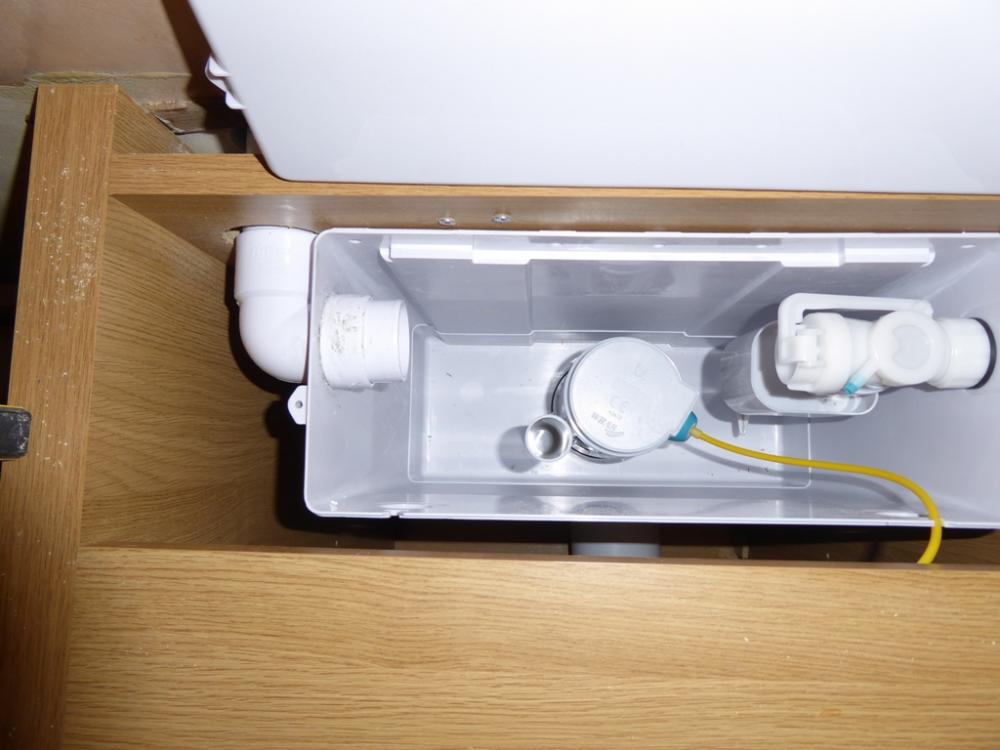
-
Neat. I wonder how long it will be before they come out with a DVB-S2 version? Seems they are thinking about it, but a Freesat compatible RPi HAT would be a really great thing to have for those of us who can't receive terrestrial TV.
-
Not really that good, as being room in roof with a big gable sticking out the middle we ended up with a fair bit more ceiling and wall area than we could have had if we had been able to build a conventional two storey house on the same footprint, plus the first floor area is smaller than the ground floor. Planning constraints on ridge height ruled that out, as the planners had originally approved a bungalow for the plot. I agree that single storey houses do present more of a challenge, but to balance that it's often easier to incorporate more ceiling/loft insulation than it is to use more wall insulation, in terms of lost living space. Being single storey needn't be that much of a disadvantage, as long as the area/perimeter ratio is reasonable.
-
Our house slightly exceeds the PassivHaus standard, but isn't a certificated PassivHaus; I just used the same principles and didn't bother to pay the significant premium for accreditation. We have had it valued and the valuer knocked 5% off the normal market value because it was a passive house and so unlikely to appeal to as wide a market. When I questioned him about this he said that most people aren't interested in a house with low running cost, they are more interested in the bling in the kitchen and would be put off by there not being a "proper boiler and heating system". Overall, the fabric build cost of building to a passive standard was around 10% less than a traditional block and brick house, according to one architect who came to see the house and asked me if he could have the cost breakdown. Most of that saving was from the reduced labour cost in choosing a build system that went up very quickly and was weatherproof within a few days of starting. There is very definitely a law of diminishing returns when it comes to improving thermal efficiency. In our case we opted to accept wall U values of 0.12 W/m².K, rather than try and reach my goal of 0.1 W/m².K, as the difference was so tiny as to not be worth worrying about; the house still exceeded the PassivHaus requirements, as things like the doors and windows had a massively greater impact on heat loss. Good airtightness is definitely critical, though, but doors and windows will most probably be the single greatest source of heat loss by a significant margin. Our ventilation heat loss (better than PH airtightness and MVHR) is around half the heat loss from the windows, and that's with windows that have a Uw of around 0.7 W/m².K. The heat loss through all our walls is around 30% higher than the window heat loss, but even if we had opted to get the walls down to the target of 0.1 W/m².K then they would still have had a leat loss of around 10% greater than the windows, and we were clearly into the law of diminishing returns from the loss of internal volume we'd have had from making the walls any thicker.
-
No need for a battery, as all domestic car chargers run on AC, not DC, so have to run from a mains supply. There's a very big mismatch between the variable DC voltage from a PV system and the demanding controlled voltage charge requirement for a typical EV or PHEV battery, so even with DC charging there is still a need to have a DC to DC converter in the car to control the charge, which will be just as inefficient as an AC to DC converter. Taking my car as an example, the battery voltage is around 350 VDC, whereas the string voltage of our PV system varies from around 300 VDC to around 380 VDC, with this voltage varying a lot from minute to minute. The PV inverter regulates this varying DC voltage to 230 VAC, and if the inverter didn't do this regulation then the car charger would need to do a similar regulation job, with similar losses. In practice the losses are small, as inverter are better than 90% efficient, as are car chargers.
-
Non-inverter Air Source Heat Pumps
Jeremy Harris replied to Triassic's topic in Other Heating Systems
I'm not convinced. The main advantage of having a variable speed ASHP is its ability to modulate down and avoid defrost cycling. Ours virtually never runs at its full rated power; more often than not it runs at around its minimum power, which significantly reduces the risk of frosting up. -
Yes, they are budget passive house standard windows (£8,500 for all the doors and windows, including a big glazed gable) with a reasonably good thermal performance, around 0.7 W/m2.K Uw. It was only after the house was finished that we realised that they were also pretty good at keeping sound out.
-
Cheap but good looking vanity worktop
Jeremy Harris replied to Jude1234's topic in Bathrooms, Ensuites & Wetrooms
Yes, it is way, way, overpriced for what it is, but it definitely does stain, really badly when it's not cleaned as soon as something like tea or coffee gets spilled on it. As a part of my last job, we upgraded all the work surfaces in a 900 person new office/lab building from laminate to Corian. To say we were disappointed with it in the refreshment areas is an understatement. It was fine in the toilets, but within a few months the Corian in the refreshment areas was badly stained from tea and coffee spills that hadn't been cleaned up quickly. Unlike stone, Corian can be cut with a router or circular saw pretty easily, due to its relatively high (around 35%) plastic resin content. The mineral powder filling is also pretty soft.