Jeremy Harris
-
Posts
26430 -
Joined
-
Last visited
-
Days Won
360
Everything posted by Jeremy Harris
-

MVHR is Largely Bogus
Jeremy Harris replied to DavidHughes's topic in Mechanical Ventilation with Heat Recovery (MVHR)
Trickle vents have a very highly variable flow rate, from near zero on a still day (so almost no ventilation) to a very high flow rate when extraction fans are running. My experience with them in three houses was that they are a curse, for several reasons. Noise was one of the main problems we had. In two of the three houses we've lived in with trickle vents they howled like a banshee with the wind in a particular direction. Dirt was another issue, they produce dirty smears where dirt and cobwebs get pulled in around them. We also didn't find them very effective in any of the houses that had them, and just tended to open windows to get ventilation in some rooms. -
Just checked an architrave, and it was 70.19mm x 18.69mm, so slightly over on width and slightly under on thickness (for some reason I thought it was 20mm thick, but it seems it's all 19mm).
-
Pity you're so far away, as I have a few lengths of 70mm x 20mm PAR oak sat in my garage. I bought all the oak from English Hardwoods, on the recommendation of Joiner over at the old place. Very pleased with everything I got from them, I don't think I had one dodgy bit in the whole order, plus they over-supplied by maybe 10% or so.
-
I used solid oak skirting and architrave, all fixed with adhesive and most of it without clamping. The skirting was easy, as it just stayed in place using just Sticks Like Sh*t. The architrave was trickier, but I found that running Sticks Like Sh*t down the wall bit, then using mitrebond on the lining to architrave bit worked very well. The technique was to put both adhesives on the lining/wall bit first, then apply the mitrebond primer stuff to the architrave and carefully stick it on. You have very little time to get the position right before the mitrebond goes off, but it does mean you can just apply pressure with your hands for a few seconds and then the things are bonded. They've been on for 5 years now, with no sign of any problems (and no pin holes to fill).
-
MVHR is Largely Bogus
Jeremy Harris replied to DavidHughes's topic in Mechanical Ventilation with Heat Recovery (MVHR)
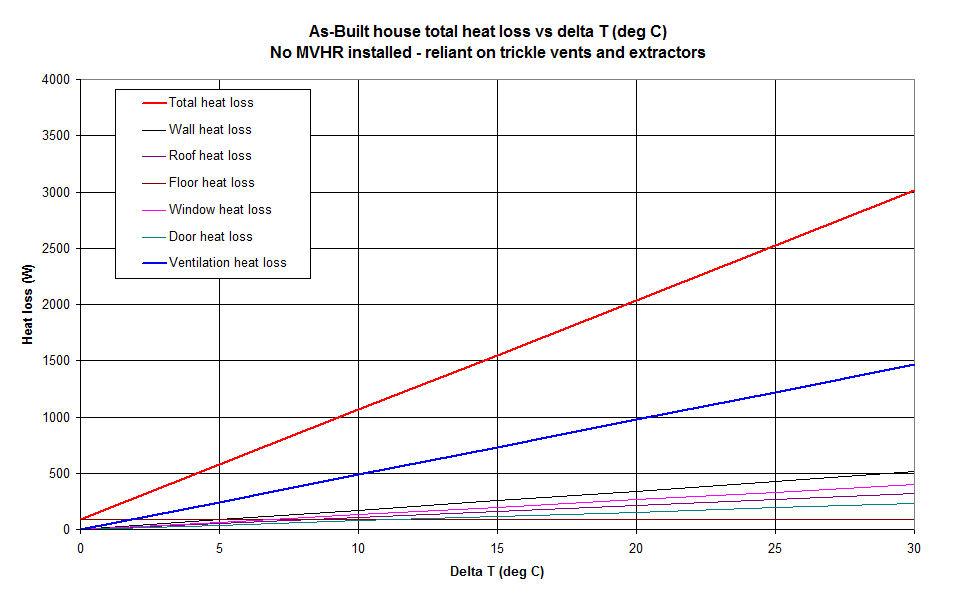
The basic assumption in Part F is that trickle vents and extraction fans will produce the same degree of ventilation as the background ventilation rate when using a continuous mechanical ventilation system, so the heat loss difference will be just that from the MVHR heat exchanger efficiency (typically about 85%). For our house, I ran the numbers both with and without MVHR, with the same level of ventilation, and these are the results: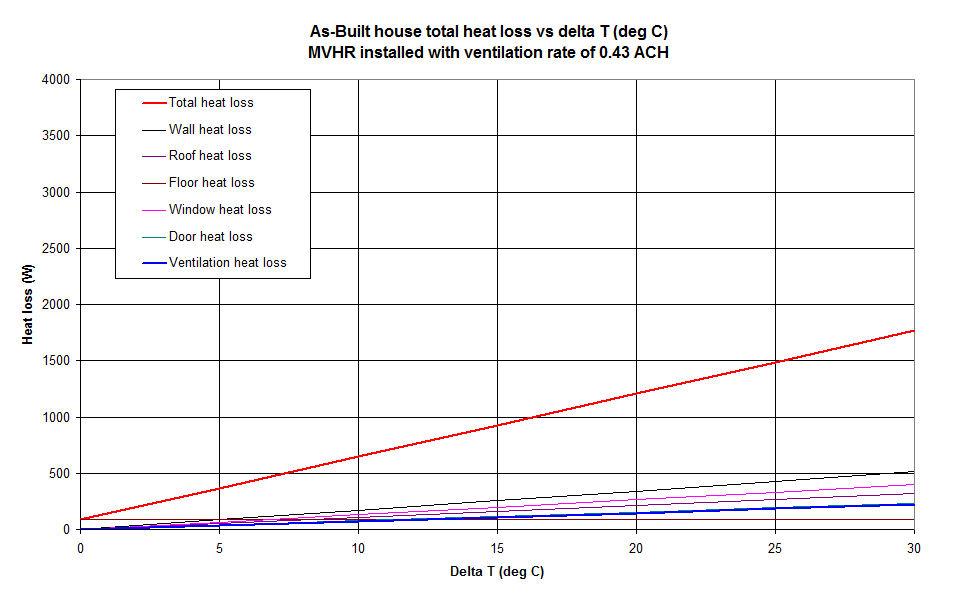
-
MVHR is Largely Bogus
Jeremy Harris replied to DavidHughes's topic in Mechanical Ventilation with Heat Recovery (MVHR)
Frankly I'd pay a lot of money to run the thing just to get the air quality benefit. It makes such a massive difference over just passive ventilation that there's no contest. We can even dry clothes inside the house quickly, avoiding the need to use the tumble dryer, with no condensation problems. MVHR probably saves me over £100 a year in hay fever medication alone. I need to work out what the saving is from not running the tumble dryer, probably a fair bit. -
The only real choke point on our UFH is where all the pipes have to go through one doorway from the utility room to the kitchen. Doorways closest to the manifold will inevitably have to accommodate a closer spacing, but there's no real reason to run tight groups of pipes around a room like that I'd have thought.
-
Woodfibre has an R value that's a fair bit poorer than PIR, but the best measure is to look at the U value, as that tells you how much heat will be lost through a given thickness of any insulation. Very roughly, PIR will need to be between 1/2 and 2/3rds the thickness of woodfibre in order to get the same level of insulation, or flipped the other way around, woodfibre needs to be at least 50% to 100% thicker to give similar performance to PIR.
-
Something for the weekend sir?
Jeremy Harris replied to BotusBuild's topic in Central Heating (Radiators)
The motor should be a standard geared synchronous motor, as these valve companies don't make their own motors, they buy them in, and pretty much every valve uses a very similar motor (most seem to be similar enough to interchange with those from other makes). This is a pretty standard universal valve motor: https://www.ebay.co.uk/itm/SYNCHRON-MOTOR-UNIVERSAL-SYNCHRONOUS-MOTORISED-VALVE-TSSYN/392273178813?hash=item5b554db0bd:g:94EAAOSwwJJcqg-c -
Not really, no. I do keep a very rough tally of how many times a day the pump comes on (just because it is easy to see on the electricity use data) and I know that it pumps around 250 litres every time it comes on (recharging the pressure vessels). From that I estimated that we use roughly 400 litres per day, more than half of that being showers.
-
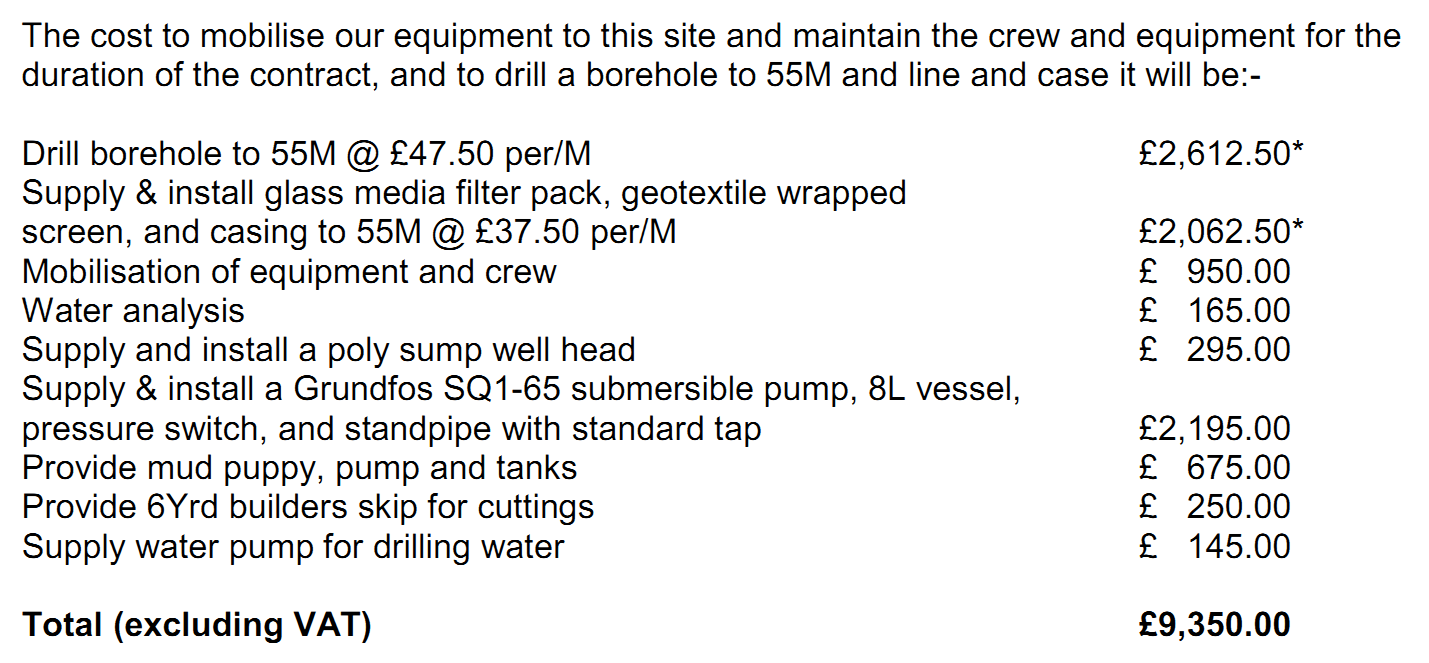
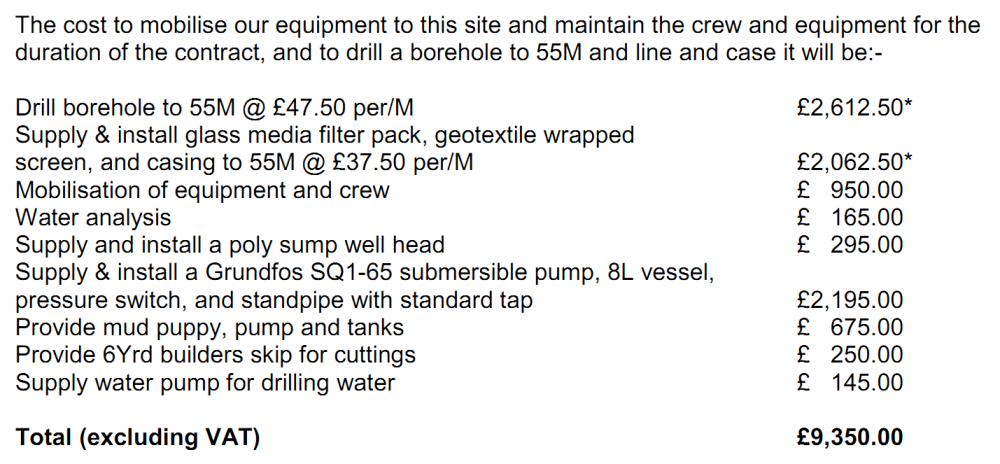
Sadly any knowledge I've acquired is a consequence of being badly let down! I knew nothing about boreholes or water treatment until ours turned into a long-running saga, that delayed our build for a long time. Finding the problems and then fixing things led to me getting advice from a really helpful chap in the USA, somewhere where lots of people have their own borehole supply (more common than municipal supplies in many areas). When it comes to cost, there are big variations from one area to another, and for drilling through different types of ground. There's a pretty big upfront fixed cost, to mobilise the drill rig, compressor, settling tanks, waste skip, bowser etc to the site and set it up, then there's usually a fixed drilling and lining cost to a minimum depth, plus an additional per metre cost above that. The per metre cost is based on the time it takes to drill, plus the cost of the casing, and varies a bit with the geology. Finally there is the cost of test pumping, installing the pump etc, and the required pressure tank, controls, filtering equipment etc. The prices I have are a bit old, as our borehole was drilled in 6 or 7 years ago now, but were initially: We ended up having some problems and so there was a reduction in the price we finally paid because of those. The above prices, as well as being a bit out of date, related to drilling in our area, through highly compacted gault clay, with the greensand aquifer about 40m down, then a layer of hard Purbeck stone under that. The drill hit the Purbeck at about 50m down, and nearly stopped dead. In error they carried on drilling through it, after changing the drill bit, and it was really slow going. They didn't think they'd hit water, so after half a day when they'd only drilled about 3m or so I called a halt, as we knew from the hydrogeology that there wasn't any water underneath the Purbeck. As it happens, they had drilled right through the greensand aquifer without noticing, and one of the drillers came back the next day to double check, as he wasn't 100% sure that the hole was dry. We test pumped it and found that the yield was way more than we needed; we could pump at 1500 litres/hour and the borehole kept up with it, and we only need about 400 litres/day.
-
Anyone used online 3D printing services
Jeremy Harris replied to Gone West's topic in Tools & Equipment
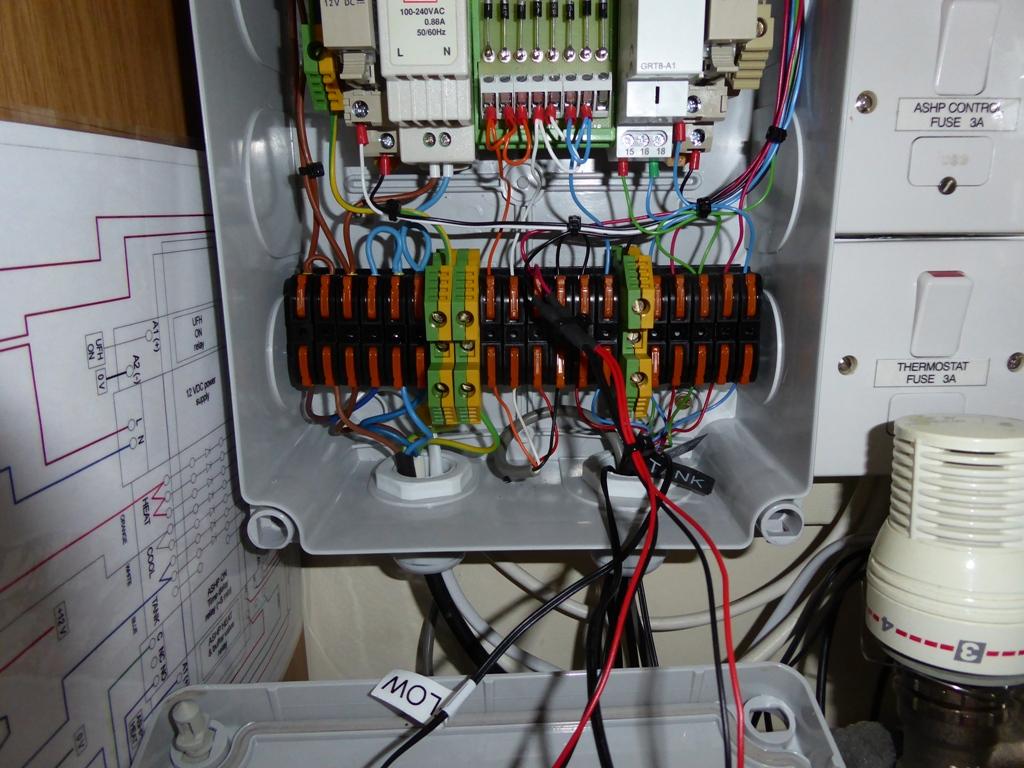
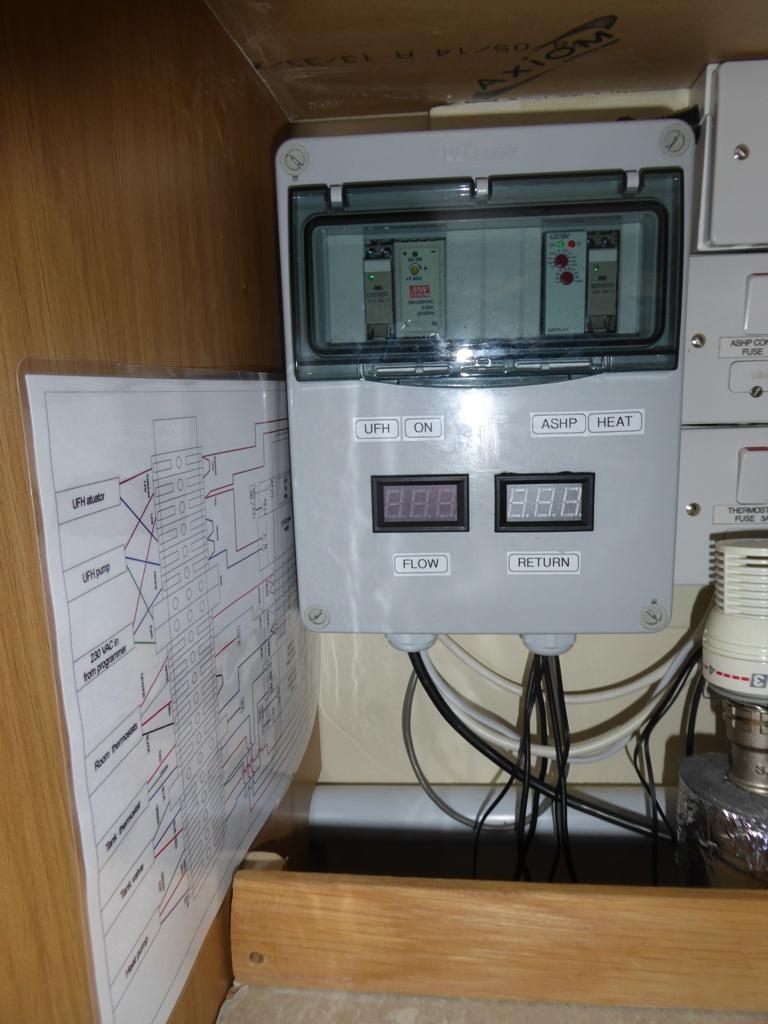
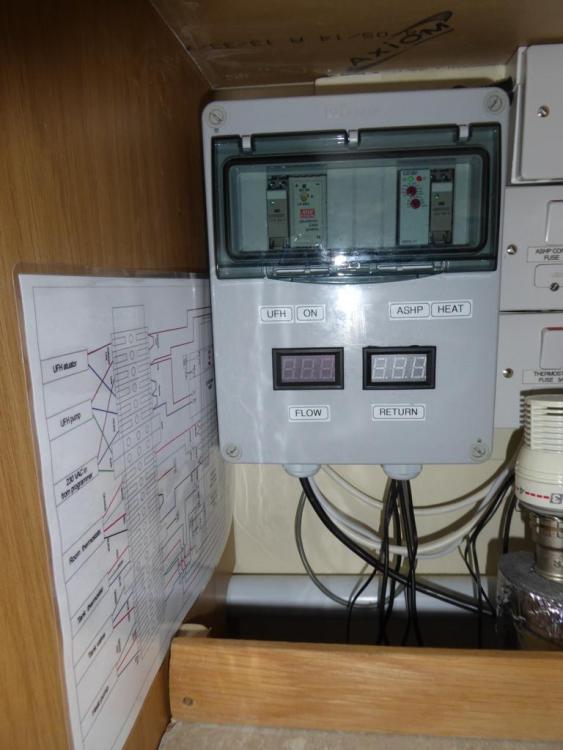
Not sure, but droning John Ward stripped apart and tested a variety of these: https://www.youtube.com/watch?v=G9JTBTrcDSE They seemed OK, but obviously don't have any approvals, so there's no way I'd use them for anything where they might be taking a high current. The ones I used were in a wiring centre for our UFH, with most of them being used for 12 VDC very low current signals and a few handling 230 VAC for the programmer, thermostat and pump, so the total current was very low, less than 0.25 A. The nominal rating marked on the ones I used is 32 A, with a wire capacity range of 0.2mm² to 4mm², but I'd not feel happy running an unknown connector like this at anything close to that current. I opted to use them solely because they made for a fairly neat and easy to wire box (everything to the right of the double earth blocks and 12 V PSU is 12 VDC) :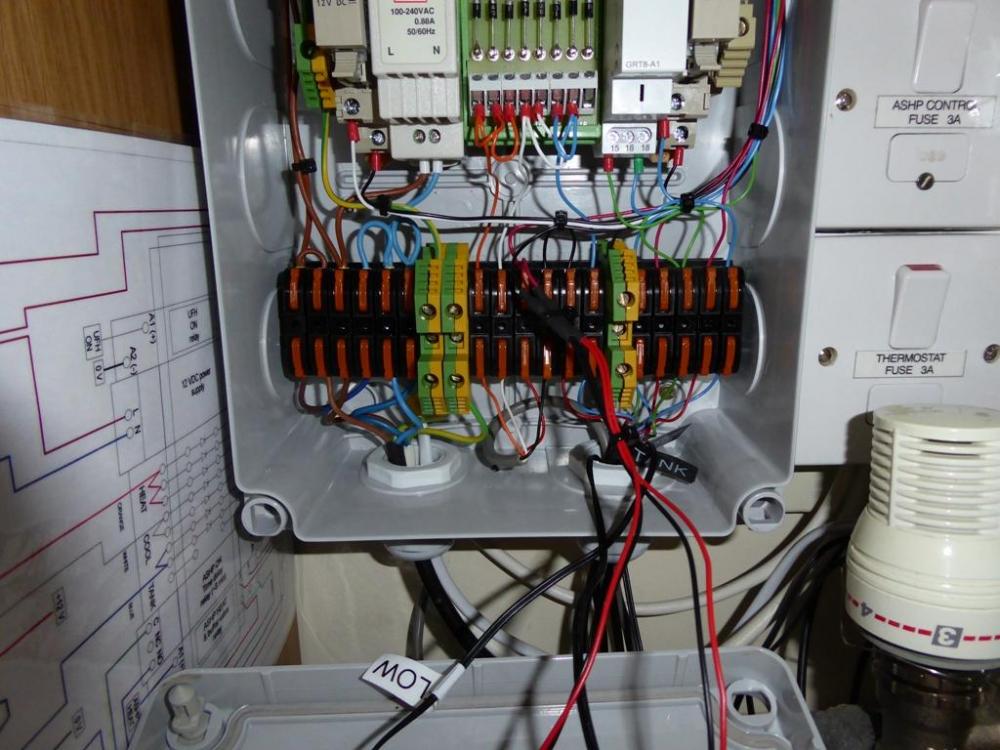
-
I misread that as Corona at first . . . Flooring going viral.
-
+1 to the above. Building inspectors have two useful qualities (usually), local knowledge and often (but not always) a pragmatic approach to issues arising during construction. The LABC one that looked after most of our build was great, really helpful and genuinely very interested in what we were trying to do.
-
Not sure, TBH. The machine has a mechanism in the base that chops up the compressed stuff in the bales (which comes out like a solid brick) and then pumps it at a pressure that I think it probably higher than a workshop extractor. The pressure is enough to almost blow the hose out of the operators hands when the space they are filling is full, and there's a definite knack to turning the flow off very quickly as the back pressure builds up.
-
Interesting observation about muck in MVHR terminals and ducts. The only one in the house that collects fluff and muck is the one in the shower room. No real idea why, I can only think it's all the fluff that comes from the towels. I've checked the other extract terminals (they just pull off and can be stuck in the dishwasher) and none of the others, even the kitchen one, seem to get grubby.
-
Anyone used online 3D printing services
Jeremy Harris replied to Gone West's topic in Tools & Equipment
The fake DIN rail mount ones I have are an extremely close copy of a genuine Wago, as far as the lever and mechanism etc goes, but they don't have any brand name marked on them, just the wire size range, voltage and current rating. The Chinese seem to be pretty damned good at copying this sort of stuff. -
Anyone used online 3D printing services
Jeremy Harris replied to Gone West's topic in Tools & Equipment
That's what I thought when I saw it, but only because I have a couple of 222s sat on my desk -
Building regs stipulate that you must either have continuous mechanical ventilation (with a specified extract capacity for the kitchen, bathroom, WC and utility room) or you must have extraction fans in those rooms. The rates are different for each, and are given in Part F.
-
We had one in the last house and I fitted a strong point behind the plasterboard in the ceiling of this house, plus the wiring, so I could fit one. As it happens, we found that we just don't need one at all. The MVHR seems well able to both keep condensation down and remove smells quickly. The only proviso I'd add is that we don't do much frying, so probably the worst thing the MVHR has to deal with is something like cooking cauliflower or broccoli, and we do tend to switch the MVHR to boost for an hour or two then, just to clear the smell quickly.
-
Looks fine, pretty much exactly how I did it, and ours has been working for years now.
-
I used a short bit of 22mm pipe on the softener end of each valve, fitted with compression 22mm to 3/4" BSPM fitting, to accept the fitting on the end of full bore 3/4" flexis.
-
I used three full bore 22mm ball valves for mine, like these: https://www.screwfix.com/p/full-bore-lever-ball-valve-yellow-22mm/30584 Not too bulky. I arranged them on a straight run of 22mm pipe along a wall, pretty much exactly as in that diagram, with a tee to the inlet valve that feeds the softener, an inline valve to the next tee that acts as the bypass then another tee to a valve that takes the outlet from the softener. With the inline valve closed and the other two open water flows through the softener. With the two valves connected to the softener closed and the inline valve open the softener is bypassed, really just for allowing a water supply if the softener needs maintenance.
-
Anyone used online 3D printing services
Jeremy Harris replied to Gone West's topic in Tools & Equipment
Easy enough to just unclip them if you ever need to poke a probe in the hole, though. The neatness of having them tidied away outweighs easy access to the probe slot, IMHO. -
Anyone used online 3D printing services
Jeremy Harris replied to Gone West's topic in Tools & Equipment
Looks good, nice and neat. Only snag is that it covers up the probe test slot, although that's not really a biggie (handy though, at times).