Jeremy Harris
-
Posts
26430 -
Joined
-
Last visited
-
Days Won
360
Everything posted by Jeremy Harris
-
Or use triangulation and a surveyor's tape. Divide the drawing up into big triangles with known distances, ignore the angles and just lay out using the distances along the arms of each triangle.
-
With no MVHR then trickle vents on all windows plus extraction fans and ducting in the kitchen, utility, WC and bathrooms would be required, I believe, in order to meet the minimum ventilation rates in those rooms. TBH, the cost of the extraction fans and ducting would be probably a fair proportion of the cost of fitting MVHR, plus there would be no saving in heating bills.
-

Fitting an undermount sink to granite
Jeremy Harris replied to Lesgrandepotato's topic in Kitchen Units & Worktops
Our under mount sink was fitted on top of the base unit by me, with rebates cut into the top of the units so its top face was level with the under side of the stone worktop. The worktop people took templates from that, and when they fitted them they just used clear silicone to both bond the stone down and seal around the sink. I have to say that they did a neater job than I could have done. -
The bit that would come in to play is the prevention of falling bit of the regs, so a handrail might be needed, and/or toughened glass. I don't have the building regs on this laptop, so can't easily check, but they can be downloaded, so you could download the relevant approved document and check.
-
FWIW, I found (by chance, from a very helpful chap at our local independent builders merchant) that we didn't really want a trade account. He advised that I'd be better having a cash account, where I paid cash with order for anything. The logic is that a trade account usually provides 30 days free credit, so the BMs load the cost of that credit on to their trade account prices. A cash account gave better prices, as the BM didn't have to provide us with credit. As we were using our own money for the build, and as interest rates on savings were almost non-existent, it made more sense to pay cash with order and get better prices. As another tip, I found that we got much better service, and prices, from our local independent BM. They tried hard to match the best price I got from anywhere, even online, and they had the advantage over online suppliers in that they had very good drivers, who'd take the time to drop stuff exactly where we needed it on site (very useful on a congested site).
-
Checklist for Dodgy Media Articles
Jeremy Harris commented on Ferdinand's blog entry in God is in the Details
I've always take the view that the Mail, Sun etc are really just comics. They only exist in order to provide entertainment, and are in the same category as publications like Hello magazine... -
Extractor not staying on (on lighting circuit)
Jeremy Harris replied to gravelld's topic in Electrics - Kitchen & Bathroom
I agree, and suspect like a lot of stuff in BS7671 it's just people at the IET that have nothing better to do than dream up ever more convoluted regs, in the desire to reduce risks which are already acceptably low. Take a read of the new Section 722 if you want a laugh, that stipulates stuff that's close to being unobtanium, and so is being very largely ignored by all the big national installers. -
Extractor not staying on (on lighting circuit)
Jeremy Harris replied to gravelld's topic in Electrics - Kitchen & Bathroom
I'll admit to getting inventive when wiring a timer fan to the last house, as the way the cables ran in the loft made it much easier to run two lengths of 1mm² T&E to the fan, with only one of them carrying the neutral, rather than run a single length of 3 core + E. I was also a bit naughty in that I fitted a DP isolator in the loft, by the hatch, that isolated the whole bathroom lighting and fan circuit. -
Checklist for Dodgy Media Articles
Jeremy Harris commented on Ferdinand's blog entry in God is in the Details
Would you really expect a socialist newspaper to not take a gratuitous pop at landlords, though? They exist by stoking up socialist outrage at what they see as inequalities in society. The daft thing is that a lot of landlords I've known haven't been from the sector of society that the Guardian views with disdain. I used to read the Guardian years ago, really to try and get a more balanced view, but got fed up with the inaccuracy of their reporting (not to mention their spelling). -
Extractor not staying on (on lighting circuit)
Jeremy Harris replied to gravelld's topic in Electrics - Kitchen & Bathroom
Connecting the earth conductor to neutral was the lucky choice when getting things a bit awry, as usually the two will be at about the same potential. I'm guessing that you don't have an RCD, though, as I'd have thought that the imbalance when trying to run power via the earth conductor would have been more than enough to make it trip. Photos of the wiring you find might help one of us suggest the best way to connect things. -
Just to add a data point about electricity bills. Our house is 130m², is heated/cooled using an ASHP and is all-electric (we use no other form of heating/cooling). We do have solar panels on the roof. Our electricity bill is around £500/year, but we get back about £150/year for the electricity we sell back to the grid (not the FiT subsidy, that's an additional £850/year). That electricity bill includes charging my electric car. The net "cost" for all fuel over the course of a year is about minus £500/year... The house is well-insulated, pretty airtight, and has MVHR (the latter saves us around £150 to £200/year). The air quality is just fantastic, like @jack I could never go back to living in a house without MVHR.
-
Extractor not staying on (on lighting circuit)
Jeremy Harris replied to gravelld's topic in Electrics - Kitchen & Bathroom
The wiring to the fan should be: L = permanently on line from lighting circuit, connected via new three pole fan isolator switch. L1 = switched line from lighting circuit, connected through the isolator switch (makes isolating the fan much safer). N = Neutral from lighting circuit, also connected through the isolator switch. The only sure fire way to trace back the wiring is to check it with a meter to find the permanently on line and the switched line. If your lighting has been wired so that it's loop in switch, then all three connections needed should be in the switch. A photo of what's behind the switch should allow one of us to tell if it's loop in switch or not. Given the age of the installation I rather suspect it's loop in fitting, which means that the neutral won't be available at the switch, only the permanently on line and the switched line. Again a photo of what's behind the switch should help one of us tell if that's the case. If it is, then it means a bit more digging around to find the best place to connect to. -
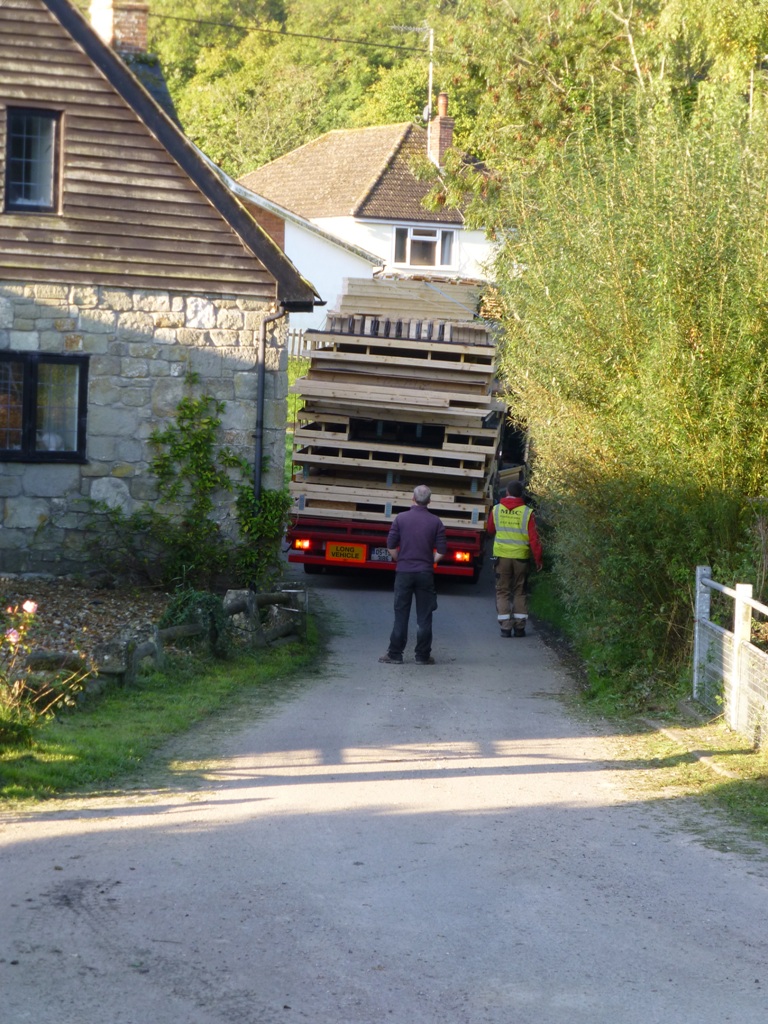
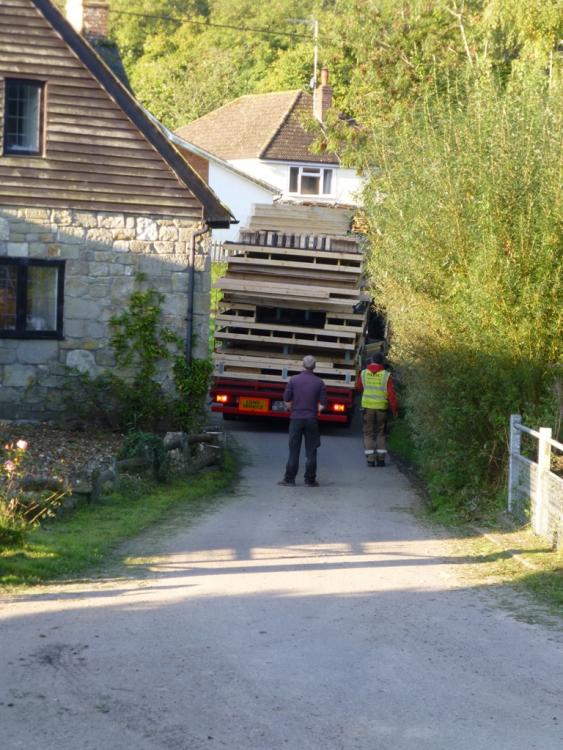
FWIW, I would have said our plot was pretty inaccessible. The lane is a single track, with a narrow bridge over a stream right by the entrance to the plot. The plot has a steep slope, too. However, our timber frame came all the way from Ireland and the truck "just" managed to back up through the 9ft 6" wide space in the lane: As well as that big truck getting to the site, we also had around fifty muckaway trucks, plus a dozen or so readymix concrete trucks, and a 100ft jib crane. Space was damned tight, but we learned early on that some drivers (notably not concrete truck drivers) seem able to do the near-impossible when it comes to manoeuvring in tight spaces.

-
Extractor not staying on (on lighting circuit)
Jeremy Harris replied to gravelld's topic in Electrics - Kitchen & Bathroom
The wiring's wrong, as the earth should never, ever be connected to a live terminal (neutral is classed as being a live terminal). The earth conductor should be parked in the terminal marked "C" on the right hand diagram. I say parked, as I believe that it's not used, as this fan is probably double insulated (most are). The wiring needs two line connections and a single neutral connection. The two line connections are a permanently on line (via an appropriate isolator switch) and a switched line from the lighting circuit. The neutral needs to be common to both the switched line and the permanently on line, so the permanently on line needs to come from the lighting circuit, but before the switch. With this type of fan it's normal to install an isolating switch that can isolate both line connections and the neutral, for safety reasons. This is the normal type of fan isolator: https://www.screwfix.com/p/mk-logic-plus-1-gang-10a-3-pole-fan-isolator-switch-white/12319 or this one: https://www.screwfix.com/p/british-general-1-gang-10a-3-pole-fan-isolator-switch-white/69862 Your wiring looks to be the old colour codes, so red is line, black is neutral and the bare wire (which must be sleeved) is earth. The permanently on line goes to L, the switched line from the lighting switch goes to L1 and the neutral goes to N. -
Checklist for Dodgy Media Articles
Jeremy Harris commented on Ferdinand's blog entry in God is in the Details
Sometimes, as with this article, the headline or photo immediately shows the lack of truthfulness, as in, "How could the outside of a house possibly be at 39°C as a consequence of poor insulation?" In the main, articles like this (which is really about compliance with regulations) don't seem to be written by subject matter experts, especially when the intention of the author may be to use something like this as a stick to beat a particular populist drum (in this case "nasty landlords", I suspect). However, a lot of the time it's just lazy journalism, with no effort put in to fact checking, that produces tosh like this. A scribe is told to go and write X number of words about something, and puts the least amount of effort possible into doing so. Sadly the internet is a rich source for the lazy journo, as probably 80% or more of the content on the web is either flawed or just plain untrue. Anyone can publish anything, and there's no obligation on anyone to only publish facts, plus those who make money from people reading web pages (from page-view related advertising) really don't want to publish truthful stuff, as it's often far less interesting than something that's been shaped to appeal to that part of human nature that enjoys sensationalist stories. The real problem is that fact checking to prove that a story is garbage takes time, and few people can be bothered with it, so we end up living in a sea of misinformation. -
There should be near-zero lateral force from the rafters to the walls. The two main options are either to hang the rafters from the ridge beam, so the ends just rest on the walls, with the loads being taken by the ridge beam, or to use a ridge board with the lower ends of the rafters tied together with joists to prevent the spreading load being imposed on the top of the walls.
-
Good point about the relative cost, @ProDave. Finding a kitchen for a couple of thousand less would pay for a basic MVHR, and the kitchen could always be upgraded later. We could easily have saved double this just by opting to fit slightly less expensive worktops in the kitchen, and they would have been easy to swap later if need be, whereas fitting an MVHR system later would be a bit of a nightmare.
-
I used contractors for the ground works, plus a timber frame supplier who provided a complete package of foundations, frame, insulation and guaranteed passive house airtightness. I then employed sub-contractors directly for things like plaster boarding and skimming, wiring, etc, and I did all the plumbing, heating system, some of the labouring for the electrical installation, fitting the MVHR system, doing all the internal joinery in oak, fitting out the kitchen, utility room, bathrooms, WC etc, laying the flooring and doing a fair bit of the outdoor work myself to try and save money. I reckon I worked for maybe a pound an hour..... Our 130m² build came in at £1380/m², excluding the cost of the land. If we'd employed someone to do everything then the cost would have been well over £2000/m².
-
Not going for MVHR seems a bit short sighted, IMHO, given the significant improvement in air quality it provides. The energy saving is a bonus. You almost certainly won't get close to an EPC rating of A with just a heat pump, trickle ventilation and mandatory extract fans (and all those mandatory extract fans mean you're going to have several holes/ducts to ventilate the bathrooms, utility room, WC, kitchen, anyway). Even with MVHR getting to EPC A is not that easy without adding a reasonable amount of PV or other renewable generation. I'd have thought that an all-electric house without renewable generation might struggle to get much better than a mid-range EPC B, TBH.
-
Which ASHP are set up to cool
Jeremy Harris replied to Triassic's topic in Air Source Heat Pumps (ASHP)
Not sure that the real-world facts support the views in that article, TBH. Our ASHP seems to run with a COP of around 4 when in cooling mode, based on measurements of how much power it uses and the output flow temp and rate. That means it's pretty much as efficient when cooling as when heating. We run our ASHP at around 10° to 12°C in cooling mode, and that cools the surface of the floor to about 17° to 18°C (it rarely drops below 18°C though). There's zero condensation, and I wouldn't expect any, as the humidity in the house would have to be around 80% for that to happen, and in hot weather we rarely see the humidity get above 50%, most of the time it's around 35% to 40% at most. We've been cooling the slab in hot weather for several years now, without any problems, and at near-zero cost, as the PV system provides over 90% of the energy needed to run it. -
Electric cable and EPS
Jeremy Harris replied to jfb's topic in Regulations, Training & Qualifications
What happens depends on a lot of variables, with time and temperature being the two most critical. Worst case, the cable ends up getting very sticky and "melting" a channel in the EPS, as the plasticiser leaches out of the cable and attacks it. Although sticky on the outside, the cable may end up getting brittle and if flexed there's a chance that the insulation might fail, but usually the damage seems to be mainly to the EPS and the outer sheath of the cable. If it stays cool, then the chances are that it will take years before there's any serious degradation, but without ripping it off and looking at it it's hard to know what might be going on. -
What to treat doors when the manufacturer says "do not oil"?
Jeremy Harris replied to ProDave's topic in Doors & Door Frames
I think the manufacturers concern may be that some types of oil may contain solvents that could affect the veneer adhesive. Perhaps test a hidden area of a door first, just to make sure. My gut feeling is that Osmo will be fine, as it's not very runny and doesn't seem to contain much solvent. -
If it is a mould or lichen, then copper may work as a way to stop it. We had a lot of moss and lichen growth on the concrete tiles at our old house, enough to regularly block the gutters and make a mess on the drive. I found that spraying the tiles with copper sulphate solution was effective at both getting rid of the stuff and preventing it from recurring for two or three years. There are copper tapes/strips sold to fit along the ridge of a roof to stop moss and lichen growth, and these probably work by leaching out enough dilute copper salts to stop anything growing. I wonder if a copper plate around the MVHR outlet might work?
-
Could it be a form of black mould? Just guessing, but the MVHR outlet is always going to be a bit warmer than ambient, plus probably a bit more humid, so perhaps this difference is enough to provide ideal conditions for some form of mould, or perhaps a lichen.
-
Getting a Valuation for Land with Planning Permission
Jeremy Harris replied to Pemu's topic in Costing & Estimating
I've just dug out our valuation from 2013. The valuer put the completed house value down as £340k, with the plot value being £140k, so in our case the plot was valued at about 40% of the completed house value. A part of that will be because we chose to build a 2 bedroom house, rather than a 3 or 4 bedroom house of the same floor area, I suspect. The 3 bedroom cottage just up the lane from us, which is a fair bit smaller than our place and needed complete refurbishment (been lived in by an old lady for around 40 years, with nothing much done to it), sold for £390k last year, which suggests that more bedrooms = greater value.