
Nickfromwales
-
Posts
31381 -
Joined
-
Last visited
-
Days Won
346
Everything posted by Nickfromwales
-
Known ones would be the obvious. Depth of trench Fines in the bottom and immediately over the pipe to protect it from stones / sharps etc Warning / Marker tape to identify the location of the pipe from future damage Terminating the run accordingly, stopcock - NRV - drain off cock etc ( differing by location with Scotland being as fussy as they are in Wales according to @ProDave ).
-
 It's very strange that a HGV driver must take breaks in accordance with the law, but 'you' or I could just drive around the clock on nothing but coffee or energy drinks. I used to do a LOT ( 1500+ miles per week ) and have been close to nodding off many many times. I doubt that would ever have happened if the company I worked for had to make me take breaks, eg had Tacho's fitted to the fleet cars to enforce it. I wonder if restricting charge times to a minimum of 30 mins ( if the charger 'knew' that you'd depleted your battery by 70% or more in one go ) would ever become legislation. I suppose not, unless they could enforce that accordingly across the electric / fossil fuel population. As always, I suspect more people would have to die through that type of accident first before the statistics showed up on the scale of consideration. My road is like Brands Hatch, but when I asked the neighbours a few years back why the next road down had two Gatos's but we had none, the answers were, 1) this is the main route for the hospital so they won't fit one until they go digital image & 2) Nobody has died on this part of the road whereas someone did die on the stretch further down They got 2 cameras, we get none. Digression over.
 -
Stairwell smoke ventilation window
Nickfromwales replied to Nickfromwales's topic in Electrics - Other
Just about to start getting to this phase so I'll bump this with options / prices etc. Thanks for the replies so far. @Dudda, Theres a basement flat where the stairwell starts, creating the primary means of escape from the 1sr floor flat. The ground floor ( pavement level ) is a chip shop so I think that's where the commercial aspect has arisen from. The chip shop will have a double fd60 doorway, separating the shop from and creating access to the stairwell, ( NOT as a fire escape route for the shop btw ). As the owner of the shop will reside upstairs eventually, she wanted to be able to enter via the shopfront and go up to her flat from there, rather than go to the isolated rear entrance to gain access where she felt a little vulnerable late at night. The shop access option also means only one flight of stairs to deal with then too. Smoke ventilator is at the very top of this stairwell, but as this primary means of escape passes the sole means of escape for the downsairs flat too I think they've ( BC ) gone for it as a requirement. Sprinklers already spec'd in the top flat, plus we've now put heads throughout the stairwell too, ( installers insisted on that as BCO basically puts the risk assessment in the hands of the designer aka installer ), plus protected fire lobby's !! I'd really thought that sprinklers would have negated the internal fd30's for the protected lobby at the very least, and we'd have been OK with just the fd60 front door at the top of the stairs......but no . I think the fact that we're doing an attic conversion up there has tipped that scale, as the property is now proposed as a 2-up 1-down from pavement level. We'll have to fire board and skim the two main ceilings in the shop too, and add smoke and heat detectors before getting a completion certificate for the upper flat. Getting a part-completion cert next week for the ground floor one, ( temporary certificate of habitation ? ) so the owner can move in down there whilst I complete upstairs. Question : Regarding the smoke velux, my sparky informs me that they come with the inastllarion kit, including controls etc and break glass. Anyone know if that's right, or any bits of kit I might be missing that I'll need to complete the job? Just for laughs :- My sparky told me a story, when prompted by my enquiry. He went to look at a job with a smoke ventilator window, which had been abandoned by its electrician. All finished but needed a little tweaking and signing off. With nobody sure how the smoke ventilator was operated he investigated further. The flexible cable for the smoke window could easily be seen, leaving the window and entering the adjacent wall, but no outlet plate / other. My mate tugged on the cable and it popped out in his hand. It had not been made off!!! The previous sparky thought it would be nice to charge for doing it, but had only cut the lead short, drilled a hole in the wall, and shoved the end in to make it look finished. Nice chap, considering it was a 3-story HMO -
Nothing wrong with that TBH. ?
-
Any idea of cost ?
-
A bit more about these fuel cell generators if you could please @JSHarris Anything like a super-silenced ethanol IC engine for R/C models?
-
One ceramic kitchen sink I had to knock the tap hole out of ( part pressed out either side so it's universal left / right drainer ) said exactly that . Go from the top, put a drift or large centre punch on the ceramic and whack it with a hammer. Some paperwork got signed before I did, but sure enough it popped out with nearly no breakout and only needed a bit of reaming with my tile file to get it spot on. Arse was going that day.
-
If there's room for a full depth trap then I'd swap it out now tbh. That trap is a compact under slung trap for dog leg baths, ( where the pipework can be seen from underneath ), but, iirc, your bath sits flat on the floor ? If so you simply don't need that one and can return it for a credit hopefully. Youll already ( ? ) have the waste outlet I assume so this is only a matter of which trap to fit, so I'd go for a nice robust trap like this one and fit'n'forget .
-
Yup. Worked like a dream on the last one like it, and one loop was around 130m. ?
-
Just buy a cheapy diamond bit off ebay. That's what I used on the last resin sink. These are fine for one offs
-
Knauf aquapanel under Karndean floor
Nickfromwales replied to JanetE's topic in Bathrooms, Ensuites & Wetrooms
It's usually loose panels which butt up to each other. Without the glue I'm sure they will 'stray' ( if the Amtico is anything to go by ) so beware. -
Bath Surround / Boxing In, and concealed pipework
Nickfromwales replied to Onoff's topic in Bathrooms, Ensuites & Wetrooms
Turn the thumbscrew on the float and lower it all the way, then try again. Don't blow them both up with your 10 bar fire hydrant ? -
They seem so stick out proud of the studs?
-
The 10a relays will likely / probably have fuses after them too
-
There's your answer . 1.0mm2 will have loads of headroom, particularly as these will all be independent radial circuits to one zone each. .
-
+1 I almost always run 1.0mm and if it's a big house I'll just do two runs per floor and split it up. 14 amps for 1.0mm and 18 amps for 1.5mm nominal, less influences like ambient temp and insulation / grouping factors. This is irrelevant though as that all relates to 'fixed' wiring. If this is an aftermarket lighting controller then the cable runs coming out of it aren't part of the fixed wiring, they're accessories. The fixed wiring constraints will terminate at the fused and isolated supply to said controller eg 1x 20a breaker feeding the controller as fixed, and the controller sending accessory live feeds outvto each application ( group of spots / light / led driver / pendant etc ) so the question would then be....what is the individual fused rating of each 'channel' of the controller output ? Best we get some clarity on exactly what's being asked here before moving on .
-
Sorry ed. .
-
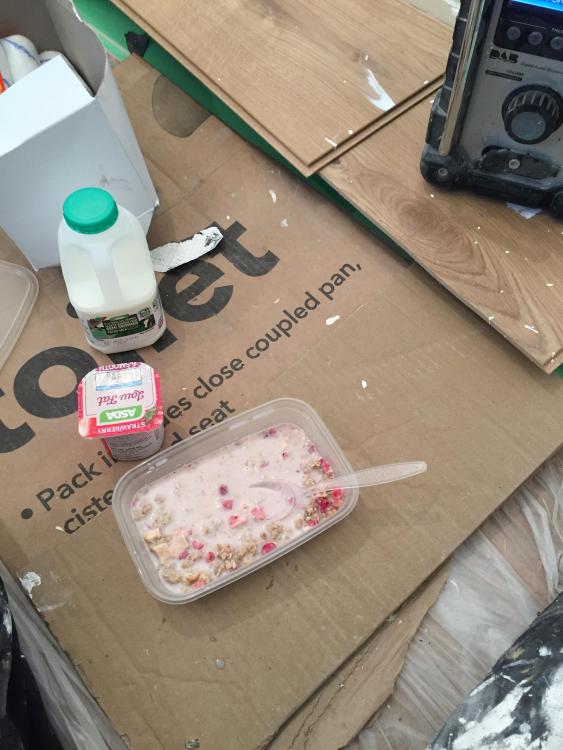
Asda fat-free 6 for a quid. ?. I do enough for the kids anyhoo
-
Yes, but an army marches on its stomach Ok, back to building stuff then
-
Its not bacon, but at least I can start seeing my feet again
-
Bath Surround / Boxing In, and concealed pipework
Nickfromwales replied to Onoff's topic in Bathrooms, Ensuites & Wetrooms
Air will be stagnant in there and neither air nor plastic conduct cold very well . Use the time to pick up tile adhesive ? -
Just convert at the mdpe fitting then. They're bullet and bombproof so I wouldn't bat an eyelid burying one of those. Maybe ring Hepworth tech and ask them if it'll go straight in with a stainless insert ?
-
Best to run copper until your out of the buried part, and then use a Hep socket or bend to convert back.
-
A bit risky if it's going to be buried. If it's not too late, can you get one of these instead ?